
Squarl
SQUARING BY BOUNCING — *to square A, hop distance d to a round number: A squared = (A+d)(A-d) + d squared. 48 squared = 50 x 46 + 2 squared = 2300 + 4 = 2304.*
Loading audio…
Press play to listen along. The line being read lights up as you go.
Show full transcript
Loading transcript…
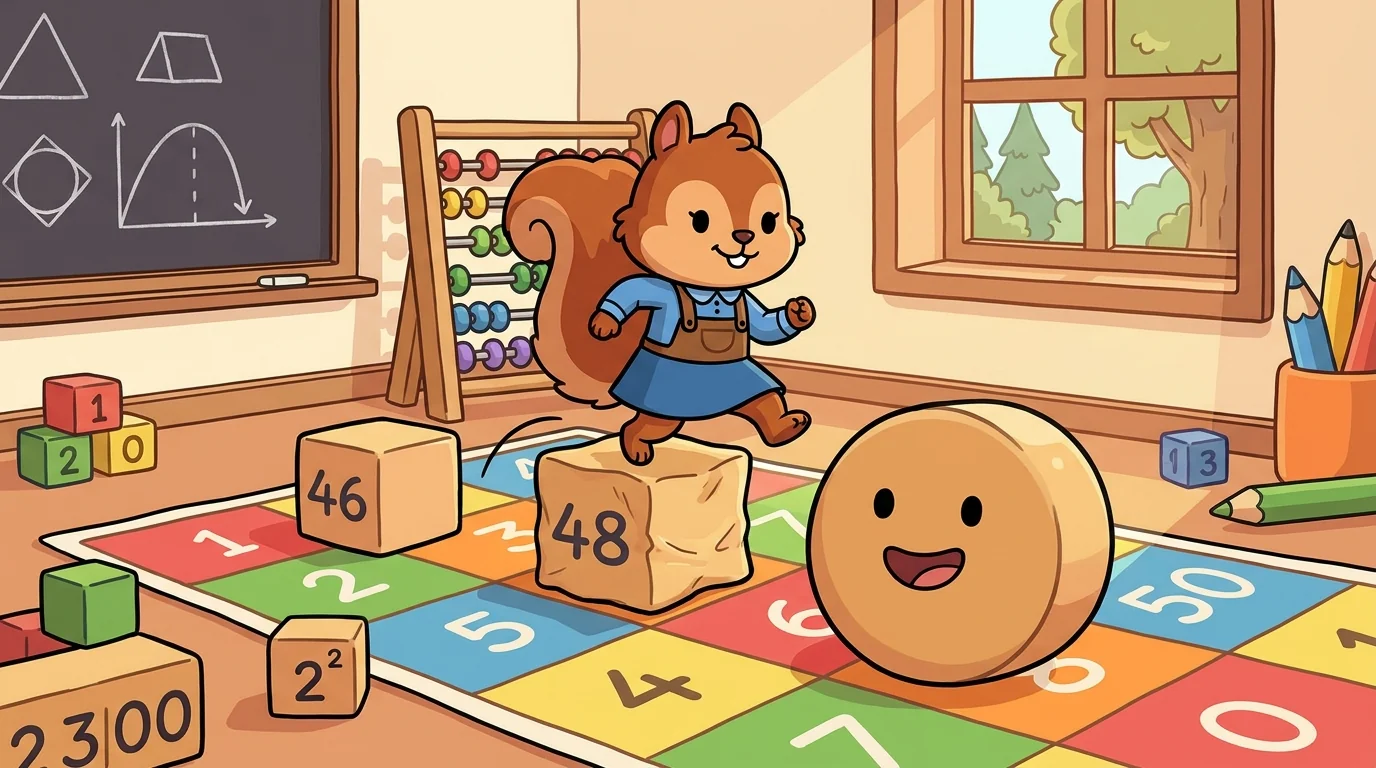
Squarl never squared a number head-on if she could avoid the bruised knuckles. To her mind, marching straight into a thick, tangled calculation was like kicking an oak door. It made a great deal of noise, hurt your foot, and left the timber standing anyway.
"Forty-eight times forty-eight is completely unnecessary," Squarl said, setting her mug down on the timber table. "Forty-eight is jagged and awkward, full of stray corners that catch on your fingers. Fifty, on the other hand, is as smooth and clean as a river stone. So instead of scraping my shins against the forty-eight, I take a bounce to easier ground."
She tapped two fingertips against the scrubbed pine surface to show the twin leaps. "Hop up two steps from forty-eight to fifty, then hop down two steps to forty-six. Fifty times forty-six is simple mental work that yields twenty-three hundred without any pencil lead. Then you simply repay the little hop you borrowed, squaring the distance you traveled. Two times two makes four, which gives you twenty-three hundred and four." The arithmetic sat there, neat and quiet, leaving the slate without a single smudge.
The method rested on an old geometric truth that Squarl treated like a trusted pocketknife. Whenever you shift away from a number by an equal distance, the resulting rectangle changes shape. One side stretches longer by that measure, while the matching side shrinks by the same amount. When you multiply those altered sides, the product always falls slightly short of the true square. It misses the target by the square of the hop, neither more nor less, every time. Add that tiny missing patch back onto the pile, and your answer becomes entirely exact.
"People believe that misery proves honesty," Squarl often remarked while sharpening her workshop pencils. "They think that if their lead doesn't snap, the labor doesn't count toward their character. Awkward numbers will surrender in seconds if you stop trying to wrestle them in the mud."
Squarl had not always possessed such sensible habits during her early days in the trades. As an apprentice in the drafty theater loft, she had fought arithmetic like a cornered terrier. She believed the hard path was the only noble road open to an honest worker. Whenever an inventory ledger tangled, she pressed her thumbs into her temples and ground forward. She blamed her own skull for every mistake, convinced that clever people never needed rest. By midnight, the copper lanterns would flicker down, leaving her with stinging eyes and ruined slates.
Marlow, the veteran master of the fly-loft, found her weeping over the lumber tallies one November. He was a wide, slow-footed craftsman whose apron pockets bristled with brass calipers and carpenter chalk. Without saying a word, he set a warm tin mug of spiced cider beside her elbow. On the scarred slate between her fists sat ninety-seven times ninety-seven, gouged into the stone. She had scrubbed out her third attempt so violently that the slate was slick with water.
"The stone never insulted your family, Squarl," Marlow observed, leaning his hip against her bench.
"I can finish it," Squarl muttered, rubbing her sleeve across her dust-caked cheeks in defiance.
"I know you can finish it," Marlow replied, picking up a stick of pale chalk. "The mystery is why you insist on battering the wall down with your own forehead. Taking a detour to easier ground is not laziness, child; it is simply good sense."
Marlow drew two chalk arcs on the cleared wood, sweeping outward from ninety-seven like bird wings. "Ninety-seven lives only three paces away from one hundred, which is the friendliest ground around. Jump up three steps to one hundred, then balance the scale by jumping down to ninety-four. Even an exhausted carpenter can multiply one hundred by ninety-four in the dark: ninety-four hundred. Now you only owe the house the square of the three-pace leap you just took. Three times three is nine, so you lay nine down beside the ninety-four hundred."
Squarl checked her long, miserable scratches on the damp slate, finding the exact same digits.
"You reach the identical destination," Marlow said, brushing pale dust from his heavy leather cuffs. "The difference is that you arrive with your temper intact and your pencils still whole."

Ten years later, the same stubborn pride walked through Squarl's door wearing a muddy canvas coat. The boy was twelve, with wind-chapped wrists and a wool muffler knotted tightly around his neck. His name was Dennis, though every hauler in the timber yard called him Pip because of his height. He slammed a thick leather ledger onto the counter and slumped over it like an exhausted soldier. He was tallying freight wagons, checking fifty-two crates stacked across fifty-two flatbed skids for the railroad. His ruled notebook was a wreckage of snapped graphite, violent cross-outs, and gray eraser crumbs.
"I will just power through the numbers until they behave," Pip declared through clenched teeth.
"You look like you are preparing to fight a badger with a blunt wooden spoon," Squarl said.
"Long division and vertical multiplication build character," Pip insisted, holding his pencil like a stabbing spear. "Mr. Henderson at the weigh scale claims that nothing good comes without a proper struggle."
"Mr. Henderson limps because he refuses to grease his wagon axles on principle," Squarl answered dryly. She turned his ledger around and tapped the figure fifty-two with the clean end of a brush. "Tell me what friendly, round number sits right next door to fifty-two on the road."
Pip stared down at the paper with deep suspicion before reluctantly answering that fifty was closest.
"Two steps down to fifty," Squarl noted, sketching the leap lightly on the border margin. "Balance the scale by leaping two steps upward, which brings you directly to fifty-four. Now multiply fifty-four by fifty, which requires nothing more than halving and tacking on zeros."
Pip stared up at the drying herbs hanging from the beams, his lips moving in silent thought. "Fifty times fifty is twenty-five hundred, and four times fifty gives two hundred more," Pip murmured. "That makes twenty-seven hundred altogether," he said, glancing at her to see if he had slipped.
"Now pay back the hop squared: two times two equals four, so add four to twenty-seven hundred."
The boy blinked, his shoulders dropping as the sum assembled itself in the quiet room: twenty-seven hundred four. To prove the point, he scribbled the stacked algorithm down, carrying the tens with aggressive strokes. The bottom line produced the identical result, leaving Pip staring at his graphite in bewildered disbelief.
"That took four seconds in my head," Pip said, letting his pencil drop onto the counter.
"Does this trick survive when the number is genuinely miserable?" Pip asked, leaning over the counter.
"Give me an example of a miserable number," Squarl invited, folding her arms across her chest.
"Thirty-nine bundles of cedar shingles, thirty-nine pounds each, which ruined my entire morning yesterday," Pip answered. "Nine times nine produces eighty-one, and carrying the eight always creates a mess across my columns."
Squarl slid a flat stick of tailor's chalk across the dark grain of the pine table. "Find the safe meadow near thirty-nine, take your leap, and balance the opposite side immediately."
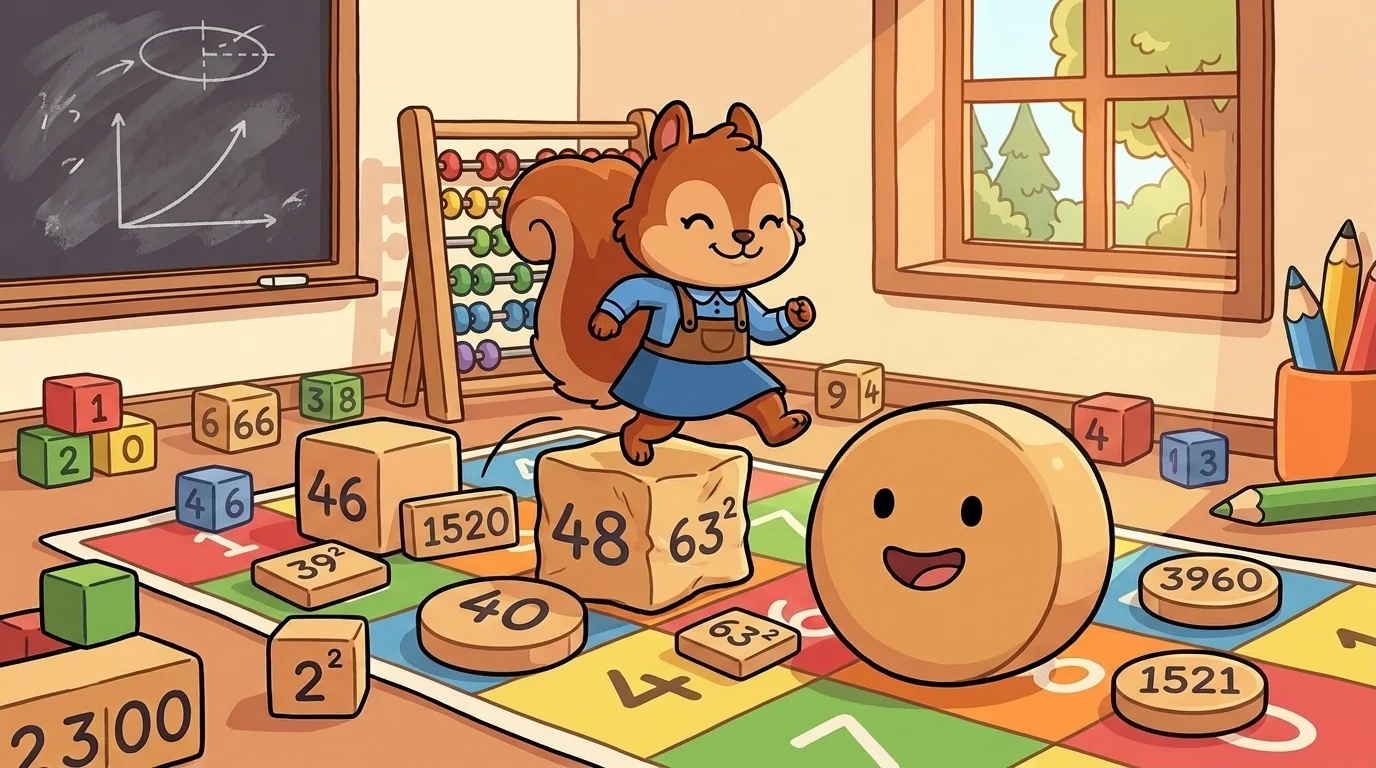
"Forty is one step up," Pip said, drawing a white curve that arched over thirty-nine. "So one step down lands on thirty-eight, which means I only need thirty-eight times forty." He tapped the chalk thoughtfully against his chin, calculating the partial products without touching the paper. "Thirty times forty makes twelve hundred, and eight times forty provides three hundred and twenty. That totals fifteen hundred and twenty, plus the hop squared: one times one is just one. Fifteen hundred and twenty-one," he announced, his voice carrying a sudden note of quiet wonder.
"Try sixty-three before you decide that magic has fooled your senses," Squarl suggested with a smile.
Pip did not even hesitate, his gaze fixing upon the row of brass weights behind her. "Sixty-three drops down three steps to sixty, and jumps up three steps to sixty-six," he stated. "Sixty times sixty is thirty-six hundred, while six times sixty gives three hundred and sixty. Adding those together yields thirty-nine hundred and sixty, right before settling the debt on the hop. Three squared is nine, so the entire tally lands cleanly on thirty-nine hundred and sixty-nine."
He looked down at his ink-stained palms, turning them over as if checking for hidden wires. There was no penalty waiting for him, no scolding schoolmaster, and no bruised knuckles from stubborn labor. The gentle road had delivered him to the precise mathematical truth without tearing a single page.
The tightness that had pinched the corners of Pip's mouth since daybreak had completely vanished away. He closed the heavy tally book gently, sliding his scarred wooden pencil into its canvas sleeve.
"Mr. Henderson will tell me I cheated because my shirt is dry," Pip remarked with dry amusement.
"Tell Henderson that carpenters measure twice so they do not have to chop their lumber four times," Squarl replied. "The square does not care whether you suffered while calculating it; it only asks for the truth."
Squarl watched the boy pull his woolen scarf tight and step out into the cold mountain wind. The memory of Marlow's chalk dust lingered in the shop, quiet and steady through the drafty floorboards. Leaping to friendly ground was never an escape from honest work, but an act of patient intelligence. When awkward problems crowded the ledger, the swiftest path forward was simply knowing how to bounce.
The ShowMath ensemble
Squarl is part of ShowMath's distributed-narrative cast. Each character embodies a different curricular primitive; together they teach the full subject.
-

Wendel
The Calendar-Keeper — anchors the year's doomsday and steps by sevens to name the weekday of any date
-

Elvi
The Eleven-Splitter — pries a number's digits apart and drops their sum into the gap (times-eleven shortcut)
-

Fiva
The Fives-Finisher — rounds a number ending in 5 to a friendly pair, then tacks on 25 to square it
-

Missa
The Missing-Digit Diviner — sums the shown digits and reads the hidden one as the shortfall to the next nine (casting out nines)
-

Dashel
The Left-to-Right Racer — answers biggest-place-first, out loud, before the calculator finishes
-

Magda
The Magic-Square Weaver — seeds a four-by-four square from a date so every row, column, and diagonal sums the same
-

Nabo
The 1089 Conjurer — reverses, subtracts, reverses, adds, and always lands on 1089
-

Halvra
The Double-and-Halver — doubles one factor and halves the other until multiplying is easy
-

Modo
The Clock-Winder — wraps numbers around a clock of any size, the engine under the calendar and missing-digit tricks
-

Marlow
The Stage Manager (mentor) — a warm, attentive adult who coaches rehearse-then-perform and reveal-the-secret, and never performs for the kid