
Missa, Modo and Marlow
WHY A SELF-WORKING TRICK CAN'T FAIL — a routine survives a skeptic because it rests on a reason, not luck: Missa sums the digits a volunteer leaves showing and names the hidden one as the shortfall up to the next multiple of nine, Modo reveals the wrap-around clock of size nine that makes it certain, and Marlow coaches the crew to reveal the reason rather than protect the mystery.
A story read by Missa, Modo and Marlow
Loading audio…
Press play to listen along. The line being read lights up as you go.
Show full transcript
Loading transcript…

Most nights the audience simply wanted to be amazed, and the crew was glad to oblige. This night, someone in the seats wanted something else entirely: he wanted to catch them out.
He rose from the third row with his arms folded across his chest and a skeptic's thin smile already in place. "Any one of these could be a memorized stunt," he said — not cruelly, but loud enough that every head turned. "So let me choose which trick. And let me choose the numbers. Then we'll all find out what's really going on up there."
Missa felt the old flinch start up in her chest, that familiar cold tightening — the what-if-he's-actually-right one — before she'd even opened her mouth. Backstage, in the wing, Marlow the stage manager caught her eye and, deliberately, did not move a single muscle to rescue her. Marlow only offered the smallest possible nod, a signal the two of them had worked out over a season of shows: you have a reason. Don't hide behind the mystery. Show them the reason.

"All right — pick the trick," Missa said, and her voice wobbled only a little on the way out.
"The missing-digit one," the skeptic said at once. "The one where you pretend to read minds. Here." He strode to the board and scrawled a big number across it, six digits long, then pressed his thumb flat over one of them so it vanished. "Tell me the digit I'm covering. And before you ask — no, you can't peek under my thumb."
Missa looked at the digits he'd left showing and began adding them together in her head, the way she always did, letting the running total climb one digit at a time. When she reached the sum she paused, and thought about the very next step up — the next full multiple of nine sitting just above where she'd landed.
"You're hiding a seven," she said.
He lifted his thumb. A seven stared back. The room made its rainstorm sound, delighted, and the skeptic's smile shifted — still doubting, but curious now, the way a person gets curious right before they get stubborn. "Lucky guess," he said. "Or memorized. Do it again."
So she did it again. And again, and again after that. Each time he wrote a fresh number and hid a fresh digit, and each time Missa quietly summed the ones she could see and named the one she couldn't — steady, unhurried, right every single time.
"That is not luck," the skeptic admitted at last, lowering his hand. "I'll grant you that. But I don't believe for one second it's magic, either. So what is it, exactly?"
This, as it happened, was the moment the whole crew loved best of all. Modo stepped forward into the light — Modo, who lived down in the machinery underneath every trick, who was never happier than when someone finally asked how.
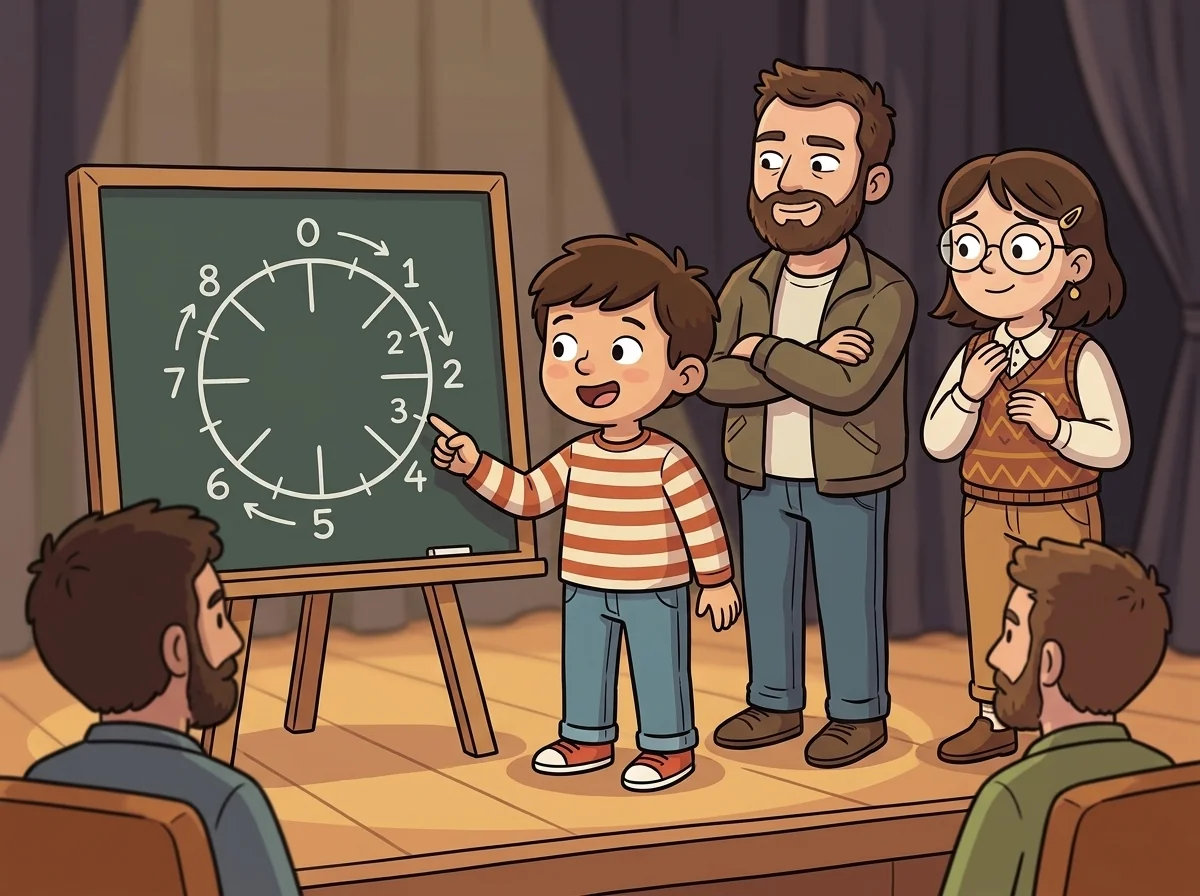
"It's a clock," Modo said. "But not an ordinary one. A clock with nine hours on its face instead of twelve. Watch." He drew a small circle on the board and marked it around the rim, zero through eight, then let the numbers keep looping — nine landing back on zero, ten back on one, around and around. "Here's the strange and wonderful part: every whole number, no matter how enormous, comes to rest somewhere on this nine-clock. And a number's digits, added together, land on the exact same spot the whole number does. So when Missa sums up the digits you left showing, what she's really doing is finding out where your number is sitting on the nine-clock. The digit you covered is simply however far it is from there to the next full lap around — the shortfall up to the next nine."
He tapped the circle twice. "You can't hide from the clock. Whichever digit you choose to cover, it turns out to be exactly the piece that was missing to carry the lap around cleanly. That's the reason she can never be wrong — not merely usually-right, not lucky on a good night. The reason underneath makes it certain."

The skeptic was silent for a long moment. Then he turned his head toward the wing, where Marlow stood with both hands pushed down into their pockets, quite plainly staying put.
"You're the one in charge back there," the skeptic said. "So why didn't you just march out here, do the trick yourself, and shut me up in ten seconds?"
Marlow smiled at that, unhurried. "Because then you would have watched me," they said, "and you'd have walked out of here having learned exactly nothing. If I perform the trick for the crew — or for you — the reason stays mine. It never once becomes yours." Marlow nodded toward Missa and Modo, standing shoulder to shoulder in the light. "My whole job, the only job that matters, is to keep coaxing those two into saying the why out loud, over and over, until the why finally belongs to them and not to me. A trick I perform at you is a mystery you go home puzzling over. A trick you actually understand is a tool you get to keep."
The skeptic slowly unfolded his arms.

Later, backstage, once the house had emptied, Missa let out the long breath she felt she'd been holding since the third row. "I really thought he was going to make me look foolish out there," she confessed.
"Oh, he was absolutely hoping to," Modo said, coiling a length of rope. "That was the whole point of him. But you weren't guessing, not for a second. You had the nine-clock under your feet the entire time, holding you up."
Missa noticed, with a kind of surprise, that her chest had gone quiet. The flinch had come, right on schedule — and then the reason had answered it, calmly and completely, and the flinch had discovered it no longer had anywhere left to stand. "Pick any trick you like," she said, trying the words on for size, half to herself. "It still works — because it isn't luck. It's a reason."
Marlow, winding a cable into a neat coil, didn't even look up. "That," they said, "is the only kind of trick worth performing. The kind you could hand to a total stranger, thumb and all, and it would go on being true in their hands."
The ShowMath ensemble
Missa, Modo and Marlow is part of ShowMath's distributed-narrative cast. Each character embodies a different curricular primitive; together they teach the full subject.
-

Wendel
The Calendar-Keeper — anchors the year's doomsday and steps by sevens to name the weekday of any date
-

Elvi
The Eleven-Splitter — pries a number's digits apart and drops their sum into the gap (times-eleven shortcut)
-

Fiva
The Fives-Finisher — rounds a number ending in 5 to a friendly pair, then tacks on 25 to square it
-

Missa
The Missing-Digit Diviner — sums the shown digits and reads the hidden one as the shortfall to the next nine (casting out nines)
-

Squarl
The Squaring-Bouncer — bounces to the nearest round number and back to square any number in her head
-

Dashel
The Left-to-Right Racer — answers biggest-place-first, out loud, before the calculator finishes
-

Magda
The Magic-Square Weaver — seeds a four-by-four square from a date so every row, column, and diagonal sums the same
-

Nabo
The 1089 Conjurer — reverses, subtracts, reverses, adds, and always lands on 1089
-

Halvra
The Double-and-Halver — doubles one factor and halves the other until multiplying is easy
-

Modo
The Clock-Winder — wraps numbers around a clock of any size, the engine under the calendar and missing-digit tricks
-

Marlow
The Stage Manager (mentor) — a warm, attentive adult who coaches rehearse-then-perform and reveal-the-secret, and never performs for the kid