
Wendel
MOD-7 CALENDAR — *anchor the year's Doomsday weekday, then step forward or back in sevens to name the weekday of any date.*
Loading audio…
Press play to listen along. The line being read lights up as you go.
Show full transcript
Loading transcript…
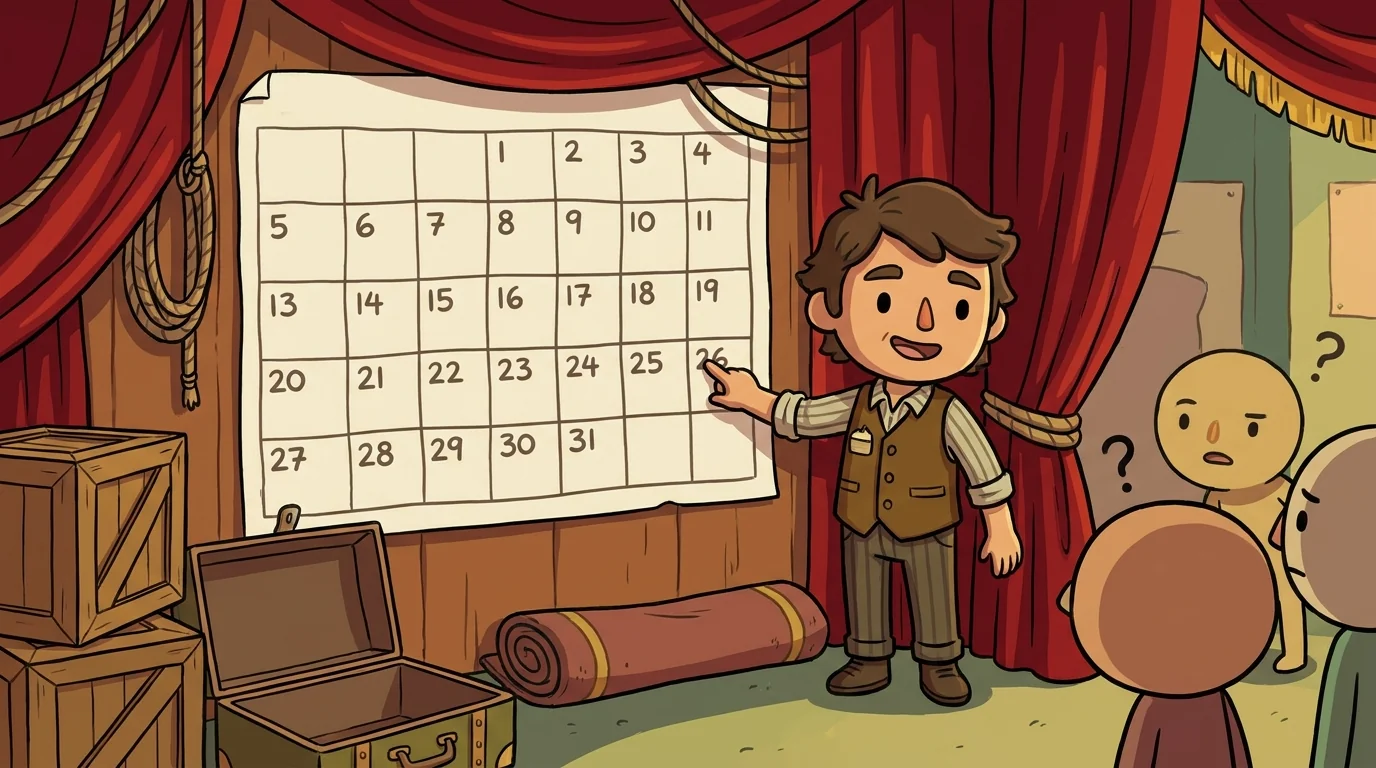
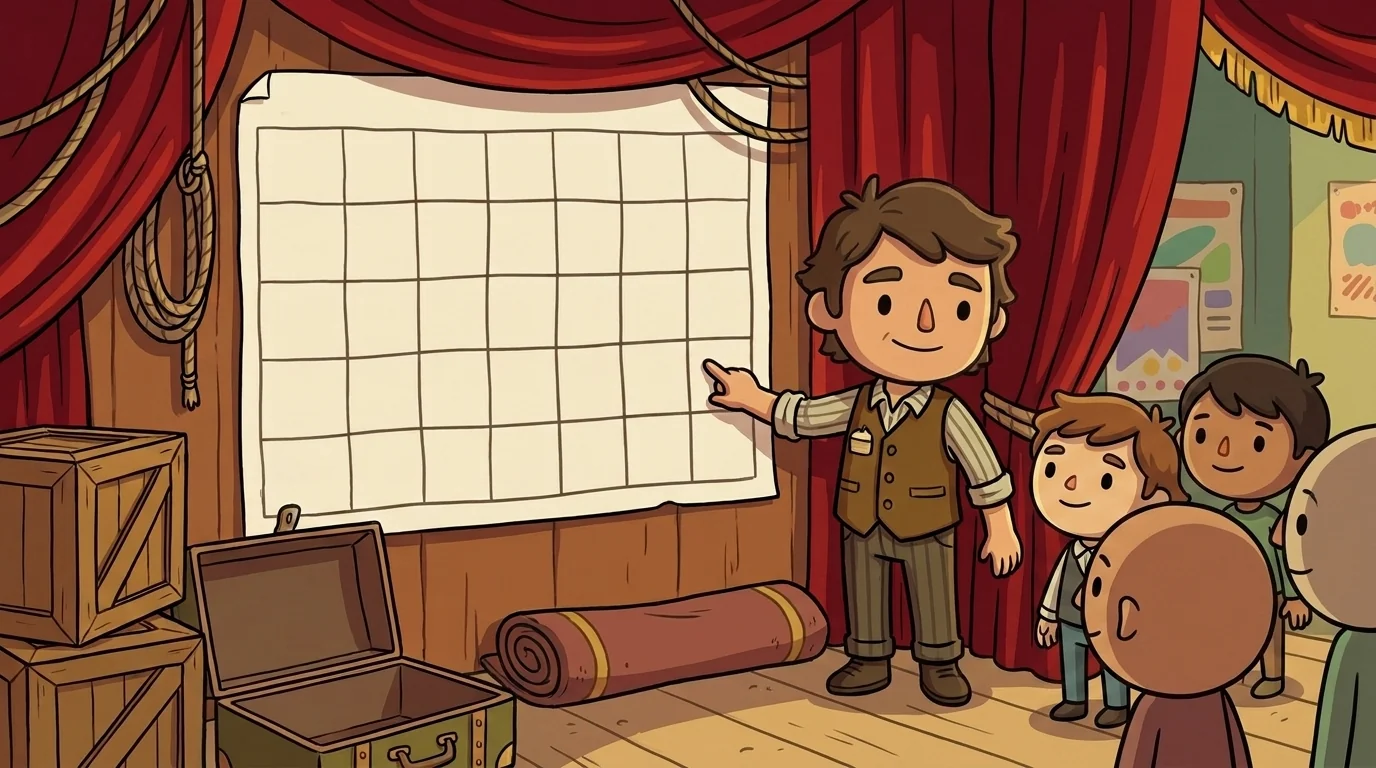
Past the counterweight arbor and the heavy velvet teasers, the back wall of the ShowMath theater smelled like machine oil and sawdust. A single sheet of cardstock hung from an iron nail in the mortar.
It was a calendar, but it looked broken.
There were thirty-one neat boxes arranged in a grid, and every box contained a number. No letters appeared at the top of the columns. There was no M for Monday, no S for Saturday, and no neat row of abbreviations running across the edge.
Whenever touring lighting designers wandered past the dimmer racks, they stopped and squinted at the paper.
"Wendel," an electrician named Arlo asked, pointing a flashlight at the wall. "What is that supposed to be?"
"That is the month of October," Wendel said, not looking up from a spool of tie-line.
"It doesn’t have days on it."
"It has thirty-one of them," Wendel said.
"You know what I mean," Arlo grumbled, tucking the penlight behind his ear. "How do you know what day of the week anything happens?"
Wendel set the spool on the workbench and wiped two dusty fingers across his jeans. He walked over and tapped the fourth box with his thumb.
"This year, the fourth of October is a Friday," Wendel said. "That’s my anchor. Some people call it the year's Doomsday."
"Sounds cheerful," Arlo muttered.
"It sounds dramatic, which is why people remember it," Wendel replied. "The name doesn't matter. The anchor is the day that doesn't move. Once I know Friday is on the fourth, every other box on this wall is just a short walk away."
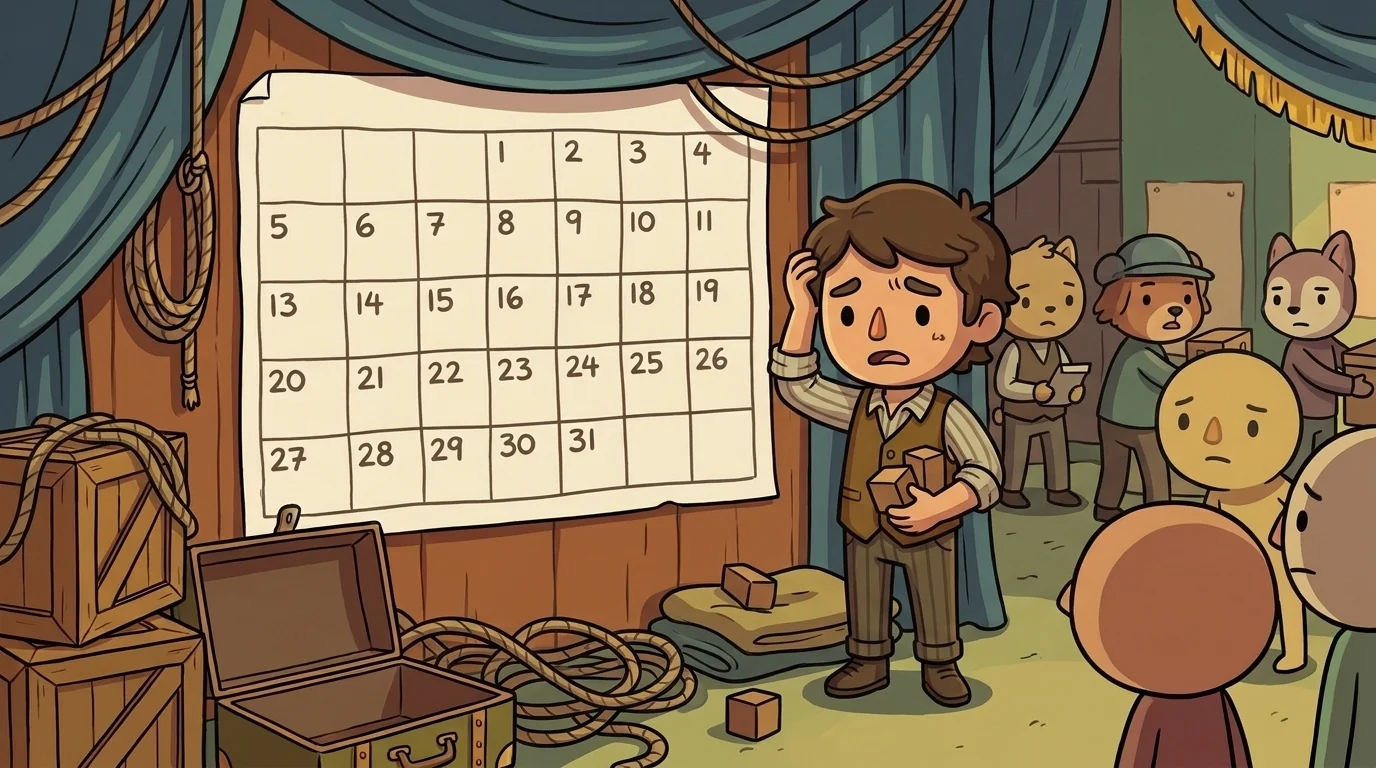
Arlo leaned closer, crossing his arms over his canvas vest. "Halloween," Arlo challenged. "Show me."
"October thirty-first," Wendel said instantly. He did not pull out a phone. He didn’t flip through a pocket schedule.
Wendel’s index finger stayed on the number four.
"Four is a Friday," Wendel murmured, his voice steady as a metronome. "Add seven, and you get eleven. Still a Friday. Add seven, and you get eighteen. Still Friday. Add seven more, and you land on twenty-five."
Wendel moved his finger across the grid to twenty-five.
"Twenty-five is a Friday," Wendel said. "Now I'm close enough to touch it. Twenty-six is Saturday. Twenty-seven is Sunday. Twenty-eight is Monday. Twenty-nine is Tuesday. Thirty is Wednesday." He tapped the final square with a soft rap of his knuckle. "Halloween is a Thursday."
Arlo fished his phone out of his back pocket and tapped the glass twice. His eyebrows twitched upward.
"Thursday," Arlo admitted. "You memorized that."
"I have trouble remembering what I ate for lunch," Wendel said evenly. "I didn't memorize thirty-one boxes. I memorized one, and then I took four big steps and six little ones."
Wendel had not always moved through the days with that kind of balance.
Ten years earlier, as an apprentice stagehand, Wendel had lived in a state of quiet, grinding panic. The theater had no windows, and under the pale glow of the work lights, morning looked identical to midnight. Rehearsal calls ran together in a gray smear. Tuesday felt like Thursday. Sunday afternoon felt like Wednesday morning.
Wendel missed cue calls. Wendel arrived twenty minutes late for load-ins with grease under his fingernails, heart hammering against his ribs.
Everyone else just knows, Wendel used to think, burning with embarrassment behind the legs of the main drape. Everyone else has a clock in their head, and mine is broken.
The other stagehands kept pocket planners with leather covers and checked off their hours with metal ballpoints. Wendel tried buying one, but lost it behind a storage crate by the third week. Whenever the production manager shouted out a date for technical rehearsals, Wendel merely nodded, smiled tightly, and pretended to understand.
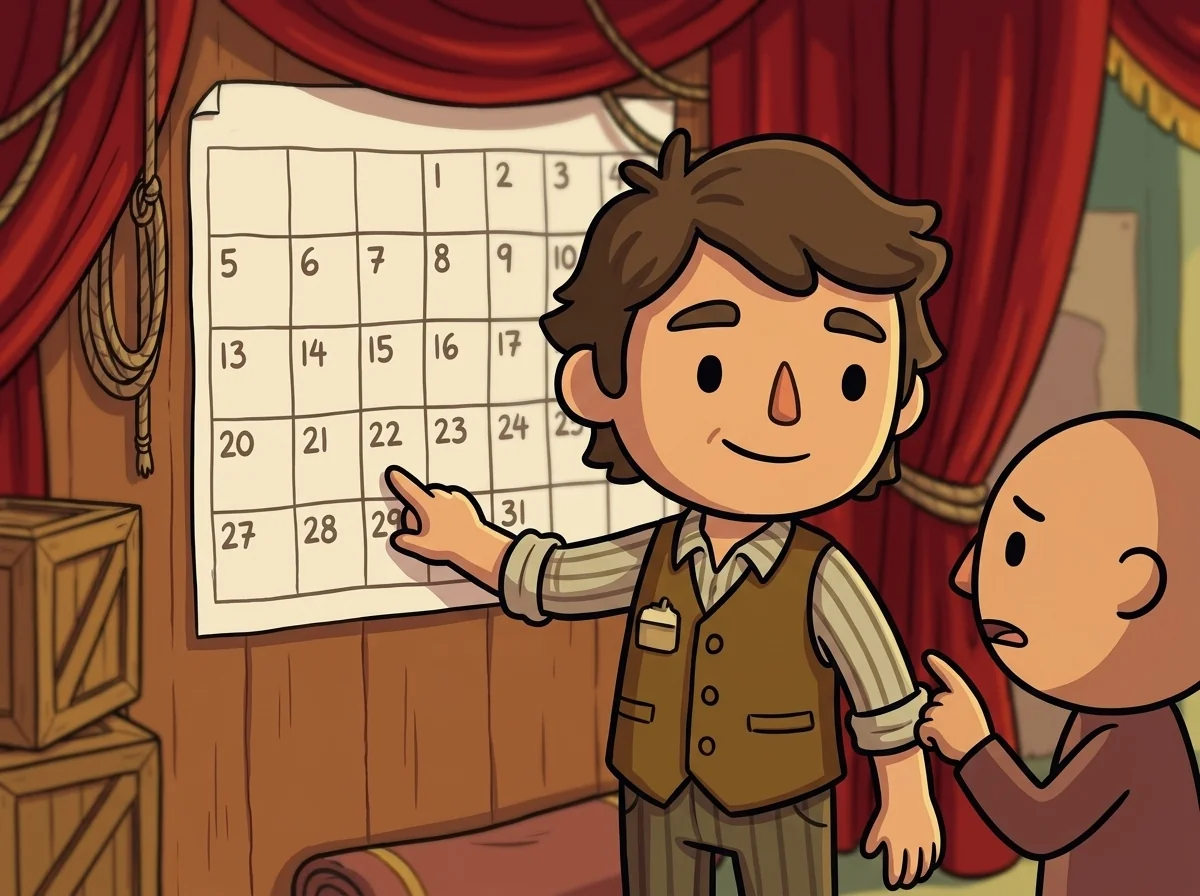
Then Marlow found Wendel sitting behind the sound console during a dark house. Marlow was sixty years old, with sleeves rolled to the elbows and rolls of spike tape hanging from her belt. She did not yell, which somehow made the moment worse.
She simply set a chipped ceramic mug on the console and pulled a yellow legal pad from her clipboard.
"You're guessing," Marlow said. It wasn't a question.
"I just lose track," Wendel muttered, looking down at scuffed work boots. "The days don't have edges in here. They all slide into each other."
"You think the calendar is a list of three hundred and sixty-five different things," Marlow said. She uncapped a black marker and drew a circle with seven dots on the page. "It isn't a list. It's a wheel."
Wendel stared at the seven dots. Marlow labeled the top dot with a zero and moved clockwise.
"The week repeats," she said, tapping the marker against the paper. "Seven is zero. Fourteen is zero. Twenty-one is zero. When you try to memorize every single date, you're carrying an entire truckload of lumber on your back. Pick up one board instead. Anchor it to the ground. Then step around the circle."
Marlow pushed the pad across the plywood desk.
"You don't need to remember everything," Marlow told Wendel that afternoon. "You only need to know how to rebuild the part you need right now."
Something tight and hard in Wendel’s chest let go. For three straight years, time had felt like an avalanche rushing past. For the first time, Wendel could see the stones beneath the snow.
The backstage door banged open, letting in a draft of October rain and damp pavement.
A seventh-grader named Devon slipped through the gap, wearing a crew badge that looked far too large for his neck. Devon was this season's student lighting intern, and right now his face looked pale under the green glow of the exit sign.
"Wendel?" Devon asked, clutching a clipboard like a shield. "Are the dimmer checks on the twelfth or the nineteenth? The schedule has two different notes, and my dad needs to know when to pick me up."
Wendel set down his wrench. "What day of the week is your dad asking about?"
Devon blinked. "Saturday. I think. It has to be a Saturday, because he works late on Fridays."
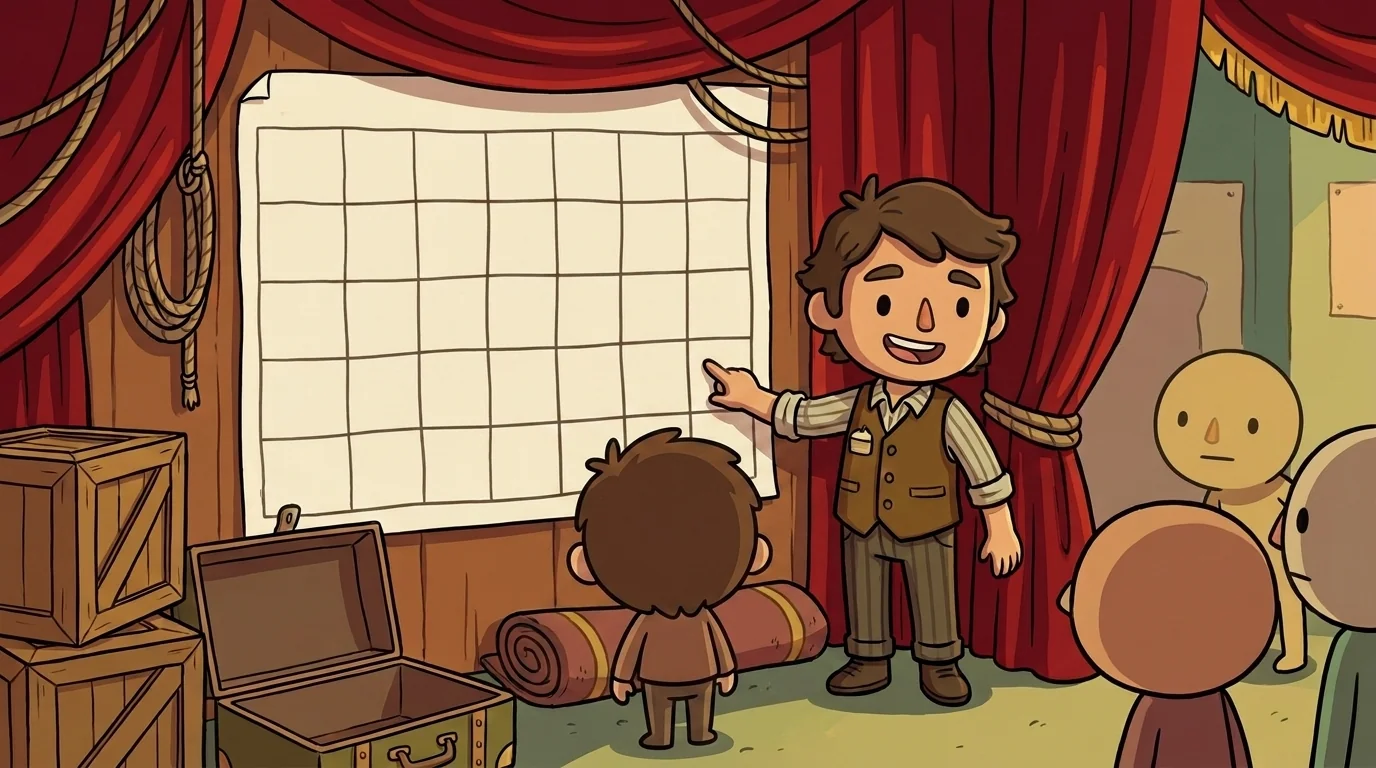
"All right," Wendel said. He gestured toward the blank grid pinned to the cinderblock wall. "Come here."
Devon stepped over a snake of heavy audio cables and stopped in front of the cardstock. He stared at the thirty-one empty boxes, his shoulders hunching up toward his ears.
"Where are the days?" Devon asked. "Is this a test?"
"No tests back here," Wendel said mildly. "Just tools. What's our anchor for this month?"
Devon shifted his weight, uncertain. "You said the fourth was a Friday."
"Right. That is our foundation," Wendel said. "Now, we want to know if the twelfth is a Saturday. Don't look at a screen. Let your feet do the work. If the fourth is a Friday, what day is seven days later?"
Devon looked up at the ceiling pipes, mouth moving silently. "Four plus seven is eleven."
"So the eleventh is also a Friday," Wendel said. "Step one day forward from Friday."
"Saturday," Devon said. "The twelfth is Saturday."
"And what about the nineteenth?" Wendel asked.
Devon reached out, his finger hesitating an inch away from the paper. "Eleven plus seven is eighteen. So the eighteenth is a Friday." He slid his finger one space to the right, over the black ink of nineteen. "The nineteenth is Saturday, too."
"Both of them are Saturdays," Wendel said. "The schedule wasn't lying to you. We have load-in on the twelfth, and light cues on the nineteenth."
Devon stood entirely still. He stared at his own finger resting on the number nineteen. His shoulders dropped an inch, the nervous tightness draining out of his neck.
"That wasn't hard," Devon whispered.
"It's never hard once you stop guessing," Wendel told him. "People think numbers are facts you have to trap inside your head before they escape. But numbers aren't birds, Devon. They're stepping stones."
"Can you do any date?" Devon asked, his voice suddenly lively. "What about my birthday? August twenty-fourth."
Wendel smiled and leaned against the counterweight rail. "August is behind us, but the rule doesn't care. In August, our anchor was the eighth. The eighth was a Thursday."
Devon didn't wait for Wendel to finish. He leaned toward the wall, tapping the air as he counted out the weeks in his head.
"Eight is Thursday," Devon muttered, his brow furrowing in fierce concentration. "Add seven... fifteen is Thursday. Add seven... twenty-two is Thursday." He paused, his eyes widening slightly. "Twenty-three is Friday. Twenty-four is Saturday. I had my party on a Saturday!"
"You didn't have to check a phone," Wendel noted softly. "You built that day out of nothing."
"I just added seven," Devon said, almost laughing at how ordinary it seemed.
"That's all the week is," Wendel said. "A circle with seven notches cut into the rim. No matter how fast the year spins, the notches stay the same distance apart."
Devon looked back at the calendar with no weekdays on it. The grid didn't look broken anymore. It looked clear, like a freshly cleared stage waiting for the set pieces to slide into their tracks.
"I always thought people who knew dates were just smarter than me," Devon said, tracing the rim of his clipboard. "They'd say 'see you on the seventeenth' and they'd already know what morning it was."
"They aren't smarter," Wendel said. "Some of them just bought a louder watch. But a watch breaks, and a phone battery dies in the middle of a double show. When you know the anchor, you carry the whole year in your pocket."
Devon nodded, tucking his clipboard under his arm with a sudden, crisp competence. "I'm going to tell my dad to bring the truck on the twelfth. That's the first Saturday."
"Go tell him," Wendel said.
The boy turned and jogged back toward the loading bay, his sneakers squeaking lightly against the painted concrete floor.
Wendel watched him go, then turned back to the quiet grid pinned against the gray brick. With a stub of carpenter's pencil, Wendel made a single small tick mark beside the number four.
One steady spot in the dark. From there, you could walk anywhere.
The ShowMath ensemble
Wendel is part of ShowMath's distributed-narrative cast. Each character embodies a different curricular primitive; together they teach the full subject.
-

Elvi
The Eleven-Splitter — pries a number's digits apart and drops their sum into the gap (times-eleven shortcut)
-

Fiva
The Fives-Finisher — rounds a number ending in 5 to a friendly pair, then tacks on 25 to square it
-

Missa
The Missing-Digit Diviner — sums the shown digits and reads the hidden one as the shortfall to the next nine (casting out nines)
-

Squarl
The Squaring-Bouncer — bounces to the nearest round number and back to square any number in her head
-

Dashel
The Left-to-Right Racer — answers biggest-place-first, out loud, before the calculator finishes
-

Magda
The Magic-Square Weaver — seeds a four-by-four square from a date so every row, column, and diagonal sums the same
-

Nabo
The 1089 Conjurer — reverses, subtracts, reverses, adds, and always lands on 1089
-

Halvra
The Double-and-Halver — doubles one factor and halves the other until multiplying is easy
-

Modo
The Clock-Winder — wraps numbers around a clock of any size, the engine under the calendar and missing-digit tricks
-

Marlow
The Stage Manager (mentor) — a warm, attentive adult who coaches rehearse-then-perform and reveal-the-secret, and never performs for the kid