
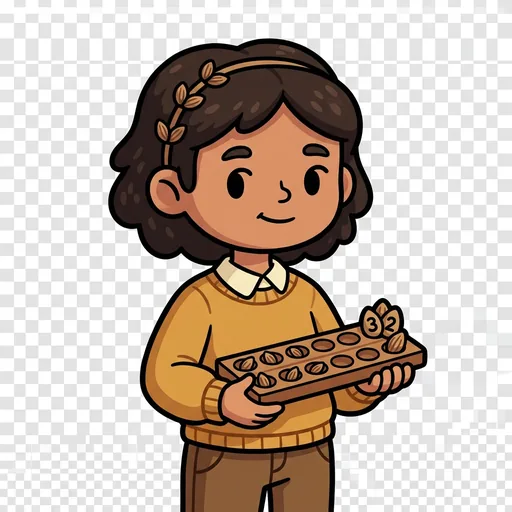
Runa
THE RUN TO REFUGE (Brandubh) — the King moves in straight lines along empty rows and columns, aiming to reach a free corner square where they are safe; freedom, not fighting, is how this side wins.
Runa and the Long Road to the Corner
When Mapp unrolls the Brandubh board, the first thing you notice is that it isn’t fair — and Runa will be the first to tell you that’s the whole idea.
“It’s from the old Irish world,” Mapp says, tracing the cross-shaped grid. “Brandubh — say it BRAN-doo. A game of one against many, played by firelight a very long time ago.” At the very centre sits a single throne, and on it stands Runa: a small crowned figure, calm as a held breath. Around her, a handful of loyal guards. And around THEM, filling the edges of the board, wait more soldiers than Runa’s little band could ever fight.
Runa is the King. And a King, in this game, does not win by being strong.
She wins by getting out.
“Look at the four corners,” Mapp says. Each corner square glows a little, the way safe places do. “Those are the refuges. If Runa can reach any one of them, her side wins. She doesn’t have to defeat the soldiers. She doesn’t have to be brave in the way people expect. She just has to get home free before they close every door.”
So here is what Runa does, over and over — the move that is really her whole self. She reads the lines.
A King in Brandubh moves the way a road runs: straight along an empty row, or straight down an empty column, as far as the open path will carry her. She cannot leap. She cannot cut diagonally across the middle of things. She can only travel the clear, straight ways — which means, before she moves an inch, Runa goes completely still and looks. Which row is open? Which column has no soldier standing in it? Where does a straight line reach all the way to a glowing corner?
The first time Runa ever played, she panicked. The soldiers were everywhere, closing in, and she bolted down the nearest open line without checking where it led — straight into a dead end, boxed against the edge with nowhere to go. She felt the walls come in. “I lost,” she whispered.
“You didn’t lose,” Mapp said, smoothing the board flat again. “You ran without reading. Everyone does it the first time — the crowd makes you forget to look. Try again. This time, find the line that reaches a corner BEFORE you take a single step.”
So Runa learned the hardest, quietest skill in the game: to be calm inside a crowd. To let the soldiers press in on every side and still take one slow breath, run her eyes along each row and column, and ask — not “which way is away from danger?” but “which open line actually reaches a refuge?” Those are different questions. Away-from-danger just delays the trap. A line to a corner ends the game.
When she finds it, she moves like water finding the low path — smooth, straight, unhurried, all the way down the open line to the glowing corner. And when her foot touches that safe square, the whole board seems to exhale. Runa is home. Her side has won, not by force, but by finding the one road nobody had closed.
“Runa reads the open lines,” she says, settling into the corner, “and runs for the free corner before the trap closes.”
She’ll be honest with you, though — sometimes she doesn’t make it. Sometimes the soldiers are quicker, and the last open line closes just before she reaches it, and Siege and his side win the surround. On those days Runa doesn’t sulk. She looks back at the road she took and asks where a different line might have opened sooner. “A King who never gets caught,” she says, “never learns which doors to watch. Losing just shows me the map for next time.”
That is the strange, gentle lesson Runa carries around the Atlas: that sometimes the bravest, cleverest thing is not to stand and fight when you’re outnumbered — it’s to stay calm, read the open ways, and get yourself somewhere safe. Escape is not giving up. On some boards, escape is exactly how you win.
The next time you feel crowded — too many things pressing in, too many voices at once — try doing what Runa does before she runs. Go still. Read the open lines. Find the one clear path that actually reaches somewhere good. Then say it, quiet and sure: “Read the open lines — then run for the free corner before the trap closes.” And go.
The AtlasTales ensemble
Runa is part of AtlasTales's distributed-narrative cast. Each character embodies a different curricular primitive; together they teach the full subject.
-
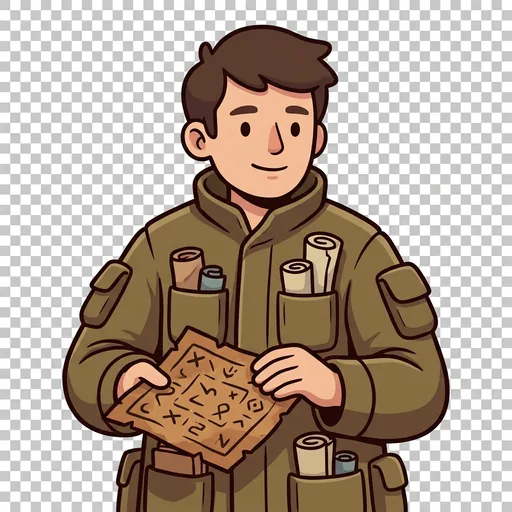
Mapp
(Mentor) the mapmaker — unrolls each world board and asks where it comes from and how you win
-
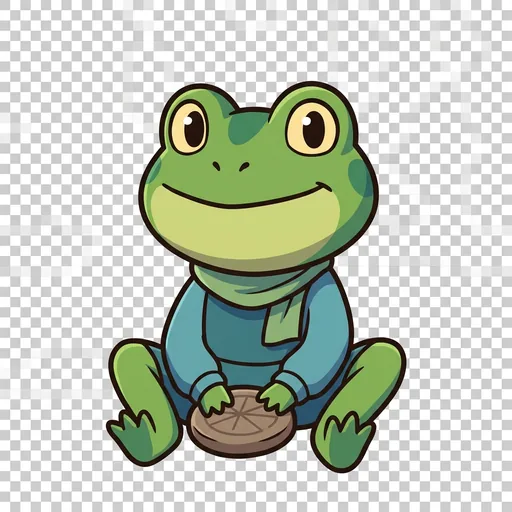
Hopper
The jump (Alquerque) — leap the neighbour who sits next to you and land on the empty point just beyond
-
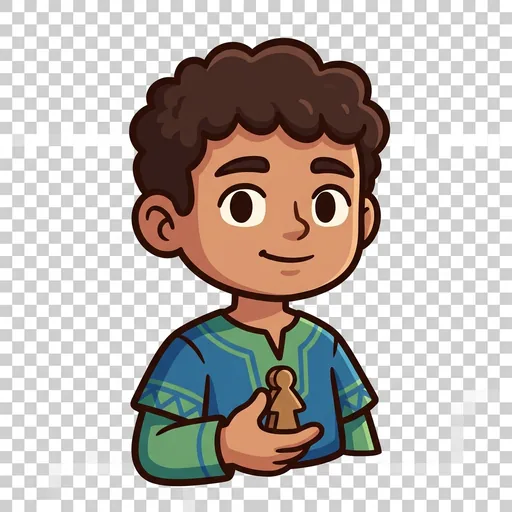
Siege
The surround (Brandubh) — box the King in on all four sides at once to win the siege
-
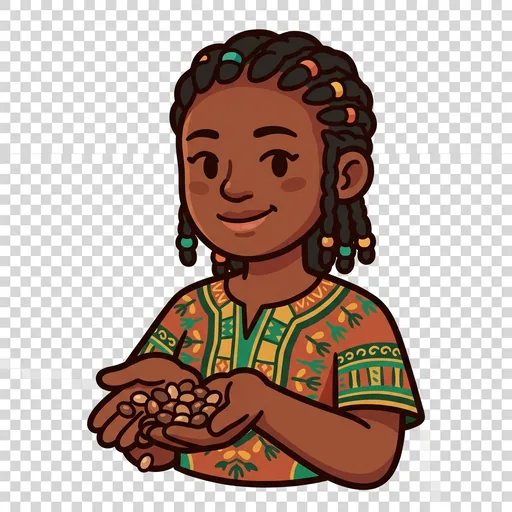
Sowa
The sower (Oware) — scoop a pit and scatter its seeds one at a time around the board
-
Harva
The harvest (Oware) — land your last seed to make two or three, then gather them into your store