
Amass
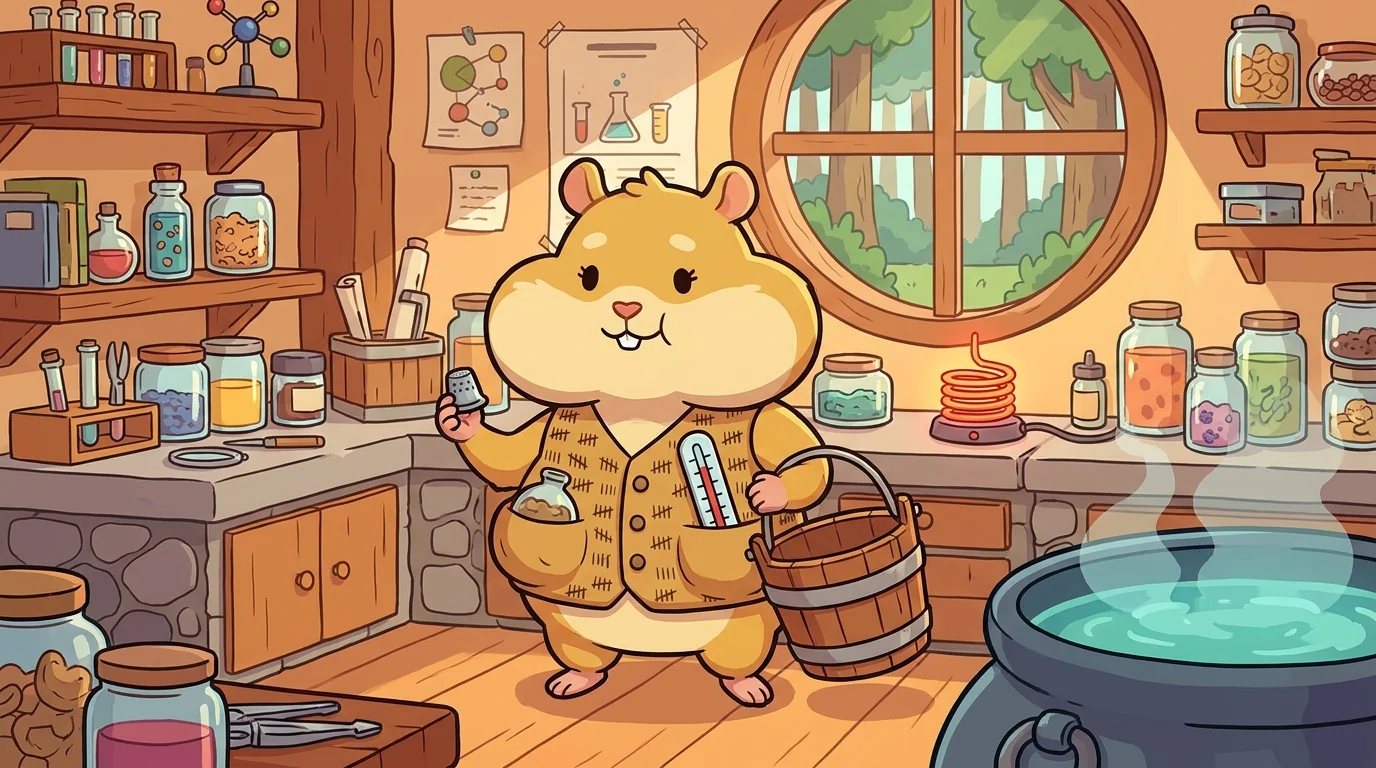
AMASS — how-hot is not how-much; a lukewarm lake holds more heat than a scalding cup.
Listen along — Amass
Loading audio…
Press play to listen along. The line being read lights up as you go.
Show full transcript
Loading transcript…
Chapter 6 — Amass and the Two Questions About Heat
Amass stood between a tiny cup of scalding tea and a wide, calm, lukewarm lake, and asked the older club a question that sounded impossible. “Which of these holds more heat?” Every hand pointed at the steaming cup. Amass smiled. “That’s the answer almost everyone gives — and it’s wrong. The lake holds far more heat than the cup. To see why, you have to understand that there are two different questions about heat, and everyone smashes them into one.”
She held up the cup. “Question one: how hot is it? That’s temperature — how fast the tiny particles inside are jiggling, on average. The tea’s particles are jiggling fast, so it’s hot — high temperature. But temperature only tells you how intense the jiggling is, not how many jigglers there are.” She swept her arm at the lake. “Question two: how much heat is stored in total? That’s thermal energy — and it depends on temperature and on how much stuff there is. The lake is only lukewarm — slow jiggling — but it has trillions upon trillions more particles than the cup. Add up all that gentle jiggling across all that water, and the total dwarfs the cup’s small amount of fierce jiggling.”
A young otter named Ripple frowned. “But the tea would burn me and the lake wouldn’t. Doesn’t that mean the tea has more heat?”
“It means the tea is hotter — higher temperature — which is exactly why it burns,” Amass said. “A burn is about how intense the heat is at the point it touches you, not how much is stored in the whole object. That’s the trap: your skin feels temperature, so you assume temperature is heat. But think of it the other way — you could warm a whole house all winter with the thermal energy in that lukewarm lake, and you couldn’t warm it for a minute with the scalding cup, because the cup, for all its fierceness, barely holds any total heat. How-hot is not how-much.”
Amass had learned to separate the two questions the hard way. “When I was small,” she told them, “I thought a bigger flame was always ‘more heat.’ So to melt a big block of wax fast, I used a tiny, screaming-hot spark instead of a large, gentle warm plate — the spark was hotter, so surely it was more heat, right? The spark scorched one pinpoint black and melted almost nothing; the warm plate, far cooler, melted the whole block. I’d chosen high temperature when the job needed lots of thermal energy.” The hotter-must-mean-more feeling had turned, that day, into the habit of always asking both questions.
“So whenever you meet heat, ask the two questions separately,” Amass finished, setting the little cup beside the vast calm lake. “How hot — that’s temperature, the intensity of the jiggling. And how much total — that’s thermal energy, which needs both the temperature and the amount of stuff. A scalding cup is high-temperature but low-total. A lukewarm lake is low-temperature but enormous-total. Confuse them and the world stops making sense — you’ll think a spark out-heats an ocean. Keep them separate, and heat finally adds up. How-hot is not how-much. They were never the same question.”
The HeatForge ensemble
Amass is part of HeatForge's distributed-narrative cast. Each character embodies a different curricular primitive; together they teach the full subject.
-

Touch
Conduction (contact-bound molecular transfer)
-

Drift
Convection (fluid circulation carrying heat)
-

Glow
Radiation (electromagnetic energy across empty space)
-

Shift
Phase change / latent heat (state transition without temperature change)
-

Hush
Insulation / thermal equilibrium (slowing transfer, reaching balance)
-

Billow
Convection — warmth makes things spread out and rise; heat needs room to move
-

Rasp
Friction heating — rub two things together and warmth appears; motion turns into heat
-

Smooth
Conduction toward equilibrium — heat always spreads toward even, and never un-spreads on its own
-
Steep
Heat capacity — some things soak up heat slowly and hold it long; water is a heat sponge