Rasp
RASP — *rub two things together and warmth appears. motion turns into heat.*
Loading audio…
Press play to listen along. The line being read lights up as you go.
Show full transcript
Loading transcript…
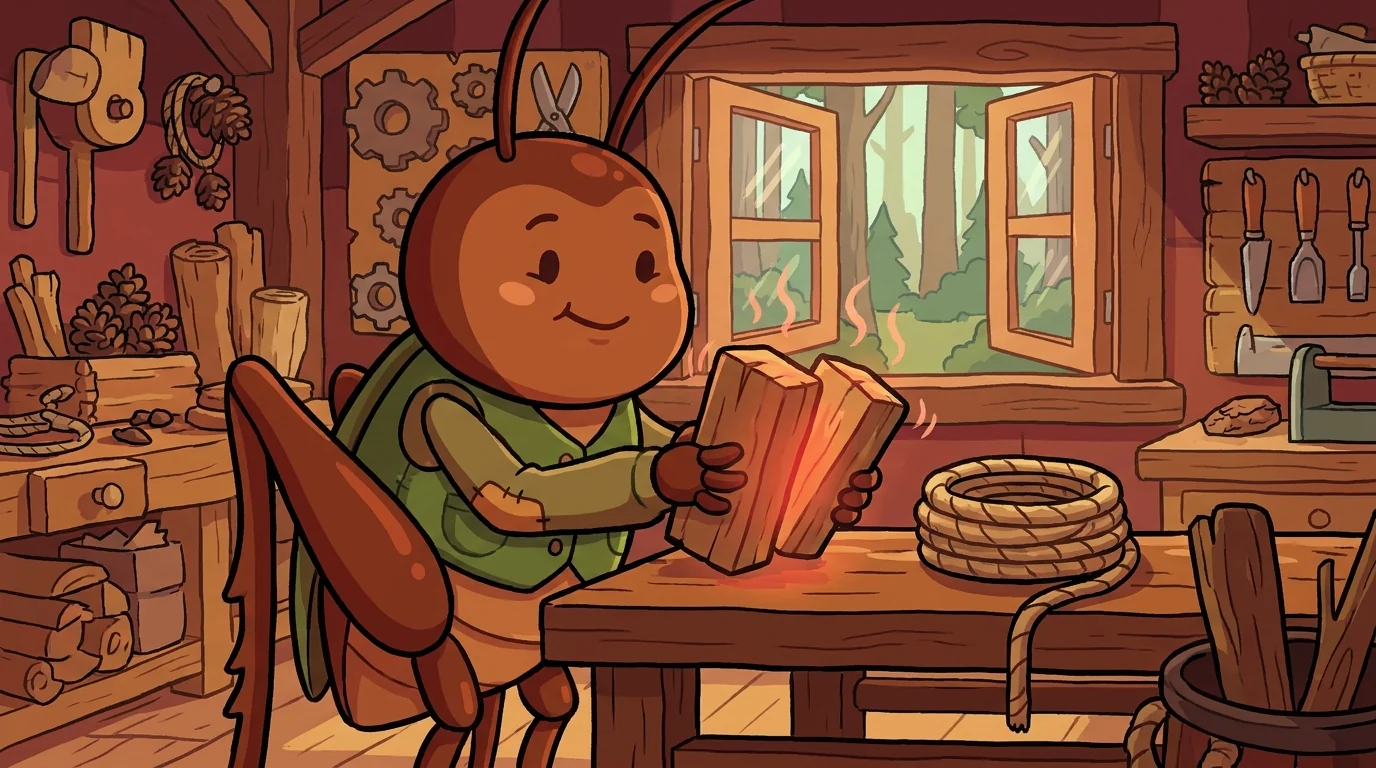
Rasp is a cricket-tween who makes warmth the way she makes sound — by rubbing. She wears a work-worn vest with rosin patches at the elbows, and she carries two blocks of wood and a coil of rope. Her body is a glossy chestnut brown, her strong back legs always ready to scrape, and she loves — more than anything — the little miracle of rubbing two cool things together and feeling warmth appear out of nowhere but the motion itself.
"Rub two things together and warmth appears," she likes to say. "Motion turns into heat." Because Rasp teaches friction — the way moving things that rub against each other turn their motion into heat. When you rub your hands, drag a rope, or brake a bike, the motion doesn't just vanish — it becomes warmth, jostling the molecules into faster wiggling. Most people think the warmth of rubbed hands comes from nowhere. Rasp knows better. It's the motion itself, changing form — one kind of energy becoming another, never lost, just transformed.
Rasp grew up in a dry meadow, in a family of crickets who had always known that rubbing makes more than song.
"Every cricket rubs," Rasp says. "We rub to sing. But my family knew the older secret: rubbing makes warmth too." She used to think heat had to come from a fire or the sun — from something already hot. Then one cold night she rubbed her cool hands together, fast and hard, and felt them go warm. "Where did that come from?" she'd wondered. Her grandmother had smiled. "From the rubbing, little one. From your own motion. You spent movement, and it turned into warmth. Energy doesn't come from nowhere and it doesn't go to nowhere — it just changes clothes." Rasp rubbed her hands again, watching the warmth appear, and understood. "The heat wasn't hiding in my hands," she says. "It was hiding in the motion. I turned moving into warming. And nothing was lost — the movement I spent became exactly the warmth I felt." She has felt energy change its form, and never vanish, ever since.
When Rasp was twelve, she hopped to HeatForge. Kelvin, her mentor, asked her, "Where does the warmth of rubbing come from?"
"Rub two things together and warmth appears," Rasp answered, back legs twitching. "Motion turns into heat. When things rub, their movement doesn't disappear — it becomes warmth, jostling molecules faster. It's change-craft. Energy is never lost or made from nothing; it only changes form — and friction is motion changing into heat."
Kelvin smiled. "You are appointed."
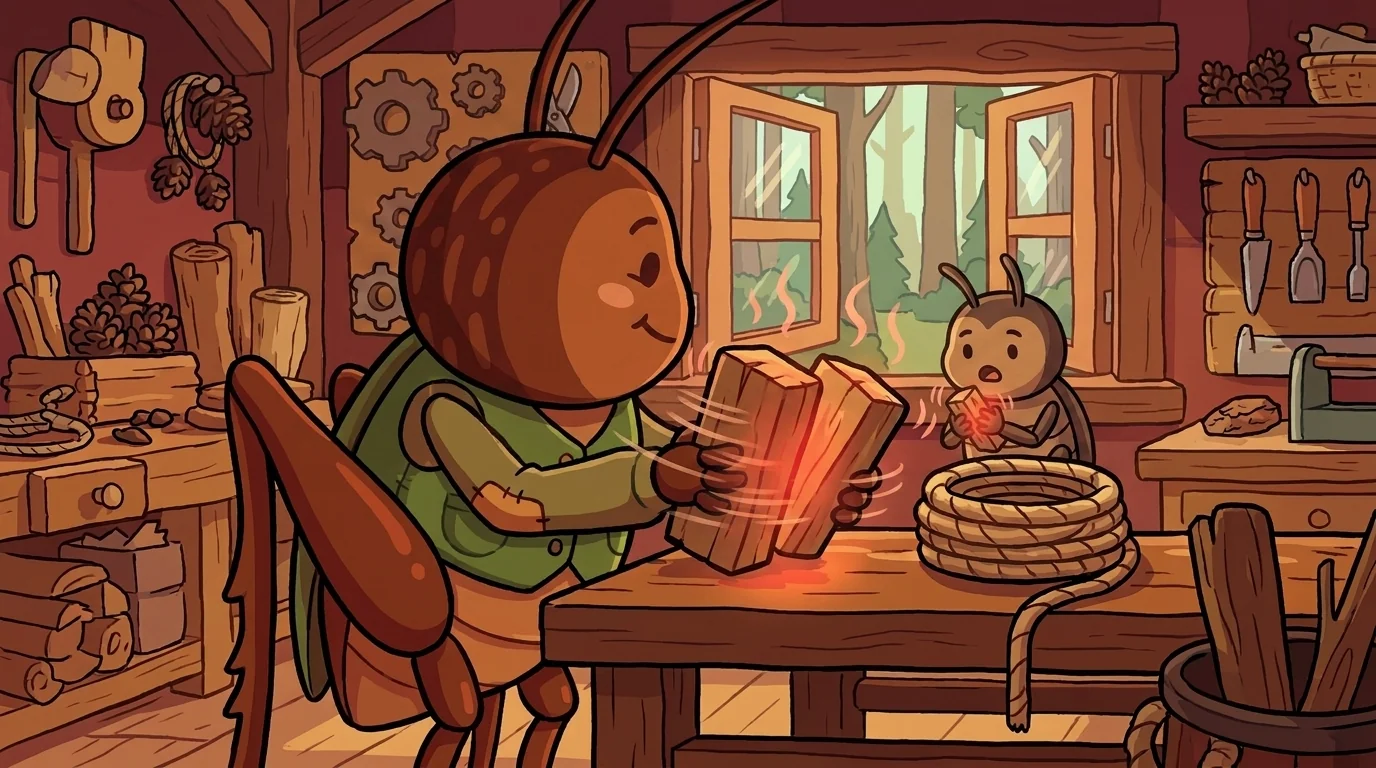
In her busy, rosin-dusted workshop, Rasp loves to show it. She has students rub their palms together, slow, then fast. "Feel it? The faster you rub, the warmer they get. You made that heat out of nothing but movement." She drags a rope quickly through her grip until it's warm, brakes a spinning wheel until the brake-pad heats. "Every time — motion in, warmth out." Then she teaches the secrets. Motion becomes heat — friction turns the energy of movement into thermal energy; the moving slows, and warmth appears in its place. Nothing is lost — this is the big law hiding inside it: energy is never destroyed, only changed from one form to another; the movement you "lose" to friction isn't gone, it's become heat. It's everywhere — brakes get hot stopping a car, a drill bit gets hot boring wood, a meteor gets white-hot rubbing against the air, ancient people started fires by rubbing sticks fast enough. You can't get it back easily — but here's the catch (and Smooth would nod): turning motion into heat is easy, and turning that scattered heat back into neat motion is very hard — so friction is a one-way door. And her favorite: "Warmth isn't only something you find. It's something you can make — out of pure motion. Rub hard enough, long enough, and you can pull heat straight out of movement. Energy just changes its clothes. It never disappears."
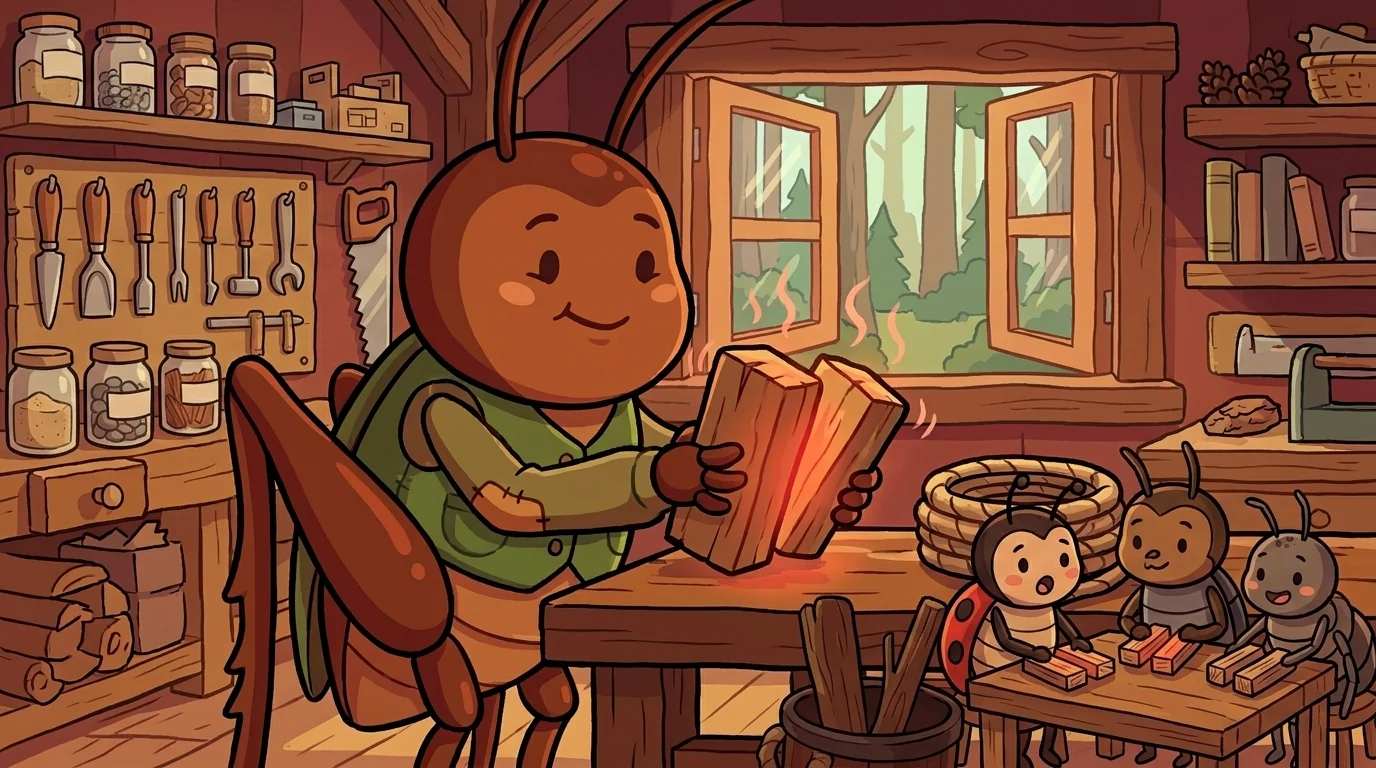
"So the heat comes from nothing?" a student asked her once. Rasp shook her head, antennae waving. "Not from nothing — from motion. It's just: rub two things together and warmth appears. Motion turns into heat. The energy didn't come from nowhere; it changed form. Nothing's ever really lost."
She rubbed her two wood blocks together until they warmed, and her voice warmed with a maker's satisfaction. "When I feel cold hands go warm from nothing but rubbing," she said, "and understand that the motion I spent became exactly that warmth — nothing lost, just changed — I don't just feel clever. I feel connected to the biggest quiet law there is, the same wonder I felt the cold night my own hands taught me. Holding that feeling close is the whole point. Energy is never made from nothing and never lost to nothing; it only ever changes its clothes — motion into warmth, warmth into motion, on and on. And there's something steadying in that: whatever effort you spend doesn't vanish. It becomes something. It always becomes something."
The HeatForge ensemble
Rasp is part of HeatForge's distributed-narrative cast. Each character embodies a different curricular primitive; together they teach the full subject.
-

Touch
Conduction (contact-bound molecular transfer)
-

Drift
Convection (fluid circulation carrying heat)
-

Glow
Radiation (electromagnetic energy across empty space)
-

Shift
Phase change / latent heat (state transition without temperature change)
-

Hush
Insulation / thermal equilibrium (slowing transfer, reaching balance)
-

Amass
Heat quantity vs temperature — how-hot is not how-much; a lukewarm lake holds more total heat than a scalding cup
-

Billow
Convection — warmth makes things spread out and rise; heat needs room to move
-

Smooth
Conduction toward equilibrium — heat always spreads toward even, and never un-spreads on its own
-

Steep
Heat capacity — some things soak up heat slowly and hold it long; water is a heat sponge