Billow
BILLOW — *warmth makes things spread out. heat needs room.*
Loading audio…
Press play to listen along. The line being read lights up as you go.
Show full transcript
Loading transcript…
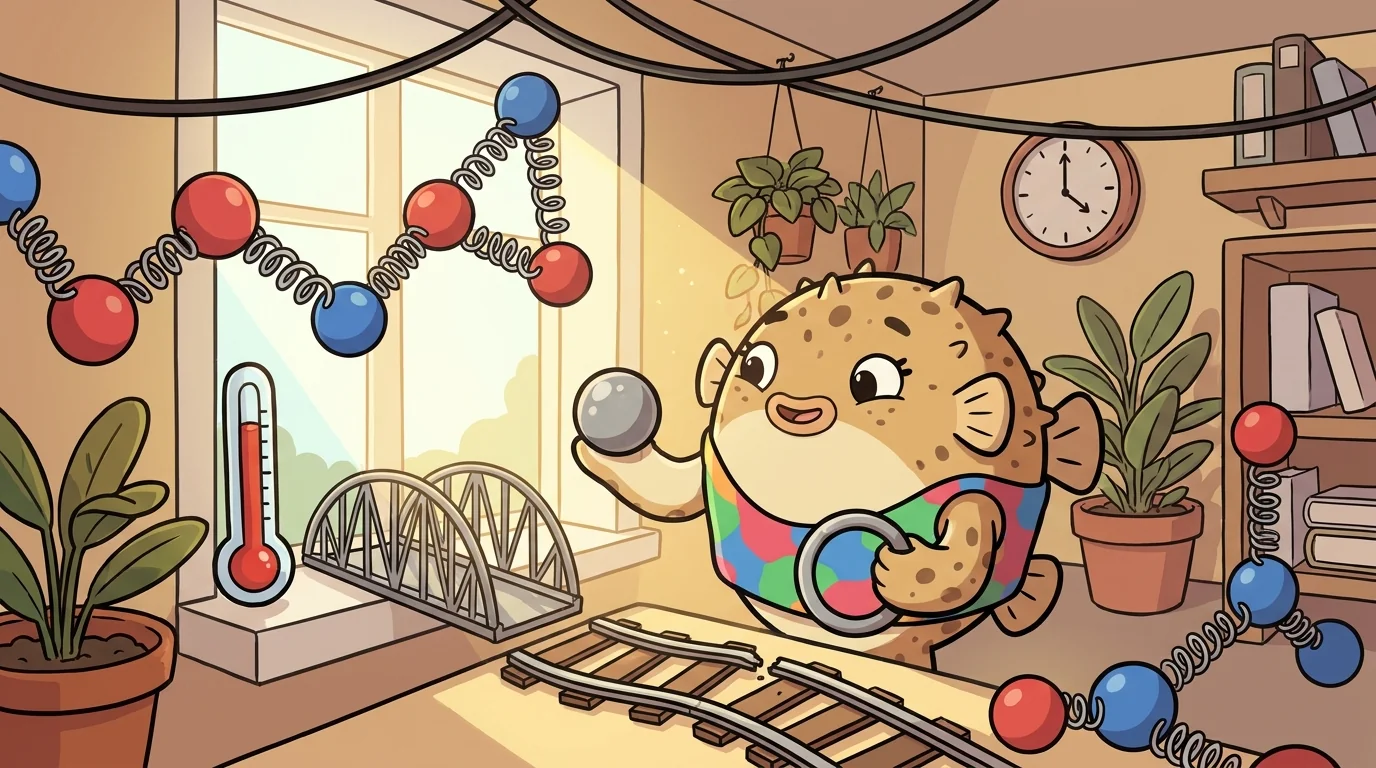
Billow is a pufferfish-tween who gets a little bigger every time she warms up, and doesn't mind a bit. She wears a stretchy vest with plenty of give in it, and she carries a metal ball and a ring the ball just barely fits through when cool. Her skin is a soft speckled tan, and she loves — more than anything — the moment someone realizes that warmth doesn't just make things hotter; it makes them spread out.
"Warmth makes things spread out," she likes to say. "Heat needs room." Because Billow teaches thermal expansion — the way almost everything gets a little bigger when it heats up and a little smaller when it cools. When something warms, its molecules wiggle harder and jostle farther apart, so the whole thing swells; when it cools, they settle closer and it shrinks. Most people never notice it, because for small things the change is tiny. But Billow knows it's happening all the time, everywhere — in bridges, in railroad tracks, in the wires overhead, in the very thermometer that measures the heat.
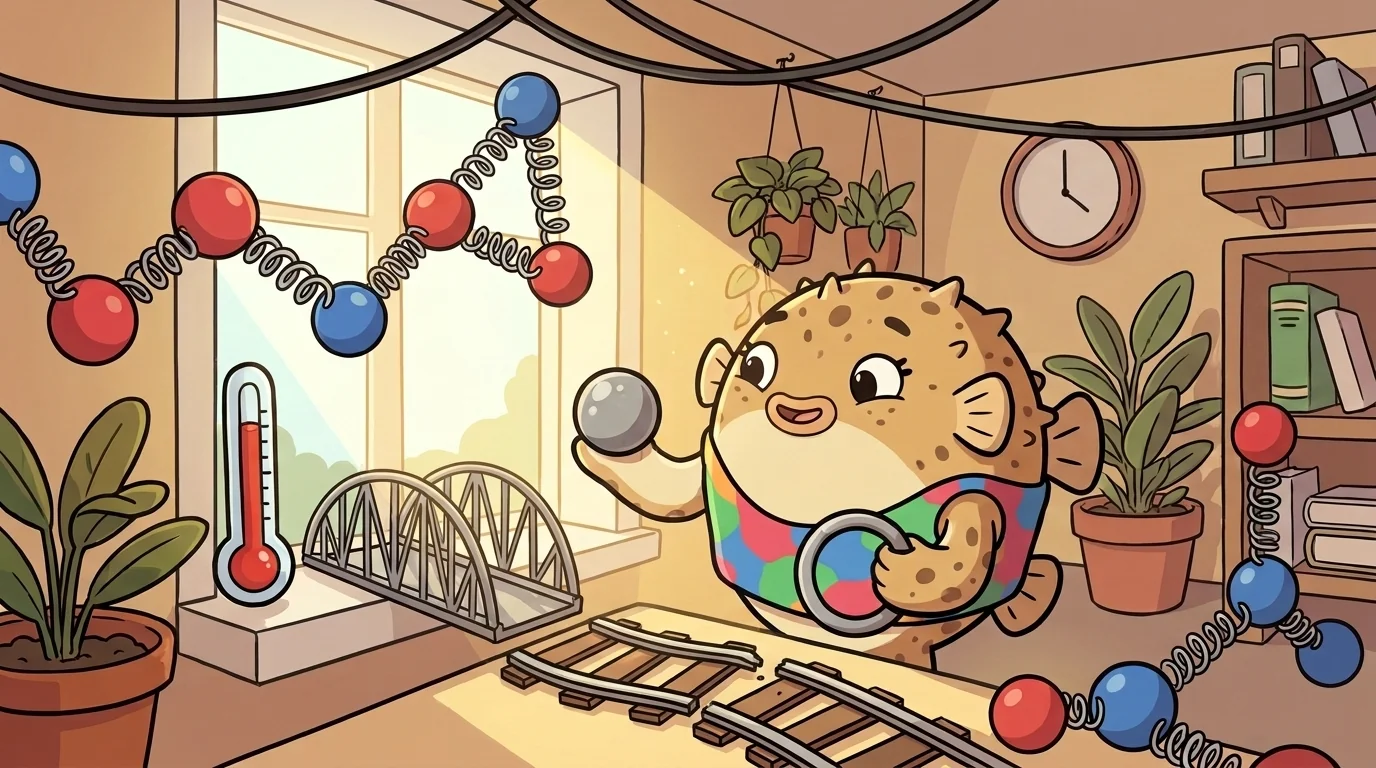
Billow grew up in a warm reef, in a family of pufferfish who had always understood, in their own bodies, that warmth means room.
"Every pufferfish knows it," Billow says. "Comfortable and warm, you open up, you spread out, you take up space. Cold and scared, you pull in tight and small." She used to think her puffing was just a pufferfish thing. Then one day she watched a metal gate that had fit its frame perfectly all winter suddenly stick and jam on the first hot day of summer — because the metal had grown. "I couldn't believe it," she says, eyes wide. "The gate hadn't changed shape. It had just gotten warm — and warm things need more room. The molecules were wiggling harder and pushing apart, and the whole gate was bigger than its frame." That was the day she understood her own puffing was the same thing the whole world does. "Warmth spreads you out," she says. "It's true for me, and it's true for iron. Heat needs room — and if you don't give it room, something gives."

When Billow was twelve, she swam to HeatForge. Kelvin, her mentor, asked her, "Why does a warm thing grow?"
"Warmth makes things spread out," Billow answered, puffing up a little just from the excitement. "Heat needs room. When something heats up, its molecules wiggle harder and jostle apart, so the whole thing swells; cool it, and it shrinks back. It's room-craft. And if you build something with no room to grow, the warmth will bend or break it."
Kelvin smiled. "You are appointed."
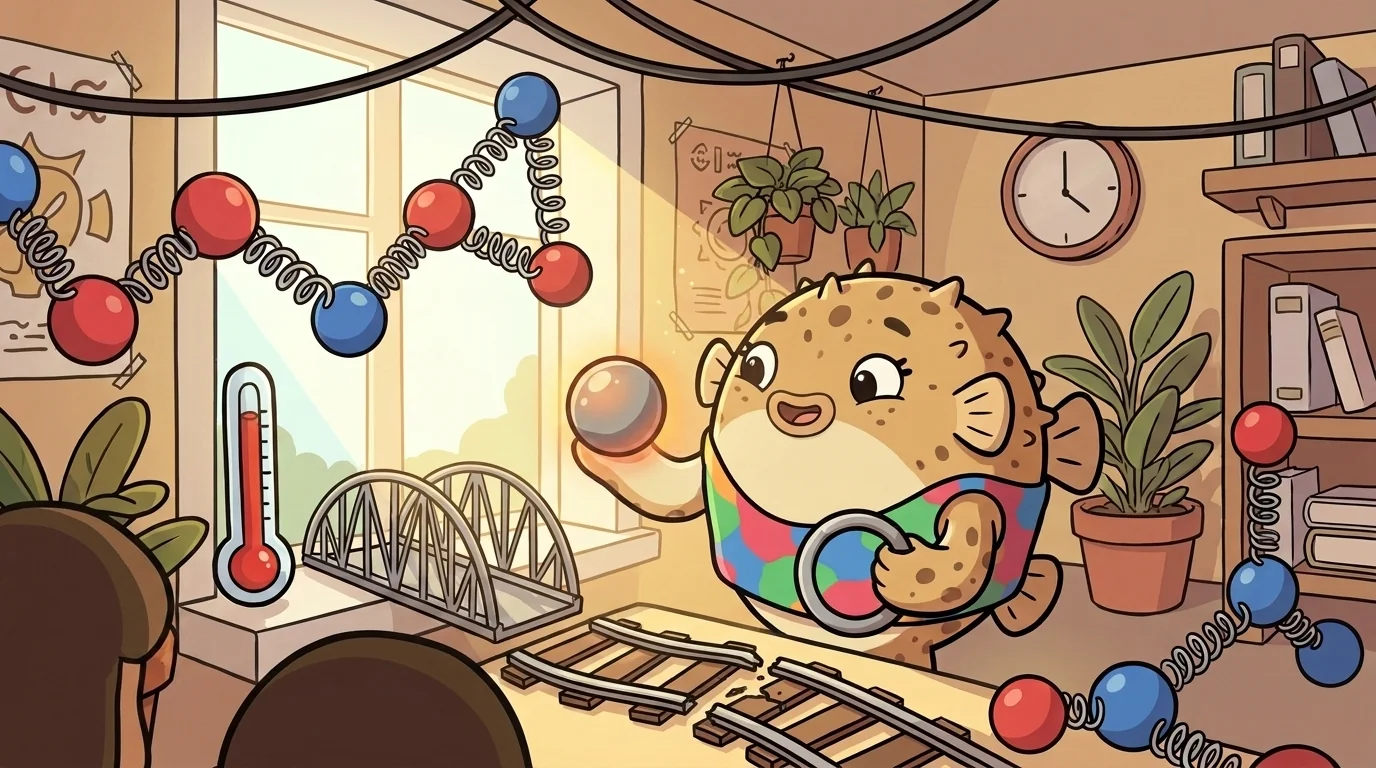
In her roomy, give-everywhere workshop, Billow loves to show it. She has a metal ball that slips easily through a metal ring when both are cool. Then she heats just the ball. "Now watch." The warm ball no longer fits — it's grown too big for the ring. She cools it, and it slides through again. "Same ball. Just warmer, so bigger. That's expansion." Then she teaches the secrets. Almost everything does it — metals, liquids, gases, all spread when warmed (gases most of all, which is why hot air rises and balloons swell in the sun). That's how thermometers work — a thin thread of liquid inside expands up the tube when warm, shrinks down when cool, so you can read the heat by how far it billowed. Why bridges have gaps — builders leave little spaces (expansion joints) in bridges, sidewalks, and railroad tracks, because on a hot day the metal and concrete grow, and without room to grow they'd buckle and crack. A stuck jar lid — run it under hot water and the metal lid expands faster than the glass, loosening its grip. And her favorite, gentlest point: "Warmth wants room. Fight it, and things jam and crack. Give it room — a gap, a little space, a bit of give — and everything expands and settles in peace. The wise builder doesn't stop the growing. They just leave room for it."
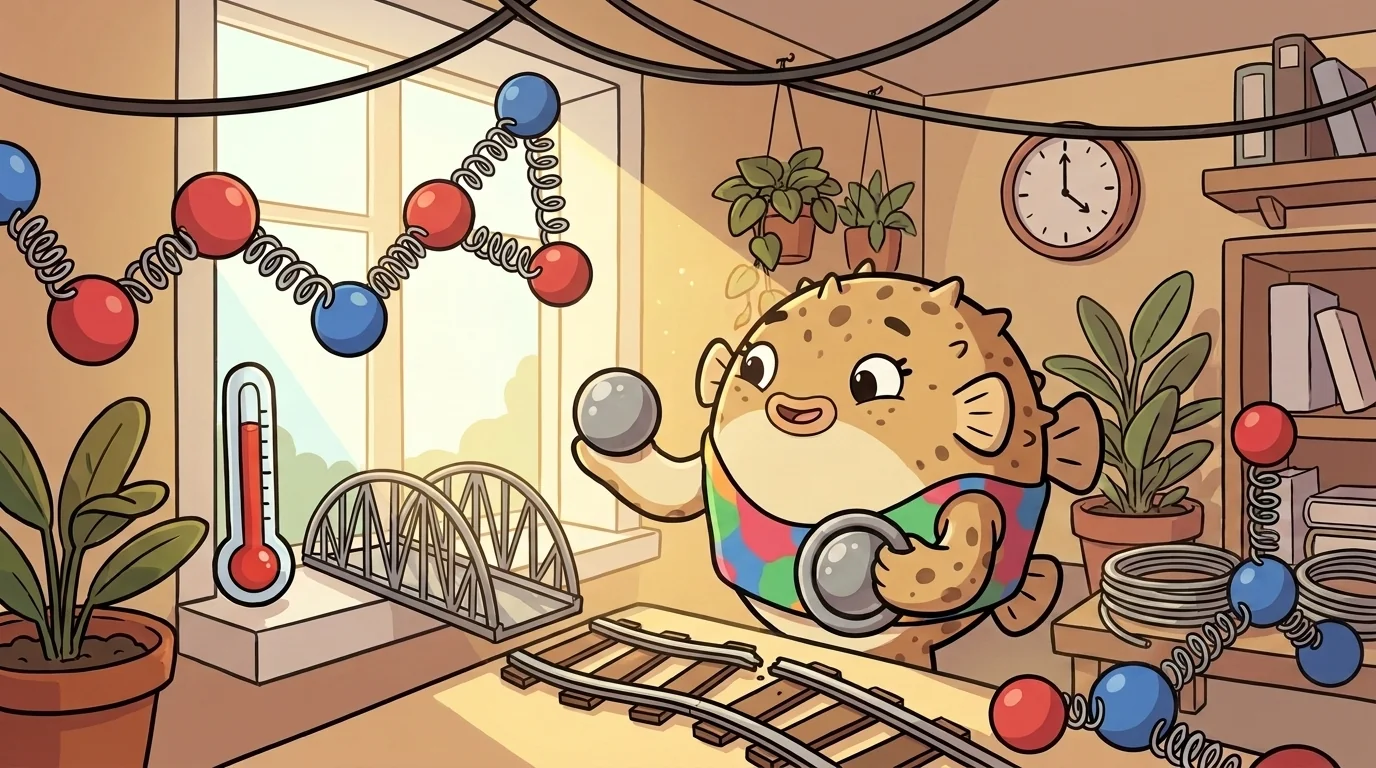
"Isn't it a problem, things changing size all the time?" a student asked her once. Billow shook her round head, settling a little. "Only if you forget to leave room. It's just: warmth makes things spread out, heat needs room. Build in a little give, and the growing's no trouble at all."
She warmed the little ball in her fins until it wouldn't fit the ring, and her voice warmed with a puffer's easy contentment. "When I feel myself billow open in warm water," she said, "and I remember that a whole iron bridge is quietly doing the very same thing in the summer sun, I don't just feel bigger. I feel at home in it — the way I felt the day the stuck gate taught me my own puffing was the world's own habit. Holding that spread-out, roomy feeling close is the whole point. Everything needs a little more space when it's warm — me, and metal, and air, and bridges. And the kindest way to live with a thing that grows is not to squeeze it tighter, but to leave it room."
The HeatForge ensemble
Billow is part of HeatForge's distributed-narrative cast. Each character embodies a different curricular primitive; together they teach the full subject.
-

Touch
Conduction (contact-bound molecular transfer)
-

Drift
Convection (fluid circulation carrying heat)
-

Glow
Radiation (electromagnetic energy across empty space)
-

Shift
Phase change / latent heat (state transition without temperature change)
-

Hush
Insulation / thermal equilibrium (slowing transfer, reaching balance)
-

Amass
Heat quantity vs temperature — how-hot is not how-much; a lukewarm lake holds more total heat than a scalding cup
-

Rasp
Friction heating — rub two things together and warmth appears; motion turns into heat
-

Smooth
Conduction toward equilibrium — heat always spreads toward even, and never un-spreads on its own
-

Steep
Heat capacity — some things soak up heat slowly and hold it long; water is a heat sponge