
Billow
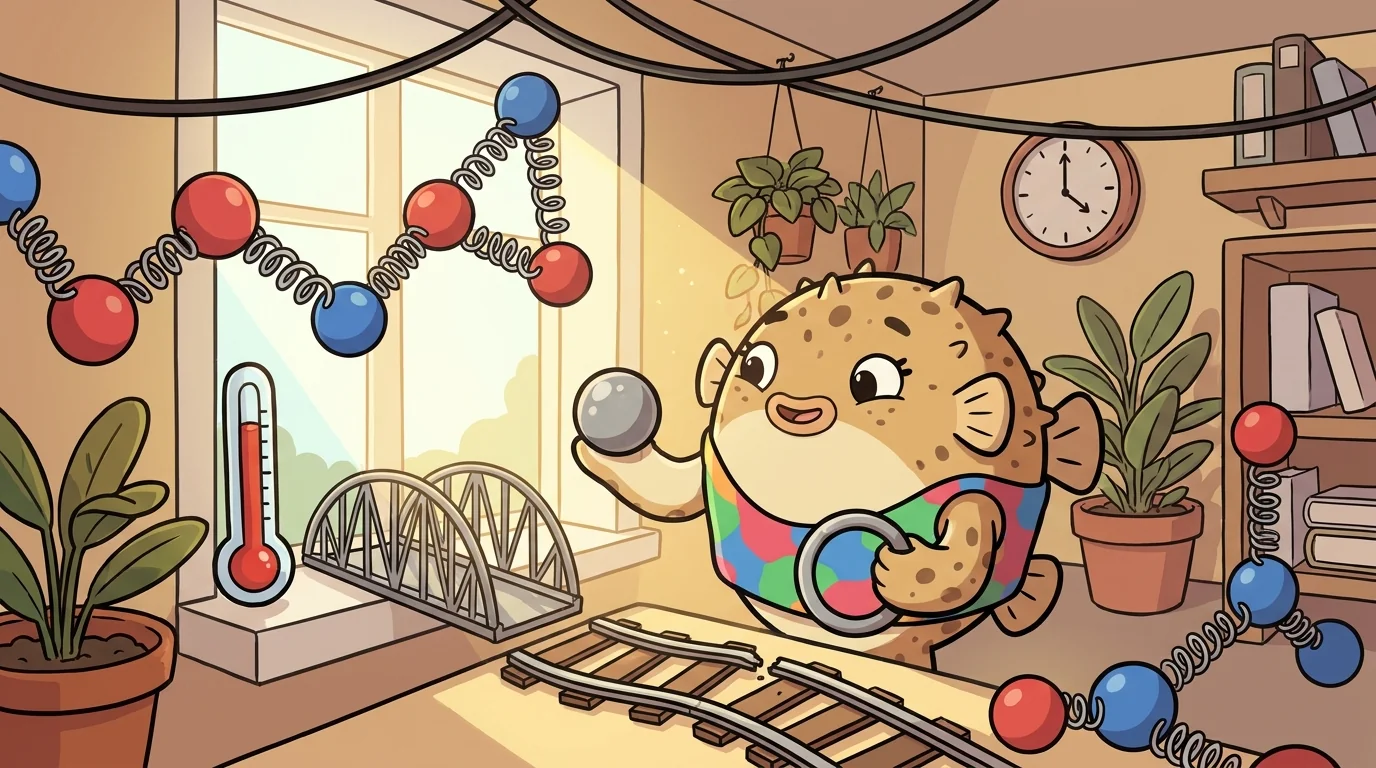
BILLOW — warmth makes things spread out; heat needs room.
Listen along — Billow
Loading audio…
Press play to listen along. The line being read lights up as you go.
Show full transcript
Loading transcript…
Chapter 6 — Billow and the Room That Warmth Demands
Billow drifted up toward the workshop ceiling, riding the warm air off a lamp, and called down to the older club below. “Notice where I am? Up here, where it’s warmest. That’s not an accident — it’s my whole primitive. Warmth makes things spread out. Heat needs room. Once you see it, you’ll spot it everywhere — in the air, in metal, in water, in the whole sky.”
She let herself sink as the air cooled. “Here’s the mechanism. When you heat almost anything, its tiny particles jiggle harder — you’ve met that from Amass. But jiggling harder means each particle knocks into its neighbours more forcefully and needs more elbow room. So the whole substance spreads out — it takes up more space than it did cold. That’s called thermal expansion. Warm air, warm metal, warm water — all of them swell, just a little, when heated, and shrink back when cooled.”
A young frog named Pib looked up at her. “But why do YOU float up there, then? Spreading out isn’t the same as rising.”
“Ah — it leads straight to it,” Billow said. “When a patch of air spreads out, it has the same particles in more space, so it’s less dense — lighter for its size than the cool air around it. And lighter-for-its-size things float up through heavier ones, the way a bubble rises through water. So warm air rises, cool air sinks to take its place, gets warmed, and rises in turn — a rolling loop called convection. That’s why the ceiling’s warm and the floor’s cold, why a hot-air balloon lifts, why the wind blows and the weather churns. It all starts with heat demanding more room.”
Billow had learned how powerful the demand is by ignoring it. “Once,” she told them, “I helped fill a sealed jar with air and screwed the lid on tight in the cool morning — packed it completely full, proud there was no wasted space. Then the sun warmed it. The air inside wanted to spread, and I’d given it no room to. The pressure built and built until the lid blew off with a bang that startled the whole garden.” The no-need-for-empty-space feeling had turned into a healthy respect: heat will have its room, and if you don’t leave it any, it takes it.
“So remember what warmth demands,” Billow finished, drifting up again on a fresh thread of warm air. “Heat makes things expand — so leave metal bridges and railway tracks little gaps to grow into on hot days, or they’ll buckle. Heat makes warm fluids less dense — so they rise, and that rising is the engine behind wind, weather, and the warm ceiling over your head. Whenever something heats up, ask where will it spread, and what happens when it does. Warmth makes things spread out. Heat always needs room — give it some, or it’ll make its own.”
The HeatForge ensemble
Billow is part of HeatForge's distributed-narrative cast. Each character embodies a different curricular primitive; together they teach the full subject.
-

Touch
Conduction (contact-bound molecular transfer)
-

Drift
Convection (fluid circulation carrying heat)
-

Glow
Radiation (electromagnetic energy across empty space)
-

Shift
Phase change / latent heat (state transition without temperature change)
-

Hush
Insulation / thermal equilibrium (slowing transfer, reaching balance)
-

Amass
Heat quantity vs temperature — how-hot is not how-much; a lukewarm lake holds more total heat than a scalding cup
-

Rasp
Friction heating — rub two things together and warmth appears; motion turns into heat
-

Smooth
Conduction toward equilibrium — heat always spreads toward even, and never un-spreads on its own
-

Steep
Heat capacity — some things soak up heat slowly and hold it long; water is a heat sponge