
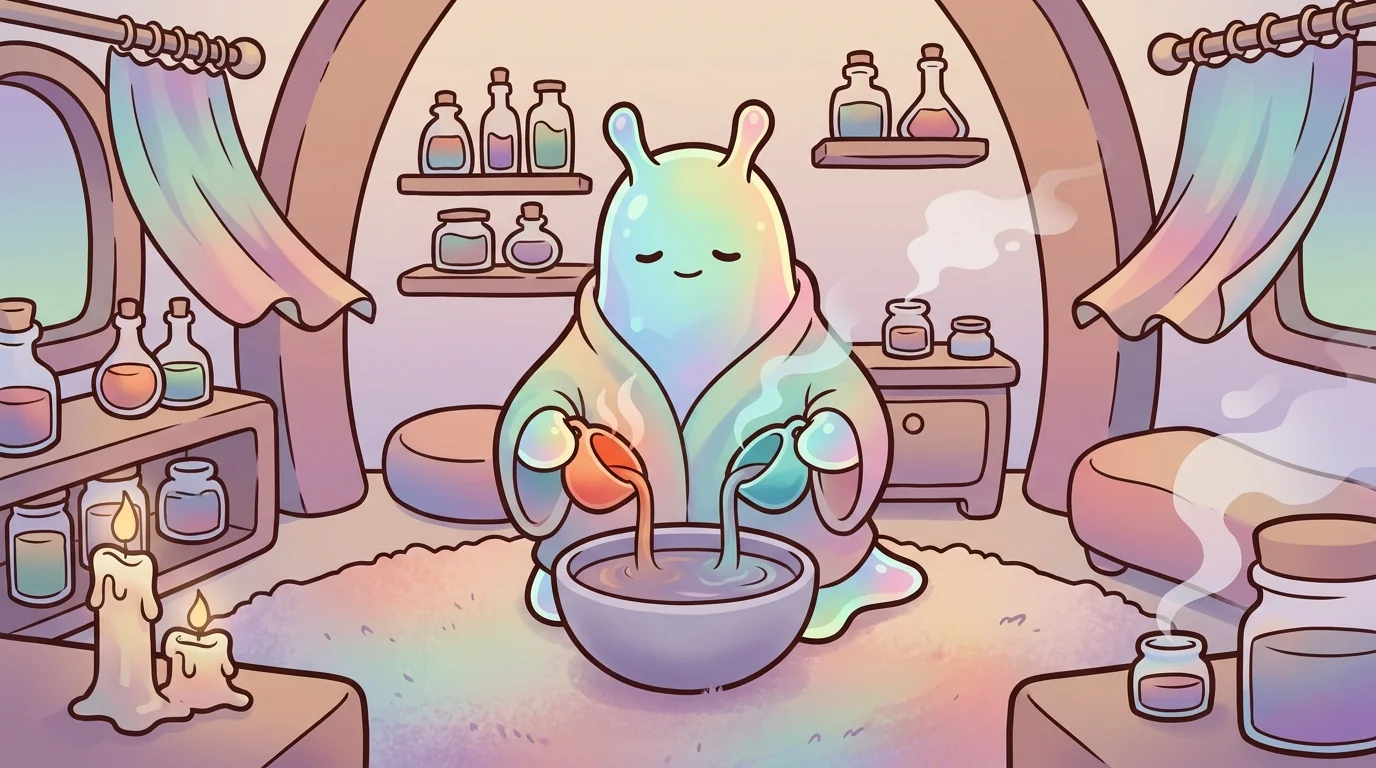
Smooth
SMOOTH — heat always spreads toward even, and never un-spreads on its own.
Listen along — Smooth
Loading audio…
Press play to listen along. The line being read lights up as you go.
Show full transcript
Loading transcript…
Chapter 6 — Smooth and the One-Way Street
Smooth set a mug of hot tea beside a glass of ice water on the table and simply waited with the older club, watching. Slowly, the tea cooled; slowly, the ice water warmed; and after a while both drifted toward the same middling temperature as the room. “There,” Smooth said quietly. “You just watched the most reliable rule in all of nature. Heat always spreads toward even — and it never un-spreads on its own. It’s a one-way street, and nothing you can do will make heat run back up it by itself.”
She touched the cooling mug. “Here’s the rule, in two parts. First: heat always flows from hotter to colder, never the reverse. The fast-jiggling particles of the hot tea bump the slower particles of the air and the cool table, speeding them up and slowing themselves down — so warmth leaks out of the hot thing into the cold, until everything reaches the same temperature. That evened-out, no-more-flow state is called thermal equilibrium. Every hot thing is on its way there; every cold thing too.”
A young toad named Wick asked the deep question. “But why only one way? Why couldn’t the tea pull heat back out of the room and get hot again?”
“That’s the profound part,” Smooth said. “Nothing forbids each particle from bouncing the other way — the rule isn’t about single particles. It’s about odds, at a scale so huge it becomes certainty. Spread-out heat is like a shuffled deck or a drop of ink swirled through water: there are countless ways for the energy to be scattered evenly and almost no ways for it to be gathered back concentrated, so ‘scattered’ is where things always end up and ‘un-scattering on its own’ essentially never happens. Heat can be forced back into a small hot spot — that’s what a fridge or an air conditioner does — but only by spending energy to pump it uphill. Left alone, heat only ever spreads. That one-way arrow is what we call the second law of thermodynamics, and it’s why time itself seems to point forward.”
Smooth had learned to stop fighting the arrow. “When I was small,” Smooth admitted, “I left a warm den door open on a cold night, then kept expecting the warmth to stay put if I just wished hard enough. It didn’t. It poured out into the cold until inside and outside matched, and I was freezing. Heat doesn’t care what you wish. It goes toward even, always.” The why-won’t-it-stay feeling had turned into a calm acceptance of the one-way street — and a habit of insulating to slow the flow instead of pretending it wouldn’t happen.
“So plan around the arrow, never against it,” Smooth finished, as the tea and the ice water settled into one mild sameness. “Heat will always leak from hot to cold toward equilibrium — so if you want to keep something hot or cold, you don’t stop the flow, you slow it, with insulation. And never wait for heat to un-spread on its own; it won’t, unless something spends energy to force it. Heat always spreads toward even, and never un-spreads by itself. It’s the surest one-way street there is.”
The HeatForge ensemble
Smooth is part of HeatForge's distributed-narrative cast. Each character embodies a different curricular primitive; together they teach the full subject.
-

Touch
Conduction (contact-bound molecular transfer)
-

Drift
Convection (fluid circulation carrying heat)
-

Glow
Radiation (electromagnetic energy across empty space)
-

Shift
Phase change / latent heat (state transition without temperature change)
-

Hush
Insulation / thermal equilibrium (slowing transfer, reaching balance)
-

Amass
Heat quantity vs temperature — how-hot is not how-much; a lukewarm lake holds more total heat than a scalding cup
-

Billow
Convection — warmth makes things spread out and rise; heat needs room to move
-

Rasp
Friction heating — rub two things together and warmth appears; motion turns into heat
-

Steep
Heat capacity — some things soak up heat slowly and hold it long; water is a heat sponge