
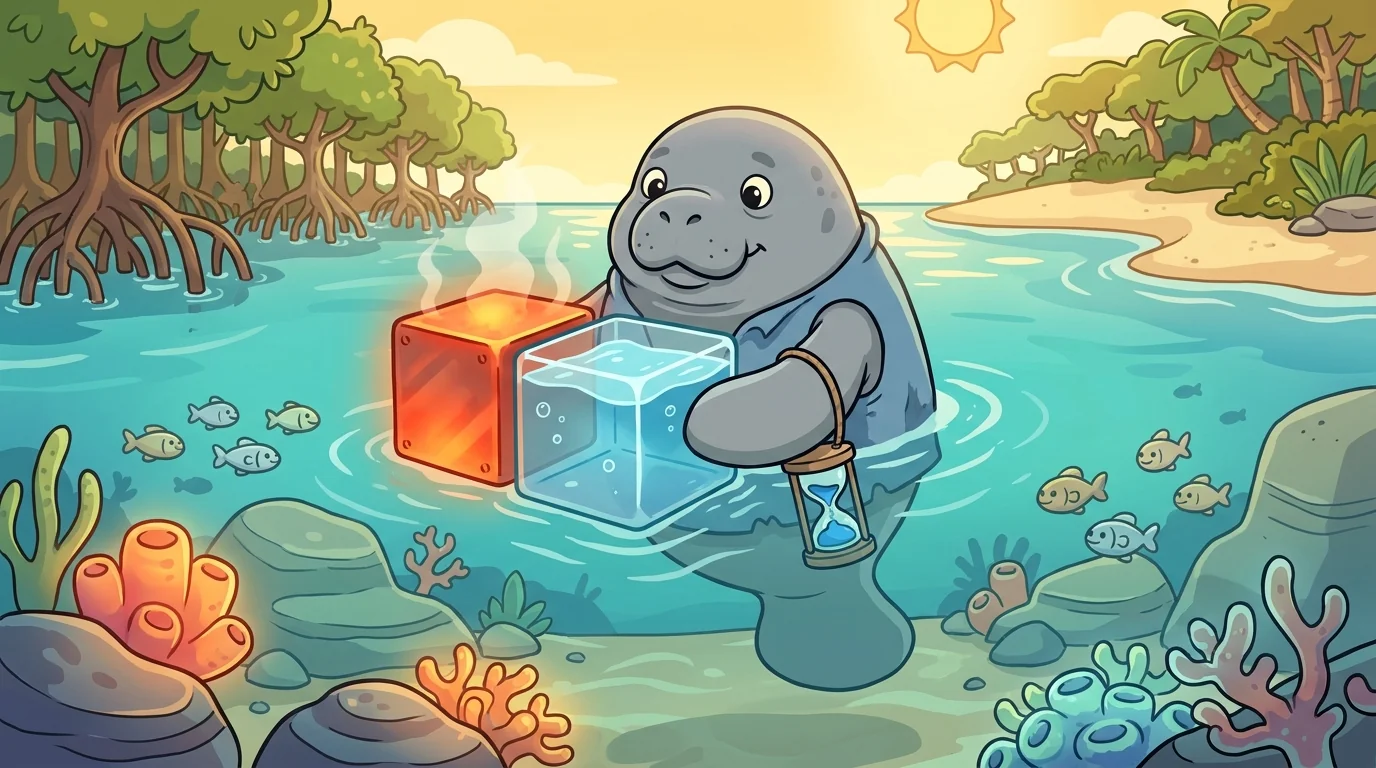
Steep
STEEP — some things soak up heat slowly and hold it long; water is a heat sponge.
Listen along — Steep
Loading audio…
Press play to listen along. The line being read lights up as you go.
Show full transcript
Loading transcript…
Chapter 6 — Steep and the Heat Sponge
Steep sat between a metal spoon and a mug of water, both left in the same sunny window all morning, and invited the older club to touch each. The spoon was almost too hot to hold; the water was merely warm. “Same sun, same time, same window,” Steep said. “So why is the metal scorching and the water only warm? Because different materials have completely different appetites for heat. Some soak it up slowly and hold it long. Some heat up in a flash and lose it just as fast. Water is the great heat sponge — and that changes the whole world.”
She tapped the mug. “The measure of this appetite is called specific heat capacity — how much heat it takes to warm a material up by a certain amount. Water’s is enormous: it takes a lot of heat to raise water’s temperature even a little, so it heats up slowly. Metal’s is tiny: a little heat sends its temperature soaring, so it heats up fast. That’s why the spoon cooked while the water stayed mild — the metal’s small appetite filled instantly, while the water’s huge appetite was barely touched by the same sunshine.”
A young newt named Dab tilted his head. “So water is just… slow. Is that useful, or just annoying?”
“It’s one of the most useful facts in nature,” Steep said. “The rule cuts both ways: what heats slowly also cools slowly. Water soaks heat up reluctantly and gives it back reluctantly — so it holds warmth long after the metal has gone cold. That’s why a hot-water bottle stays warm all night while a hot spoon is cold in a minute. And now think big: the oceans are a heat sponge the size of the planet. They soak up the sun’s heat by day and in summer, release it slowly by night and in winter, and so they steady the temperature of everywhere near them. That’s why coastal places have mild, even weather, while inland places — no sponge nearby — swing between baking days and freezing nights.”
Steep had learned to respect the sponge by fighting it. “Once,” Steep admitted, “I tried to boil a big pot of water fast by blasting it with a quick, fierce heat, impatient — and it just sat there, barely steaming, drinking my heat and refusing to hurry. I was sure something was broken. Nothing was broken. Water simply has a huge appetite; there’s no rushing it — you just have to keep feeding it.” The why-won’t-it-hurry frustration had turned into a patient understanding of what water is.
“So learn each material’s appetite,” Steep finished, setting the mild mug beside the scorching spoon. “Water: huge appetite — slow to warm, slow to cool, a sponge that stores and steadies heat. Metal: tiny appetite — fast to warm, fast to cool. Choose the right one for the job: water to hold warmth or smooth out swings, metal to move heat fast. And remember why the coast is gentle and the desert is cruel — it’s the same fact, written across a whole planet. Some things are heat sponges. Water most of all.”
The HeatForge ensemble
Steep is part of HeatForge's distributed-narrative cast. Each character embodies a different curricular primitive; together they teach the full subject.
-

Touch
Conduction (contact-bound molecular transfer)
-

Drift
Convection (fluid circulation carrying heat)
-

Glow
Radiation (electromagnetic energy across empty space)
-

Shift
Phase change / latent heat (state transition without temperature change)
-

Hush
Insulation / thermal equilibrium (slowing transfer, reaching balance)
-

Amass
Heat quantity vs temperature — how-hot is not how-much; a lukewarm lake holds more total heat than a scalding cup
-

Billow
Convection — warmth makes things spread out and rise; heat needs room to move
-

Rasp
Friction heating — rub two things together and warmth appears; motion turns into heat
-

Smooth
Conduction toward equilibrium — heat always spreads toward even, and never un-spreads on its own