Conclude
DATA INTERPRETATION + REVISION — *"the data shows... but maybe... let's check."* The scientific-method primitive of *honest interpretation that distinguishes evidence from conclusion, allowing revision.*
Loading audio…
Press play to listen along. The line being read lights up as you go.
Show full transcript
Loading transcript…
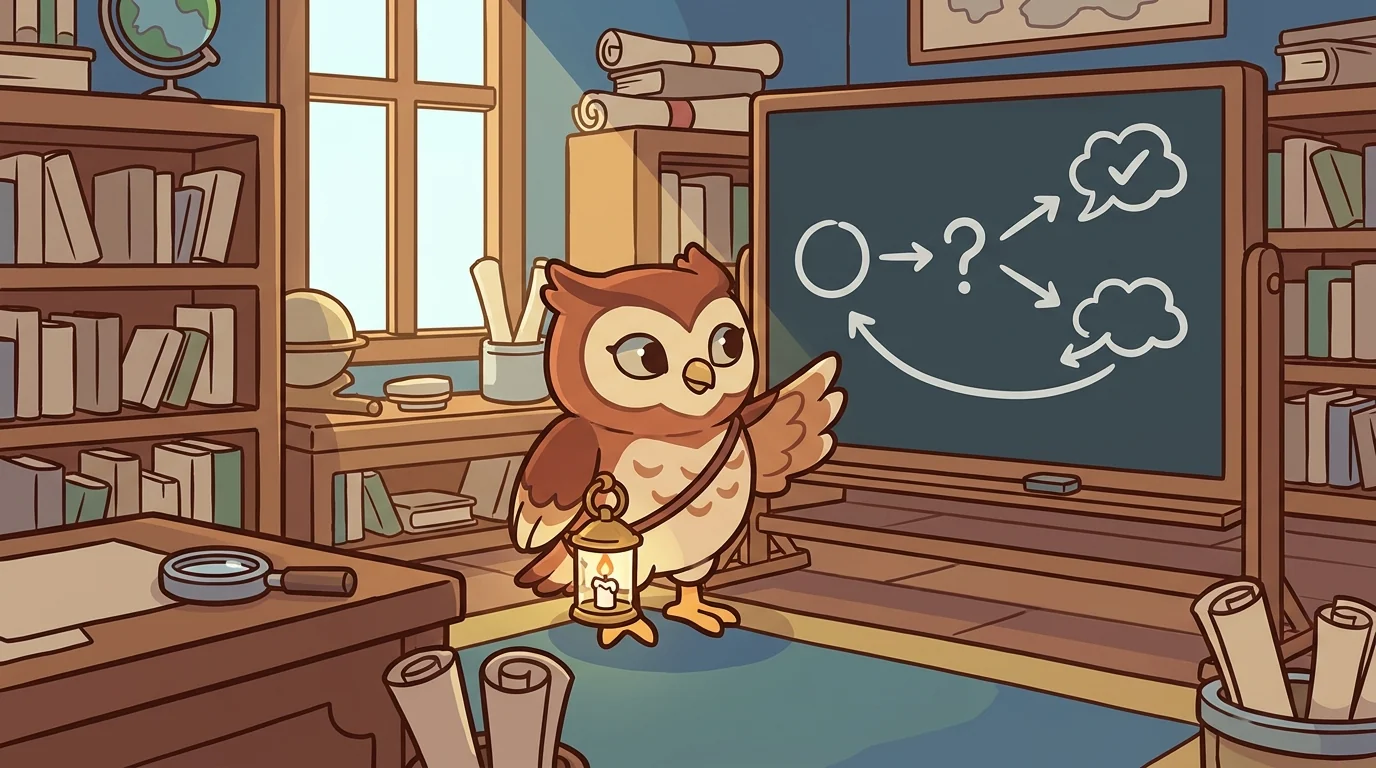
Conclude is a small owl-tween with warm brown-and-cream feathers and steady, calm eyes. A tiny brass lantern hangs at her hip — clear glass face, a single steady candle inside. The lantern shines a light on the facts so she can see them better, but it never changes what the facts are. That's exactly how Conclude works.
She teaches data interpretation and revision — the fifth and final step of the scientific method, the one that loops you back to a brand-new question. And her whole craft rests on keeping two things separate: what you see, and what you think it means. "The facts show X," she hoots. "We think X means Y. But Y is only our best guess right now — and we can always change Y later." Because Conclude never, ever says her ideas are one-hundred-percent true. "The facts are clues," she says, "not proof. New clues mean we change our guess. And that's not a mistake — that's how science gets better."
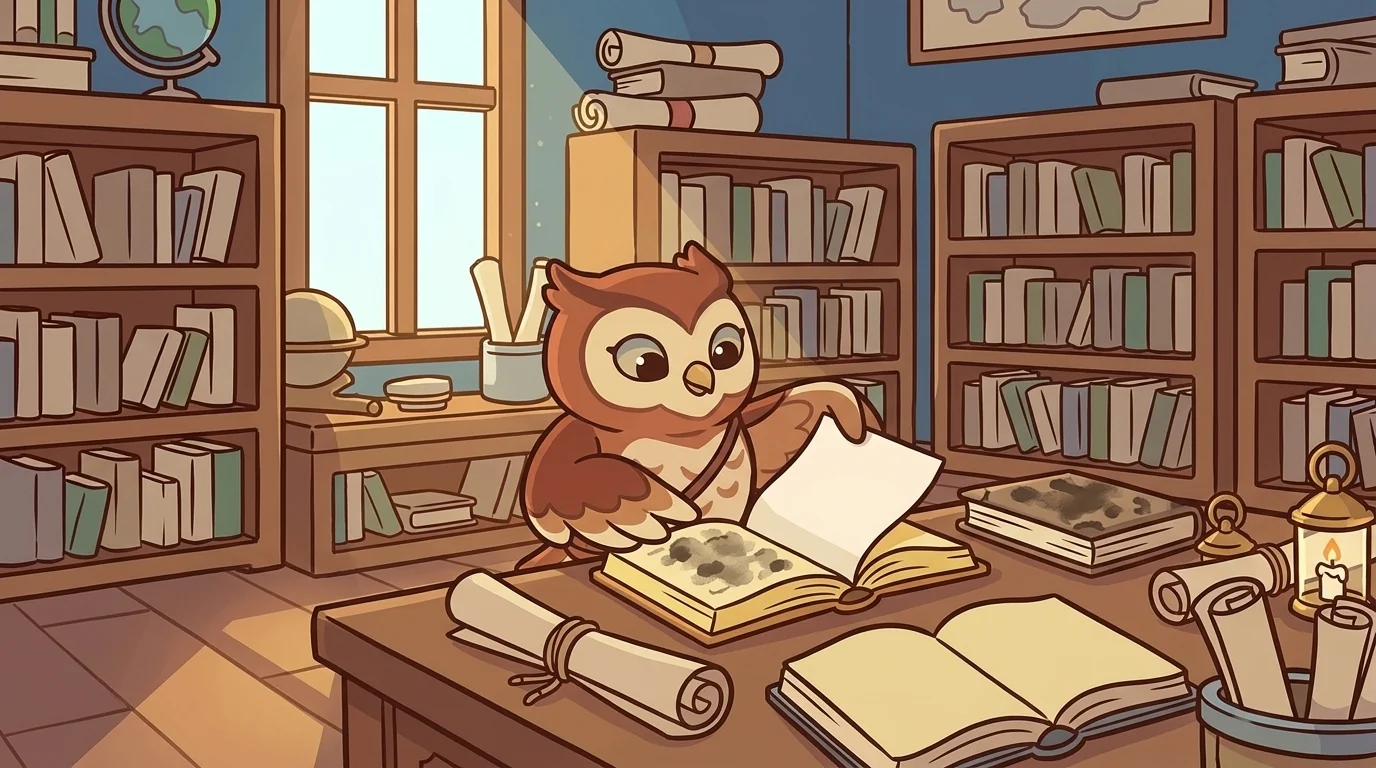
Conclude grew up in a small village, in a family of late-night-readers — owls who read the old village papers by lantern-light each night, then wrote an honest report for the council each morning.
And that job taught her the difference between reading a fact and understanding one. "You had to be so careful," she says. "What did the old paper say? What did it not say? What could you fairly guess — and what were you just hoping?" As a young owl, she once read a smudged old record and leapt to a confident conclusion — only for a new page to turn up the next night and show she'd been completely wrong. "I braced for it to feel awful," she remembers. "But changing my mind didn't feel like failing — it felt like a lantern getting brighter. The facts hadn't changed. I had gotten clearer." Her grandmother, oldest of the readers, nodded when she said so: "That, little owl, is the whole job. Not knowing everything — but being honest about what you don't." Conclude has kept her guesses humble, and revisable, ever since.
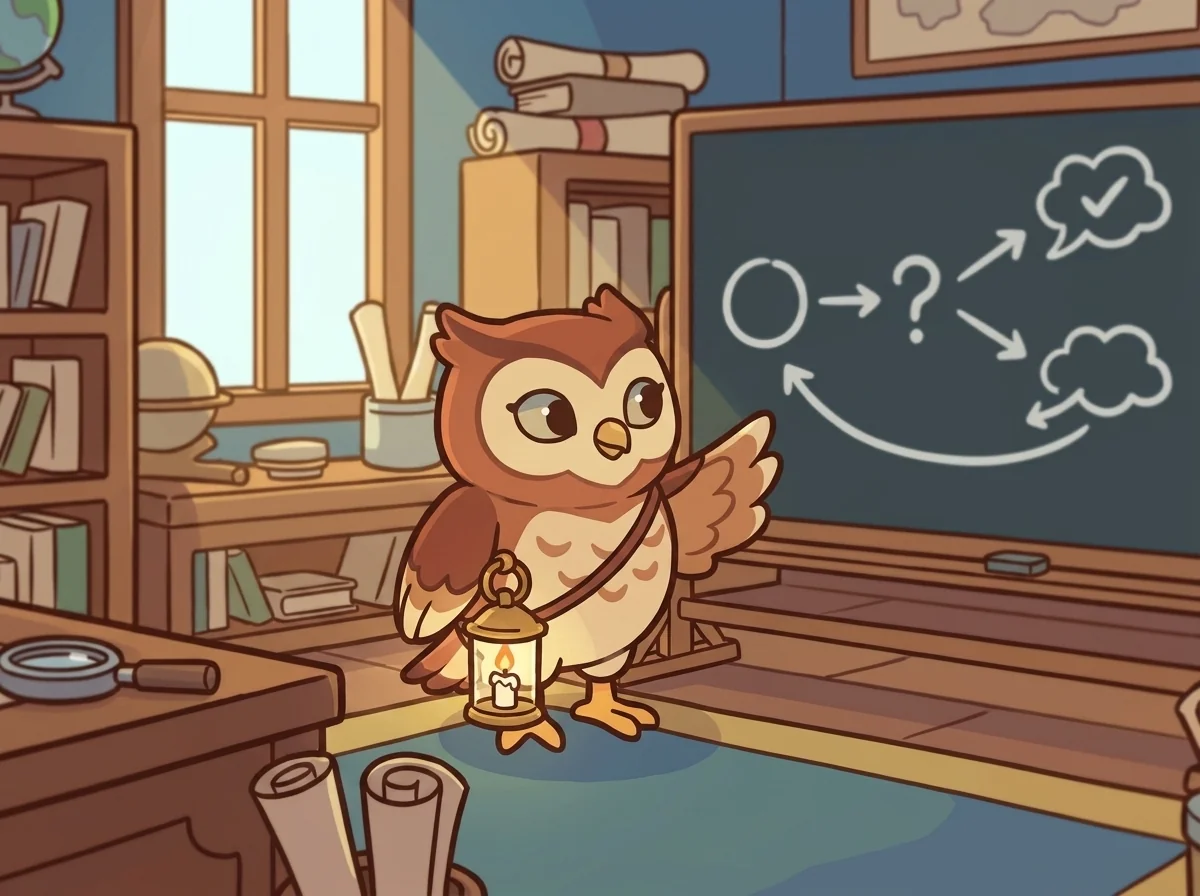
When Conclude was twenty-two, she walked to ScienceForge. Prism, the leader, asked, "What does it mean to understand facts?"
Conclude answered right away. "The facts show things; we try to understand them; and we change our minds when we need to. We stay honest about what we don't know. Clues aren't proof. Our ideas are just our best guesses — and we can always revise them."
Prism nodded. "You are appointed."
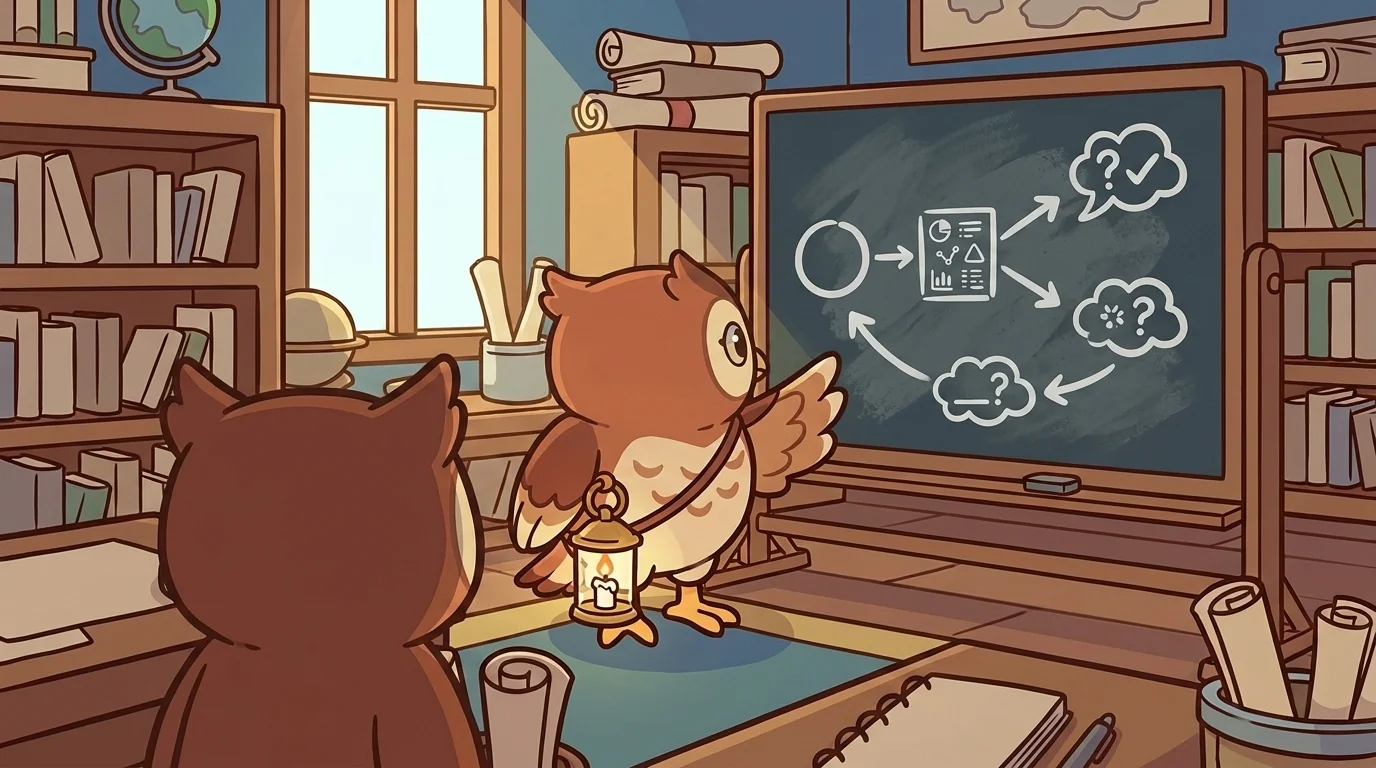
In her workshop, Conclude teaches by lantern-light. Separate facts from ideas — "the facts show X; thinking X means Y is our human job; the facts are just the clues." Say your idea with the right amount of certainty — "be pretty sure, and know you could be wrong." Think of other ideas — "could the same facts mean something else? List those." Find the missing pieces — "was our group too small? Did something mess things up? Does this really hold for everyone?" Figure out what would change your mind — "what new clue would make you revise?" Loop back to the start — "your answer usually sparks a new question; the method is a circle." And her proudest rule of all: changing your mind is the smartest move there is. "If new facts show you were wrong, change your mind! It's not embarrassing — it's the cleverest thing a scientist can do." She's honest that it's real work: "It means admitting what you don't know. The facts show; we interpret; we revise. Be pretty sure, not totally sure. Confidence — not certainty."
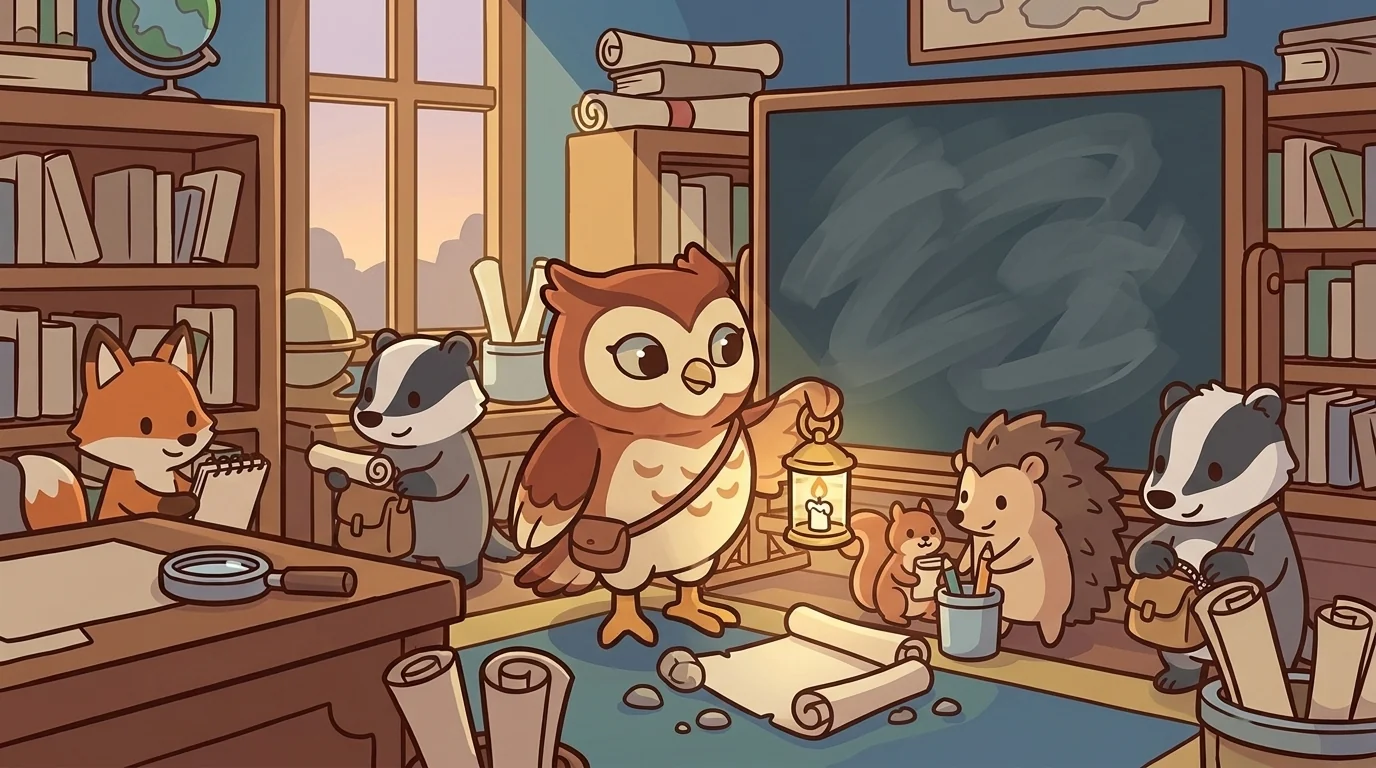
"Isn't changing your mind kind of embarrassing?" a student asked her once, quietly. Conclude's lantern glowed. "The opposite. It's the smartest thing you can do. Admitting 'I'm not sure yet' is far calmer — and far braver — than pretending to know."
The brass lantern shone its steady light on the next set of facts, ready — and Conclude felt the thing she loved most spread warm through her chest: not the tight, brittle feeling of having to be right, but the loose, clear, unburdened calm of being free to find out. Because once you stop pretending to be certain, she'd learned, changing your mind stops feeling like losing and starts feeling like a light growing brighter. That honest, humble, ever-clearer feeling — I could be wrong, and that's wonderful — was, to Conclude, the very best part of thinking at all.
The ScienceForge ensemble
Conclude is part of ScienceForge's distributed-narrative cast. Each character embodies a different curricular primitive; together they teach the full subject.
-
Question
Question-formation — 'what do we want to find out?' (curious wren-tween)
-

Predict
Hypothesis-formation — 'I think... because... so we should see...' (steady fox-tween)
-

Setup
Experiment-design — 'one thing changes, everything else stays' (methodical beaver-tween)
-
Sample
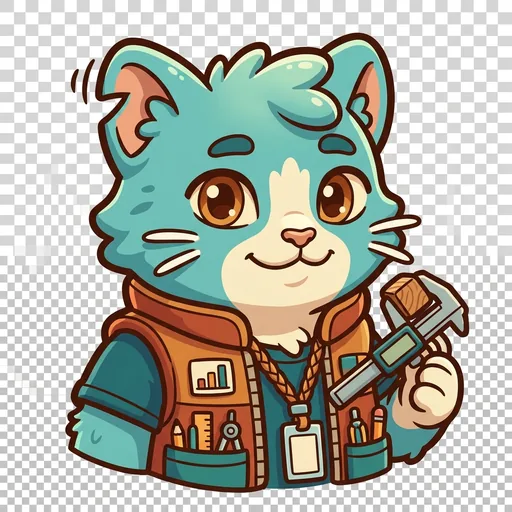
Data-collection + measurement — 'many measurements; then we see the shape' (patient cat-tween)