
Wendel, Elvi, Fiva and Dashel
FOUR SELF-WORKING ROUTINES IN ONE ACT — a mental-math show is a chain of methods, not luck: Wendel anchors a year's doomsday and steps by sevens to any weekday, Elvi pries a two-digit number's digits apart and drops their sum in the gap for ×11, Fiva turns a number ending in 5 into the friendly pair n·(n+1) and tacks on 25, and Dashel adds from the biggest place first so the answer is already growing out loud.
A story read by Wendel, Elvi, Fiva and Dashel
Loading audio…
Press play to listen along. The line being read lights up as you go.
Show full transcript
Loading transcript…
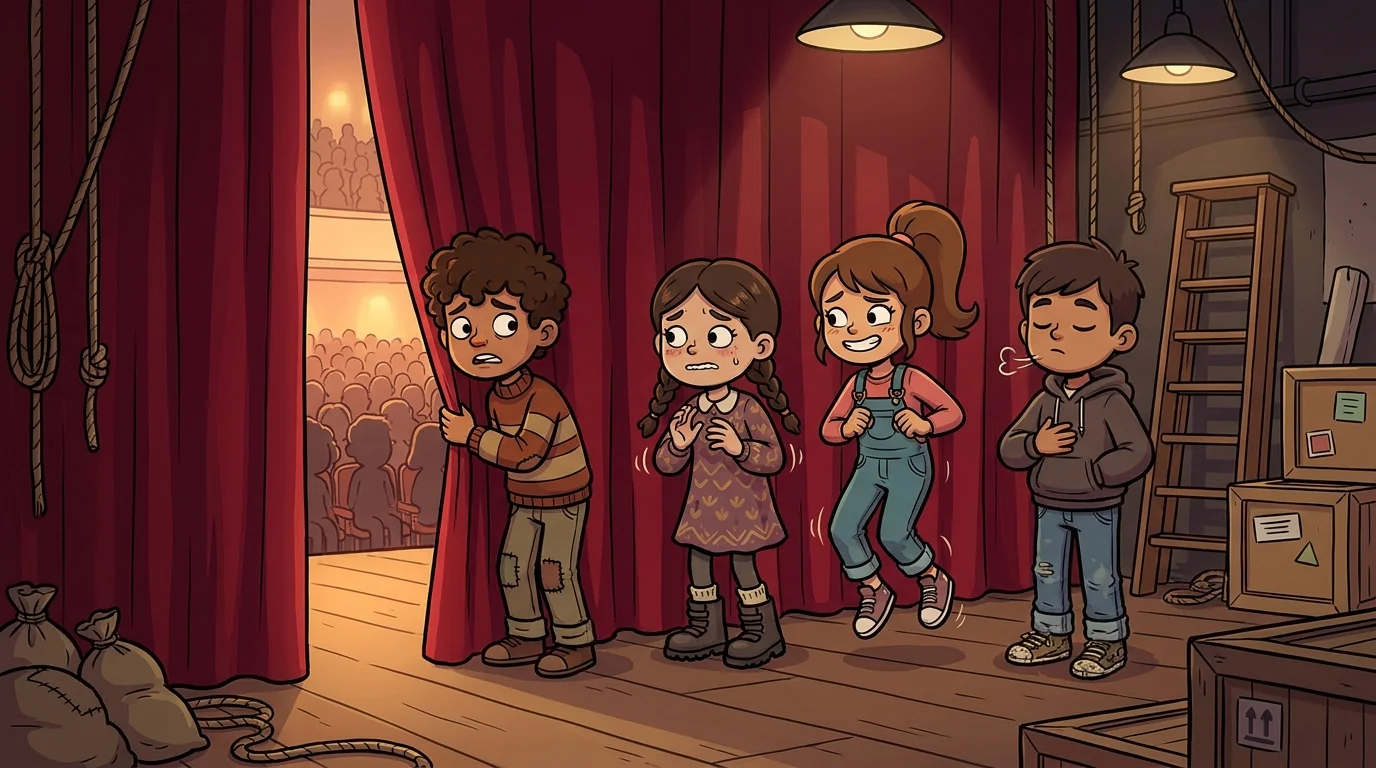
The curtain was still down, but they could hear the room filling up on the other side of it — chairs scraping, voices layering, a whole audience gathering for the stage crew's very first show. Wendel peeked through the gap in the velvet and let it fall shut. "That is a lot of people," he said.
"That is a wonderful lot of people," Fiva corrected, though her hands were doing the little dance they did when she was nervous.
Elvi bounced on her toes. Dashel just breathed, slow, the way he did before a race. Nobody said the quiet thing they were all thinking, which was: what if I freeze out there?
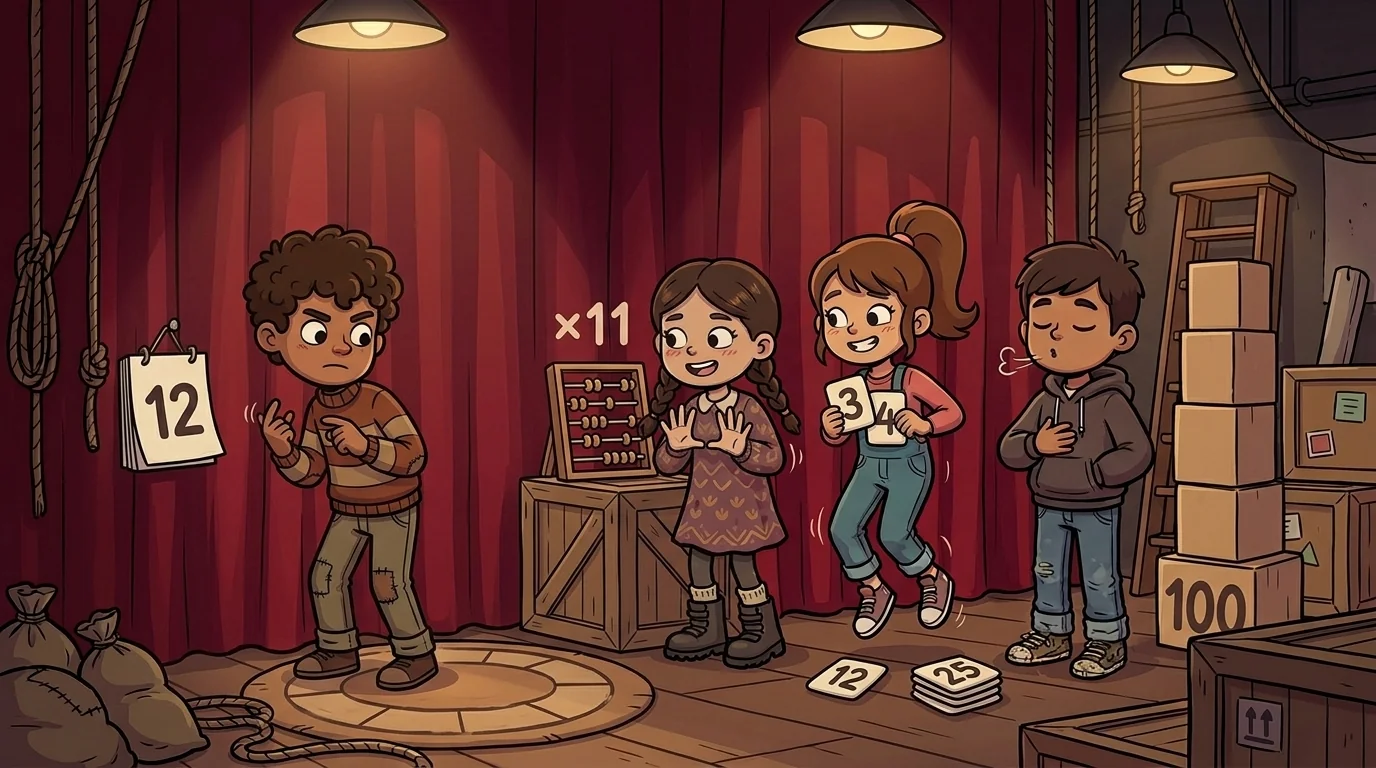
Behind the curtain they ran the act one last time, the way they'd rehearsed it — four routines braided into a single show, each of them carrying one.
Wendel went first, because Wendel loved a date. "Somebody shouts a birthday, and I tell them the day of the week," he said. "I don't memorize a calendar. I anchor the year's doomsday, then I just step — by sevens — until I land on the date. Weekdays go around and around by sevens, so I never fall off." He'd worn a groove in that idea; it felt like walking a path he knew in the dark.
Elvi's routine was the ×11 flash. "Give me any two-digit number and I times it by eleven before you finish asking. Twenty-three?" She mimed prying the 2 and the 3 apart. "I open a gap between the digits, add them — five — and drop it in the middle. Two, five, three. Two-fifty-three." She grinned. "It's not fast fingers. It's that eleven copies a number into itself, shifted, so the middle is just the sum of the neighbors."
Fiva squared numbers that ended in five. "Thirty-five times thirty-five? I round the 3 up to its friendly partner — three times four is twelve — and every one of these ends in twenty-five. Twelve twenty-five. Always. Because a number ending in five is sitting exactly between two easy neighbors, and the pair of them do the heavy lifting."
Dashel went last, and Dashel raced the calculator. "Add me two big numbers. I answer from the big end first, out loud, so the answer's already mostly true before the machine has carried a single digit."

The curtain went up.
For one held breath, the light was blinding and the room was a wall of faces, and every one of them felt the freeze coming — the blank, white what-was-my-first-line dread.
Then Wendel heard someone call out a date, the way people always did, and his feet found the path. Anchor the doomsday. Step by sevens. He landed on the weekday and said it before he'd decided to, and the room gasped, and the freeze melted into something warm and loud.
After that they were just doing the thing they knew. Elvi caught a number out of the air and split it open. Fiva took a five and folded it into its friendly pair. The methods held them up like a floor they'd built themselves and then forgotten was under their feet.

Near the end, a small voice from the front row — a kid, gripping the edge of their seat — said, "But what if you get one wrong?"
The crew glanced at each other. It was the question under all the nerves.
Dashel crouched at the stage edge. "Here's the secret," he said, not performing now, just talking. "None of us is guessing out here. Wendel isn't hoping the weekday is right — the sevens make it right. Elvi isn't lucky — eleven always copies the number that way. Fiva's fives always land on twenty-five. I'm not fast, I just start where the answer is biggest." He tapped the stage. "The tricks work by themselves. We just have to trust the method enough to say it out loud."
The kid thought about that. "So the nervous part isn't about being right."
"The nervous part is just the lights," Fiva said gently. "The right part was decided back when we learned why each one works."

They took their bow to a room that clapped like a rainstorm. Backstage, still glowing, Elvi finally said the quiet thing out loud — "I thought I was going to freeze" — and everyone laughed, because they all had, for exactly one breath, and then their own trusted method had reached out and caught them.
"Four routines, one show," Wendel said, echoing the line they'd rehearsed. "Each of us led with the one we trust most."
And the act had held — not because they were fearless, but because every trick in it was self-working, and they'd known that all along.
The ShowMath ensemble
Wendel, Elvi, Fiva and Dashel is part of ShowMath's distributed-narrative cast. Each character embodies a different curricular primitive; together they teach the full subject.
-

Wendel
The Calendar-Keeper — anchors the year's doomsday and steps by sevens to name the weekday of any date
-

Elvi
The Eleven-Splitter — pries a number's digits apart and drops their sum into the gap (times-eleven shortcut)
-

Fiva
The Fives-Finisher — rounds a number ending in 5 to a friendly pair, then tacks on 25 to square it
-

Missa
The Missing-Digit Diviner — sums the shown digits and reads the hidden one as the shortfall to the next nine (casting out nines)
-

Squarl
The Squaring-Bouncer — bounces to the nearest round number and back to square any number in her head
-

Dashel
The Left-to-Right Racer — answers biggest-place-first, out loud, before the calculator finishes
-

Magda
The Magic-Square Weaver — seeds a four-by-four square from a date so every row, column, and diagonal sums the same
-

Nabo
The 1089 Conjurer — reverses, subtracts, reverses, adds, and always lands on 1089
-

Halvra
The Double-and-Halver — doubles one factor and halves the other until multiplying is easy
-

Modo
The Clock-Winder — wraps numbers around a clock of any size, the engine under the calendar and missing-digit tricks
-

Marlow
The Stage Manager (mentor) — a warm, attentive adult who coaches rehearse-then-perform and reveal-the-secret, and never performs for the kid