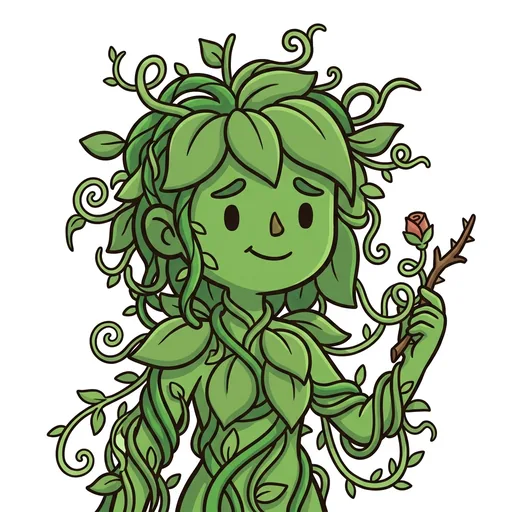
Sprawl
One piece that helps the next, that helps the next
Loading audio…
Press play to listen along. The line being read lights up as you go.
Show full transcript
Loading transcript…
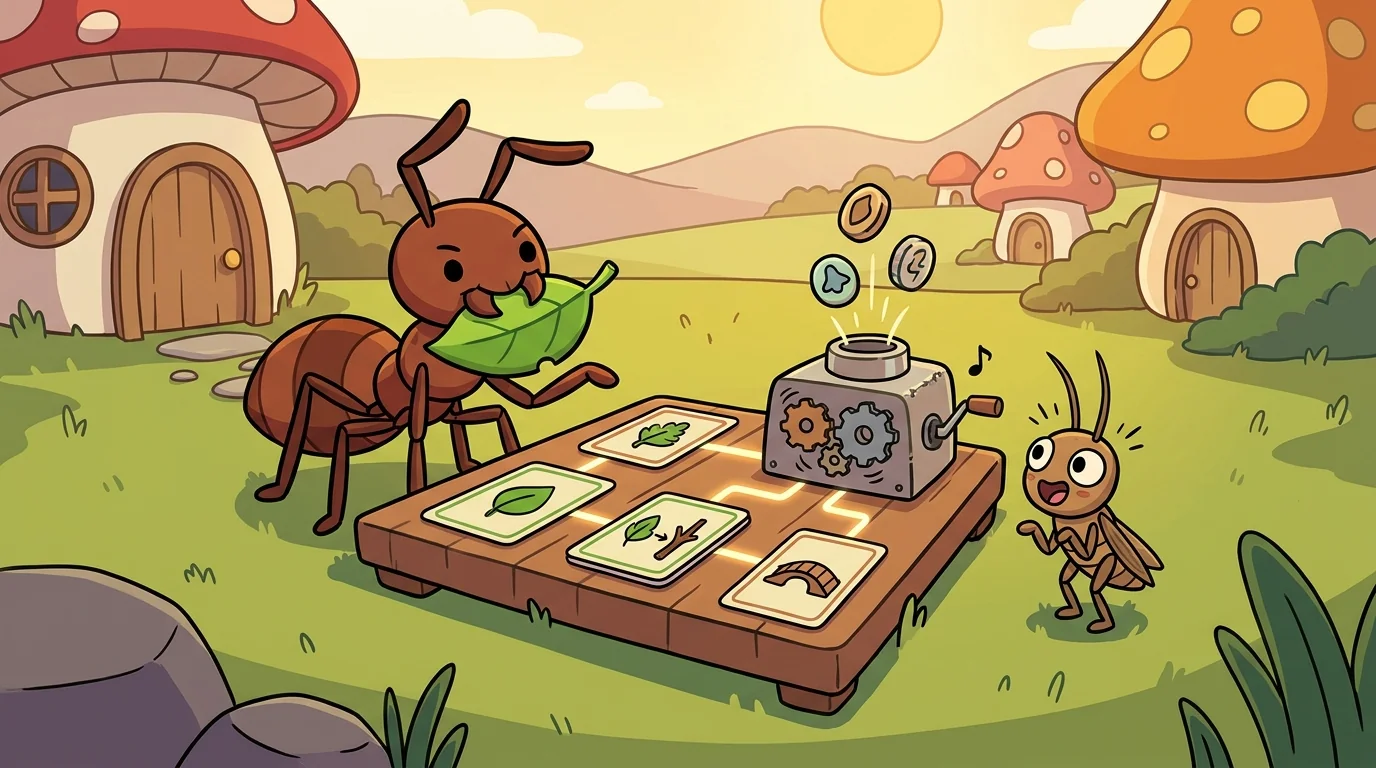
At the edge of the meadow-village, a leafcutter ant stood proudly beside a game where a few small tokens had, over several turns, become a humming little machine of parts that fed each other.
Sprawl was round and sturdy, forever carrying a leaf in her jaws, and she loved nothing more than a system that grew. On the board sat her game: a first card that gave you a leaf each turn, a second that turned two leaves into a twig, a third that turned twigs into a bridge — each new piece making the ones before it worth more. "Watch," she told a young cricket. "One card does a little. But the next card USES what the first one makes. And the third uses THAT." She ran a turn, and the little machine clicked: leaf, twig, bridge, and the outputs kept climbing.
The cricket's antennae quivered. "It's... growing on its own."
"Because every piece feeds the next," Sprawl said, delighted. "That's an engine. You don't just DO things each turn — you BUILD a thing that does more things for you, and it grows." She set another card down and the whole machine sped up. "One piece that helps the next, that helps the next. A good engine grows itself."
Sprawl had learned about building-that-builds when she was small.
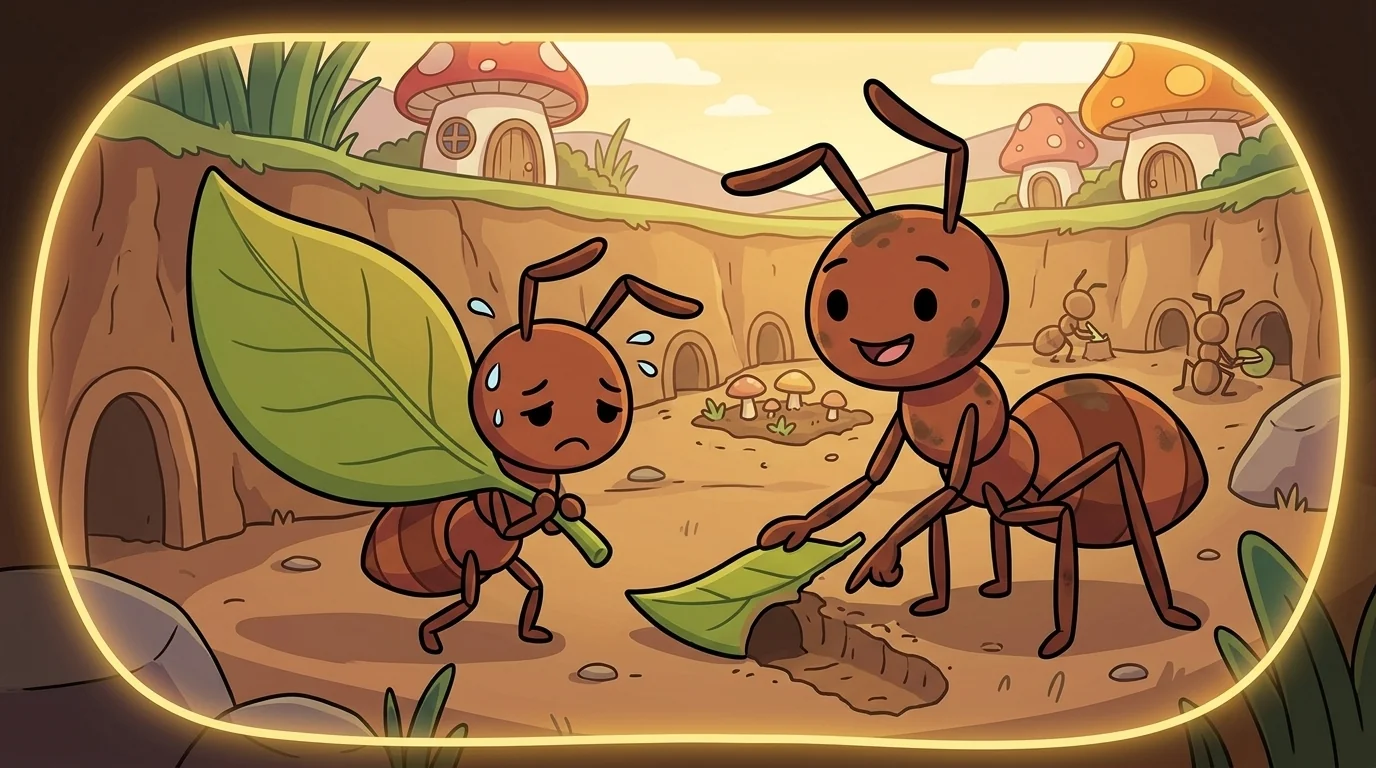
She grew up in a young colony, where her family were the system-makers — ants who built the tunnels and gardens that fed everyone. But little Sprawl, watching the grown ants, thought big things had to be built big — all at once, in one heroic effort — and she'd try to haul an enormous load alone, exhaust herself, and quit, sure she was too small to build anything that mattered.
Her aunt, dusty and unbothered, set down her own leaf beside her one morning. "You keep trying to build the whole thing in one go," she said. "But nothing big is built big. It's built SMALL — one piece that makes the next piece easier, over and over." She pointed down a tunnel. "See? One ant dug a little. That made room for the next to dig further. That fed a garden that fed more diggers. Nobody built the colony. The colony built itself, one small helpful piece at a time."
Sprawl stopped trying to haul the whole load alone. She laid down one small piece — a short tunnel — that made the next piece easier, and that one made the next. Soon a system was growing that she could never have built in one heave. The too-small, worn-out feeling lifted into a warm, humming pride. She wasn't too small. She'd just been trying to build big instead of building small-that-grows.
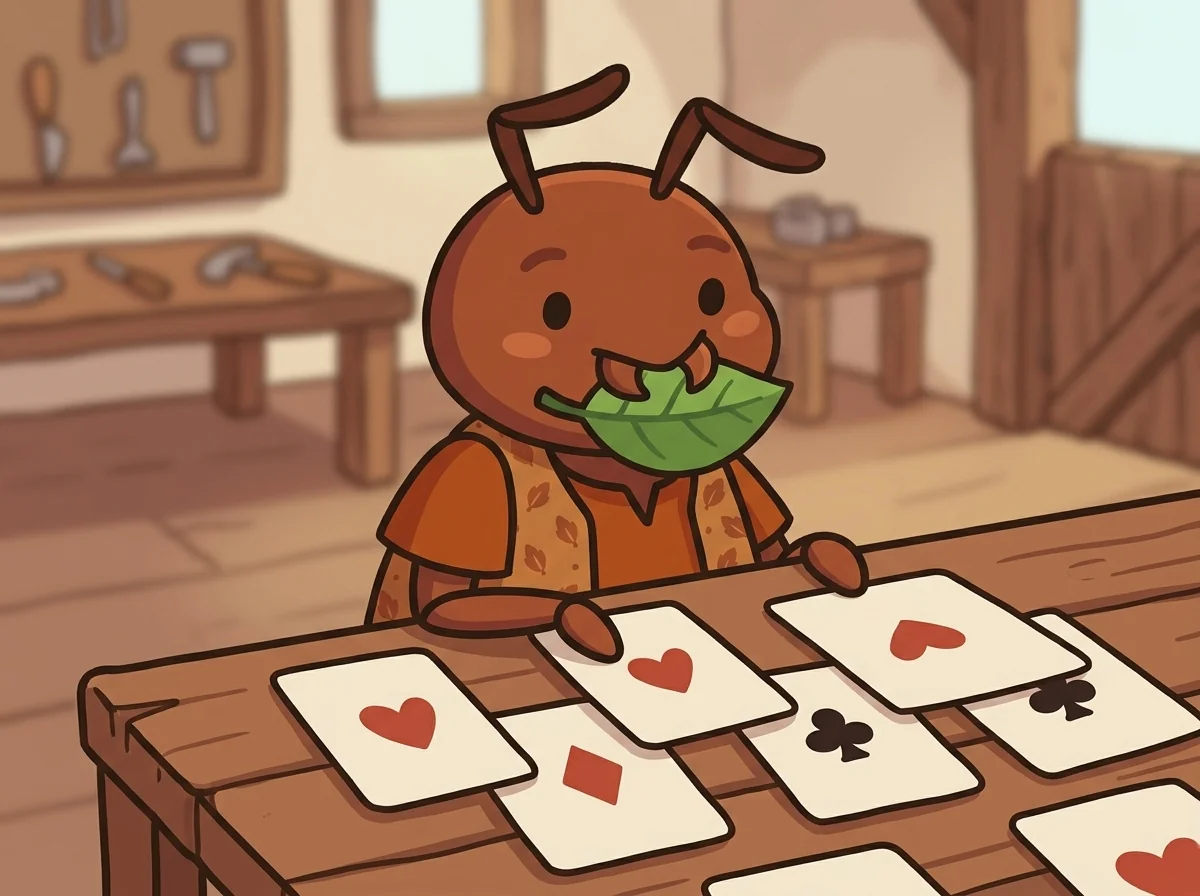
She trundled up to TableForge at twelve, because a place that studied how games were built ought to understand the thing she loved: pieces that feed each other.
Blueprint, the old mentor, met her at the gate and asked one question. "What makes building a thing, inside a game, feel good?"
Sprawl didn't answer with words. She laid out a few cards where the first fed the second and the second fed the third, and played a few turns. The little engine grew, each turn producing more than the last, and by the end it hummed. "There," she said. "You didn't just take actions. You built a machine that makes the actions for you, and it got bigger the more you fed it."
Blueprint watched the engine climb. "The player's reward is the thing they built," he said.
"The growing IS the fun," Sprawl said. "Each piece makes the last ones better. That click when it all connects — that's the whole joy of it." She hefted her leaf.
Blueprint looked at the humming little engine. "You belong here," he said.
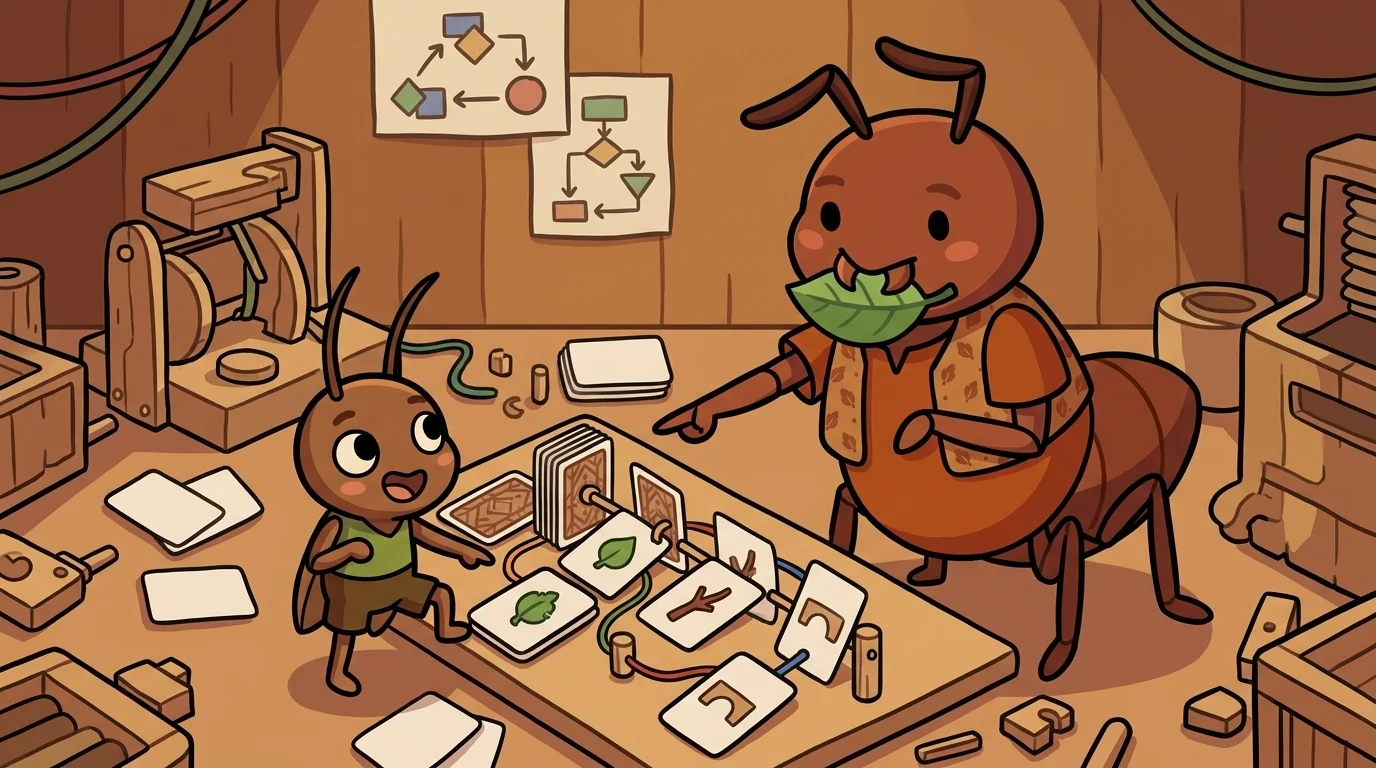
Sprawl's workshop was full of half-built machines, and one afternoon a kid came in stuck on a game they'd made.
"You just take stuff each turn," they said, "and it never adds up to anything. Turn one feels the same as turn ten. It's boring, and I don't know how to make it feel like it's GOING somewhere."
Sprawl knew that flat, going-nowhere feeling. She'd tried to build big and burned out once.
"Your pieces don't talk to each other," Sprawl said. "Right now each one just... does its own thing and stops." She looked at the game. "What if THIS card made THAT card better? What if the thing you get on turn one helps you get more on turn two?" She rewired three cards so each fed the next. "Now play it."
The kid played, and this time turn one set up turn two, which powered turn three, and by turn five the little engine was humming — each turn produced more because of what they'd built before. "Oh," they said, eyes wide, playing faster. "It's SNOWBALLING. Everything I did earlier is helping me now."
"That's the whole secret," Sprawl said. "You don't make a game feel like it's going somewhere by adding more separate stuff. You make the pieces feed each other, so a small start grows itself into something big. Build small-that-grows."
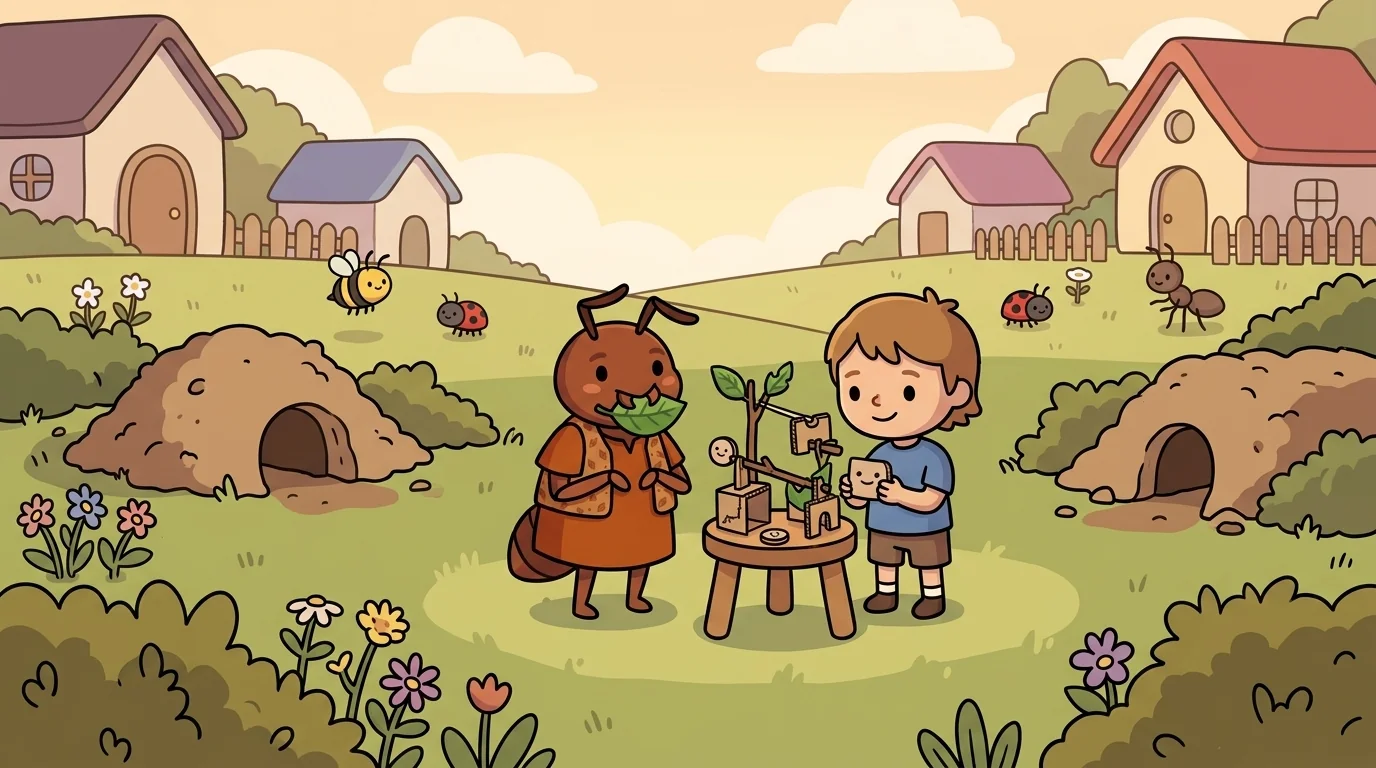
Later, when the machines had gone quiet, the kid came back with their humming game.
"When you connect the pieces like that," they said, "how do you know it won't just grow out of control?"
Sprawl thought about the colony that built itself, one small tunnel at a time.
"You watch the growing and you feel it," she said. "Too little feeding, and it stays flat — turn ten is turn one, nothing builds, and your chest goes dull. Too much, and it grows so fast it breaks the game. But when it's just right, there's this rising hum — each turn a little bigger because of the last, a click, click, click as the pieces connect — and you can feel the whole thing coming alive under your hands." She lifted her leaf, content. "That rising hum is the engine breathing. That's how you know."
The kid nodded, and Sprawl watched the going-nowhere flatness lift off them — the same warm, humming pride that had grown in her, long ago, when she stopped trying to build big and learned to build small-that-grows. They stood in the meadow light, both of them a little more alive, glad that the best things, in a game or a colony, are the ones that grow themselves.
Hear it as an audio drama
A short play starring Sprawl, from TableForge. Different voices, same idea. Listen any time after you read.
Loading audio…
Read the drama script
- Narrator: From Spark and Anvil and TableForge — this is Sprawl, in chapter 1 of the TableForge cast.
- Narrator: This drama uses an AI-generated voice. Voiced via Gemini 2.5.
- Narrator: Sprawl designs the deep, satisfying kind of game — the sort where your early moves quietly power up your later ones. Sprawl calls it building an engine.
- Sprawl: The best feeling in a game is when one piece helps the next, which helps the next. You set something up, and three turns later it's paying off in a chain you built yourself. That's an engine — and a good engine grows itself. Each part makes the other parts stronger.
- Narrator: An engine — pieces that feed each other, so your plan snowballs.
- Sprawl: I design pieces that COMBINE. This card gives you coins; that one turns coins into gears; a third turns gears into points. Alone, each is small. Together, they form a machine YOU assembled. The joy isn't any single piece — it's watching the whole thing click into motion.
- Narrator: Sprawl once made a game where every piece stood totally alone.
- Sprawl: Each card did its own thing and never talked to the others. Players just picked the biggest number each turn. It was fine — and completely forgettable. There was nothing to BUILD, no combo to discover, no "aha, if I get this AND that..." Just a pile of separate little actions.
- Narrator: So now Sprawl designs for connection.
- Sprawl: For each piece I ask: what does this make BETTER? If the answer is "nothing," it's an island, and islands are boring. When pieces feed each other, players stop picking the biggest number and start dreaming up combos. That's when a game gets deep.
- Narrator: A designer's cards each did their own isolated thing.
- Sprawl: See how no card cares about any other card? Make this one BOOST that one. Now a player who grabs both feels clever — they built a little machine. Suddenly they're planning three turns ahead instead of just grabbing.
- Narrator: The designer linked the pieces, and playtesters started gasping "wait, if I combine these—" and scheming turns in advance.
- Sprawl: One piece that helps the next, that helps the next. Let your pieces feed each other, and the engine grows itself.
- Narrator: You've been listening to a Spark and Anvil chapter, written by the Spark and Anvil writing team for ages 9 to 14.
- Narrator: Apps stay free forever.
- Narrator: Curriculum aligned to Common Core and Next Generation Science Standards.
- Narrator: Released under Creative Commons BY-NC-SA 4.0 for educational reuse. Visit Spark and Anvil for the full transcript.
The TableForge ensemble
Sprawl is one of the friends in TableForge. Each friend shows you one idea by how they act; meet them all and you have the whole subject.
-
Primer
Onboarding / a game that teaches itself
-

Bones
Dice + randomness + probability — chance is part of game design — it is about fun and fairness, never betting
-

Hand
Cards + hidden information — what-you-HOLD is information; what-you-SHOW is a different question
-

Move
Turn-structure + action economy — every turn is a question and an answer; turn-as-question framing
-
Poise
Balance / no single strategy dominates
-

Swing
Feedback loops / keeping the game close
-

Meddle
Player interaction / how players affect each other
-

Trial
Playtest + iteration — what-they-DID matters more than what-they-SAID; first-playtest-supposed-to-fail framing
-
Theme
Game-mechanic + theme integration — the-game-IS-its-mechanics; Habgood intrinsic-integration anchor; theme-MUST-do-work framing