
Otis
GROWTH REFRAME — turn "I'm bad at this" into "not yet — my brain is building the pathway"; treat mistakes as the sound of learning
Loading audio…
Press play to listen along. The line being read lights up as you go.
Show full transcript
Loading transcript…

At Lantern House there was a young bear named Otis — big and slow and gentle — and his was the kindest job in the whole building: he watched over the exact moment a child decides they are simply bad at this, and he taught them, patiently, that the moment is a lie.
Otis knew that feeling from the inside, which was why the children trusted him with it. He knew how a single mistake could swell up huge and hot in your chest until it stopped feeling like a mistake and started feeling like evidence — proof that you weren't clever enough, that everyone else understood and you never would, that the wise thing would be to stop now, before you embarrassed yourself any further. That feeling could end a child's learning in a single instant. Not because they couldn't do the thing — but because the feeling told them, convincingly, not to try.
"That feeling is real," Otis would say, in his low, warm rumble. "I'm not going to pretend you don't feel it. But feeling real and being true are two different things. That feeling is just fear, wearing the costume of a fact."
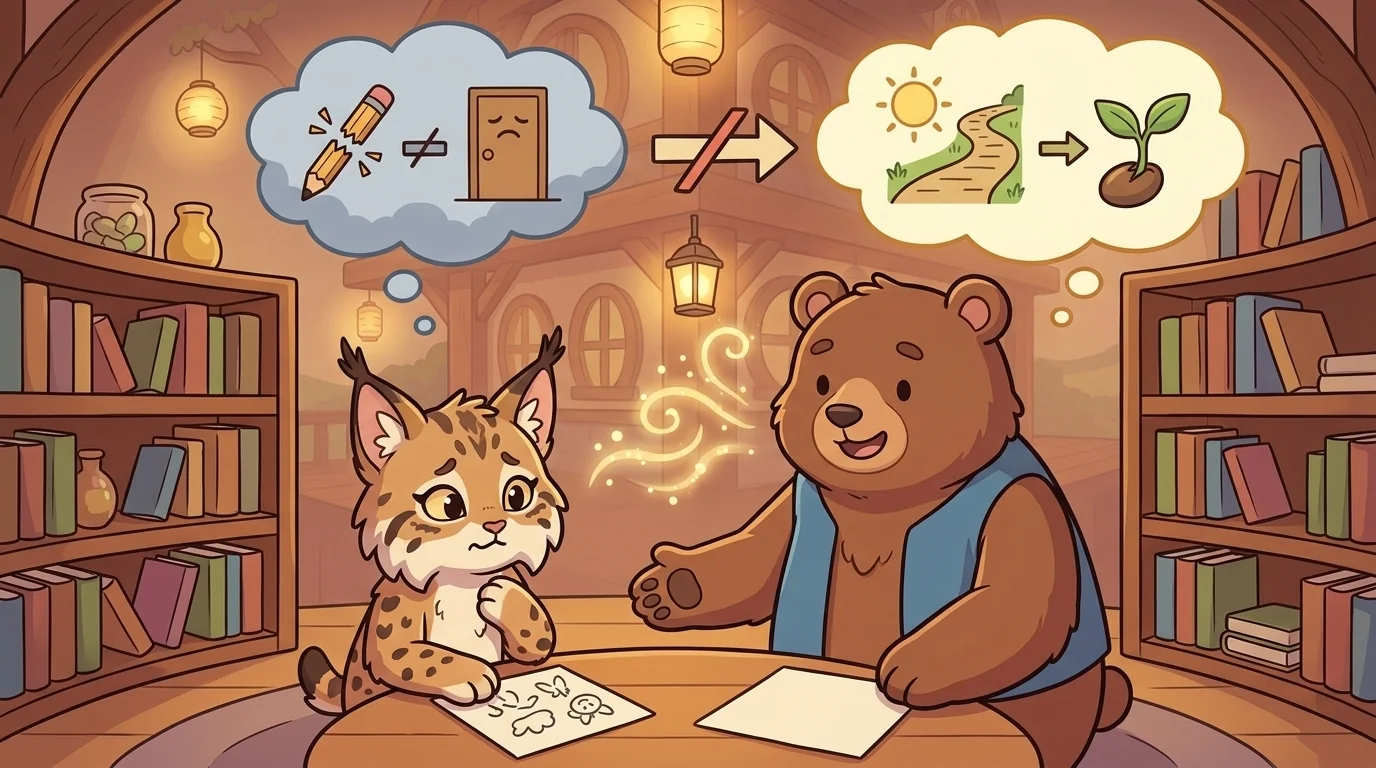
A young lynx named Bea got one thing wrong — a single thing — and Otis watched the whole storm cross her face: the flush, the sting, the fast-swelling certainty that this was proof of something permanent.
"I'm just bad at this," she said, already shoving her things into a pile. "I don't get it, I'm never going to get it, and I quit."
Otis didn't argue. He didn't say no you're not — because Bea would not have believed a word of it, and being argued with only ever makes the feeling dig its claws in deeper.
He lowered himself down beside her instead, big and calm and unhurried, and said, "Can I show you the smallest trick in all of Lantern House? It's a single word. You just said, I'm bad at this. Say it one more time — but hang one word off the very end of it. Say: I'm bad at this... yet."
Bea rolled her eyes. But she said it. "I'm bad at this... yet."
And something in her chest, wound tight a second ago, loosened by a fraction.

"Feel that?" said Otis, gently. "Bad at this is a locked door — it tells you this is simply how you are, permanently, with nothing to be done about it. But bad at this yet is a door with a handle on it. It says: not there right now. On the way. Still building. And here's the part that matters most — that version happens to be the literally true one. Because while you struggle, your brain is building the pathway, physically, cell by cell. And every mistake you make is the sound of it building."
"A mistake is... a good thing?" said Bea, deeply unconvinced.
"A mistake is your brain finding the exact edge of what you already know," said Otis. "And that edge is the only place where learning ever happens. Someone making mistakes is someone learning. Someone making none at all is only doing something too easy to grow from. So when you got that one wrong just now — that wasn't proof you're bad at this. That was the sound of the path being built under you. I would stake anything on it."

Otis taught Bea to catch the storm before it swept her out of her chair. The instant she heard the old thought — I'm bad at this — she would add the single word, yet, and then say out loud what she'd actually learned from the mistake, plainly, with no shame folded into it. Not I'm stupid, but okay — I mixed up these two things; now I know to check that one. The mistake became a piece of information instead of a verdict handed down about her.
The storms grew smaller after that. They never vanished — Otis was scrupulously honest that they never fully do, for anyone. "But you are not required to obey the feeling," he said. "You can feel the whole thing, add your one word, and keep going anyway. That is the bravest act performed in this house — and it isn't being fearless. It's being scared, adding yet, and staying in the chair."
Bea stayed in the chair. And the thing she had been so sure she was bad at — she wasn't, a few weeks on. She was simply someone who had said yet enough times to finish building the path.

Metis watched Otis catch a child at the very lip of quitting and gently turn her back around, and blinked her slow silver blink.
"You guard the one moment the other coaches can't reach," she said. "The moment a learner decides to stop."
"Every clever skill in this house is worthless," said Otis, "if a child walks away certain they can't. My whole job is to make sure they never walk away believing that — because everything the others teach only works on someone still sitting in the chair."
And that evening, when Metis asked what had worked, Bea answered — still in her chair, which was the entire point:
"When I catch myself thinking 'I'm bad at this,' I add one word — 'not yet.' A mistake isn't proof I'm bad. It's my brain building the path."
The TutorForge ensemble
Otis is part of TutorForge's distributed-narrative cast. Each character embodies a different curricular primitive; together they teach the full subject.
-

Metis
Metacognition — plans before a task and reflects after (the mentor who orchestrates the coaches)
-

Wade
Preview — skims the headings and turns each into a question before reading
-

Pilar
Planning & chunking — breaks a big task into small stepping-stones, one at a time
-
Spry
Focus & brain-breaks — works in short focused sprints, then a real movement break
-

Cael
Self-explanation — asks 'but why does that work?' and answers in his own words
-

Rune
Elaboration — ties each new idea to something he already knows
-

Lumi
Concrete examples — turns a fuzzy idea into a real example you can picture
-

Indie
Dual coding — draws a quick picture so words and images work together
-

Mnemo
Mnemonics — turns a hard fact into a silly rhyme or picture you can't forget
-

Reeva
Retrieval practice — closes the book and recalls from memory before peeking
-

Halcyon
Spaced practice — spreads studying across days instead of cramming the night before
-

Tovi
Interleaving — mixes different problem types instead of drilling one kind