
Wade and Cael
ACTIVE READING — Wade (ask questions before you read) + Cael (explain "why" after) — together, reading becomes an investigation
A story read by Wade and Cael
Loading audio…
Press play to listen along. The line being read lights up as you go.
Show full transcript
Loading transcript…

Wade the otter and Cael the marten each had a way of reading, and for a while — the way skilled people sometimes do — they were quietly certain they were rivals.
Wade read from the front of a task: before he'd let himself dive in, he skimmed every heading and turned each one into a question, so that his brain went in already hunting for something specific. Cael read from the back of every idea: after each part, he stopped and asked "but why does that actually work?" — and made himself answer it in his own plain words before moving on.
A young dormouse named Sef watched the two of them argue amiably about whose way was the better one, and finally, a little exasperated, said: "Why don't you just... do both? One of you goes before, one of you goes after. That isn't a fight over the same spot. That's the two opposite ends of the same reading."

Wade and Cael looked at each other, both a little sheepish, both realising he was completely right.
"He's got it exactly," said Cael, slowly. "You set up the questions going in. I answer them coming back out. We were never actually competing — we were standing at the two ends of one thing. We're the two halves of reading like a detective."
"A detective!" said Wade, lighting up, because he loved a good frame more than almost anything. "Yes — that's it precisely. A real detective doesn't just wander into a room and hope she happens to notice something useful. First she asks, before she even steps in: what am I actually looking for here? That's me — the questions, before. And then, the moment she finds a clue, she stops and asks: what does this mean? why does it matter? That's you — the why, after."
"Passive reading," said Cael, "is walking straight through the room with your eyes glazed over, hoping something sticks to you as you pass. Detective reading is walking in already carrying your questions — and then stopping dead at every single clue to work out what it's telling you."

So they taught Sef the case together, in two clean halves. Before he read a page: Wade's step — skim all the headings, turn each into a question. "Where does this begin? What causes that? Why does this part even matter?" Now Sef walked in with a detective's list of exactly what to look for, instead of an empty stare.
During and after each part: Cael's step — the instant he struck an answer to one of his own questions, he stopped and explained it back in his own words. "Okay — so it works because..." Not the book's phrasing, which he could parrot without understanding; his own, the way a good detective says a clue out loud to be sure she truly grasps what she's holding.
"The before-questions are what make you notice the clues at all," said Wade. "You physically cannot miss the answer to a question you're actively out hunting for — your brain snaps to it."
"And the after-why is what makes the clues mean something," said Cael. "A clue you can't explain is just a thing you happened to see and will forget by morning. A clue you can explain, in your own words, is one you actually understand — and understanding is the part that stays."
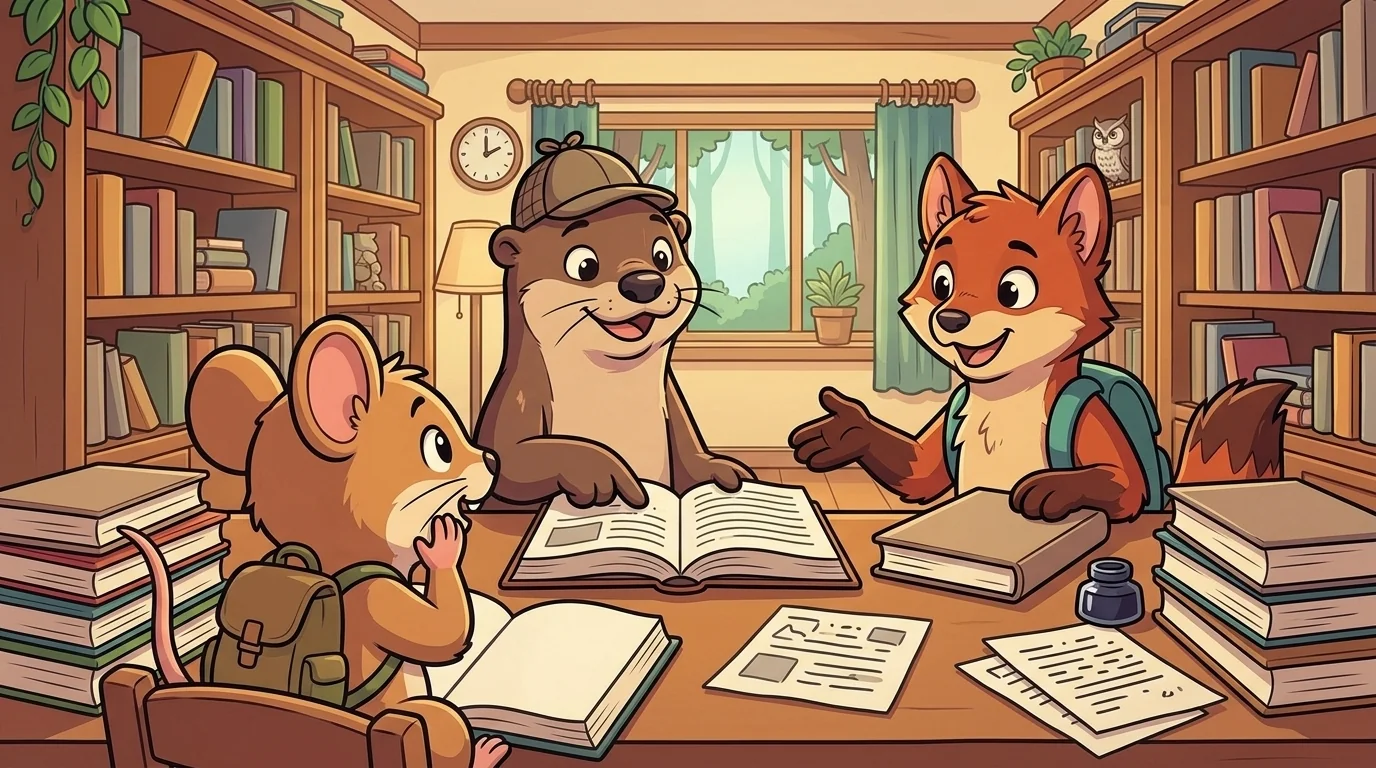
Sef read his next hard page like a genuine case to crack. He waded in first, turning every heading into a question. Then he read, hunting — and every single answer landed, hard and satisfying, because he'd been lying in wait for it the whole time. And after each one he explained the why in his own words, and watched it turn from a thing-he'd-merely-seen into a thing-he-actually-got.
It didn't take a minute longer than his old glazed-over reading had taken. It simply worked, where the old way had quietly never worked at all. And — to his genuine surprise — it was fun, because a hunt is always more fun than a slog, and a case is always more fun than a chore.
"I actually remember the entire thing," Sef said, amazed at himself. "And I understand it, too. Before, I'd read a whole page and remember nothing at all. This time I cracked it."
"Because you read it like a detective," said Wade and Cael, together, "instead of a tourist."
Metis watched the otter and the marten teach the two ends of one single skill, and blinked her slow silver blink.

"One of you opens the case," she said. "One of you closes it. And between the two of you, nothing gets read passively in this house ever again."
"Reading was never something you receive," said Cael. "It's something you do," finished Wade. "Ask your questions going in. Explain the answers coming out. That — start to finish — is the whole case."
And that evening, when Metis asked what had worked, Sef answered like a detective snapping shut a solved file:
"I ask questions before I read, then explain the answers in my own words after. That turns reading into detective work — I notice the clues AND understand them."
Ensemble note Members: Wade (preview / question-first) + Cael (self-explanation / why-after) — the pair-edge that forms active reading. The Advanced tier deepens the edge: the before-question makes you notice the clue (primed attention), the after-why makes the clue mean something (understanding that stays), and the detective frame supplies the motivation a slog lacks. Two ends of one skill, never rivals.
The TutorForge ensemble
Wade and Cael is part of TutorForge's distributed-narrative cast. Each character embodies a different curricular primitive; together they teach the full subject.
-

Metis
Metacognition — plans before a task and reflects after (the mentor who orchestrates the coaches)
-

Wade
Preview — skims the headings and turns each into a question before reading
-

Pilar
Planning & chunking — breaks a big task into small stepping-stones, one at a time
-
Spry
Focus & brain-breaks — works in short focused sprints, then a real movement break
-

Cael
Self-explanation — asks 'but why does that work?' and answers in his own words
-

Rune
Elaboration — ties each new idea to something he already knows
-

Lumi
Concrete examples — turns a fuzzy idea into a real example you can picture
-

Indie
Dual coding — draws a quick picture so words and images work together
-

Mnemo
Mnemonics — turns a hard fact into a silly rhyme or picture you can't forget
-

Reeva
Retrieval practice — closes the book and recalls from memory before peeking
-

Halcyon
Spaced practice — spreads studying across days instead of cramming the night before
-

Tovi
Interleaving — mixes different problem types instead of drilling one kind
-

Otis
Growth reframe — turns 'I'm bad at this' into 'not yet' (anti-shame, RSD-safe)