
Spry
FOCUS SPRINTS — work in short, fully-focused bursts, then take a real movement break, then return
Loading audio…
Press play to listen along. The line being read lights up as you go.
Show full transcript
Loading transcript…
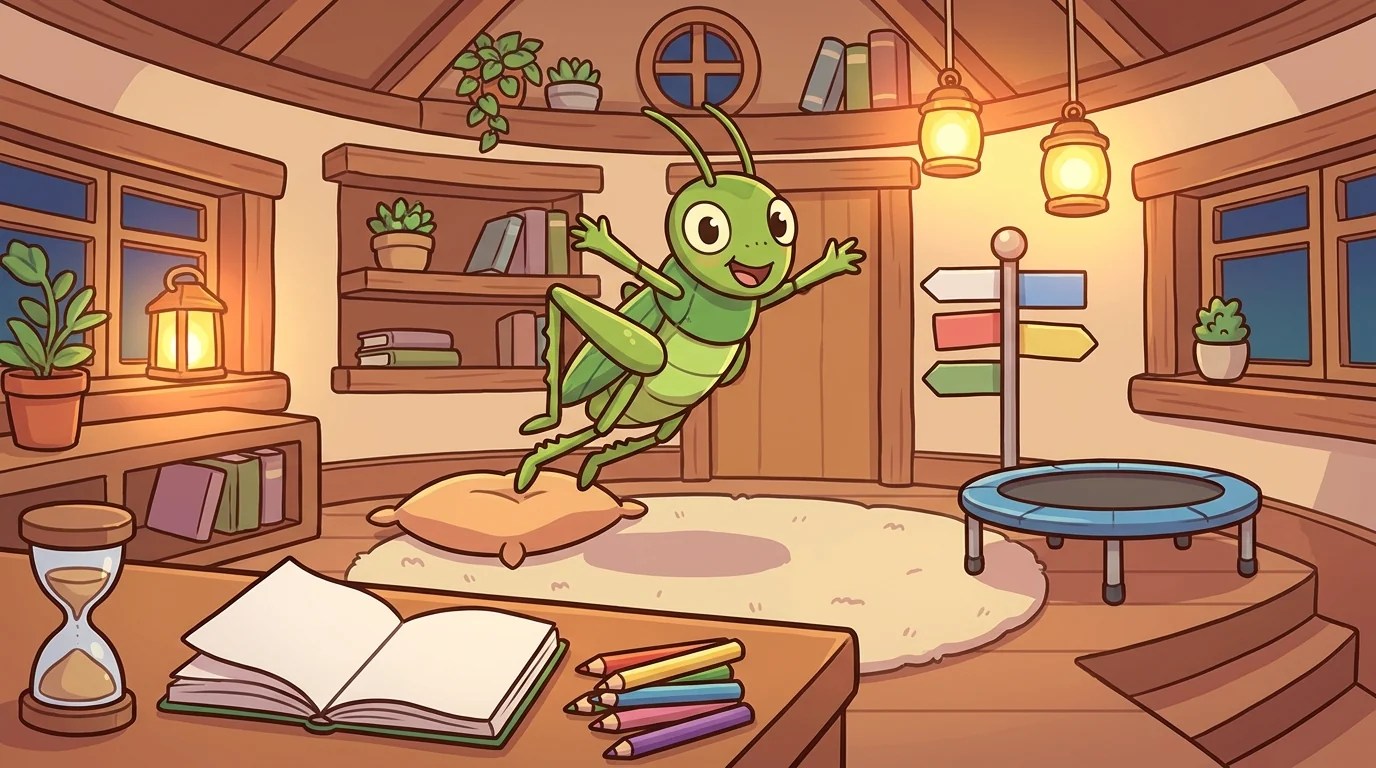
At Lantern House there was a young grasshopper named Spry who genuinely could not sit still for very long — and who had, rather cleverly, turned that into a gift instead of treating it as a fault.
Spry had learned something the hard, foggy way: a brain is not a machine you can simply leave switched on and running all day long. It behaves much more like a muscle. It can sprint hard for a short while — truly hard, truly focused, everything switched on — and then it needs to rest, or it will quietly fog over and go on sitting there, pretending to work, while absolutely nothing goes in. The sitting looks like studying from the outside. Inside, it's just fog.
"So don't waste your afternoon fighting your own brain," Spry said, already half-bouncing. "Sprint, then spring."
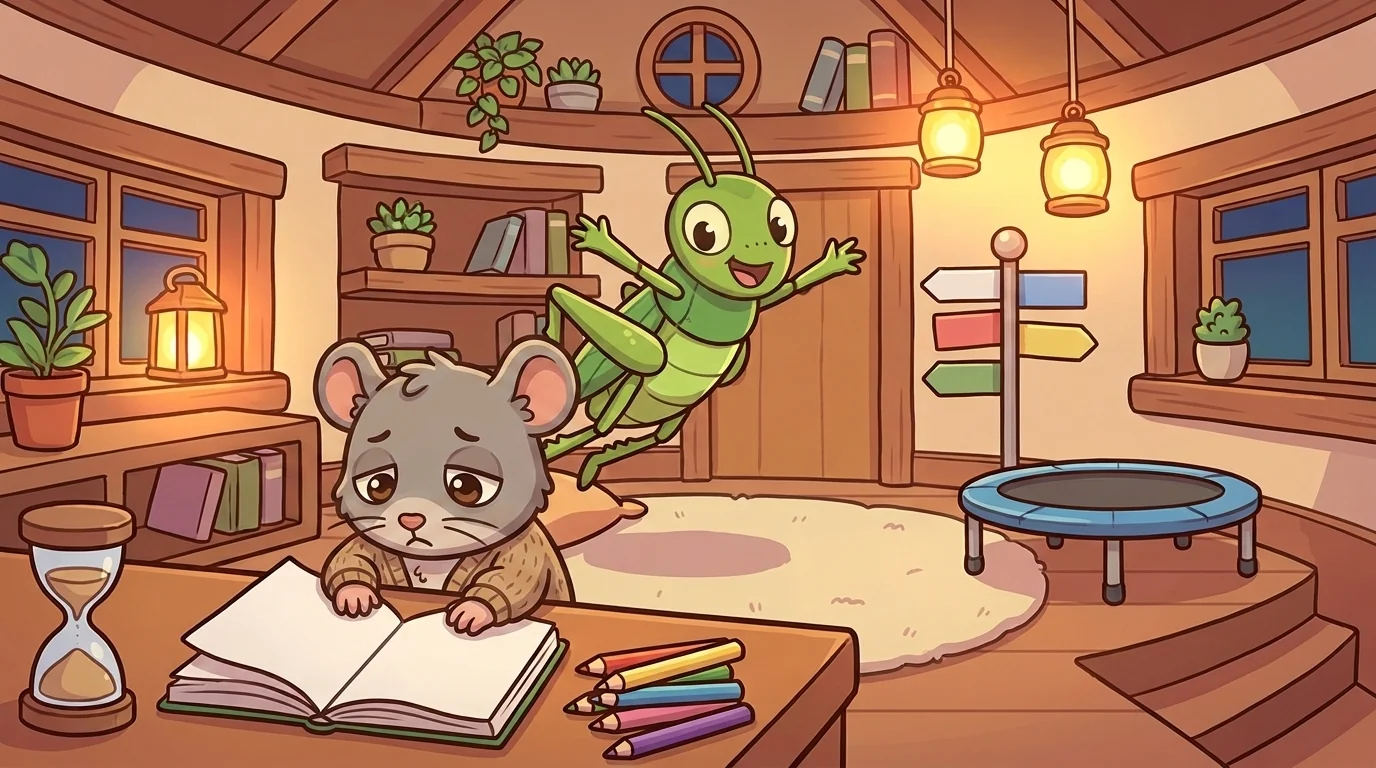
A dormouse named Nell was determined to study the proper way, which she had decided meant sitting perfectly still at her desk for one unbroken hour without moving a whisker. She lasted about twenty minutes. After that her eyes kept sliding off the page, she read the very same sentence four times running without a word of it landing, and she felt guilty and tired and thoroughly stuck — and yet she made herself go on sitting there anyway, because stopping felt like weakness, like giving up.
Spry found her there, glazed over, going precisely nowhere.
"How long have you been at this?" he asked.
"An hour," Nell said miserably. "And I've barely learned a thing. I'm just... foggy. It's not working and I don't know why."
"You've been at it an hour," said Spry gently, "but you only actually studied for the first twenty minutes. The other forty, you sat still and felt bad next to an open book. That last part isn't studying — it's just suffering, in a chair, near some pages."

"Here's the whole deal," said Spry, and his entire body seemed to bounce with the plan. "You do a sprint — a short one. Fifteen, maybe twenty minutes, fully focused, no wandering off, no glancing at anything else — everything you've got, poured into that one short stretch. Then, the instant the sprint is done —" he sprang straight up into the air — "you spring. You get up. You move your body. Walk, stretch, fetch water, look out the window at something far away. A real break — five minutes, actually moving."
"And then?" said Nell.
"Then you sit back down and do another sprint. And your brain — the same brain that was solid fog a minute ago — is clear again, because you finally let it breathe. Two sharp sprints with a real break between them beats one long foggy hour every single time, and it isn't even close."
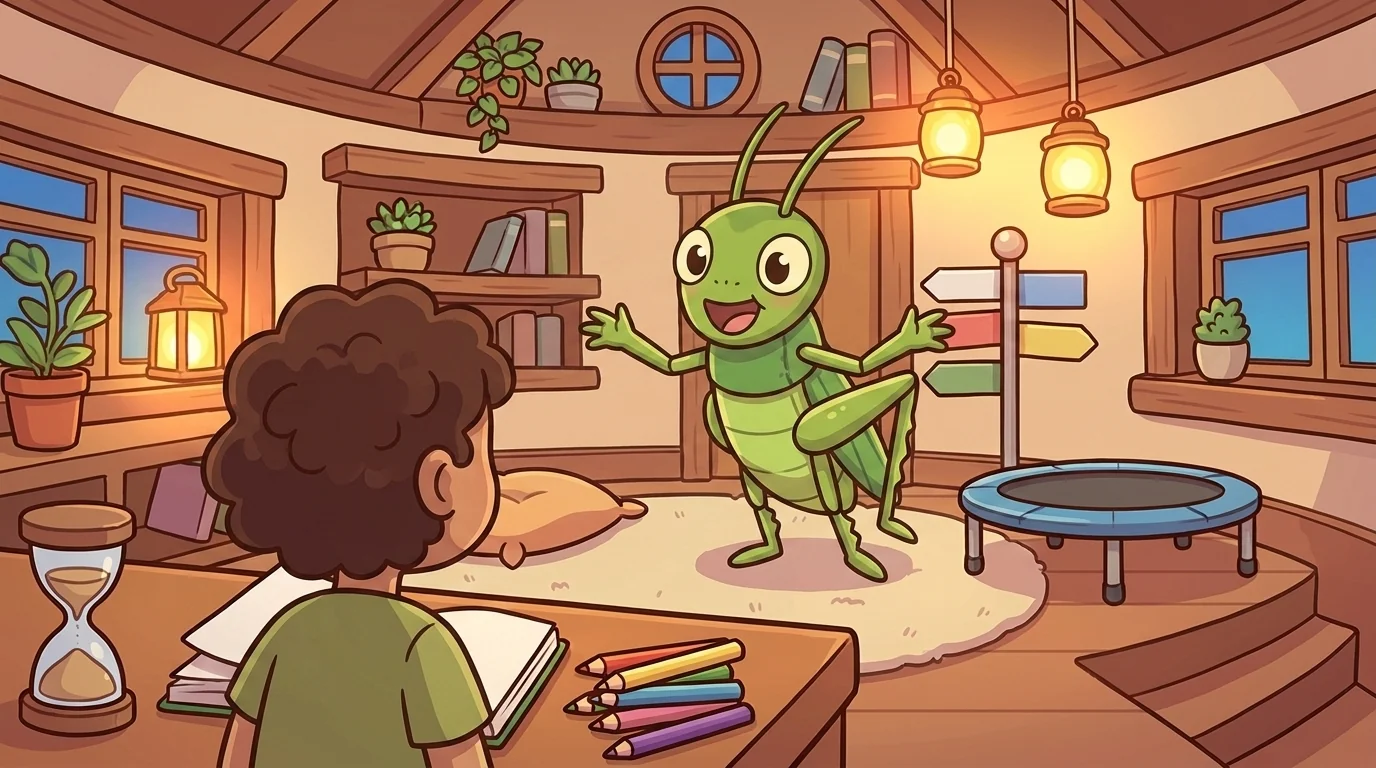
Nell tried it, more than half-convinced it was somehow cheating. Twenty minutes, full focus, phone left deliberately across the room. Then a genuine break: she stood, walked to the window, rolled her shoulders, drank some water, stared at the far hills for a little while and thought about nothing in particular.
When she sat back down, it was like a light clicking on. The fog had simply lifted. In the next sprint she learned more in twenty focused minutes than she had in the entire foggy hour before it — and the break, far from wasting her time, was the thing that had made the time work at all.
"The break is part of the studying," Spry told her, when she reported back amazed. "It isn't the enemy of it. Your brain does its quiet filing-away while you move around — that's when what you just learned actually gets put on the shelf. Skip the break and you skip the filing, and then it slides off before it's ever stored."
He was careful, though, about one thing, and he grinned as he said it. "The break has to end. That's the whole deal, the fine print. You spring up — but then you sprint again. A break that never ends isn't a break at all. It's just... a stop. The trick is the returning."

Metis watched Spry bounce his whole class through their sprints and their springs, and blinked her slow silver blink.
"You made resting part of the work," she said.
"Resting is part of the work," said Spry, mid-hop. "Nobody runs a whole race without ever taking a breath. Why on earth would anyone try to study one that way?"
And that evening, when Metis asked what had worked, Nell — who had once sat foggy and wretched for a whole wasted hour — answered brightly, wide awake:
"I work in a short, full-focus sprint, then spring up for a real break — then come back. That beats grinding for hours in the fog."
The TutorForge ensemble
Spry is part of TutorForge's distributed-narrative cast. Each character embodies a different curricular primitive; together they teach the full subject.
-

Metis
Metacognition — plans before a task and reflects after (the mentor who orchestrates the coaches)
-

Wade
Preview — skims the headings and turns each into a question before reading
-

Pilar
Planning & chunking — breaks a big task into small stepping-stones, one at a time
-

Cael
Self-explanation — asks 'but why does that work?' and answers in his own words
-

Rune
Elaboration — ties each new idea to something he already knows
-

Lumi
Concrete examples — turns a fuzzy idea into a real example you can picture
-

Indie
Dual coding — draws a quick picture so words and images work together
-

Mnemo
Mnemonics — turns a hard fact into a silly rhyme or picture you can't forget
-

Reeva
Retrieval practice — closes the book and recalls from memory before peeking
-

Halcyon
Spaced practice — spreads studying across days instead of cramming the night before
-

Tovi
Interleaving — mixes different problem types instead of drilling one kind
-

Otis
Growth reframe — turns 'I'm bad at this' into 'not yet' (anti-shame, RSD-safe)