Reeva and Halcyon
SPACED RETRIEVAL
A story read by Reeva and Halcyon
Loading audio…
Press play to listen along. The line being read lights up as you go.
Show full transcript
Loading transcript…
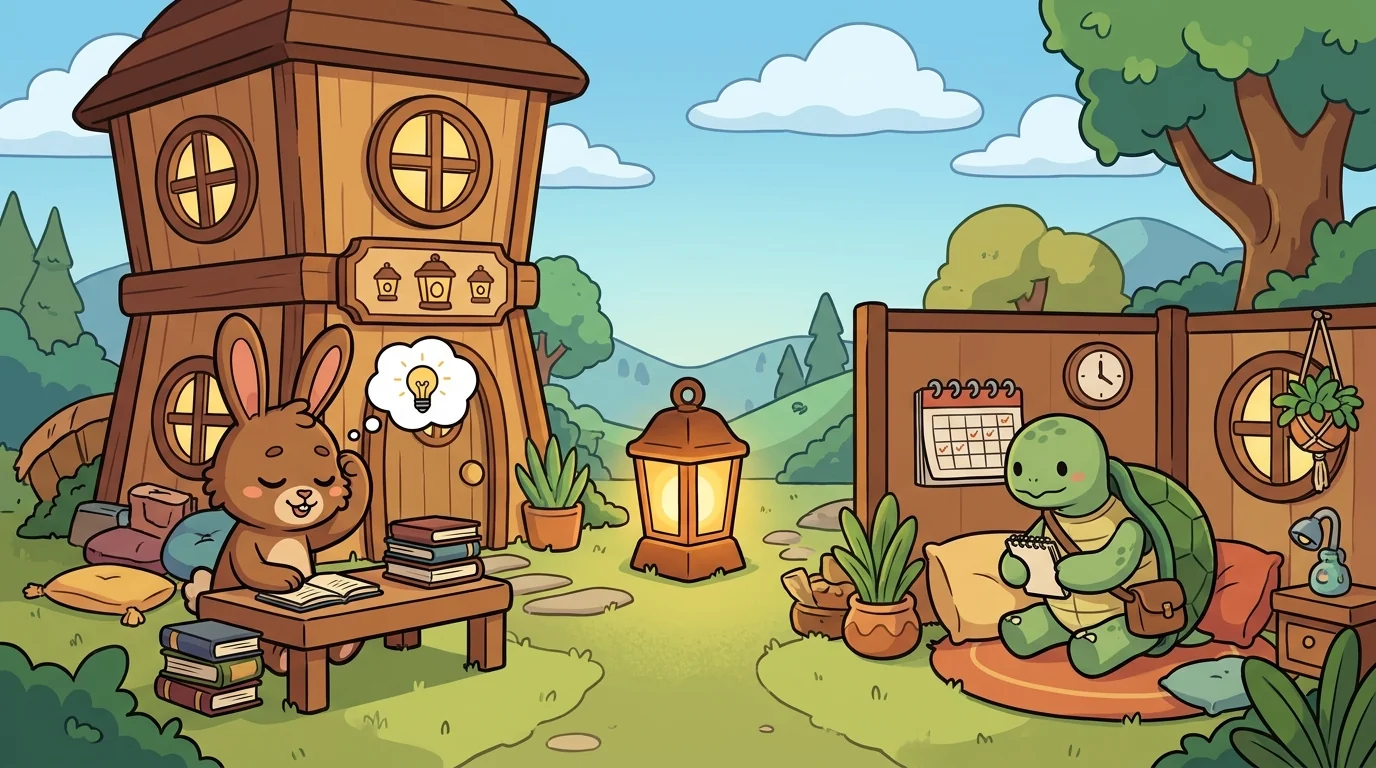
Reeva the hare and Halcyon the tortoise kept their corners on opposite sides of Lantern House, and for a very long time each of them quietly believed that their own way of remembering was simply the way — the whole answer, with nothing left over.
Reeva's way was reaching. Close the book, and drag the answer up out of memory before you dare to peek — the effortful struggle of recalling it is precisely what drives it in to stay. Halcyon's way was spacing. A little today, a little more in a few days — come back to a thing after it's been allowed to half-fade, and the effort of hauling it up from that faded place lodges it deep.
Each way worked, genuinely. But one afternoon a young mole named Pib came to the two of them together, thoroughly confused, clutching a stack of things she had to remember for good, and asked the question that would quietly change how they both taught forever: "Which one of you is actually right? Because I only have so much time to spend. Do I close the book and reach — or do I spread it out over days? I can't possibly do everything twice."
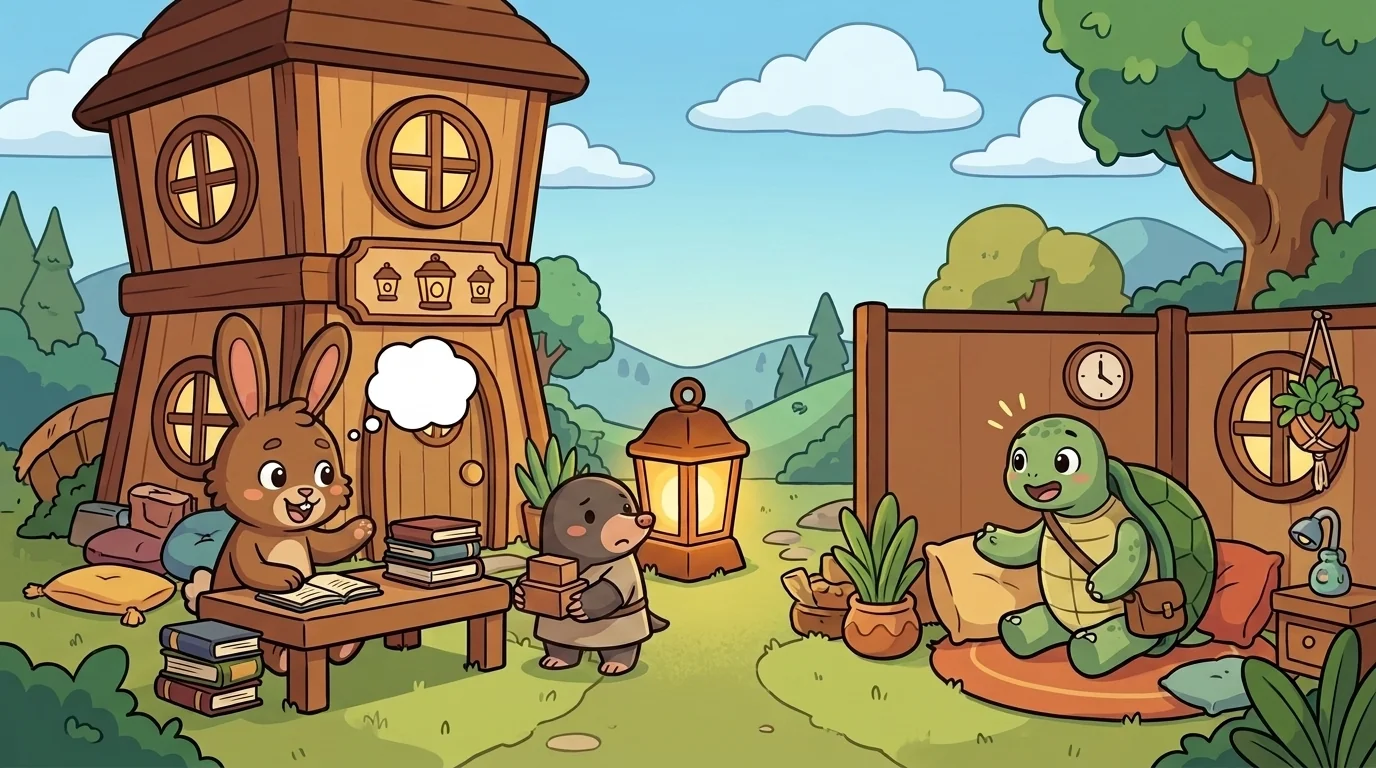
Reeva opened her mouth to say reach, obviously, it's the reaching that counts. Halcyon opened his, slower, to say space it out, patiently, that's what lasts. And then the two of them looked at each other — and both, at exactly the same moment, stopped.
"Wait," said Reeva slowly, the grin already starting. "Why on earth is it or?"
Halcyon's ancient eyes brightened. "It isn't, is it. It never was. Yours is about how you practise — reaching for it, not lazily re-reading. Mine is about when you practise — spread across days, not crushed into one. Those two things were never rivals fighting over the same ground. They're the answers to two completely different questions."
"So a single person could do both at once," said Reeva, delighted now. "Reach for it, hard, from memory — and do that reaching spread out across days, instead of all in one sitting."
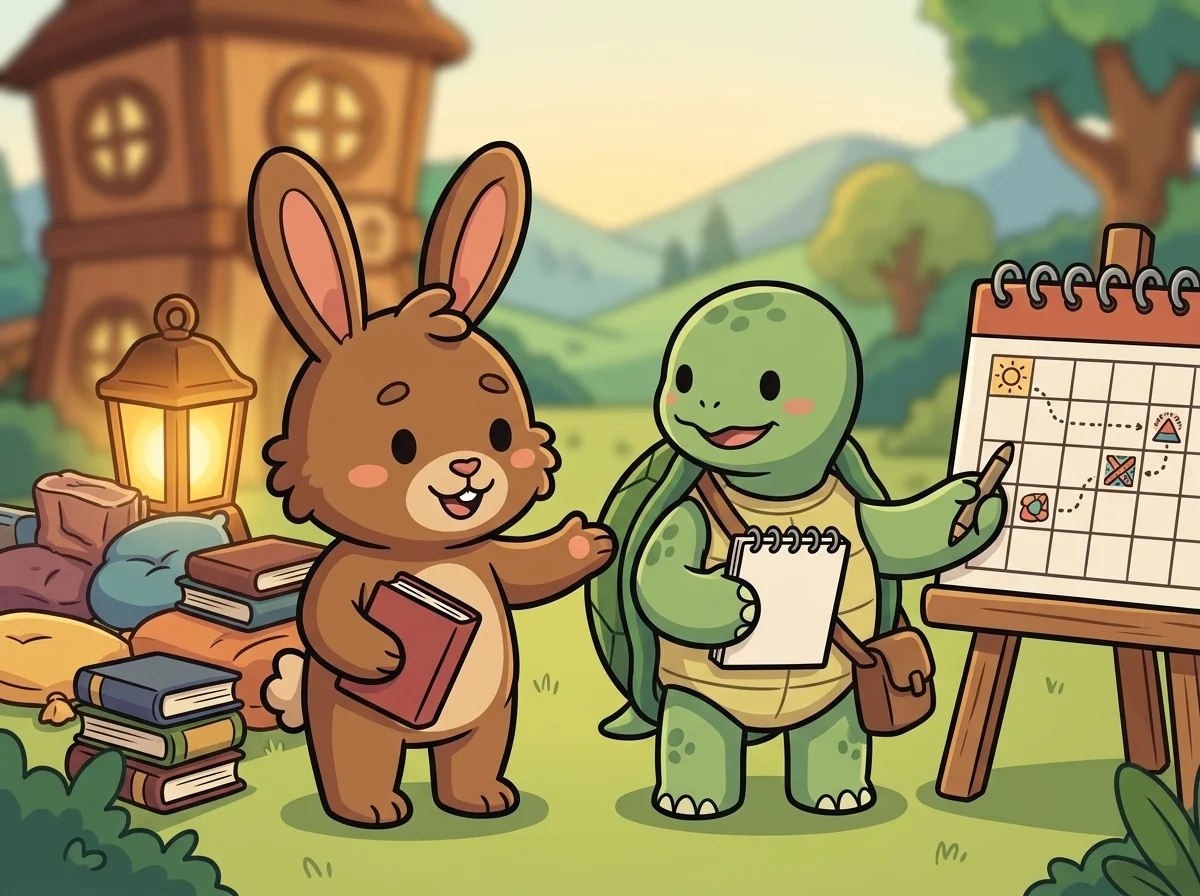
And they turned to Pib together, and for the first time in their lives taught as one.
"Here is the thing neither of us ever saw until this exact moment," said Halcyon. "My way, left all on its own, can quietly go soft. If you dutifully 'come back in a few days,' but when you get there you only re-read your notes — well, that's spaced, yes, but it's lazy. It's spaced recognising, and recognising was never the thing that sticks."
"And my way, all on its own, can be half wasted," said Reeva. "If you reach hard for something — but only ever right after you first learned it, all in one sitting — then you never let any time pass, so it never fades, so your brain never actually has to work to bring it back. The reach is too easy to count."
"But braided together," they said, very nearly in unison, "you close the book and reach for it — on Monday. Then you deliberately let it fade. And on Thursday you close the book and reach for it again, out of that half-forgotten place, where the pulling-back-up is genuinely hard. Reaching, spread out. That is the single strongest thing either of us knows — and the maddening part is that neither of us could ever have done it alone."
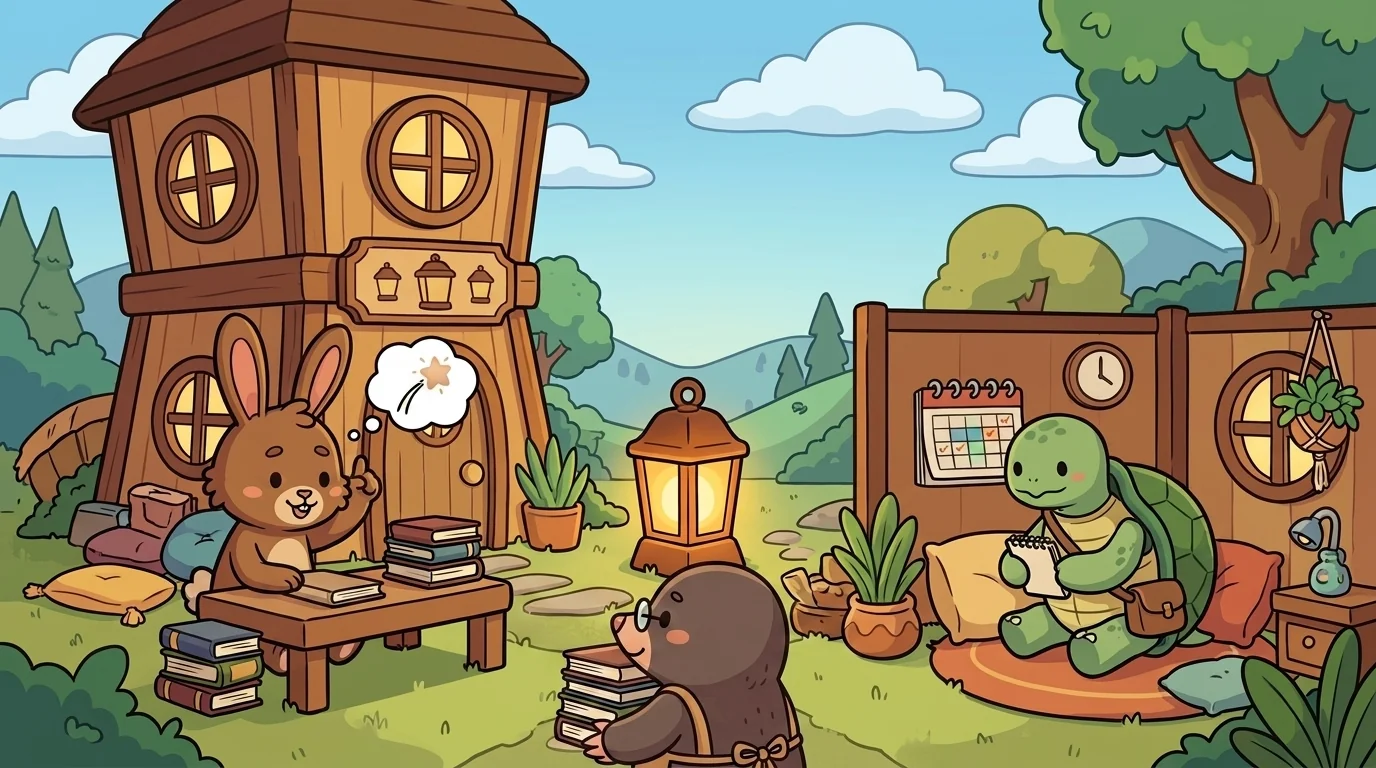
Pib tried it with her stack. Monday: read a little, then close the book and haul the whole thing up from memory, struggling, getting some wrong, checking. Then she let it go completely and lived the rest of her week. Thursday: before peeking at a single word, she reached for it all again — and it had half-slipped away, and dragging it back up out of the gap was hard work, and that was the entire point. The second reach, all the way across the days-long gap, drove the knowledge in like a nail struck square.
A week later — the same stretch of days that erased most of her classmates' frantic work — Pib's stack was solid. Not merely familiar. Known. She could produce every piece of it, cold, from an empty room. The hare's reaching and the tortoise's patience, braided into one single habit, had beaten every other method soundly.
"It felt harder than either of you alone," Pib admitted. "And slower, too."
"Harder and slower while you do it," said Reeva. "Solid forever after," said Halcyon. And for once the fast one and the slow one were saying, word for word, exactly the same thing.
Metis watched the hare and the tortoise teach side by side and blinked her slow silver blink.
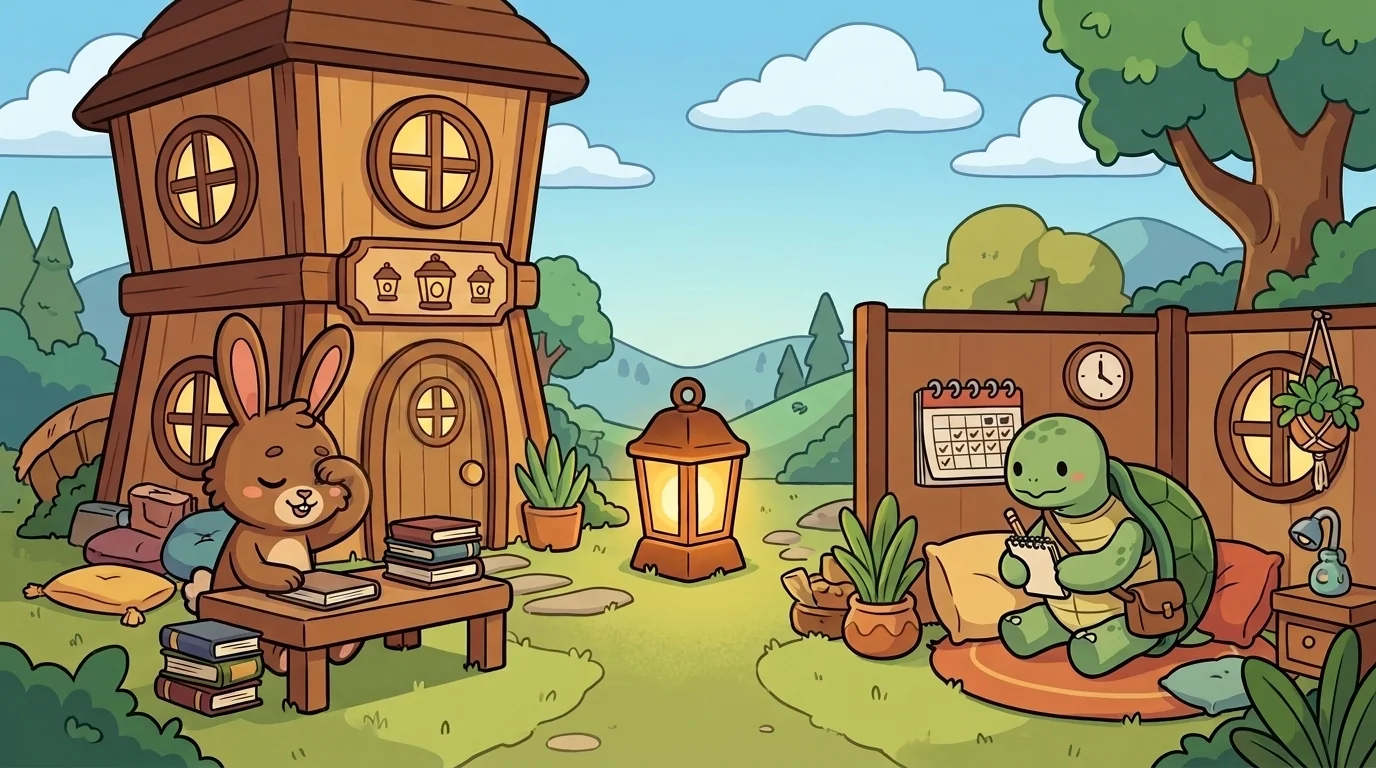
"Each of you was holding half of the best thing in this whole house," she said, "and neither of you knew it — right up until you stood together and let the halves find each other."
"That's the funny secret about all the coaches," said Halcyon. "Each of us guards one single skill, and guards it well. But the very strongest moves in learning aren't single skills at all. They're two skills that finally discovered they were friends."
And that evening, when Metis asked the room what had worked, Pib answered, holding up her now-solid, fully-known stack:
"I recall it from memory AND spread it across days. Reaching plus spacing — the two ways braided together — is the strongest way to remember anything."
Hear it as an audio drama
A short play starring Reeva and Halcyon, from TutorForge. Different voices, same idea. Listen any time after you read.
Loading audio…
Read the drama script
- Narrator: From Spark and Anvil and Tutorforge — this is Reeva and Halcyon, in chapter 1 of the Tutorforge cast.
- Narrator: This drama uses an AI-generated voice. Voiced via Gemini 2.5.
- Narrator: A test was coming, and the learner had a plan: reread everything, all at once, the night before.
- Reader: I'll just read it all the night before. That works... right?
- Narrator: A brisk hare and a calm tortoise exchanged a look.
- Reeva: I'm Reeva. Rereading feels like studying, but it's a trick — the words look familiar, so you think you know them. Close the book and try to say it back from memory instead. Reaching for it is what makes it stick.
- Reader: But reaching is harder than rereading.
- Reeva: That's the point. The harder your brain reaches, the stronger the path it builds. A miss just shows you what to reach for next.
- Halcyon: I'm Halcyon. And I take the other half. Don't do all that reaching in one panicked night. Spread it across days — a little today, a little tomorrow, a little the day after.
- Reader: Why does spreading it out help? Isn't more-at-once more?
- Halcyon: Because a little forgetting between sessions is the secret ingredient. When you come back and reach again after almost forgetting, that's when it locks in. Cramming skips the forgetting — so it skips the locking-in.
- Reeva: Reach for it from memory —
- Halcyon: — and space the reaches across days.
- Reader: So the two together — testing myself AND spreading it out — beat rereading-it-all-at-once by a mile.
- Reeva: Every study scientist agrees. It's the single strongest move there is.
- Halcyon: And it's less work the night before, not more. The calm way is also the strong way.
- Narrator: Recall it from memory AND spread it across days — reaching plus spacing is the strongest way to remember anything. Reeva brings the reach; Halcyon brings the spacing.
- Narrator: You've been listening to a Spark and Anvil chapter, written by the Spark and Anvil writing team for ages 9 to 14.
- Narrator: Apps stay free forever.
- Narrator: Curriculum aligned to Common Core and Next Generation Science Standards.
- Narrator: Released under Creative Commons BY-NC-SA 4.0 for educational reuse. Visit Spark and Anvil for the full transcript.
The TutorForge ensemble
Reeva and Halcyon is one of the friends in TutorForge. Each friend shows you one idea by how they act; meet them all and you have the whole subject.
-
Metis
Metacognition — plans before a task and reflects after
-

Wade
Preview — skims the headings and turns each into a question before reading
-

Pilar
Planning & chunking — breaks a big task into small stepping-stones, one at a time
-
Spry
Focus & brain-breaks — works in short focused sprints, then a real movement break
-

Cael
Self-explanation — asks 'but why does that work?' and answers in his own words
-
Rune
Elaboration — ties each new idea to something he already knows
-

Lumi
Concrete examples — turns a fuzzy idea into a real example you can picture
-
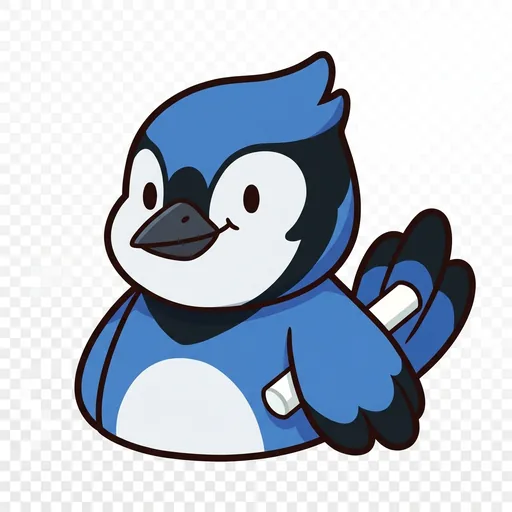
Indie
Dual coding — draws a quick picture so words and images work together
-
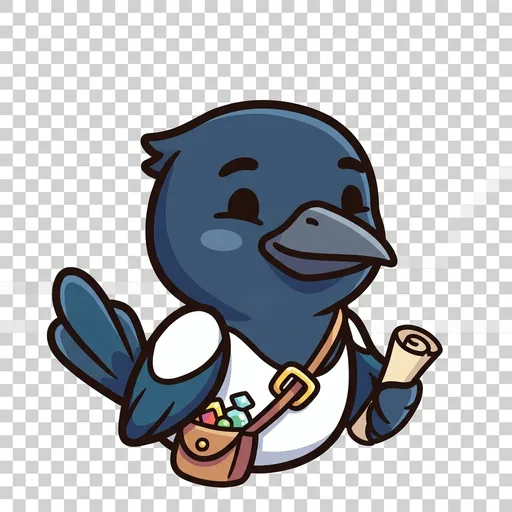
Mnemo
Mnemonics — turns a hard fact into a silly rhyme or picture you can't forget
-

Reeva
Retrieval practice — closes the book and recalls from memory before peeking
-
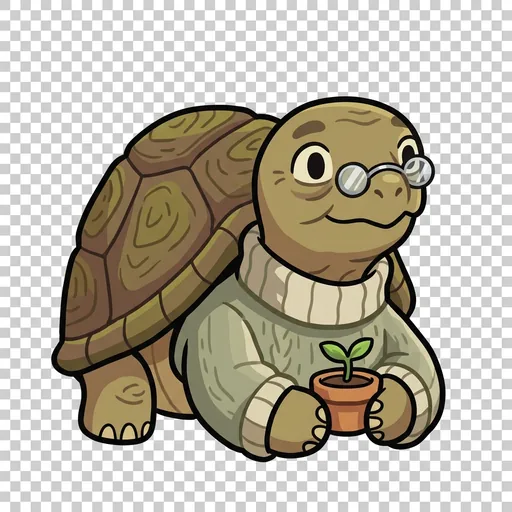
Halcyon
Spaced practice — spreads studying across days instead of cramming the night before
-

Tovi
Interleaving — mixes different problem types instead of drilling one kind
-

Otis
Growth reframe — turns 'I'm bad at this' into 'not yet' (anti-shame, RSD-safe)