Mental-maths sprint
Work it out in your head, then type the answer. No clock, no pressure — just practice.
Cast, stories & more
More ways to play
Where this idea comes from· Napier, 1617 · Kojima, 1954
Napier’s bones
The Scottish mathematician John Napier described a set of numbered rods for multiplying in his book Rabdologiae, printed in Edinburgh in 1617, the year he died.
One thing to hold: Ten rods, often carved from bone or ivory, each showing the times table of one digit in little diagonal boxes.
Why it matters: Lay the rods side by side and a big multiplication becomes adding along diagonals — the same idea as lattice multiplication.
The soroban
The soroban is the Japanese abacus. It grew from the Chinese suanpan, which reached Japan by the late 1500s.
One thing to hold: On today’s soroban each rod has one bead above the bar, worth five, and four below, worth one each.
Why it matters: Practised users can picture the beads in their heads and add long numbers without touching anything.
What we don’t know: Exactly when the abacus reached Japan is not certain; writers give dates from the 1400s to the late 1500s.
The soroban’s own word:
Anzan — “blind calculation”: you picture the soroban and move the beads in your mind.
Could you add two numbers by picturing the beads, with no soroban in front of you?
Dates:
- 1850 About this time the soroban loses one of its two beads above the bar.
- 1891 Irie Garyū takes away one bead below the bar, leaving four.
- 1930 The one-above, four-below soroban comes back; by the 1940s it is the usual kind, the one used today.
- 1946 On 11 November in Tokyo, Kiyoshi Matsuzaki’s soroban beat Private Thomas Nathan Wood’s electric calculator 4 rounds to 1. The calculator won only multiplication.
😄 Brain break

Meet the cast — the characters who teach this
-
 Lefty Left-to-right
-
 Tenna Make-a-ten
-
 Halvor Double & halve
-
 Soro Soroban beads
-
 Squill Square near a base
-
 Elva The ×11 trick
-
 Grandel Subtract from a round number
-
 Crisca Cross-multiply
-
 Nina Cast out nines
-
 Rounda Estimate first
-
 Splitt Break apart
-
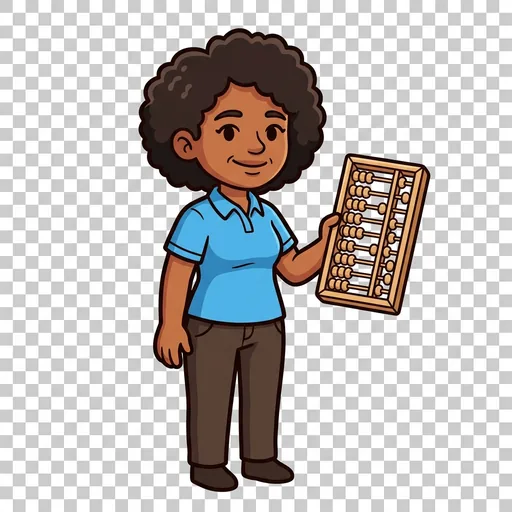 Abaca the mental-math coach who sets the sprint and reflection
What next? Pick a door
- More like this ShowMath Can you perform this math trick? FlickForge Where will the struck disc stop? MosaicForge Where will this tile score the most?
- A bit harder CrowdForge Which lever makes the park fairer? Solitaire Lab Does this rule make solitaire better? VectorForge Where will this matrix send the point?
- Something different MangaForge Which shot fits this panel? SidekickQuest How do you play WITH a little one? DoodleForge What will this little loop draw?