Cammy
PASCAL'S RULE — *to count committees of size k from n people, split by the last person: if they're in, choose k-1 from the rest; if out, choose k from the rest; so C(n,k) = C(n-1,k-1) + C(n-1,k).*
Loading audio…
Press play to listen along. The line being read lights up as you go.
Show full transcript
Loading transcript…
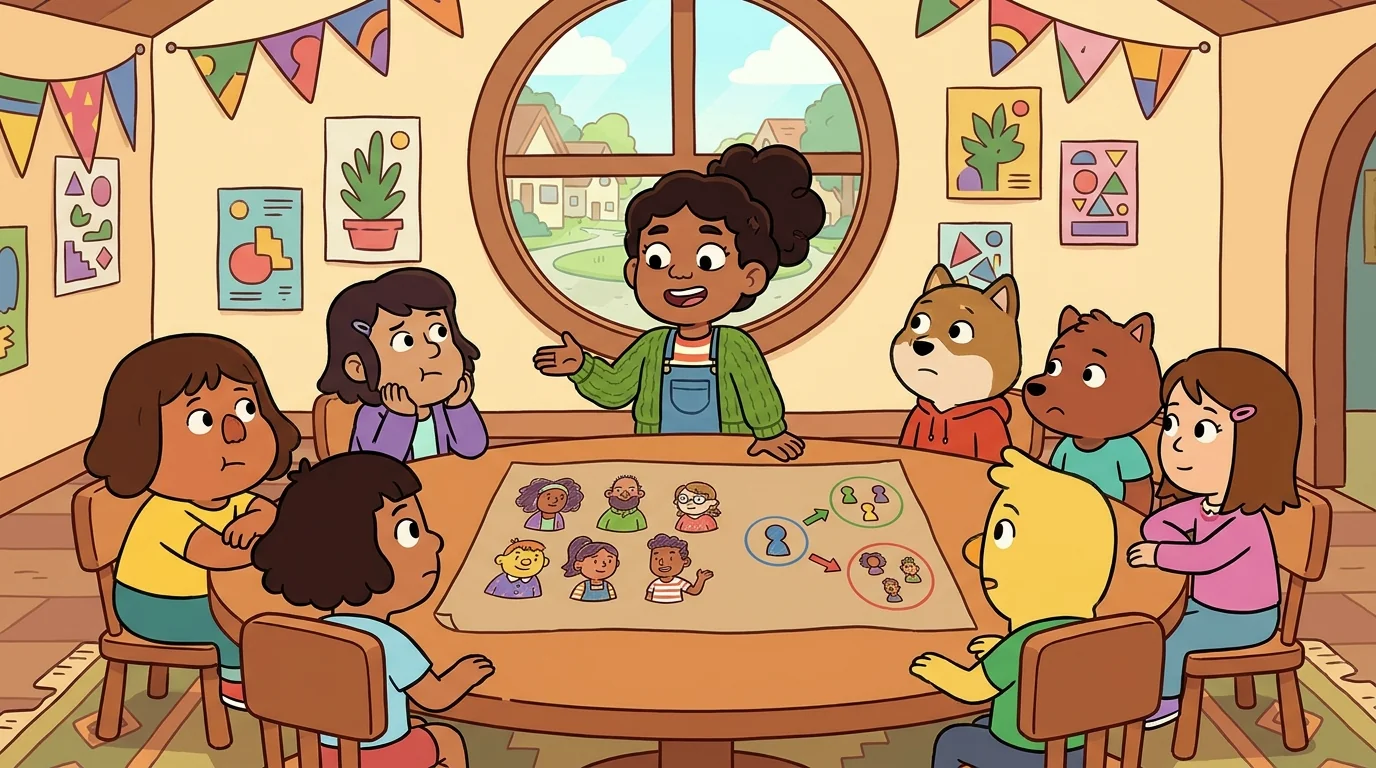
Cammy formed committees. "Pick a committee of three from these seven people — how many different committees are possible?" People would try to list them all and quickly tangle. Cammy never listed. She asked one small question about one person. "Look at the last person on the list. There are only two possibilities: that person is on the committee, or they're not. Two clean cases, and together they cover everything."
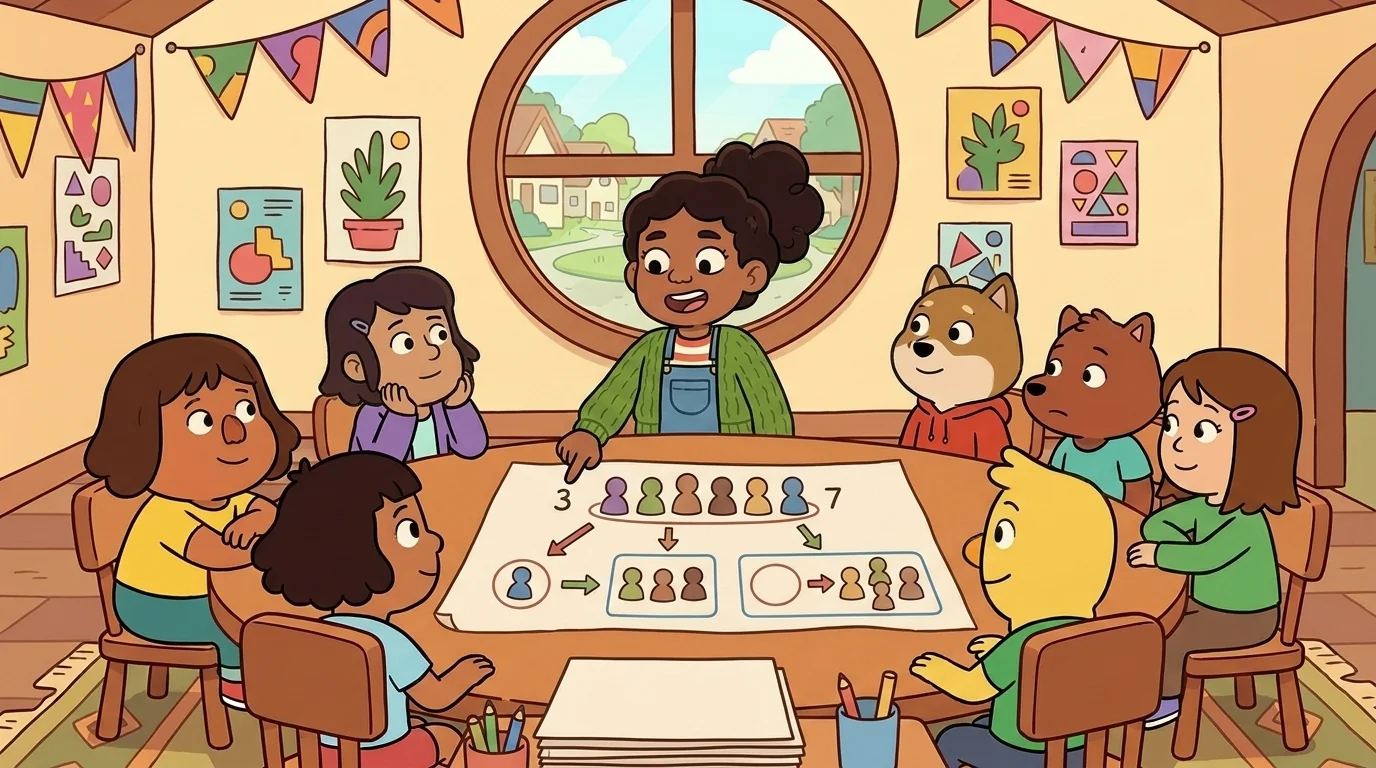
"If that last person is on the committee," Cammy explained, "then I only need to fill the other two seats from the remaining six. If that last person is not on it, I need all three seats from the remaining six. So the committees-of-three from seven equals the committees-of-two-from-six plus the committees-of-three-from-six." Two smaller committee questions, added together. "One yes-or-no about one person," Cammy would say, "splits a giant choice into two smaller choices — and there's no overlap and nothing left out, because everyone is either in or out."
Cammy used to freeze at big decisions, unable to settle anything.
As a young apprentice, choices with many options paralyzed her — she'd try to weigh every possibility at once and end up choosing nothing, stuck, sure that decisive people had some certainty she lacked. Big open choices felt like standing in a doorway forever, unable to step through.
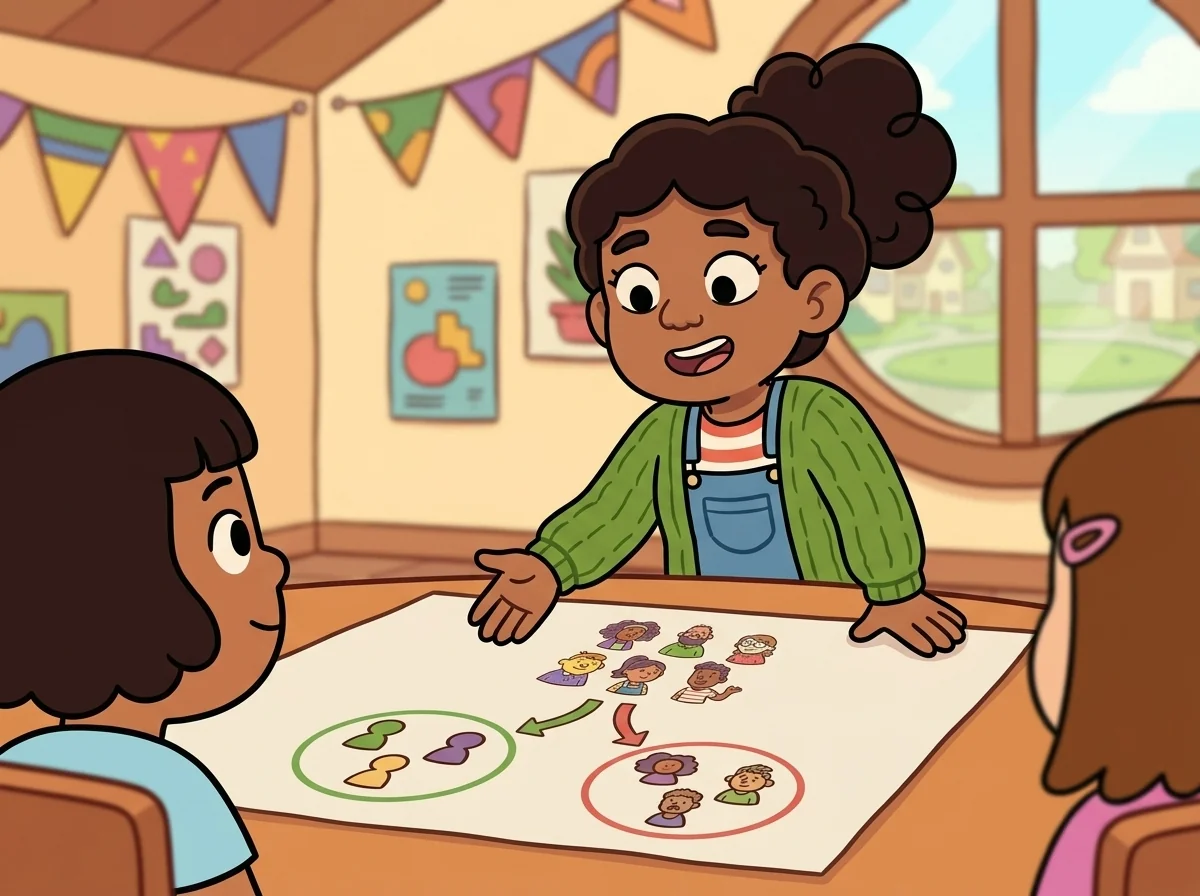
Quill, the workshop's mentor, watched her stall over which tiles to pick for a task. "You're trying to decide everything at once," Quill said. "Start with one small yes-or-no." Quill pointed at a single tile. "This one — in, or out? Just answer that." Cammy answered. And suddenly the huge choice had cracked into two smaller, calmer worlds: the world where that tile was in, and the world where it was out. "You don't settle a big choice all at once," Quill said. "You settle one small in-or-out, and the giant thing splits into two things you can handle." Something in Cammy that had frozen in doorways found it could take one small step.
The kid who came to Cammy was stuck, overwhelmed by options. "There are too many ways to pick. I can't even start."
"Then start tiny," Cammy said. "Forget the whole choice. Look at just one person — the last one. In, or out?"
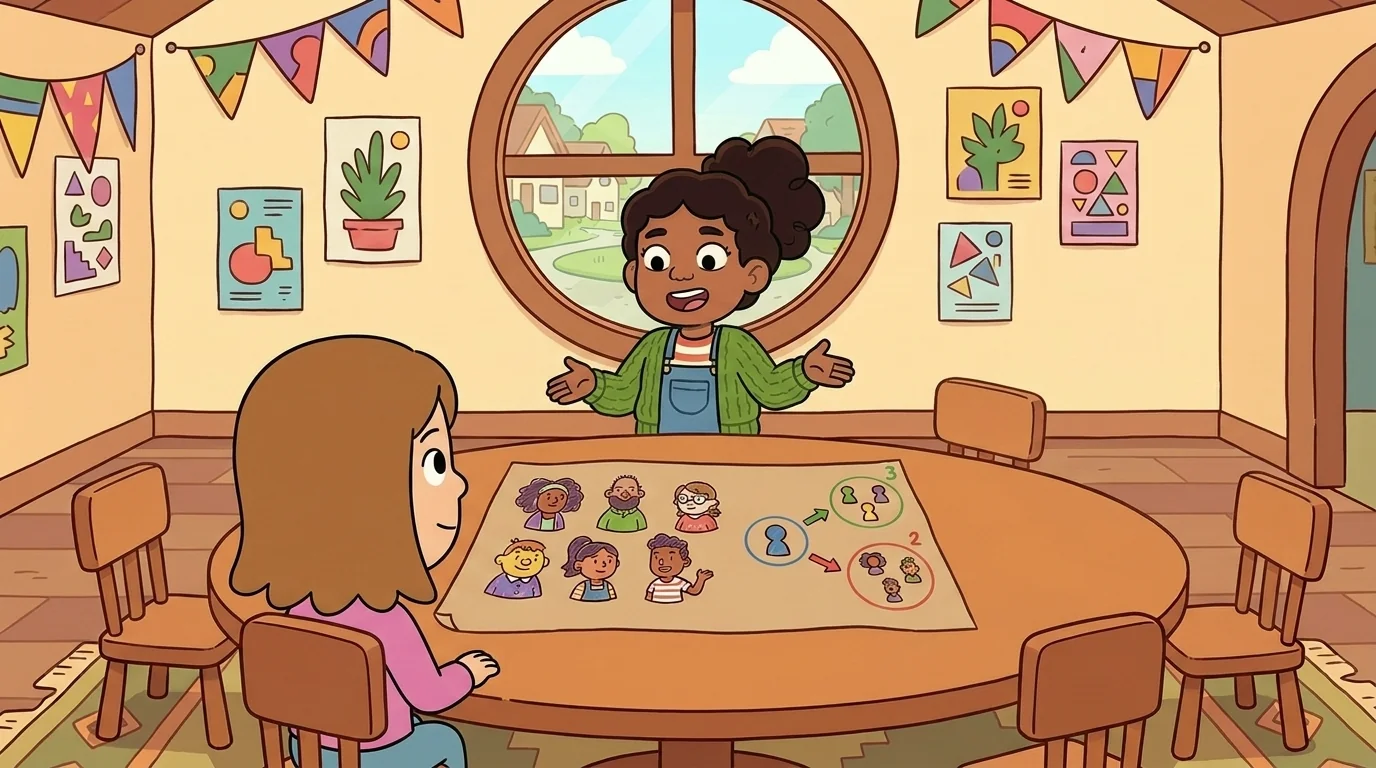
"...Those are the only two?"
"The only two. So — if they're in, how many seats are left to fill from the others? And if they're out?" She walked the kid through both. "Add the two cases. Do they cover every possible committee?"
The kid thought. "...Yeah. Every committee either has that person or doesn't. There's no in-between." Their shoulders dropped. "So I just add the two smaller answers."
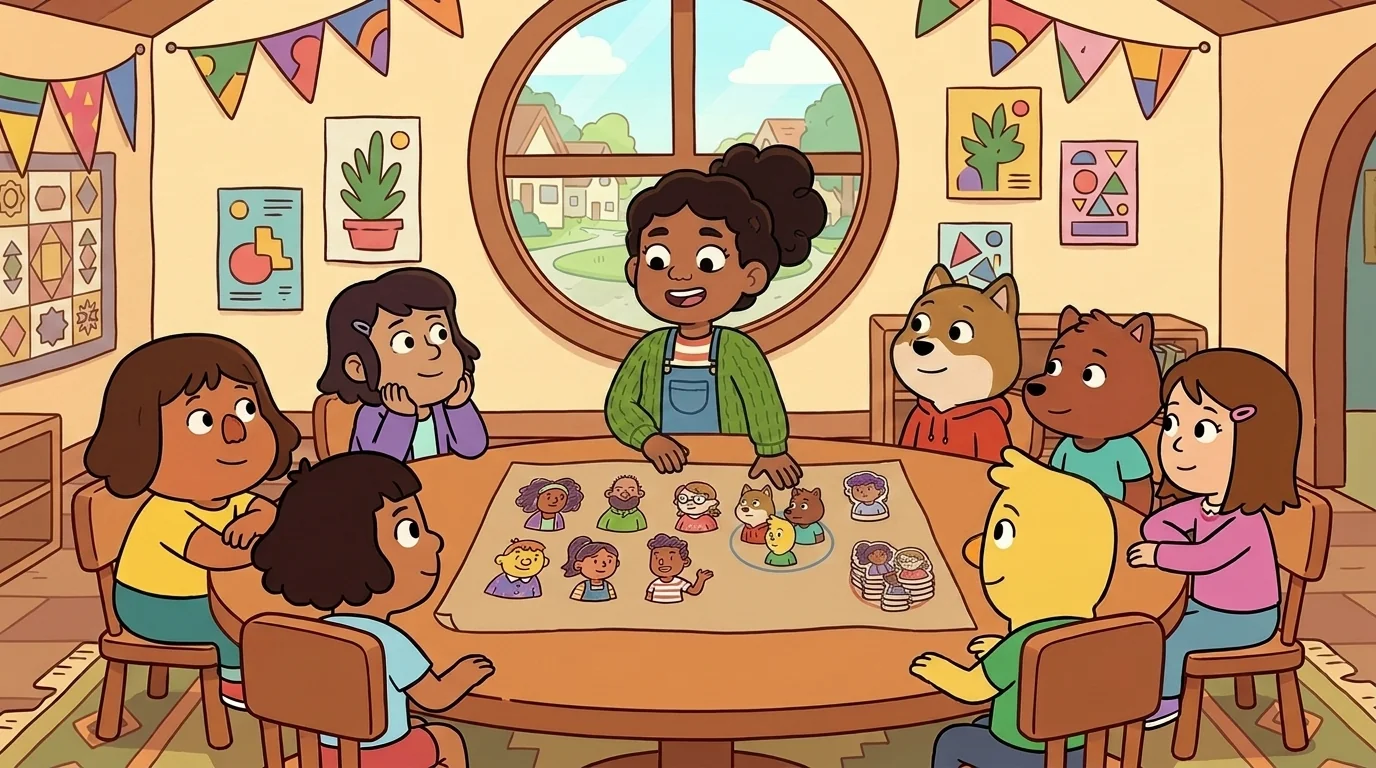
They counted a couple of small committees by the in-or-out split — choosing two from four is choosing one-from-three plus two-from-three, three plus three, six — the kid settling one yes-or-no and adding the two cases, checking each time that the two cases covered everything with no overlap. And with each one, the frozen-in-the-doorway feeling eased into the calm of a decision made one small step at a time.
The feeling that settled into the kid then wasn't only the relief of a counted committee. It was steadier and braver: the discovery that a huge choice becomes handleable the moment you settle one small in-or-out, and that "this case plus that case" can cover everything with nothing missed. If a giant selection could be tamed by a single yes-or-no about one person, then being frozen just meant the question was still too big — and could be cut smaller. That warm, decisive calm — I can face a big choice one small yes-or-no at a time — spread all the way through, and Cammy felt her own old doorway-freeze ease once more, because it was the exact calm Quill had once given an apprentice who couldn't choose.
"Ask one thing — is the last person in or out? — then add the two cases," Cammy said, sliding the committee together. "A giant choice is just two smaller ones, once you settle one small yes-or-no."
The CountCraft ensemble
Cammy is part of CountCraft's distributed-narrative cast. Each character embodies a different curricular primitive; together they teach the full subject.
-

Tallis
The Two-Ways Counter — counts the same collection along rows, then along columns, and insists the two totals be equal (double counting)
-

Bijou
The Pair-Matcher — draws a one-to-one pairing between two sets to prove they are exactly the same size (bijection)
-

Stacia
The Staircase-Mirror — mirrors a one-two-three staircase against itself to make a rectangle (triangular numbers)
-

Nona
The Gnomon-Grower — adds the next odd L-shaped layer to grow a square one ring at a time (perfect squares)
-

Arel
The Square-Cutter — cuts a square into four rectangles to read off a-squared plus two-a-b plus b-squared (area model)
-

Domina
The Domino-Tiler — tiles a strip with squares and dominoes and counts the number of ways (Fibonacci tilings)
-

Chessa
The Handshake-Counter — pairs everyone with everyone exactly once to count the handshakes (choose two)
-

Sett
The Subset-Flipper — flips an in-or-out coin for each item to list every subset exactly once (two-to-the-n)
-

Parry
The Parity-Prover — two-colours a board to show when a tiling simply cannot exist (parity and impossibility)
-

Quill
The Proof Director (mentor) — a warm, attentive adult who coaches build-the-two-counts-then-read-the-identity, and never proves for the kid