Tallis
DOUBLE-COUNTING — *count one collection two different ways; since it is the same collection, the two totals must be equal, and that equality is the proof.*
Loading audio…
Press play to listen along. The line being read lights up as you go.
Show full transcript
Loading transcript…

Tallis kept a tray of pebbles arranged in a neat rectangle — say, four rows of six — and asked every visitor the same thing. "How many pebbles? Don't move them. Just count." Most people counted one way and stopped. Tallis never stopped at one. "I count along the rows: six, plus six, plus six, plus six — twenty-four. Then I count again, down the columns: four, four, four, four, four, four — also twenty-four." Tallis would beam. "Same pebbles, counted two different ways. So the two totals have to match. And when they must match, you've proved something: four sixes equals six fours."
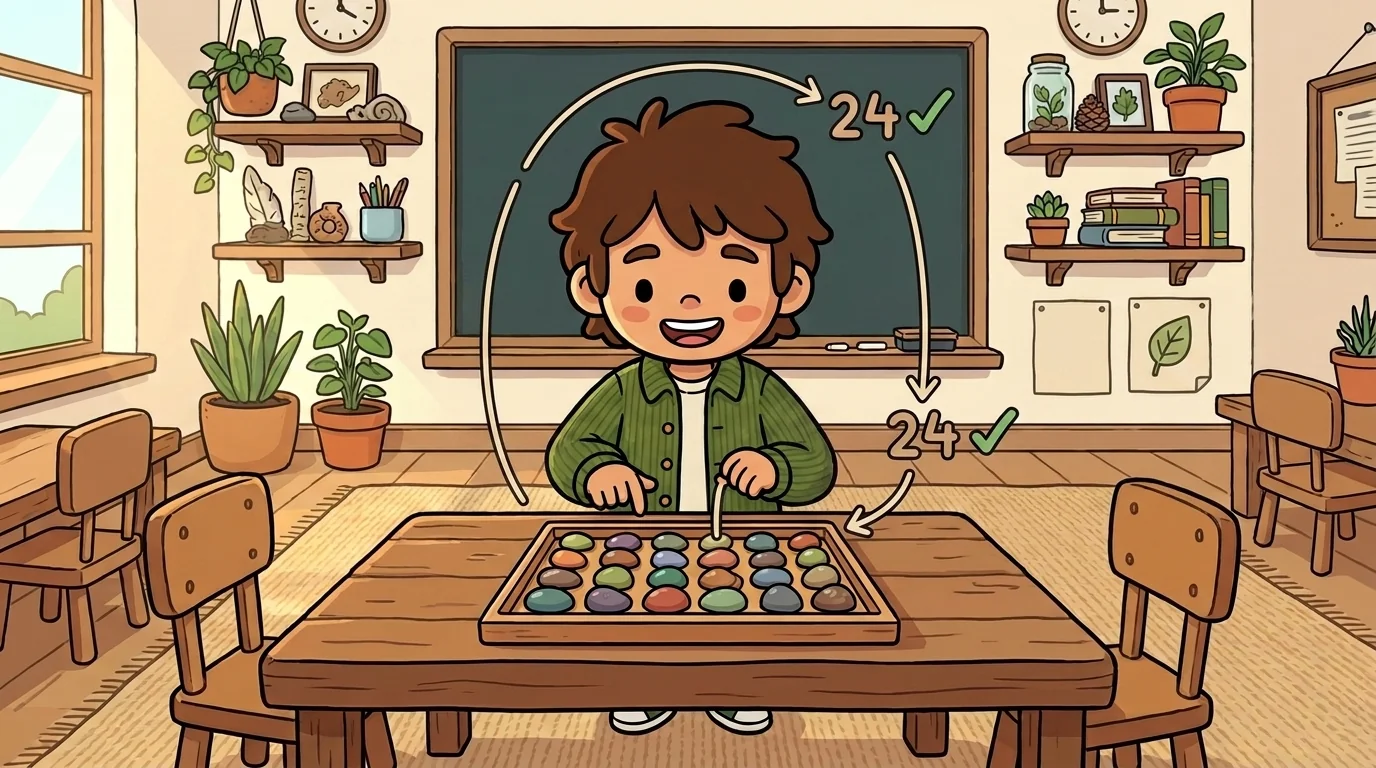
That was Tallis's whole art — counting one collection two ways and insisting the answers agree. "It's not a trick and it's not an opinion," Tallis would say. "It's the same pile. Two honest counts of the same pile can't disagree. That's how you turn 'I think so' into 'it must be so.'"
Tallis hadn't always believed two views could both be true.
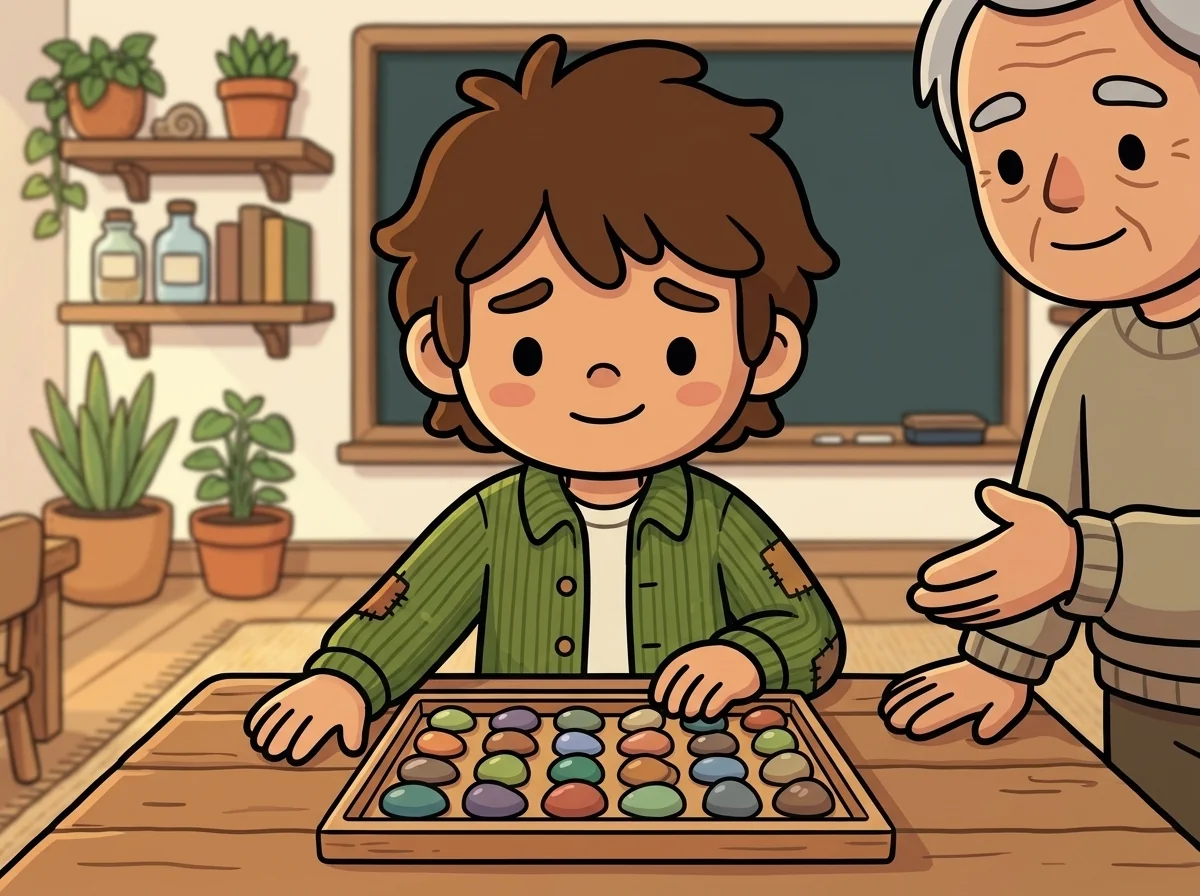
As a young apprentice in the counting workshop, Tallis argued constantly — sure that if two people counted differently, someone had to be wrong. Tallis would dig in, defend one way of seeing, and treat a different count as a challenge to win. It made the workshop tense and made Tallis lonely, always braced for the next argument about who was right.
Then Quill, the workshop's mentor, laid a handful of tiles in a rectangle. "You keep fighting over whose count is right," Quill said. "Watch what happens when you let both be right." Quill counted by rows, then by columns — two different journeys, one identical total. "You weren't wrong and they weren't wrong. You were counting the same thing two ways, and the agreement is the whole point. The best proofs aren't one person winning. They're two honest views that have no choice but to meet." Something in Tallis that had always been braced for a fight quietly set down its guard.
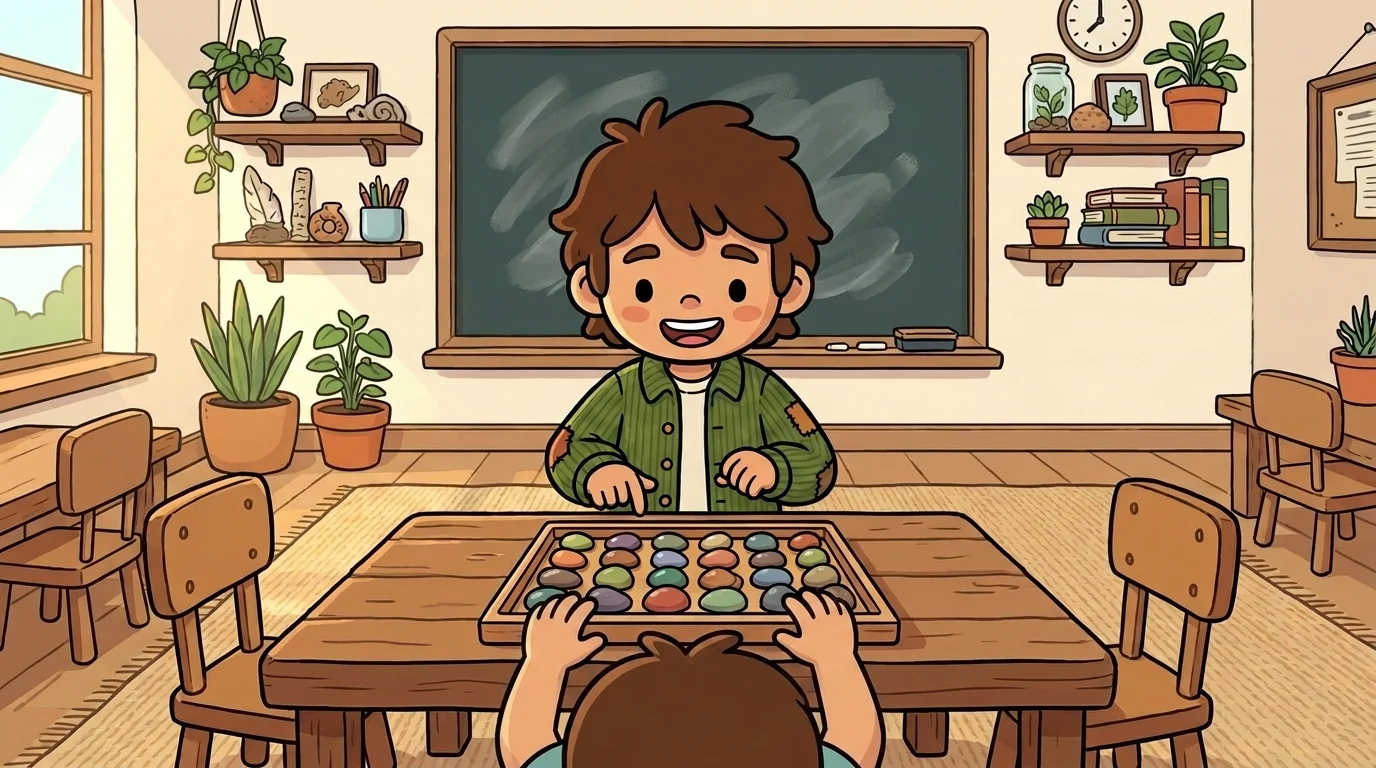
The kid who came to Tallis arrived mid-argument with themselves, frustrated. "My friend counted it differently and got the same number and now I don't know who's right."
"Maybe you both are," Tallis said, sliding over the pebble tray. "Count by rows for me." The kid counted: twenty. "Now count the very same pebbles by columns." The kid, wary, counted again: twenty. "Huh," they said. "It's the same."
"Of course it is," Tallis grinned. "Same pebbles. Two ways. They have to match."

They tried a 3-by-5 arrangement — three fives is fifteen, five threes is fifteen — and a 2-by-7 — two sevens, seven twos, both fourteen. Each time the kid counted one collection two ways and watched the totals land on the same number, and each time the frustrated crease between their eyebrows softened, replaced by something more curious than combative.
The feeling that grew in the kid then wasn't only the satisfaction of a matched count. It was gentler and more freeing: the discovery that two different ways of seeing don't have to be a fight to win — that when they're honest views of the same thing, they agree, and the agreement itself is the proof. If two counts of one pile must meet, maybe they and their friend hadn't been rivals at all. That warm, unclenching openness — both views can be true; agreement is stronger than winning — spread all the way through, and Tallis felt the old braced-for-a-fight feeling ease once more, because it was the exact openness Quill had once given an apprentice who thought someone always had to be wrong.
"Count it two ways; the two totals must match," Tallis said, resettling the pebbles. "That's not an argument you win. It's a truth two honest counts agree on."
The CountCraft ensemble
Tallis is part of CountCraft's distributed-narrative cast. Each character embodies a different curricular primitive; together they teach the full subject.
-

Bijou
The Pair-Matcher — draws a one-to-one pairing between two sets to prove they are exactly the same size (bijection)
-

Stacia
The Staircase-Mirror — mirrors a one-two-three staircase against itself to make a rectangle (triangular numbers)
-

Nona
The Gnomon-Grower — adds the next odd L-shaped layer to grow a square one ring at a time (perfect squares)
-
Arel
The Square-Cutter — cuts a square into four rectangles to read off a-squared plus two-a-b plus b-squared (area model)
-
Domina
The Domino-Tiler — tiles a strip with squares and dominoes and counts the number of ways (Fibonacci tilings)
-
Chessa
The Handshake-Counter — pairs everyone with everyone exactly once to count the handshakes (choose two)
-
Cammy
The Committee-Splitter — sorts every committee by whether the last person is in or out (Pascal's rule)
-

Sett
The Subset-Flipper — flips an in-or-out coin for each item to list every subset exactly once (two-to-the-n)
-

Parry
The Parity-Prover — two-colours a board to show when a tiling simply cannot exist (parity and impossibility)
-

Quill
The Proof Director (mentor) — a warm, attentive adult who coaches build-the-two-counts-then-read-the-identity, and never proves for the kid