Stacia
TRIANGULAR NUMBERS — *1+2+...+n forms a staircase; a mirrored copy completes it into an n by (n+1) rectangle, so the sum is n(n+1)/2.*
Loading audio…
Press play to listen along. The line being read lights up as you go.
Show full transcript
Loading transcript…

Stacia built staircases out of tiles — one tile in the top row, two in the next, three below that, all the way down to n. "Add them up," she'd challenge, "one plus two plus three plus... all the way to n." People would start slogging through the addition. Stacia would stop them. "Don't add. Mirror." She'd build a second, identical staircase, flip it upside-down, and slide it against the first — and the two lopsided staircases locked together into a perfect rectangle, n rows tall and n-plus-one wide.
"Now it's easy," she'd say. "The rectangle holds n times n-plus-one tiles. But that's two staircases. So one staircase — my actual sum — is just half the rectangle." One plus two plus three up to n equals n times (n+1), divided by two. "The pile that looked impossible to add," Stacia would say, patting the rectangle, "was only ever half of something perfectly neat."

Stacia used to feel like that lopsided staircase herself — jagged, unfinished, never quite a whole shape.
As a young apprentice, Stacia was painfully aware of her own uneven edges — the things she couldn't do yet, the rows that didn't reach as far as everyone else's. Next to the tidy, complete-seeming others, she felt like a shape with a diagonal cut down one side: not a real rectangle, just a jagged half of one. It was a small, aching sense of being perpetually incomplete.
Quill, the workshop's mentor, watched her stare glumly at her own staircase of tiles. "You keep seeing the jagged edge," Quill said, "and calling it broken." Then Quill built the mirror copy and slid it against hers — and her lonely staircase became half of a flawless rectangle. "Your 'incomplete' shape wasn't broken. It was half of something whole. Bring a copy alongside it and the wholeness was there all along." Quill smiled gently. "Nothing that's half of a perfect thing is broken. It's just waiting for its other half." Something in Stacia that had felt jagged quietly recognized itself as half of something fine.

The kid who came to Stacia was frowning at a staircase of tiles, one through six.
"I have to add all of these and I keep losing my place," they said.
"Then stop adding," Stacia said. "Build a copy of your staircase. Flip it. Slide it against the first one." The kid did — and the two staircases clicked into a rectangle, six tall and seven wide. "How many tiles in the rectangle?"
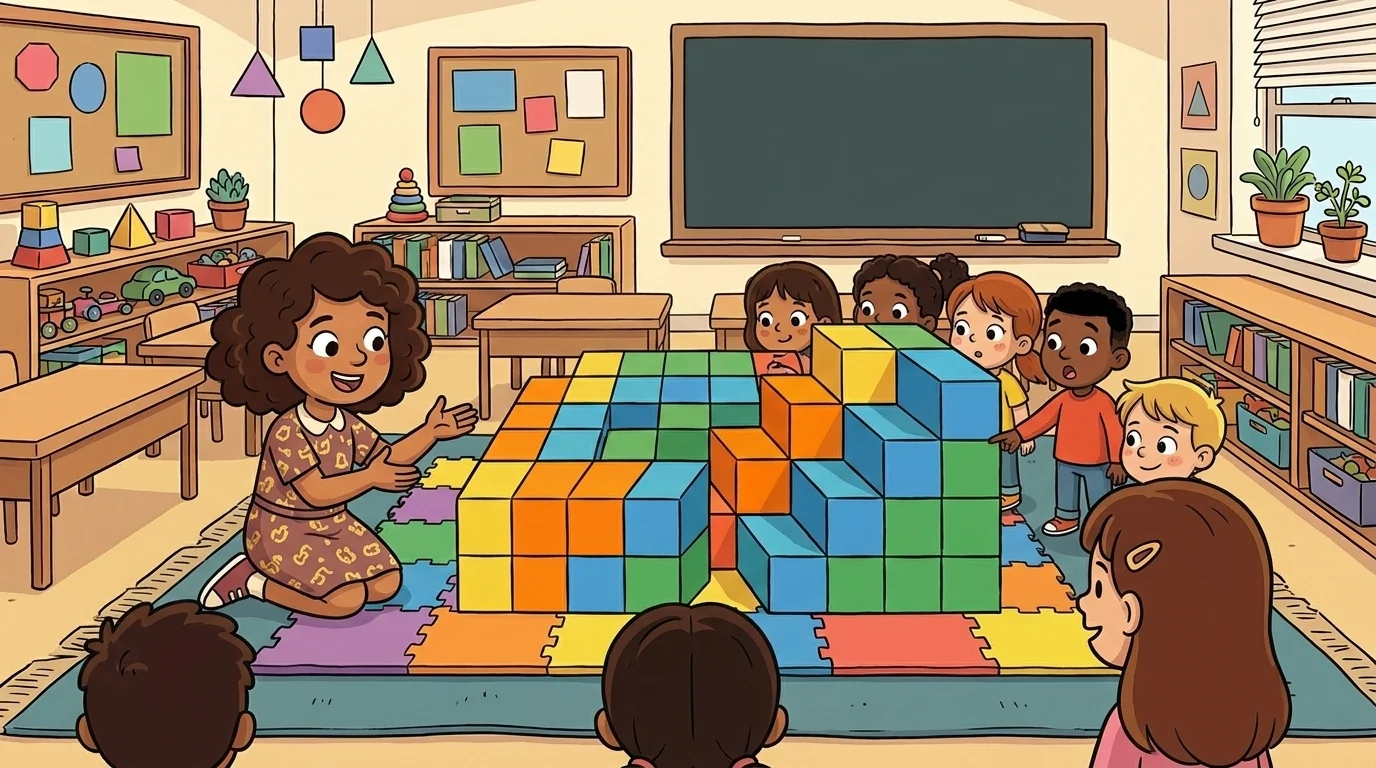
"Forty-two."
"And your staircase is half of it."
"...Twenty-one!" the kid said. "But I never added them up."
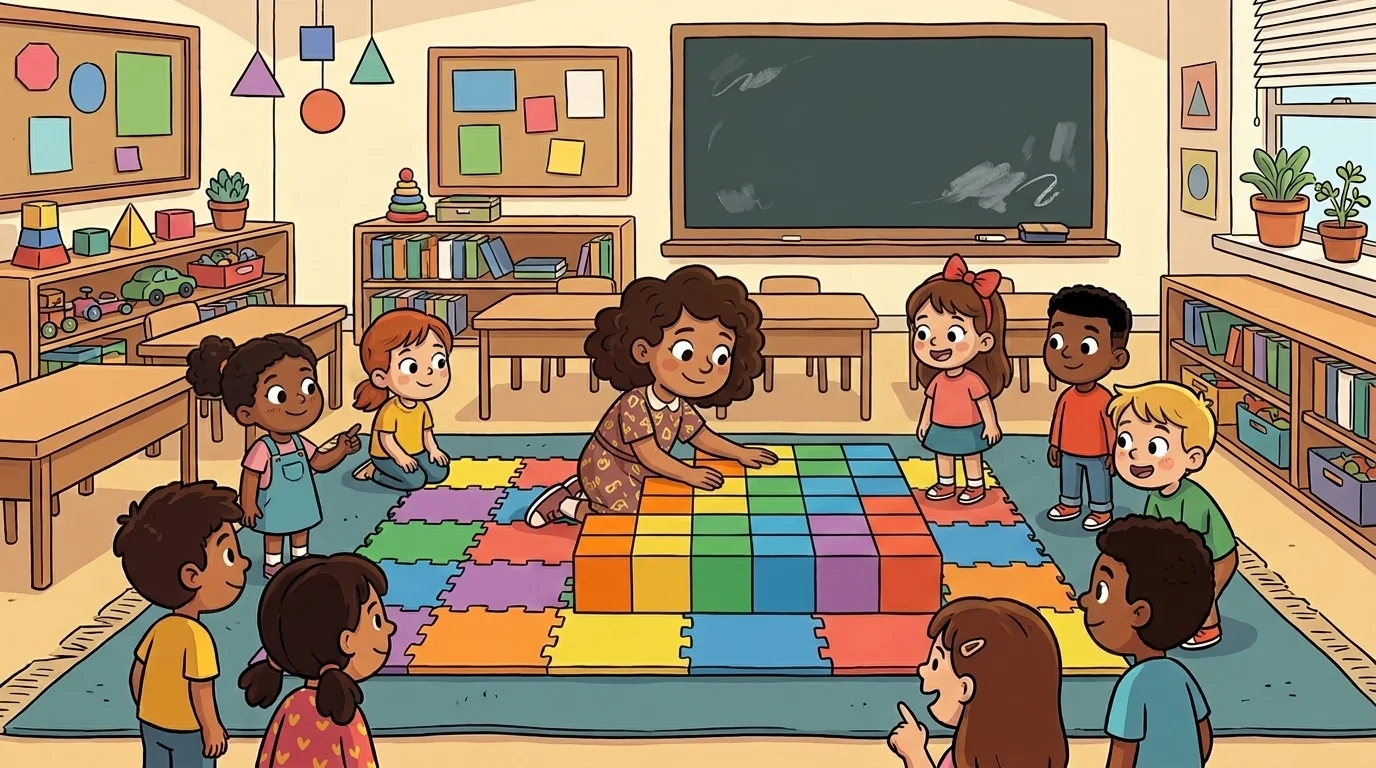
They mirrored a few more — a 1-to-4 staircase became half of a 4-by-5 (ten); a 1-to-5 became half of a 5-by-6 (fifteen) — the kid completing each lopsided shape with its twin and reading the sum as half the rectangle. And with each one, the kid seemed to relax about the "unfinished" look of the staircase, seeing it now as a shape that was simply waiting for its other half.
The feeling that rose in the kid then wasn't only the neatness of a sum found without slogging. It was warmer and more reassuring: the sense that a lopsided, unfinished-looking thing might be exactly half of something whole — that "incomplete" can just mean "waiting for its mirror." If a jagged staircase was really half a perfect rectangle, then feeling not-quite-finished wasn't the same as being broken. That gentle, settling warmth — my uneven edge is half of something whole — spread all the way through, and Stacia felt her own old jaggedness ease once more, because it was the exact wholeness Quill had once shown an apprentice who thought she was only a broken half.
"Mirror the staircase into a rectangle; the sum is half of it," Stacia said, running a hand along the neat rectangle's edge. "The lopsided shape was never broken. It was half of something perfect the whole time."
The CountCraft ensemble
Stacia is part of CountCraft's distributed-narrative cast. Each character embodies a different curricular primitive; together they teach the full subject.
-

Tallis
The Two-Ways Counter — counts the same collection along rows, then along columns, and insists the two totals be equal (double counting)
-

Bijou
The Pair-Matcher — draws a one-to-one pairing between two sets to prove they are exactly the same size (bijection)
-

Nona
The Gnomon-Grower — adds the next odd L-shaped layer to grow a square one ring at a time (perfect squares)
-

Arel
The Square-Cutter — cuts a square into four rectangles to read off a-squared plus two-a-b plus b-squared (area model)
-

Domina
The Domino-Tiler — tiles a strip with squares and dominoes and counts the number of ways (Fibonacci tilings)
-

Chessa
The Handshake-Counter — pairs everyone with everyone exactly once to count the handshakes (choose two)
-

Cammy
The Committee-Splitter — sorts every committee by whether the last person is in or out (Pascal's rule)
-

Sett
The Subset-Flipper — flips an in-or-out coin for each item to list every subset exactly once (two-to-the-n)
-

Parry
The Parity-Prover — two-colours a board to show when a tiling simply cannot exist (parity and impossibility)
-

Quill
The Proof Director (mentor) — a warm, attentive adult who coaches build-the-two-counts-then-read-the-identity, and never proves for the kid