Bijou
BIJECTION — *match every item in one set to exactly one item in another with none left over on either side; the perfect pairing proves the two sets are the same size, without counting either.*
Loading audio…
Press play to listen along. The line being read lights up as you go.
Show full transcript
Loading transcript…
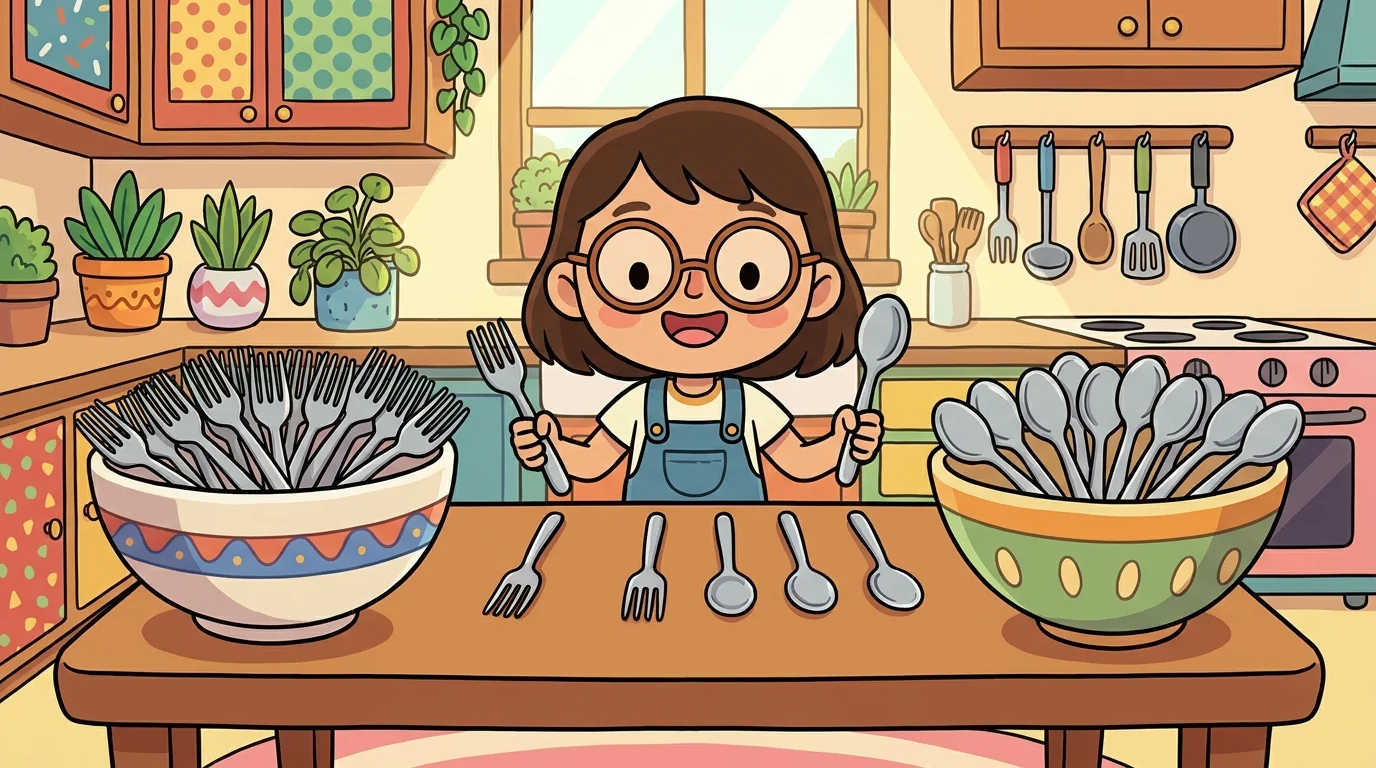
Bijou never counted when she could pair instead. Faced with a big bowl of forks and a big bowl of spoons, most people would count each bowl and compare the numbers. Bijou just started matching. "One fork, one spoon. Another fork, another spoon." Pair after pair, until one bowl ran out. "If they run out at the exact same moment — nobody left holding a fork, nobody left holding a spoon — then there are the same number, and I never had to count either bowl." A perfect one-to-one pairing, no totals needed.
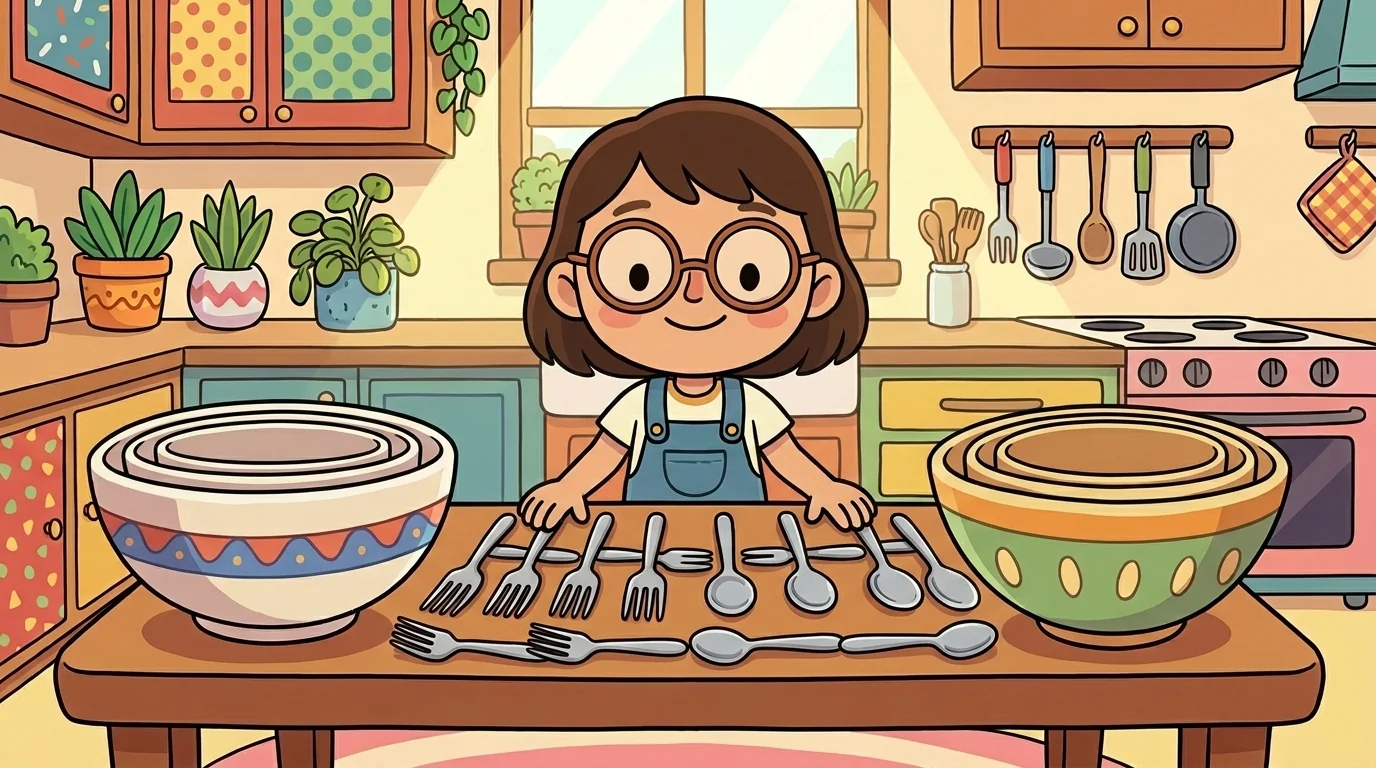
"Counting is fine for small piles," Bijou would say, "but pairing works even when the piles are enormous — even infinite. You don't need to know how many. You only need to know that everyone found a partner and nobody was left over. Match them up cleanly, and equal is proved."
Bijou had once believed she could never know she was enough, because she could never finish counting.
As a young apprentice, Bijou was overwhelmed by anything large — a huge set of tiles, a long list, a crowd — because she thought the only way to understand a group was to count every single member, and big groups made her feel small and defeated. If I can't count it all, I can't know anything about it, she thought, and so the big things always won.
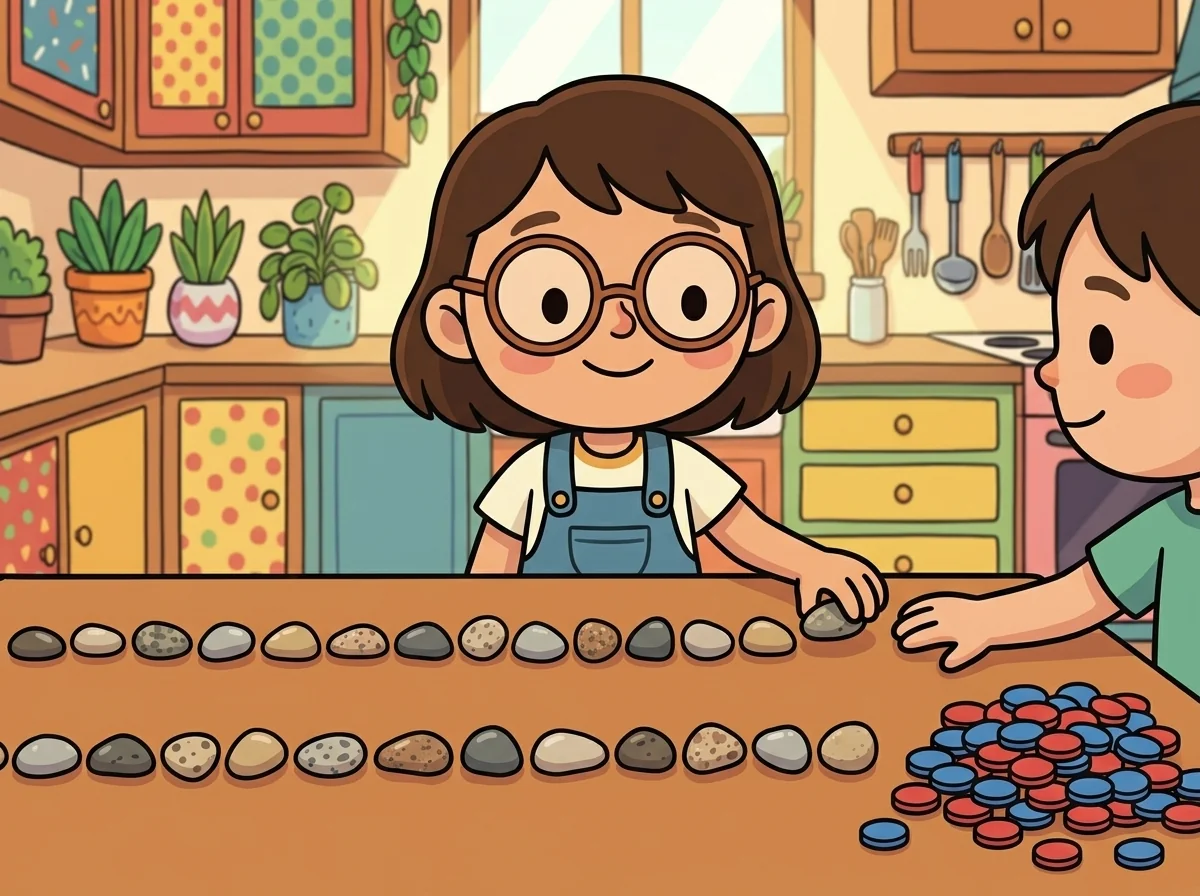
Quill, the workshop's mentor, set two long rows of stones in front of her — far too many to enjoy counting. "You think you have to number every stone to compare the rows," Quill said. "You don't." Quill walked down the rows, touching one stone from each, pairing them. "See — they end together. Same size. I never counted past 'one.'" Quill looked at her kindly. "You don't have to tally everything to know how it measures up. Sometimes you just have to find the match. That's true for stones — and it's true for you." Something in Bijou that had felt too small to ever finish counting quietly steadied.
The kid who came to Bijou looked daunted by a huge scatter of red and blue tiles.
"There are way too many to count," they said, deflating.
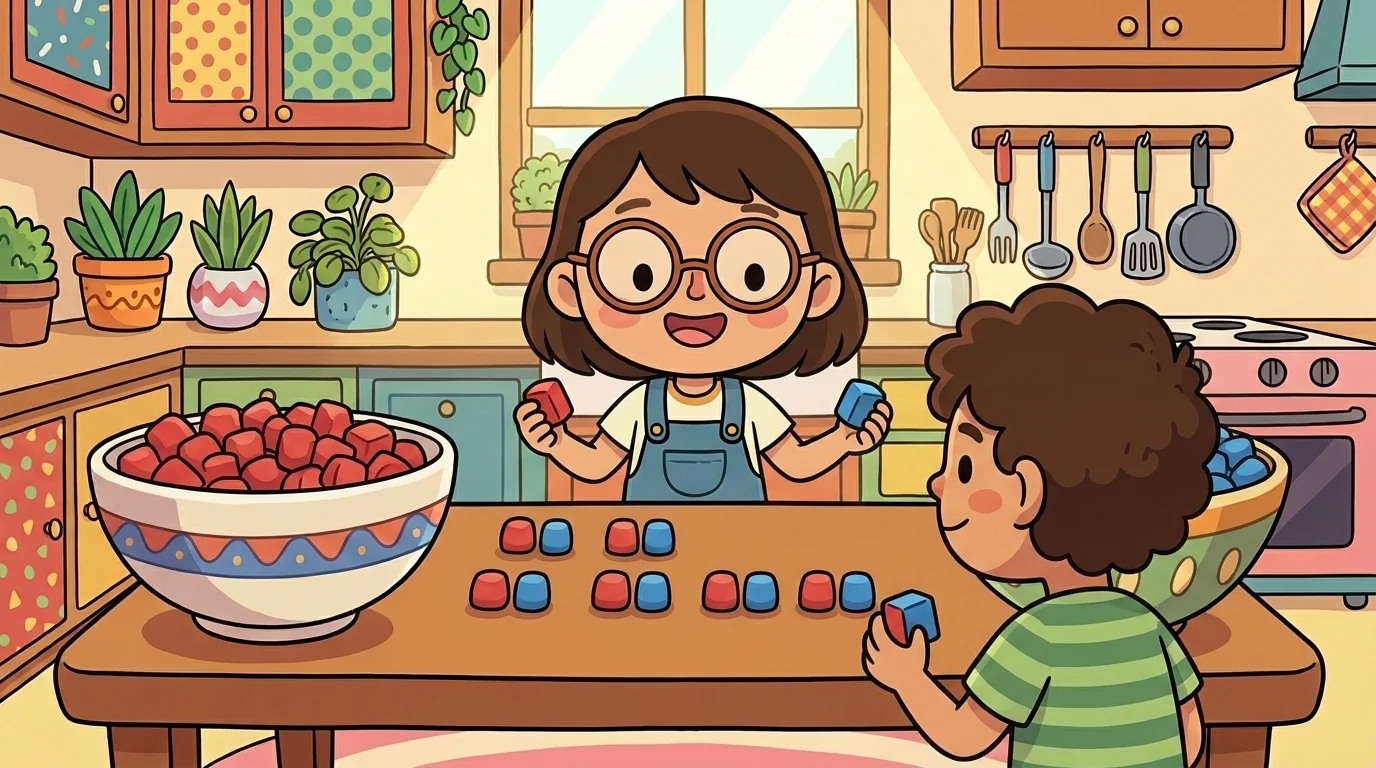
"Then don't count," Bijou said. "Pair. Take one red, take one blue, set them together. Again. Again." The kid started matching red-to-blue, pair by pair. "Now — did anyone get left over?"
The kid checked. "...No. They came out even."
"Then there are the same number of reds and blues," Bijou said. "And you never counted a thing."
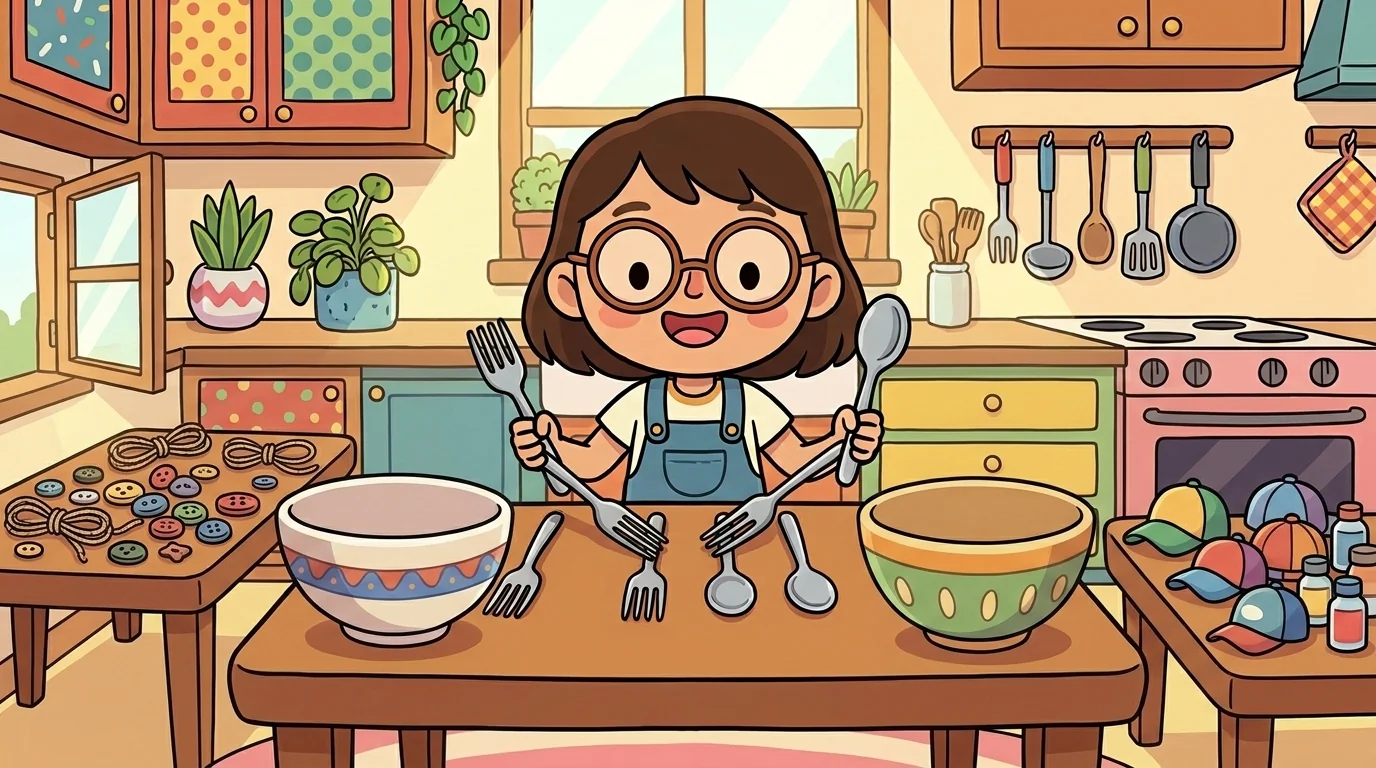
They paired a few more mixed heaps — buttons to loops, caps to bottles — and each time the kid matched one-to-one and read the result off the leftovers instead of a total. When something was left over, Bijou showed how that, too, was an answer: whichever side had the extra was the bigger one, proved without counting. Either way, the kid learned the size of a thing by matching, not tallying.
The feeling that settled into the kid then wasn't only the relief of skipping a giant count. It was kinder and more freeing: the discovery that you can know how something measures up without exhaustively numbering every part of it — that a clean match is proof enough, even for the biggest piles. If two huge heaps could be shown equal by pairing, then being "enough" was never really about finishing an impossible count. That warm, unburdened steadiness — I can know I measure up by finding the match, not by counting forever — spread all the way through, and Bijou felt her own old overwhelm ease once more, because it was the exact steadiness Quill had once given an apprentice who thought she had to count every stone.
"Pair them one-to-one; if nobody's left over, they're the same size," Bijou said, sweeping the matched tiles together. "You don't have to count everything to know it's equal. You just have to find the match."
The CountCraft ensemble
Bijou is part of CountCraft's distributed-narrative cast. Each character embodies a different curricular primitive; together they teach the full subject.
-

Tallis
The Two-Ways Counter — counts the same collection along rows, then along columns, and insists the two totals be equal (double counting)
-

Stacia
The Staircase-Mirror — mirrors a one-two-three staircase against itself to make a rectangle (triangular numbers)
-
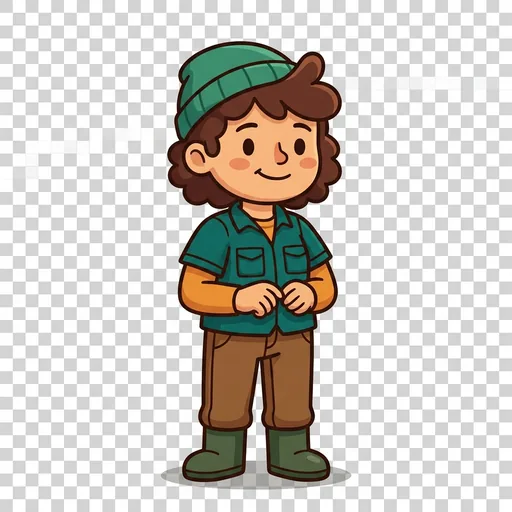
Nona
The Gnomon-Grower — adds the next odd L-shaped layer to grow a square one ring at a time (perfect squares)
-
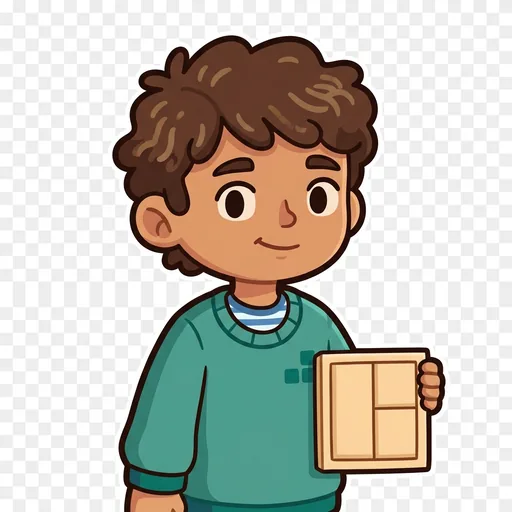
Arel
The Square-Cutter — cuts a square into four rectangles to read off a-squared plus two-a-b plus b-squared (area model)
-

Domina
The Domino-Tiler — tiles a strip with squares and dominoes and counts the number of ways (Fibonacci tilings)
-
Chessa
The Handshake-Counter — pairs everyone with everyone exactly once to count the handshakes (choose two)
-
Cammy
The Committee-Splitter — sorts every committee by whether the last person is in or out (Pascal's rule)
-

Sett
The Subset-Flipper — flips an in-or-out coin for each item to list every subset exactly once (two-to-the-n)
-

Parry
The Parity-Prover — two-colours a board to show when a tiling simply cannot exist (parity and impossibility)
-

Quill
The Proof Director (mentor) — a warm, attentive adult who coaches build-the-two-counts-then-read-the-identity, and never proves for the kid