
Nona
PERFECT SQUARES BY GNOMONS — *an n by n square grows to (n+1) by (n+1) by adding an L-shaped layer of 2n+1 tiles; so 1+3+5+...+(2n-1) = n squared.*
Loading audio…
Press play to listen along. The line being read lights up as you go.
Show full transcript
Loading transcript…
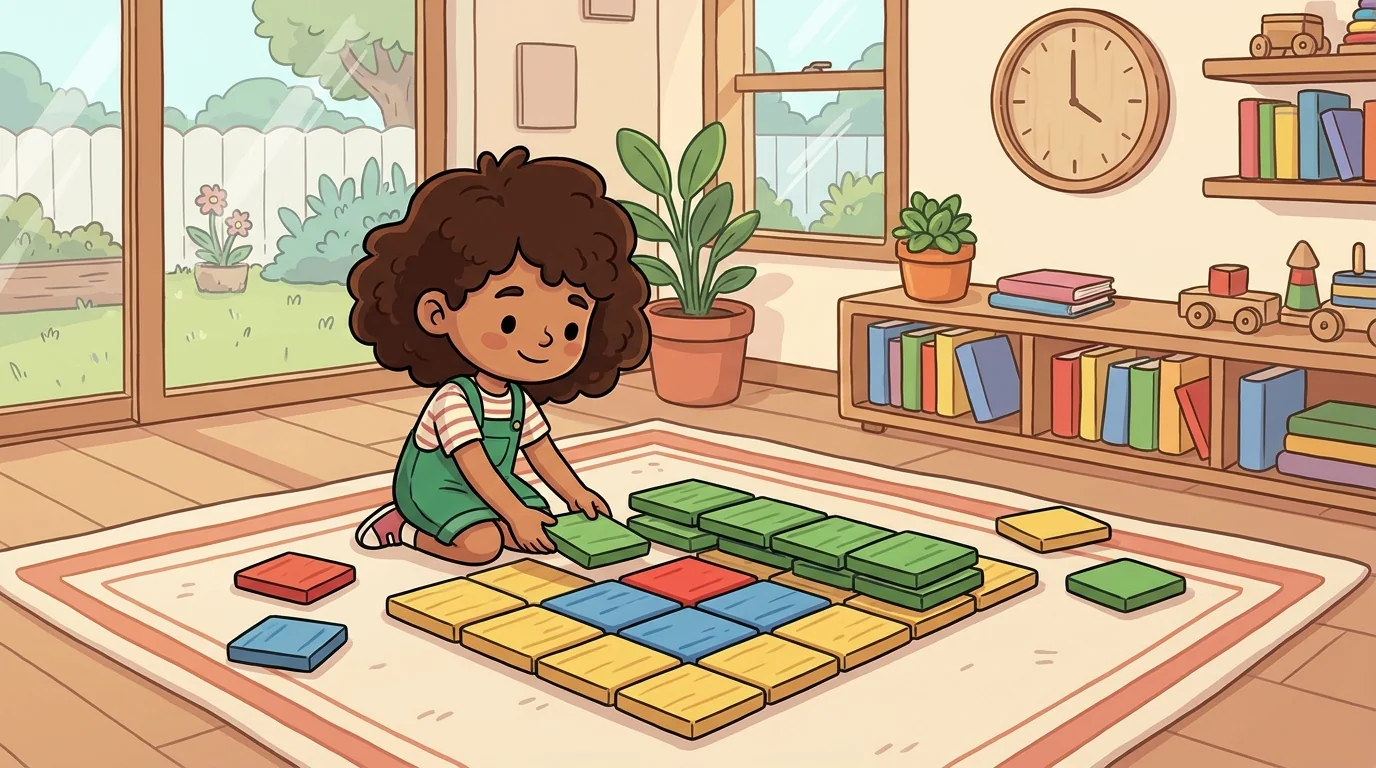
The workshop smelled of wet river stone, cedar shavings, and gray tile paste. Nona worked at a long pine bench scarred by four generations of apprentice chisels. Her knuckles were chalky with lime dust, her thumbs calloused from pressing slate. She kept her materials sorted in low cedar trays, divided by color and thickness. Most people saw a box of loose tiles and thought only of random fragments. Nona saw corner joints waiting to lock together.
She began her morning demonstration with a single square of glazed cobalt pottery. A one-by-one square was small, but it was solid, balanced, and completely finished. Then she reached into a tray of pale birch-colored tiles to build an L-shaped layer. She laid one tile along the top edge, set another against the right side, and tucked a third into the corner socket. Three tiles made the bend, wrapping two sides without disturbing the blue stone underneath. Together, the four pieces formed a clean two-by-two square.
"One tile plus three tiles gives you four," Nona said, smoothing her thumb over the seam. The original blue tile had not moved a fraction of an inch from its starting place. It was not scratched, cracked, or shoved aside by the newcomers. It was simply wearing a new jacket of stone.
Next came five ash-gray tiles to form the second L. She set two along the upper edge and two along the right flank. The fifth tile dropped neatly into the corner to unite the two wings. Four plus five made nine, producing a three-by-three square with edges as straight as a plumb line.
"Every time you add the next odd number as an L-shaped layer, the square grows larger and stays square," Nona said. Outsiders usually treated the sequence like a curious trick, but it was just honest geometry. One, plus three, plus five, plus seven, plus nine. Stacked together in order, consecutive odd numbers built the squares: one, four, nine, sixteen, twenty-five, thirty-six. The odd numbers were not awkward leftovers from division. They were the exact brackets required to expand a square without throwing its corners out of true.
"People think adding something new might wreck the shape," Nona said, resting her palms on the cool stone. "They think you have to break down what you made before you can build anything bigger. But the right layer doesn't wreck what is there. It grows it."
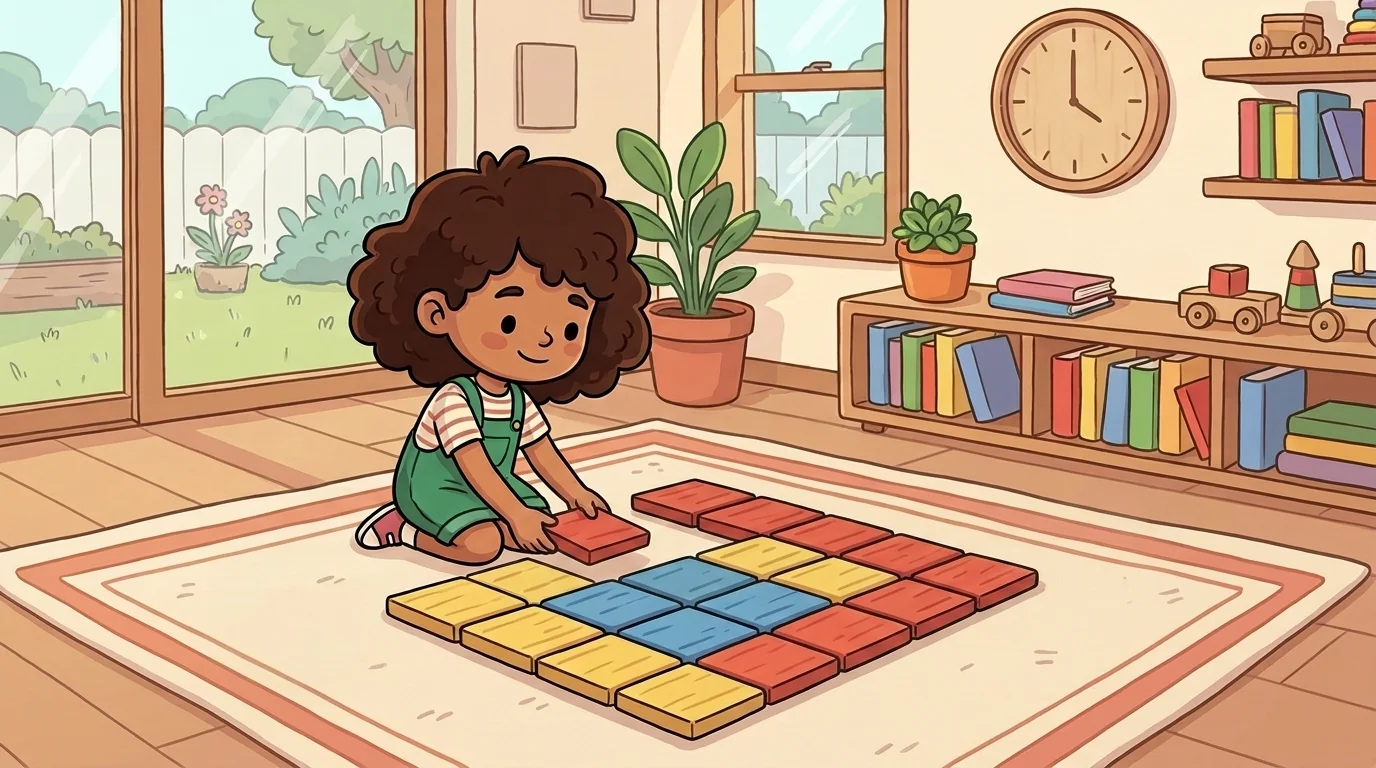
Nona remembered the years when change had felt like pure catastrophe. As a young apprentice, she clung fiercely to whatever small tasks she had already mastered. If she smoothed a cedar peg until it fit flush, she hid it deep in her apron pocket. She refused to drive it into a joint, terrified that the mallet might split the grain. When Quill assigned the shop to cut paving stones, Nona spent two weeks grinding a single square of green jasper until it gleamed like water.
Then she stopped, keeping both elbows planted on the table to protect the stone. She would not set it into mortar, and she would not trim its edges for a frame. She stayed a careful little one-by-one square, frozen while other apprentices ruined stones and learned lessons. Whenever another worker carried a tray of fresh stone past her bench, Nona flinched. She was certain that any addition would strike her jasper and shatter it into gravel.
Quill, the workshop's master, watched her defensive posture for three days without scolding her. He was an old stonemason whose knuckles were gray with mortar and whose vests smelled of damp earth. On a rainy Thursday, he dragged a low stool over to her bench. He did not reach for her green jasper. Instead, he laid four terracotta squares in front of her, nudging them into a neat two-by-two block.
"You think adding a layer will break you," Quill said, his voice as dry as limestone dust. Nona tightened her grip on her jasper, pressing the stone into her palm until the corners bit. "If you attach heavy things to a finished piece, the seam gives way," she muttered. "It ruins the work."
Quill did not argue with her. He reached into a wooden bucket and drew out five chips of pale river slate. He laid two chips across the top edge of the terracotta block. He laid two chips along the right edge, matching their seams with the terracotta beneath. Then he set the fifth chip into the corner gap, locking the two arms into a single rigid bracket. The slate snapped cleanly against the terracotta with a sharp, hollow click.
"Look at your four red stones," Quill said, gesturing with a blunt finger. "Did they crack?" Nona leaned over the bench, squinting at the joints. The four terracotta tiles sat undisturbed, solid and red against the grey bench. "No," she admitted.
"It didn't crack," Quill told her gently. "It grew. And it is still a perfect square, just a bigger one." He tapped the corner of the new slate bracket. "The right kind of growth doesn't ruin what you already are. It keeps you whole and makes you more. You were never going to break, Nona. You were going to get bigger."
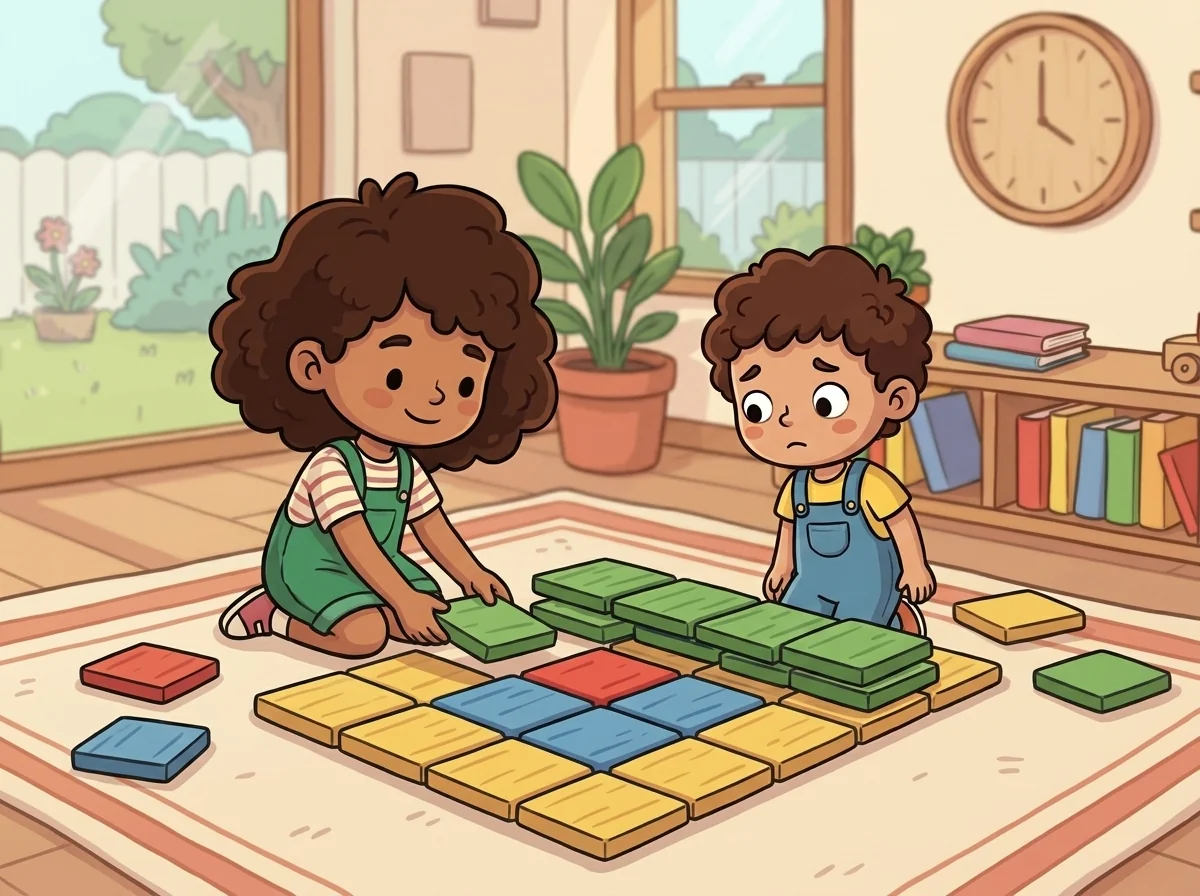
Something rigid inside Nona’s chest, held tight for weeks, finally slackened. She opened her hand, set the green jasper onto the bench, and picked up three marble chips to frame it.
The memory faded as the shop door creaked open, admitting a gust of chilly air and a hesitant boy. His name was Ren, and he was twelve, with chalk smudges across his forearms and scuffed work boots. He carried a shallow wooden tray containing a three-by-three square of nine ochre tiles. It was the first paver Ren had ever completed without misaligned seams, and he held it tightly.
"Master Quill told me to start on a sixteen-tile paver," Ren mumbled, staring at his boots. "I'm not doing it."
"Why not?" Nona asked, wiping a smudge of clay from her thumb.
"I don't want to try the harder square. I'll just mess up the one I've got."
Ren hovered his hands over his nine ochre tiles, ready to shield them. "To make sixteen, I'd have to pry these loose and scrape off all the backing," he explained. "Then everything gets smeared, the corners chip, and I end up with nothing."
Nona leaned against the bench and picked up a dry dusting brush. "Who told you to take it apart?"
Ren blinked at her, confused by the question. "Sixteen tiles means four rows of four," he said, speaking slowly. "This one is only three rows. You can't turn a three into a four without breaking the pattern."
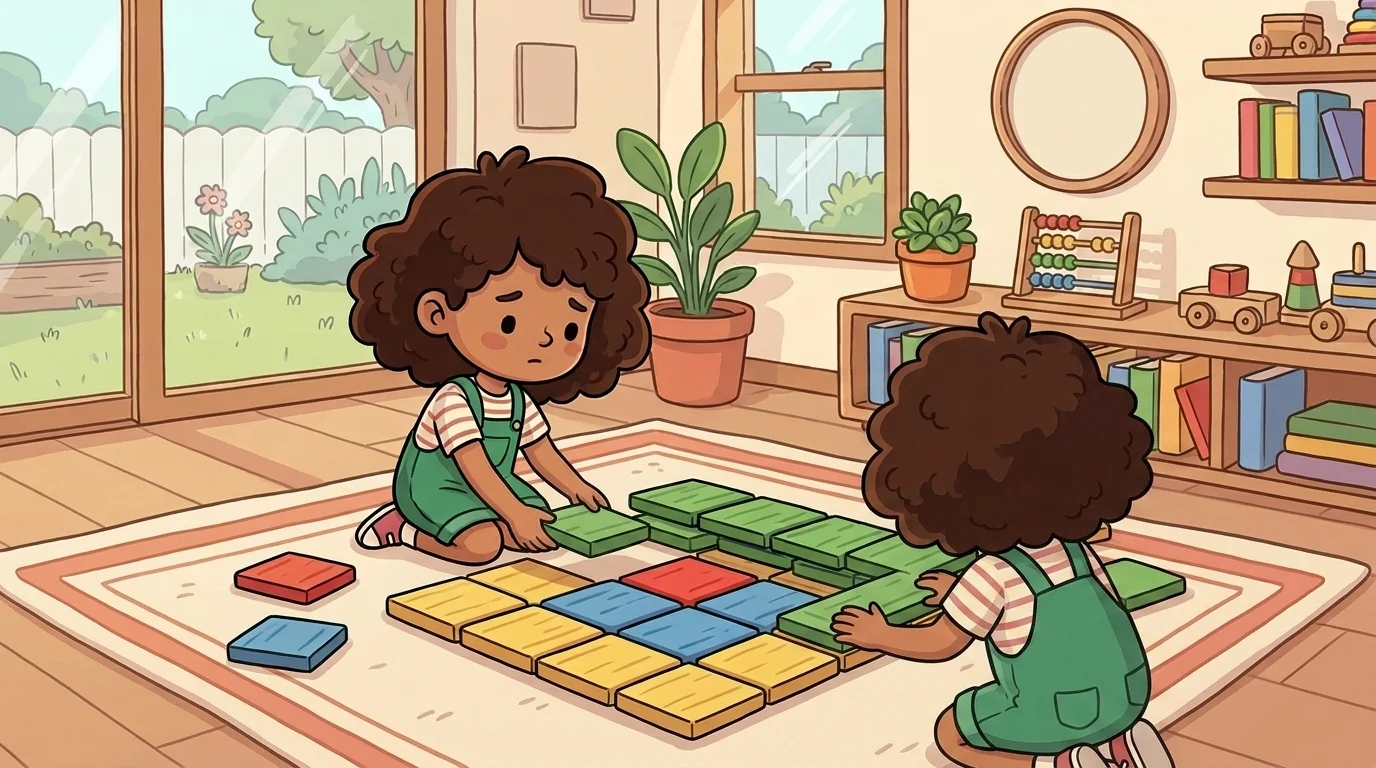
"Let's grow it gently," Nona said, sliding his tray toward the center of the pine table. "Here is your three-by-three square, exactly nine tiles. Don't rebuild it, and don't unstick a single seam." She tapped a crate of dark slate tiles beside his elbow. "Just wrap the next odd layer around it. How many tiles in the next L?"
Ren hesitated, looking between Nona and the crate of dark slate. He laid a finger along the top row of his ochre paver. "Three tiles would cover the top," he calculated quietly.
"And three tiles down the right edge," Nona added.
"That's six," Ren said. He paused, his eyes narrowing as he visualized the corner. "Wait. If you put three on top and three on the side, the corner is empty. You need one extra tile in the elbow to make the lines meet flush."
"So how many tiles total for the bracket?" Nona asked.
Ren counted silently on his knuckles. "...Seven."
"Add them," Nona commanded with a nod toward the slate bin.
Ren picked up seven slate tiles, handling each one as cautiously as blown glass. He laid three tiles across the top edge of his ochre block. He laid three tiles along the right side, aligning the edges with his thumb. Finally, he picked up the seventh tile and slid it into the empty corner socket. It settled into place with a dry, solid thud.
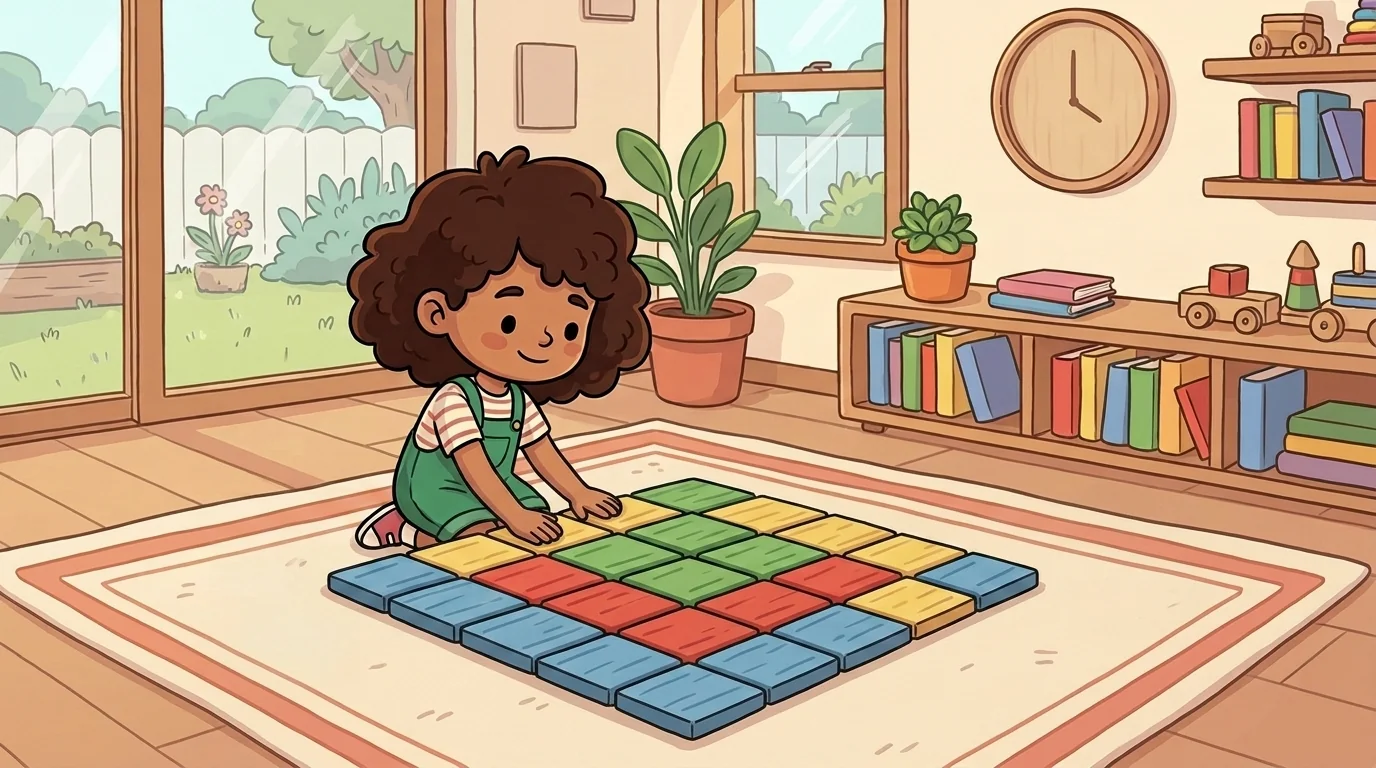
"What size is it now?" Nona asked.
Ren traced the outer border with his fingertips, counting under his breath. "Four across," he said, his voice rising in sudden wonder. "Four down. Four times four is sixteen." He looked up from the table, his eyes bright. "And I didn't break the nine. It's still in there."
"It never had to move," Nona said. "The nine tiles are doing the heavy lifting now. They hold the center so the slate doesn't wobble."
Ren stood over the table, his shoulders dropping as the anxious stiffness drained out of his spine. He reached toward a bin of cream-colored limestone without asking for permission. "The next odd number after seven is nine," he declared, pulling tiles from the tray. He laid four limestone tiles across the top and four down the outer flank. The ninth piece dropped into the corner socket, expanding the square to twenty-five tiles.
"And after nine comes eleven," Ren said, grinning now as he grabbed handfuls of red jasper tiles. He wrapped the eleven red tiles around the cream limestone, fitting the corner with ease. Twenty-five plus eleven made thirty-six, producing a massive six-by-six paver that filled the tray. Each layer hugged the square underneath, keeping every earlier tile resting safely in place. With each new bracket, the boy seemed braver about adding on, less fearful that expansion would destroy his work.
The feeling that settled over Ren was more than the satisfaction of stacking tiles in tidy rows. It was the discovery that growth does not require tearing down who you were yesterday. You could take on a whole new layer and remain completely whole, carrying your earlier self safely inside. If a square could expand and stay square, then stepping toward harder work was no longer a threat.
Nona felt her own lingering stiffness soften as she watched the boy run his palms across the stones. It was the exact courage Quill had handed an apprentice who once feared a second layer would ruin her. She patted the sturdy outer border of red jasper.
"Add the next odd L, and the square grows to the next size," Nona said softly. "Growing doesn't break you. The right new layer keeps you whole and makes you more."
The CountCraft ensemble
Nona is part of CountCraft's distributed-narrative cast. Each character embodies a different curricular primitive; together they teach the full subject.
-

Tallis
The Two-Ways Counter — counts the same collection along rows, then along columns, and insists the two totals be equal (double counting)
-

Bijou
The Pair-Matcher — draws a one-to-one pairing between two sets to prove they are exactly the same size (bijection)
-

Stacia
The Staircase-Mirror — mirrors a one-two-three staircase against itself to make a rectangle (triangular numbers)
-

Arel
The Square-Cutter — cuts a square into four rectangles to read off a-squared plus two-a-b plus b-squared (area model)
-

Domina
The Domino-Tiler — tiles a strip with squares and dominoes and counts the number of ways (Fibonacci tilings)
-
Chessa
The Handshake-Counter — pairs everyone with everyone exactly once to count the handshakes (choose two)
-

Cammy
The Committee-Splitter — sorts every committee by whether the last person is in or out (Pascal's rule)
-

Sett
The Subset-Flipper — flips an in-or-out coin for each item to list every subset exactly once (two-to-the-n)
-

Parry
The Parity-Prover — two-colours a board to show when a tiling simply cannot exist (parity and impossibility)
-

Quill
The Proof Director (mentor) — a warm, attentive adult who coaches build-the-two-counts-then-read-the-identity, and never proves for the kid