
Sett
SUBSETS ARE 2 TO THE N — *each of n items gets an independent in-or-out choice, so the number of subsets is 2 multiplied by itself n times, and every subset is one unique pattern of choices.*
Loading audio…
Press play to listen along. The line being read lights up as you go.
Show full transcript
Loading transcript…
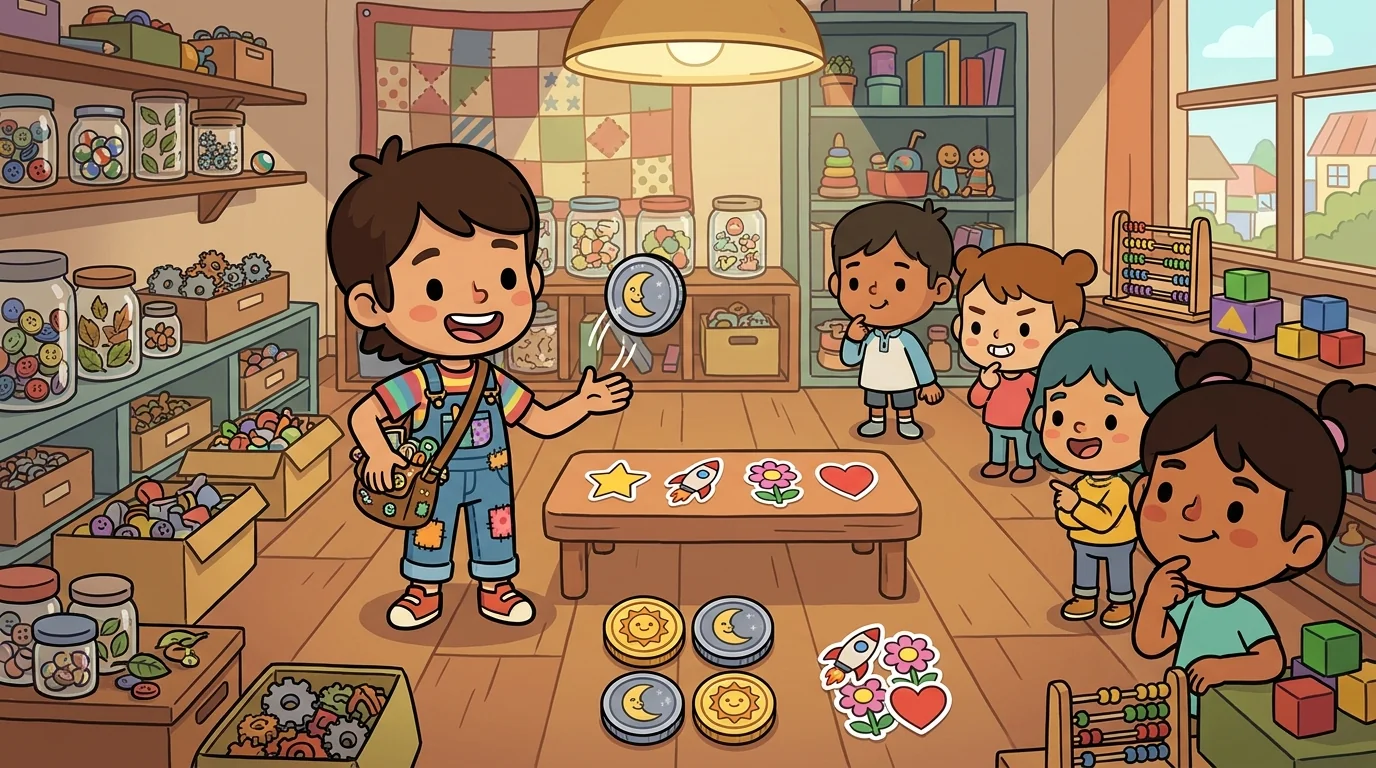
Sett collected everything, and organized it by subsets — every possible smaller group you could pull from a collection. "I've got these four stickers," Sett would say. "How many different groups could I make from them — counting the empty group and the whole set?" People start listing: just this one, just that one, these two together... and get lost. Sett doesn't list. Sett flips coins. "For each sticker, I make one tiny decision: in, or out. Heads it's in, tails it's out. Four stickers, four independent in-or-out flips."
"And here's the magic," Sett would say. "Every different pattern of flips is a different group — and every possible group is some pattern of flips. None missed, none doubled. So the number of groups is two choices, times two, times two, times two — two to the fourth — sixteen." Two, multiplied by itself once per item. "You never have to list them," Sett said. "You just count the choices: a coin per thing, and two to the n covers them all — including the empty one and the everything one."
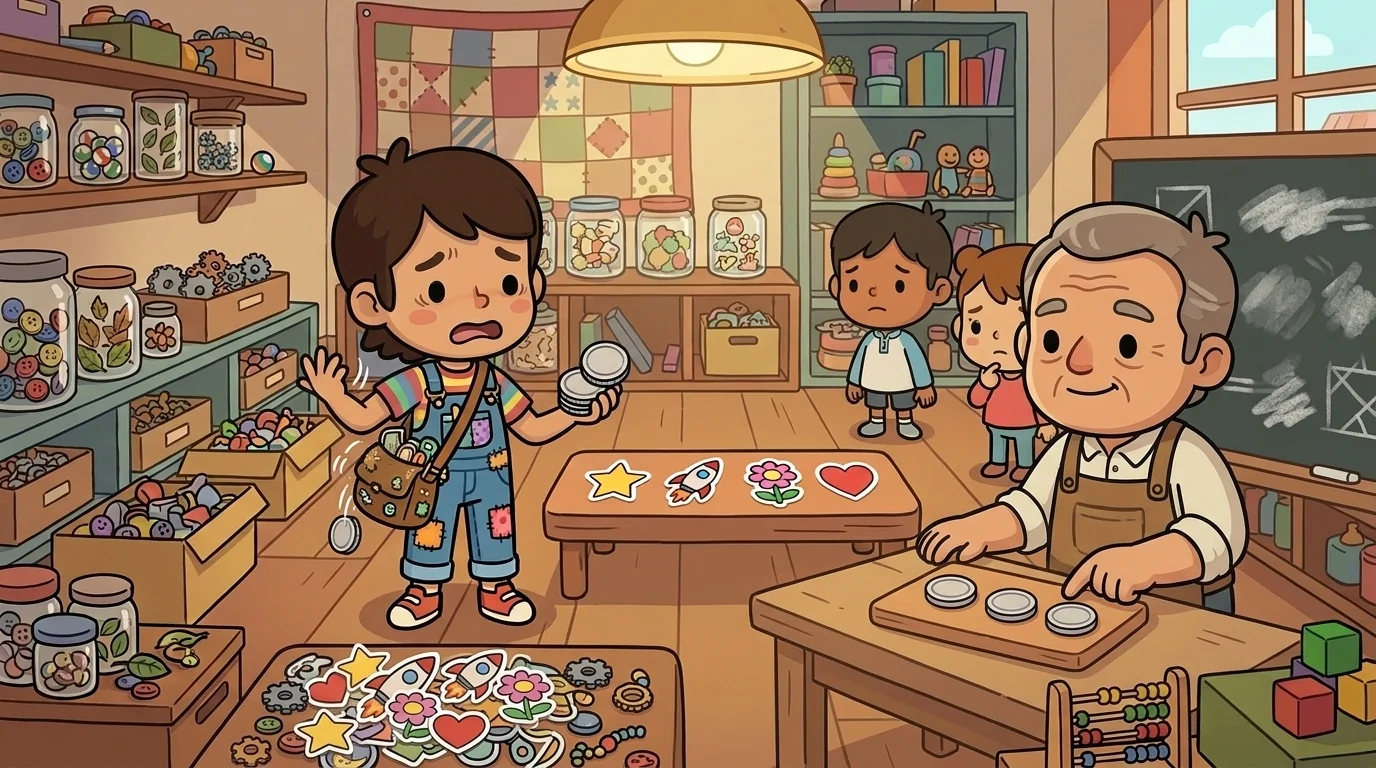
Sett used to feel buried under choices, sure they'd always miss one or pick wrong.
As a young apprentice, Sett hoarded options and could never feel sure a list was complete — always the nagging worry that some combination had been forgotten, or counted twice, or lost. Any "how many possibilities" question felt like a pile Sett could never fully account for, and that uncertainty was exhausting.
Quill, the workshop's mentor, found Sett re-listing the same combinations for the third time, anxious. "You keep trying to list them and losing your place," Quill said. "Stop listing. Decide." Quill lined up three tokens. "For each one: in, or out. That's it. Every pattern of in-and-out is exactly one group, and every group is exactly one pattern." They counted the choices instead of the groups: two times two times two, eight. "You can't miss one and you can't double one," Quill said, "because each group has its own unique set of yes-or-no's. Nothing gets lost when everything has its own place." Something in Sett that had always feared missing one finally rested.
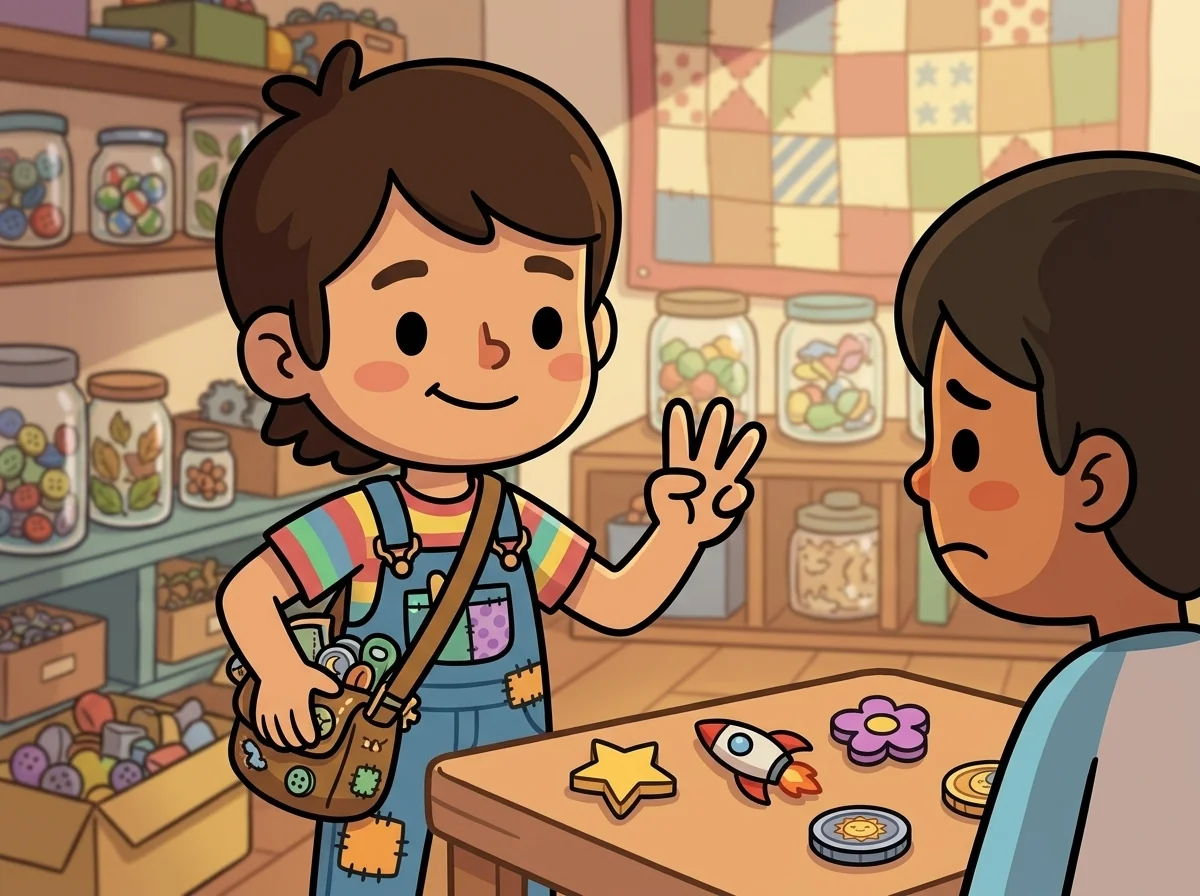
The kid who came to Sett looked anxious, like they were sure they'd forget something. "If I list all the combinations I'll definitely miss some."
"Then don't list — decide," Sett said. "You've got three things. For each one, just one choice: in or out. How many choices per thing?"
"Two."
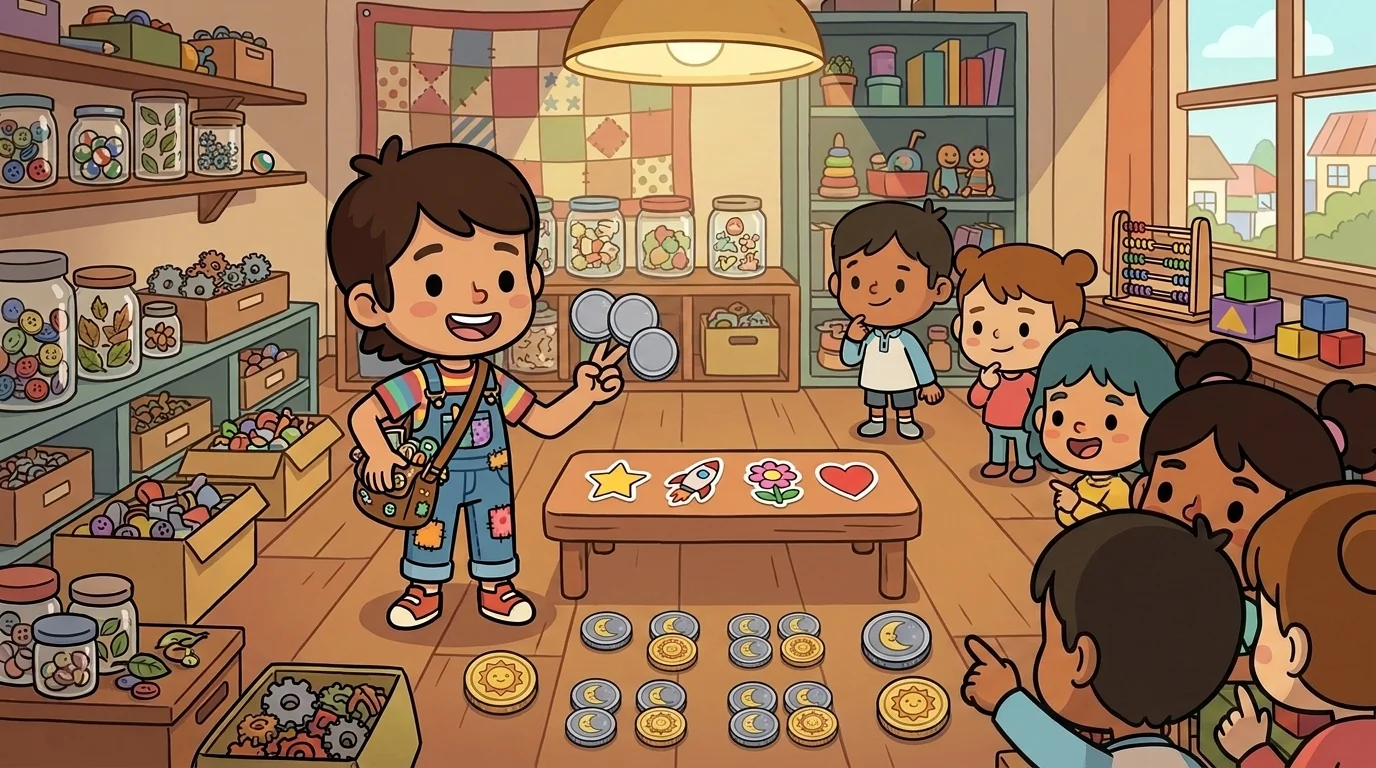
"Three things, each an independent two-way choice. So how many patterns total?"
"...Two times two times two? Eight."
"Eight — and that includes taking none of them and taking all of them. Every group is one pattern; every pattern is one group. Could you miss one?"
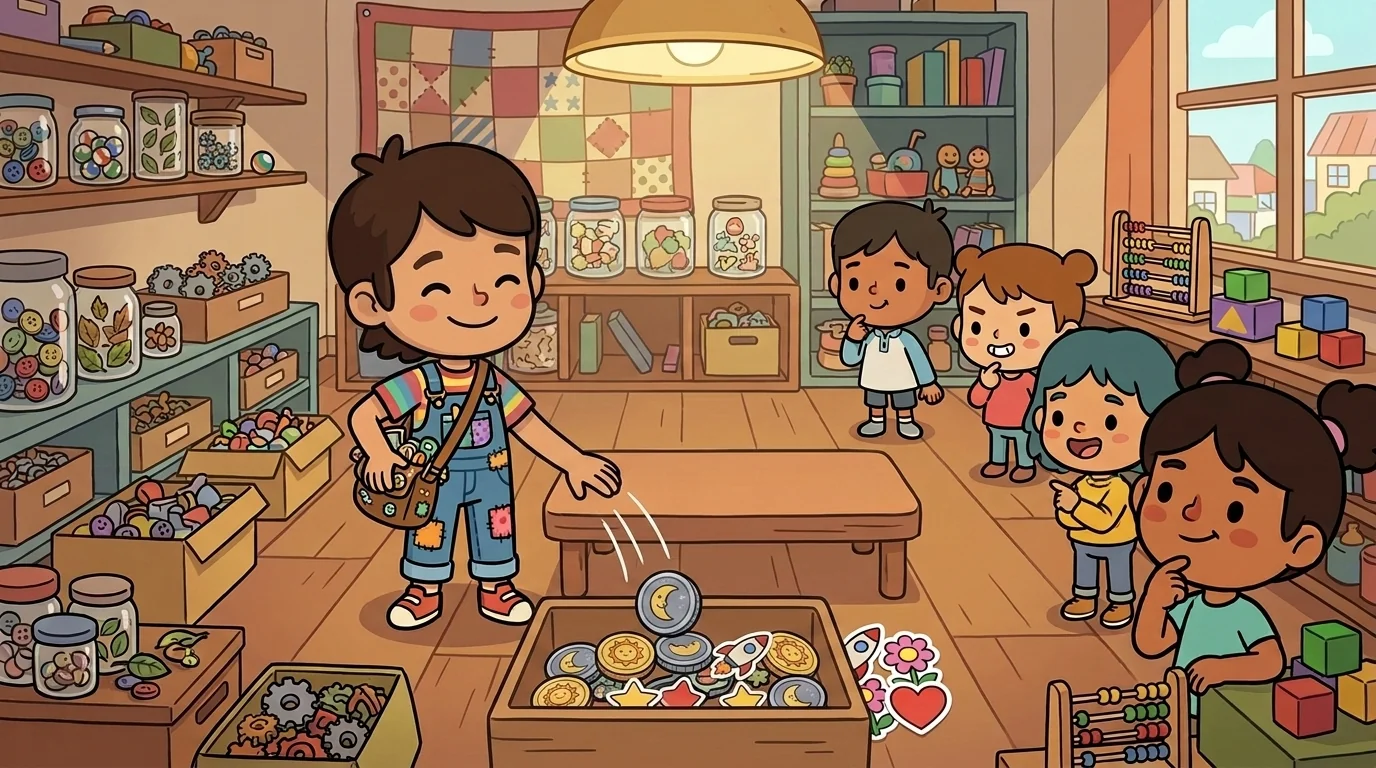
The kid thought about it. "...No. Each one has its own set of yes-or-nos."
They counted a couple of collections by the coin-per-item rule — four items give sixteen subsets, five give thirty-two — the kid multiplying two by itself once per item and trusting that every combination had its own exact pattern. And with each one, the anxious "I'll miss something" feeling gave way to the calm certainty that nothing could be lost when everything had its own place.
The feeling that grew in the kid then wasn't only the neatness of counting subsets. It was more reassuring than that: the discovery that endless-seeming possibilities are really just a string of small yes-or-no choices, and that when each combination has its own unique pattern, none can be missed and none doubled. If every possible group had a guaranteed, exact place, then the fear of forgetting one was a fear they could set down. That warm, settling certainty — every possibility has its own place; nothing gets lost — spread all the way through, and Sett felt the old buried-under-choices worry ease once more, because it was the exact certainty Quill had once given an apprentice terrified of missing one.
"Flip an in-or-out coin for each item; that's two to the n," Sett said, sweeping the tokens into a tidy pile. "You never have to list them all. Every group has its own place, and the choices count themselves."
The CountCraft ensemble
Sett is part of CountCraft's distributed-narrative cast. Each character embodies a different curricular primitive; together they teach the full subject.
-

Tallis
The Two-Ways Counter — counts the same collection along rows, then along columns, and insists the two totals be equal (double counting)
-

Bijou
The Pair-Matcher — draws a one-to-one pairing between two sets to prove they are exactly the same size (bijection)
-

Stacia
The Staircase-Mirror — mirrors a one-two-three staircase against itself to make a rectangle (triangular numbers)
-

Nona
The Gnomon-Grower — adds the next odd L-shaped layer to grow a square one ring at a time (perfect squares)
-
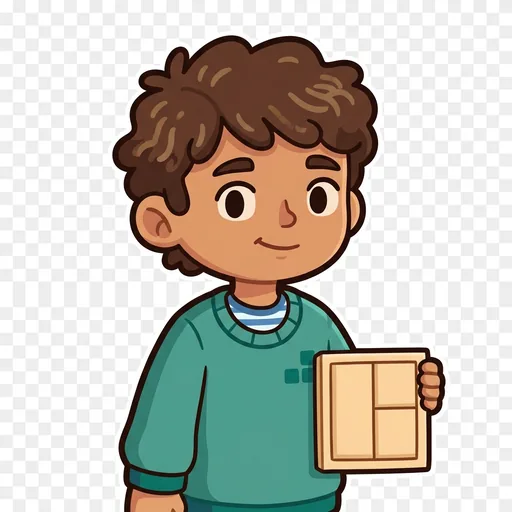
Arel
The Square-Cutter — cuts a square into four rectangles to read off a-squared plus two-a-b plus b-squared (area model)
-
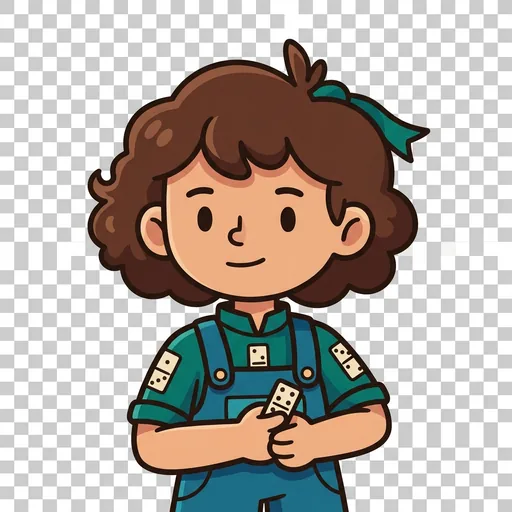
Domina
The Domino-Tiler — tiles a strip with squares and dominoes and counts the number of ways (Fibonacci tilings)
-
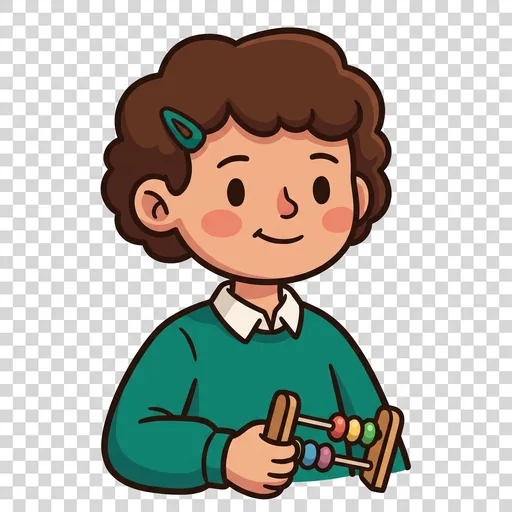
Chessa
The Handshake-Counter — pairs everyone with everyone exactly once to count the handshakes (choose two)
-
Cammy
The Committee-Splitter — sorts every committee by whether the last person is in or out (Pascal's rule)
-

Parry
The Parity-Prover — two-colours a board to show when a tiling simply cannot exist (parity and impossibility)
-

Quill
The Proof Director (mentor) — a warm, attentive adult who coaches build-the-two-counts-then-read-the-identity, and never proves for the kid