
Parry and Domina
PROVING A COUNT IS ZERO — impossibility is the flip side of counting: Domina tiles strips with squares and dominoes and counts the ways, and Parry two-colours a board so that every domino must cover one square of each colour — so when the two colours don't come out equal, the number of tilings is provably zero, no trying required.
A story read by Parry and Domina
Loading audio…
Press play to listen along. The line being read lights up as you go.
Show full transcript
Loading transcript…
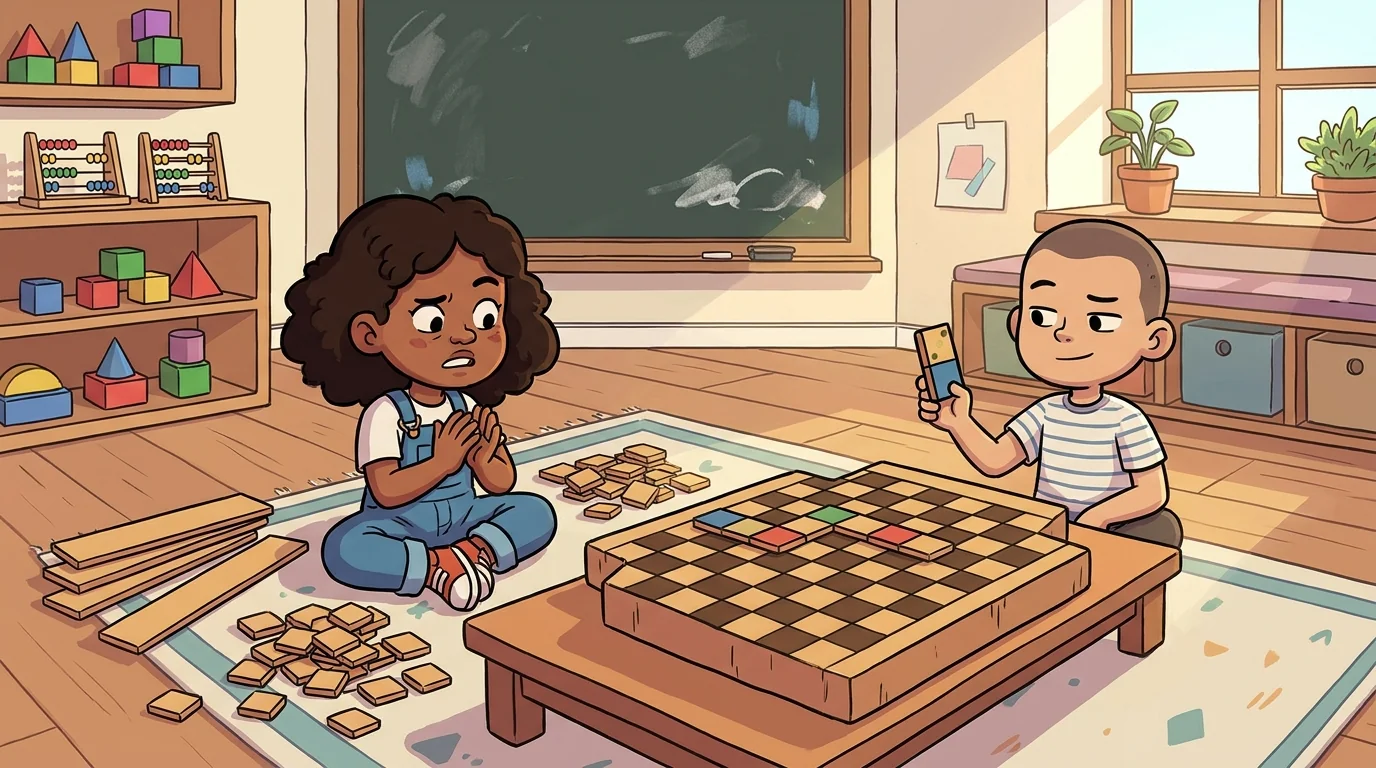
Domina loved counting the ways more than almost anything. Hand her a long, thin board and a bag of tiles — the little squares and the dominoes, each domino covering two spaces at once — and she would patiently work out every possible way to cover it end to end. The counts always came marching out in that friendly climbing pattern she adored, where each new number turned out to be the sum of the two before it, like a staircase building itself.
So when someone set a checkerboard in front of her with two opposite corners snipped clean off and said, "go on, then — tile that one with dominoes," she rubbed her hands together in happy anticipation. This was precisely her favorite kind of afternoon.
An hour later, it was decidedly not her favorite kind of afternoon.
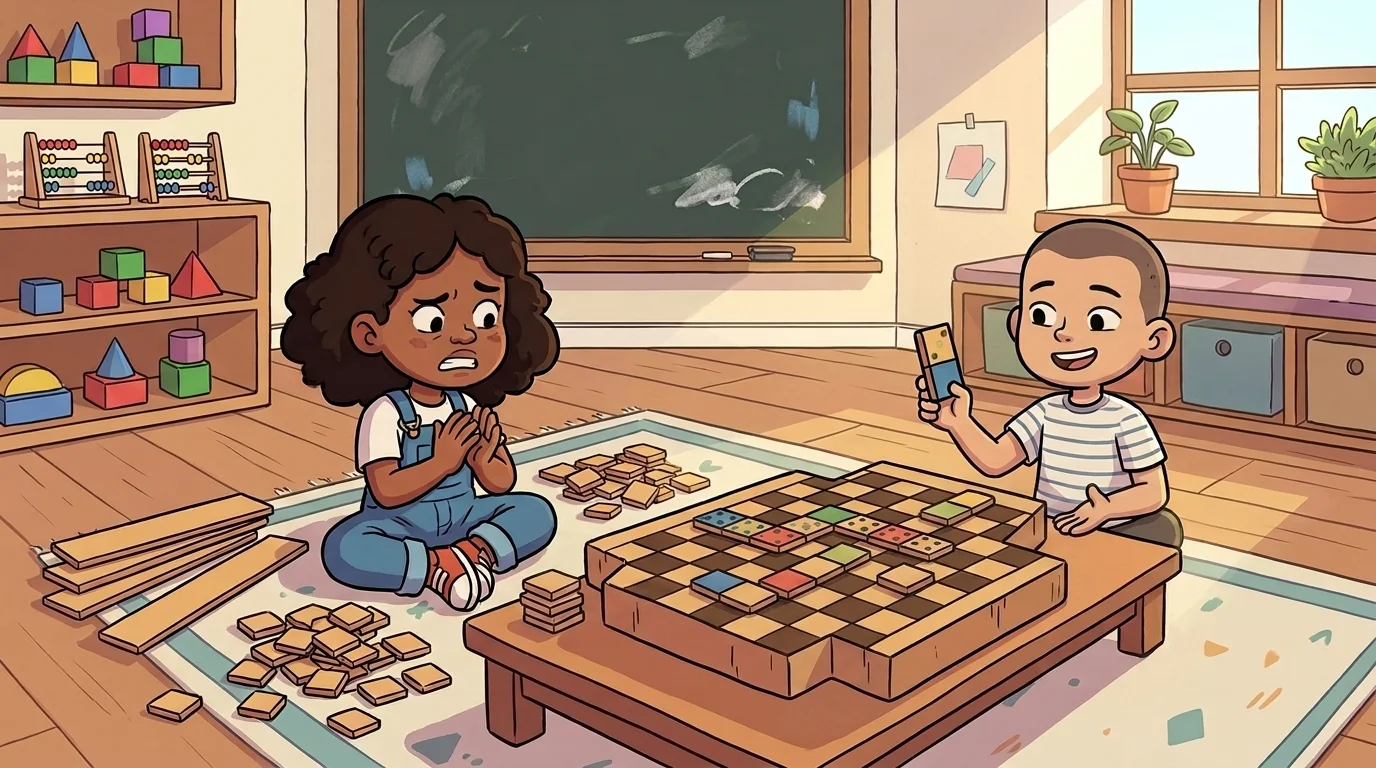
She had tried absolutely everything she could think of. Dominoes laid across in tidy rows, dominoes standing on end in columns, starting from the very middle and working out, starting from an edge and working in, clever winding spirals, stubborn brute-force marches. And every single time, without exception, she would cover nearly the whole board and then find herself stranded with two lonely squares left over — sitting in different corners of the board, too far apart to ever be bridged by a single domino.
"I'm just not seeing it," she muttered, sweeping all the tiles off with the side of her hand to start over yet again. Her chest had gone tight, with that low sinking feeling underneath it — the one that leans in close and whispers everyone else could figure this out. She had counted the ways for a hundred boards without breaking a sweat. Why, then, could she not find so much as one way for this one stubborn board?
Parry drifted over, took a single unhurried look at the snipped-corner board, and — pointedly — did not reach for a tile.
"How long have you been at this?" Parry asked.
"Long enough to feel genuinely stupid about it," Domina admitted.
"Well, I've got good news," Parry said. "You're not stupid. The board is lying to you."
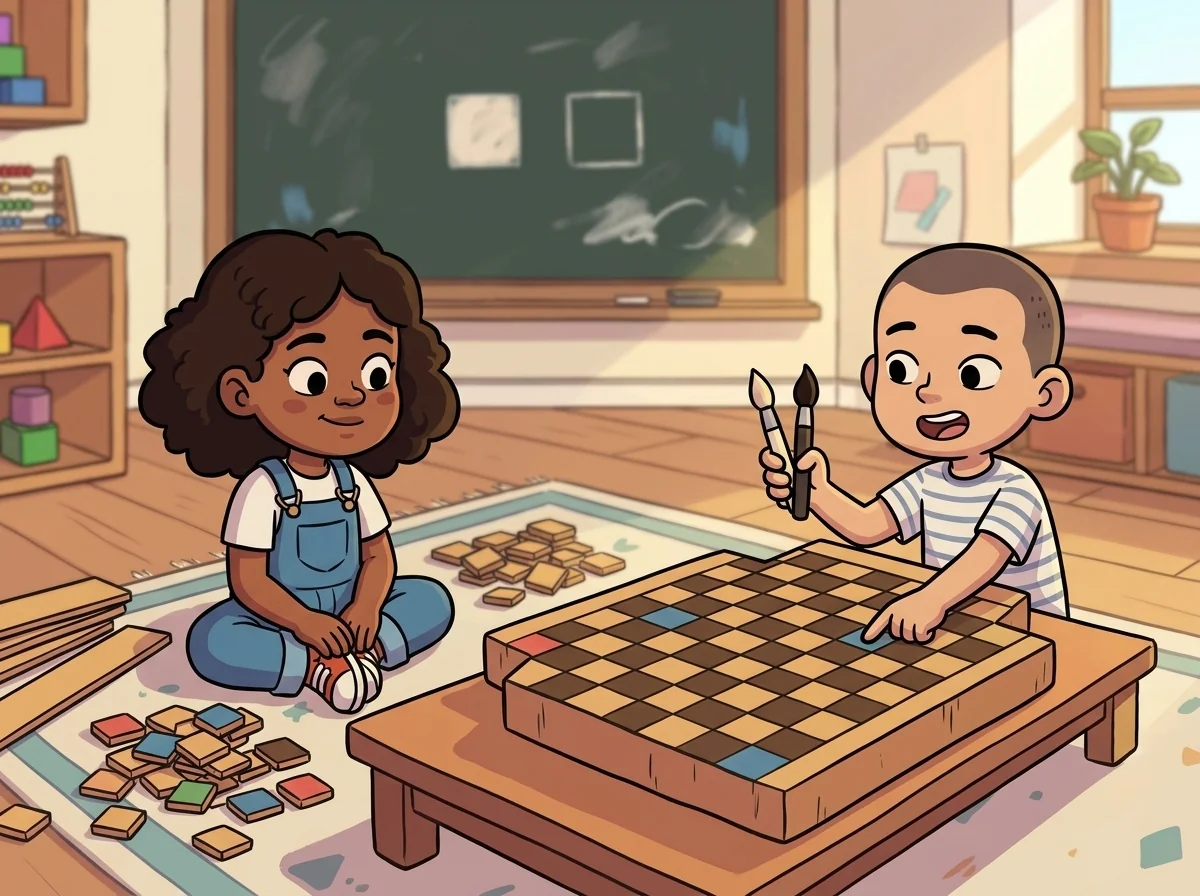
Parry produced two markers, one light and one dark. "Watch this. I'm going to colour the whole thing in like a proper checkerboard — light, dark, light, dark, every square taking the opposite of its neighbor." They filled it in swiftly, the familiar alternating pattern rippling out across the board. "Now hold on to this next part, because it's the key to everything. A domino always covers two squares that are touching, side by side. And here's the thing about a checkerboard: any two squares that touch are always one light and one dark, never a matching pair. Which means every domino you could ever lay down, anywhere on this board, in any direction, swallows exactly one light square and exactly one dark square. One of each. No exceptions, ever."
Domina nodded slowly. That part she knew deep in her bones.
"So here's the trap," Parry went on. "If this board could be completely tiled by dominoes, then it would have to hold exactly the same number of light squares as dark ones — because the dominoes only ever come in one-of-each pairs, and pairs can only add up evenly." They tapped the two missing corners, the empty notches where the board had been snipped. "But look very carefully at which corners got cut away. On any checkerboard, two opposite corners are always the same colour as each other. Both of these were dark. So this poor board is left with thirty-two light squares and only thirty dark ones. Two extra lights — and not a single dark square anywhere left to pair them off with."
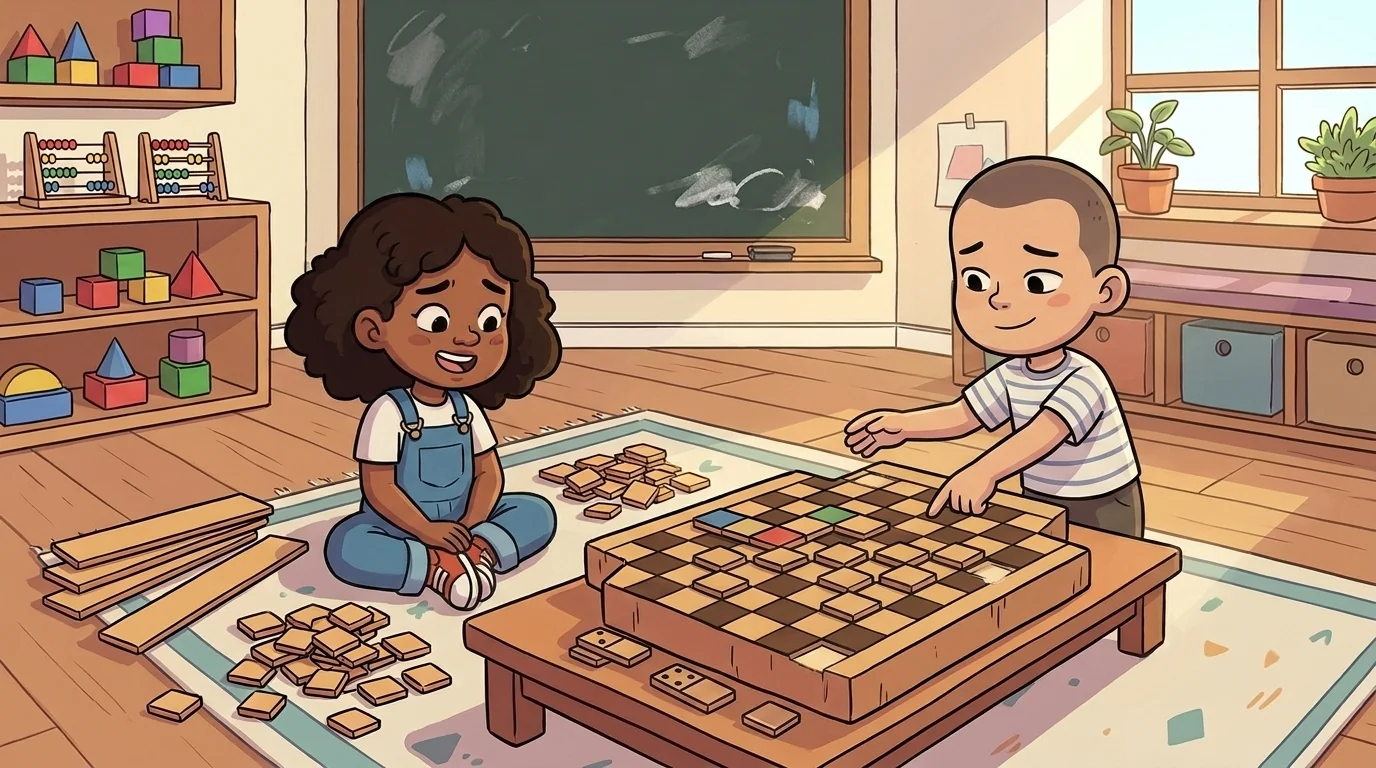
Domina stared down at the board she had wrestled with all afternoon.
"Two extra lights," she repeated quietly. "And every domino has to take one of each."
"So no matter how clever you are, or how long you keep at it," Parry said, gently now, "you will always end up with two light squares stranded and nothing on earth to cover them with. Not because you missed some trick you should have spotted. Because there is no trick. The number of ways to tile this board isn't small, and it isn't hiding. It's zero."
Something in Domina's chest let go all at once. It wasn't the tight, sinking feeling anymore — it was very nearly the opposite of that: a clean, level, quiet certainty settling into the space where the dread had been.
"I wasn't failing," she said, half in wonder. "I was proving it — just the slow, painful way. Trying and trying and always finishing with the exact same two leftovers, over and over." She laughed a little, still shaky around the edges. "You just did it the fast way. You counted the colours."
"That's all impossibility ever really is," Parry said. "It's counting — from the other side of the mirror. You count how many ways a thing can be done: sometimes the answer is a big, friendly number, sometimes a small one. And every so often you count, and the answer comes out zero — and the colours are right there to tell you exactly why."
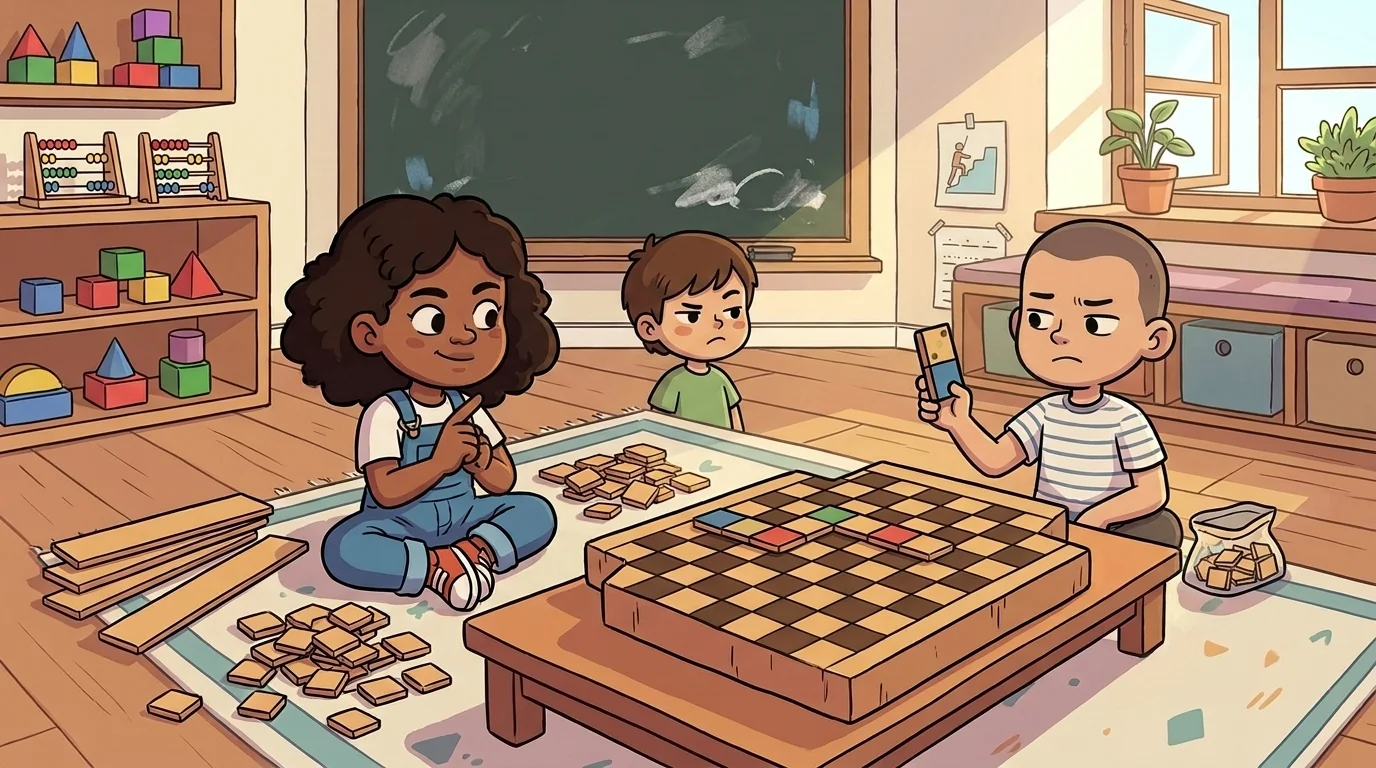
Later that day, Domina taped the two-coloured board up on the wall, directly above her bag of tiles, right beside all her charts of climbing numbers.
A kid who had watched the whole thing unfold frowned up at it, puzzled. "But if it's impossible," the kid said, "why would you keep it up on the wall? Isn't that basically just... a picture of you losing?"
"No," Domina said, and she was faintly startled by how sure the word came out. "It's a picture of me knowing. Before, I felt like some kind of failure who couldn't crack it. Now I know the answer cold — and the answer is 'zero ways' — and I can prove it to anybody with two markers in about ten seconds flat." She tapped the two mismatched corners. "Counting the ways has always been my favorite thing in the world. Turns out that counting why there aren't any is the very same thing — just wearing the other colour."
The kid studied the board for a long, thoughtful moment. "So 'it can't be done,'" they said finally, "is an answer you're actually allowed to be proud of."
"When you can prove it," Domina said, "it's the proudest answer there is."
The CountCraft ensemble
Parry and Domina is part of CountCraft's distributed-narrative cast. Each character embodies a different curricular primitive; together they teach the full subject.
-

Tallis
The Two-Ways Counter — counts the same collection along rows, then along columns, and insists the two totals be equal (double counting)
-

Bijou
The Pair-Matcher — draws a one-to-one pairing between two sets to prove they are exactly the same size (bijection)
-

Stacia
The Staircase-Mirror — mirrors a one-two-three staircase against itself to make a rectangle (triangular numbers)
-

Nona
The Gnomon-Grower — adds the next odd L-shaped layer to grow a square one ring at a time (perfect squares)
-
Arel
The Square-Cutter — cuts a square into four rectangles to read off a-squared plus two-a-b plus b-squared (area model)
-

Domina
The Domino-Tiler — tiles a strip with squares and dominoes and counts the number of ways (Fibonacci tilings)
-
Chessa
The Handshake-Counter — pairs everyone with everyone exactly once to count the handshakes (choose two)
-
Cammy
The Committee-Splitter — sorts every committee by whether the last person is in or out (Pascal's rule)
-

Sett
The Subset-Flipper — flips an in-or-out coin for each item to list every subset exactly once (two-to-the-n)
-

Parry
The Parity-Prover — two-colours a board to show when a tiling simply cannot exist (parity and impossibility)
-

Quill
The Proof Director (mentor) — a warm, attentive adult who coaches build-the-two-counts-then-read-the-identity, and never proves for the kid