
Tallis, Bijou and Cammy
THREE METHODS, ONE IDENTITY — a combinatorial proof is trusting that counting the same collection different ways must agree: Tallis counts every handshake twice (once per hand) and halves it to n(n-1)/2, Bijou matches each handshake one-to-one with a cell above a grid's diagonal, and Cammy splits the handshakes by whether the newest friend is in them — and all three totals are forced to be equal.
A story read by Tallis, Bijou and Cammy
Loading audio…
Press play to listen along. The line being read lights up as you go.
Show full transcript
Loading transcript…
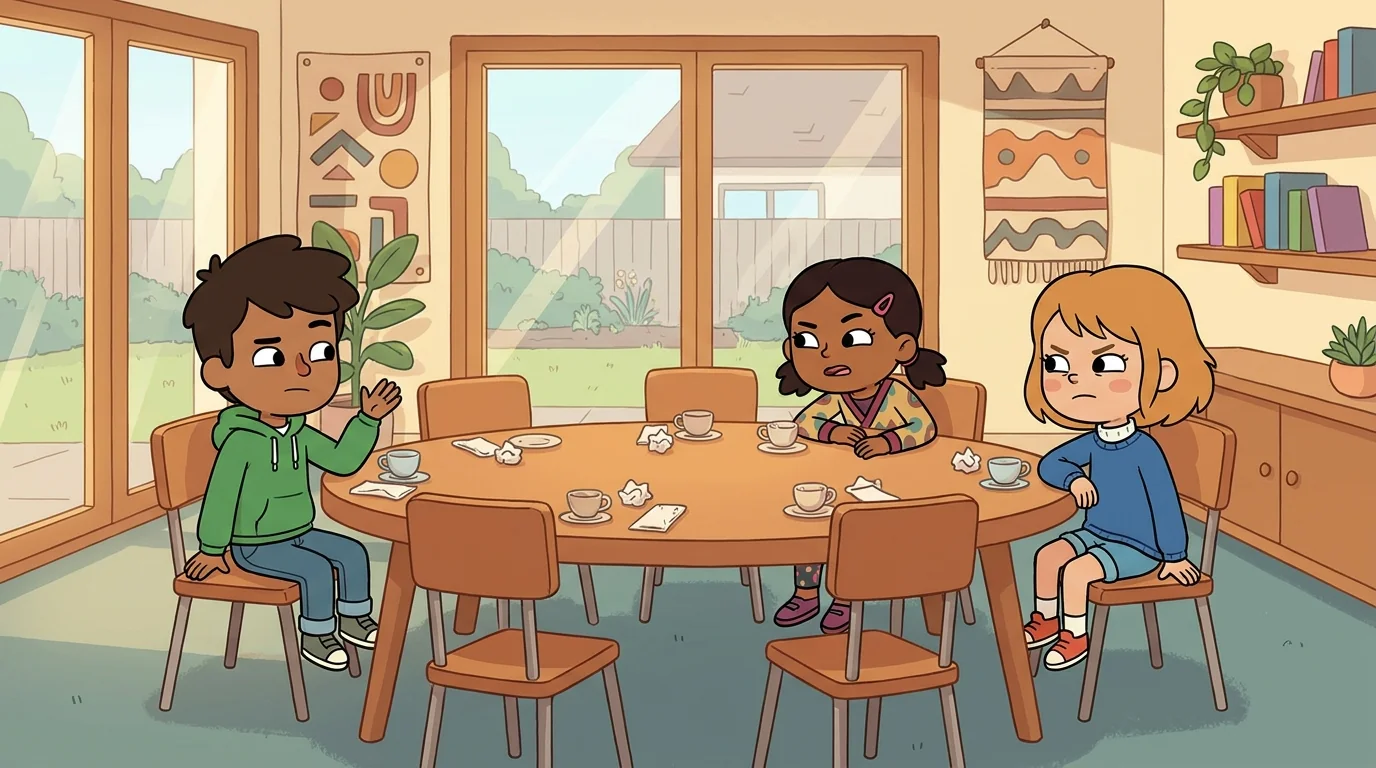
There were seven of them crowded around the table, and they had just finished a round of hellos — everyone shaking hands with everyone else, exactly once each, in the friendly chaos that always breaks out when a group finally gets together. Now Tallis wanted to know something precise: how many handshakes had that actually been?
"Easy," said Bijou, without hesitation.
"Easy," said Cammy, at the very same instant.
"Easy," said Tallis — and then all three of them, talking over one another, announced a completely different plan for how to count it, and stopped, and looked at each other across the table. Each of them was suddenly, quietly certain that her way was the real way, the correct way, and that the other two were about to walk cheerfully off a cliff.
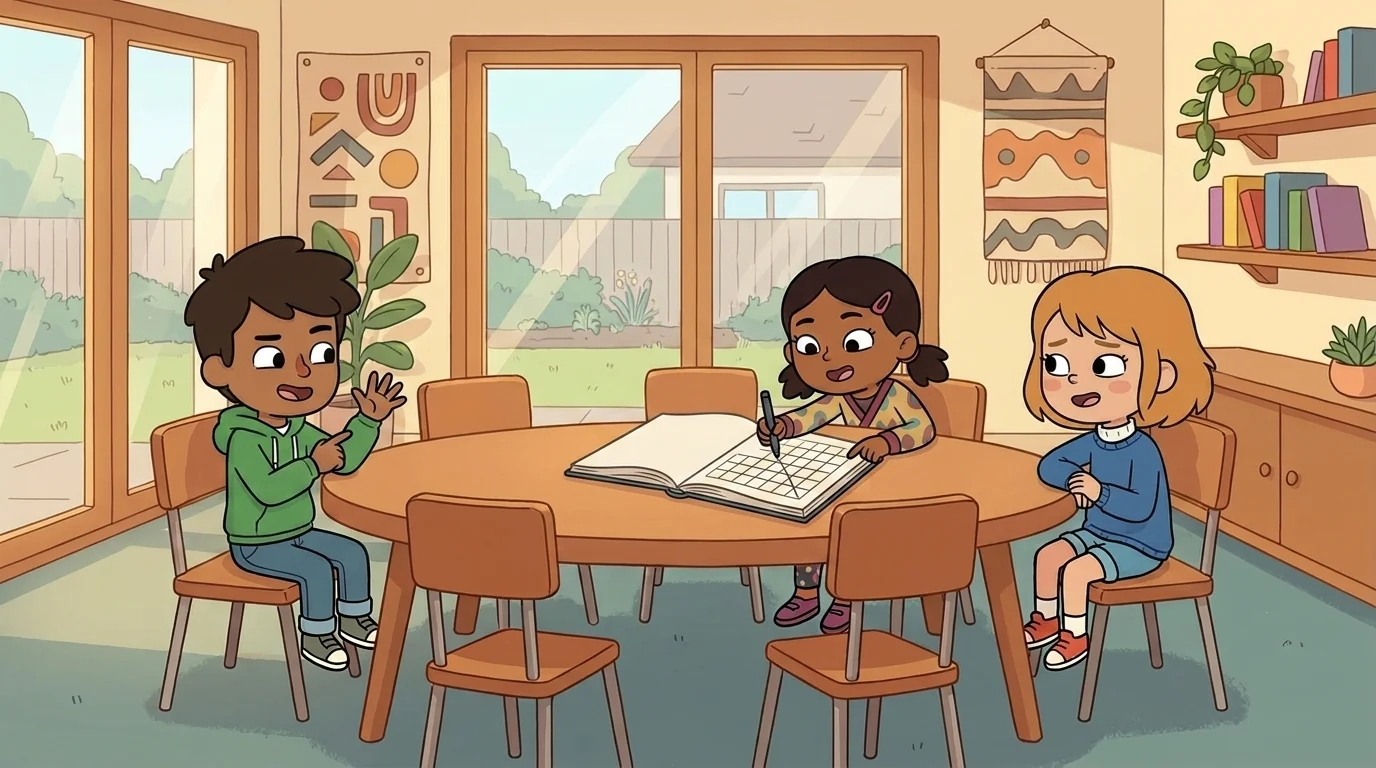
Tallis went first, because Tallis had never in her life met a thing she couldn't count twice.
"Watch me," she said. "Each of the seven of us shook hands with the other six. So that's seven people, and six handshakes apiece — seven times six, which is forty-two." She held up a flat hand before anyone could object. "But that number counts every handshake twice over — once from my side of it, and once from yours, because there are two hands in every shake and I've counted both of them. So I cut it in half. Twenty-one handshakes." She sat back, thoroughly satisfied. "Count all the hand-ends, then fix the double. Twenty-one."
Bijou shook her head — not the you're-wrong kind of head-shake, but the that-is-simply-not-how-my-brain-works kind. "I don't count hand-ends at all. I pair things up instead." She pulled a sheet toward her and drew a grid, seven columns across and seven rows down, one column and one row for each friend. "Every handshake is a place where two friends cross — one specific little cell in this grid, where their column meets their row. But the diagonal running corner to corner is you shaking your own hand, which nobody does, so those cells don't count. And every real handshake shows up in the grid twice — once above the diagonal and once below it, mirror images." She carefully shaded only the cells sitting above the diagonal. "So I just count these. The upper triangle. Each shaded cell paired off with exactly one handshake, one to one, nothing left over." She counted them, cell by cell. "Twenty-one."
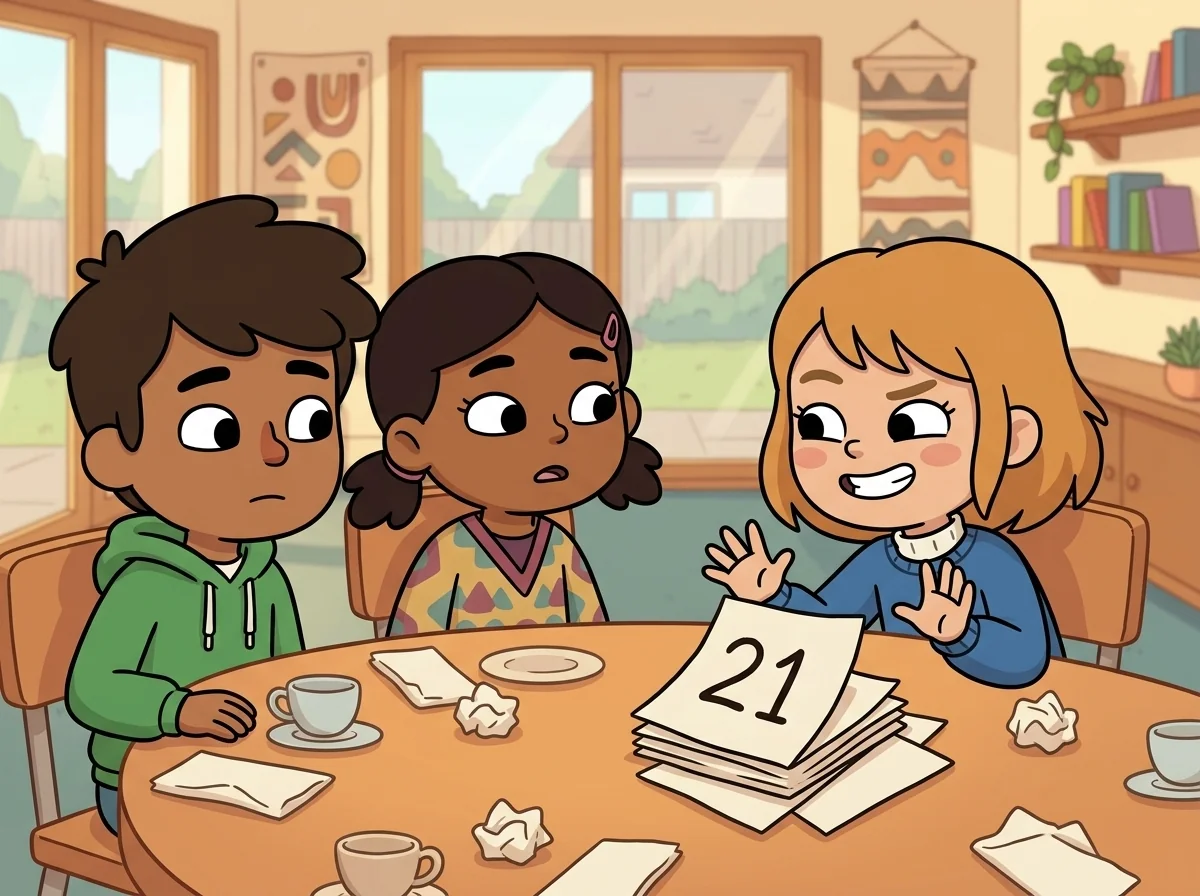
Cammy, meanwhile, had been grinning through the whole thing.
"You two are doing so much arithmetic," she teased, delighted. "I split it up instead." She tapped the tabletop. "Take the newest friend to walk in the door — that's me; I got here last, remember. Now, every single handshake either has me in it, or it doesn't. Those are the only two kinds. The handshakes without me are just the other six friends shaking hands among themselves. The handshakes with me are me shaking each of those six, one at a time." She wrote it out in two neat piles. "So the grand total is 'however many handshakes six friends make' plus 'my own six.' And here's the lovely part — peel me off the top, and what's left underneath is a smaller copy of the very same question."
She chased it all the way down the staircase: six friends breaking into five-plus-a-newest, and five into four-plus-one, and on and on, adding up each peeled-off layer as she went. "Six, then five, then four, three, two, one," she counted, stacking them. "Twenty-one."
For a second nobody at the table said a single word.
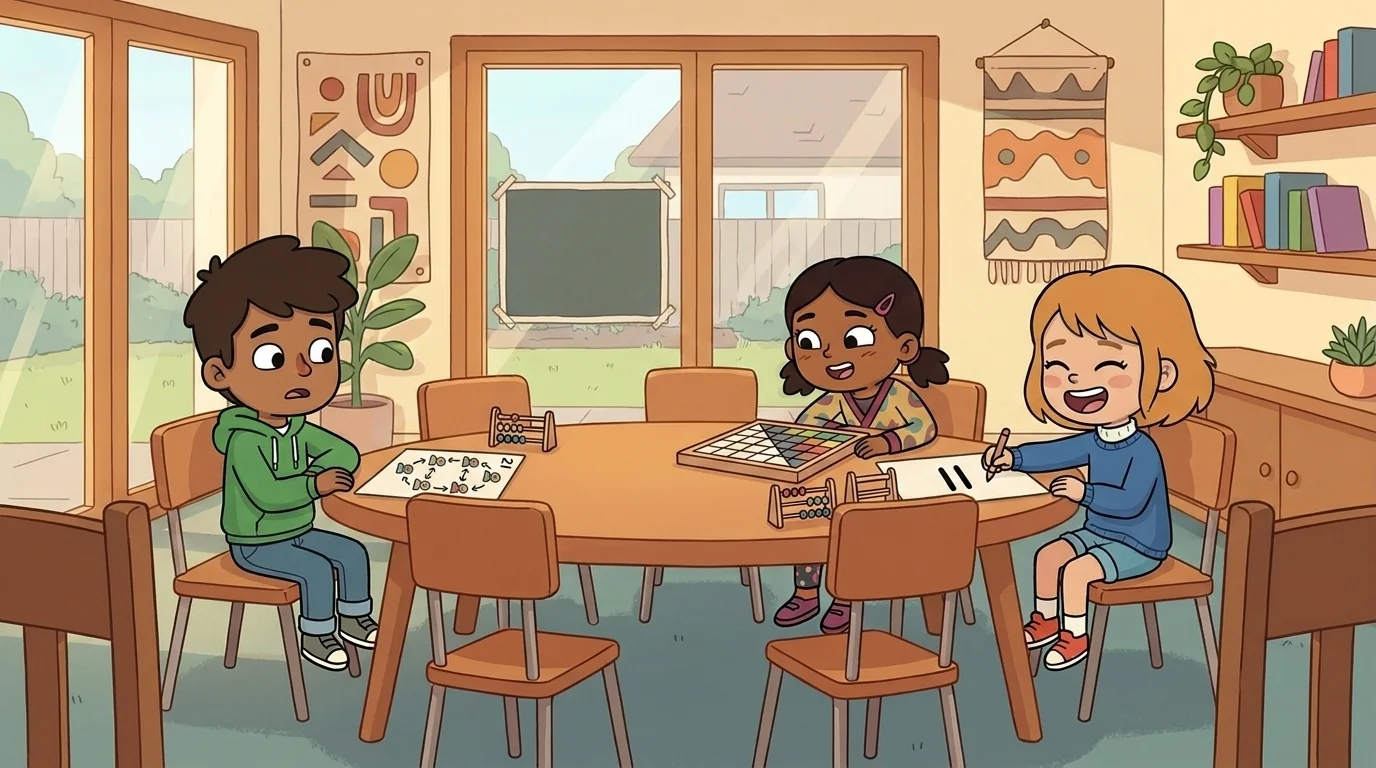
"...We all got twenty-one," Tallis said, slowly, as though testing whether it was safe to believe.
"We all got twenty-one," Bijou agreed, staring at her shaded triangle as if it had turned and winked at her.
Cammy laughed out loud, the sound bright in the quiet. "Well of course we did! It's the same seven people!" She swept a hand over the whole table. "We counted the same exact pile of handshakes three different ways — I split it into layers, Bijou paired it off cell by cell, Tallis doubled it and cut it back down. But it was one single pile the whole time. And however you choose to count one pile, the count is just the count." She grabbed the pen and drew a big, emphatic equals sign linking all three of their answers together. "That, right there, is the whole trick. When two honest ways of counting the same thing come out to different numbers, then one of them has a mistake hiding in it somewhere. But when they come out to the same number — that is not a happy coincidence. That is a proof."
Tallis stared at the equals sign for a long moment. She had spent the entire conversation braced, quietly, to be told her way was the wrong one. Instead the other two roads had come walking up on either side of hers and simply stood there, nodding, agreeing.
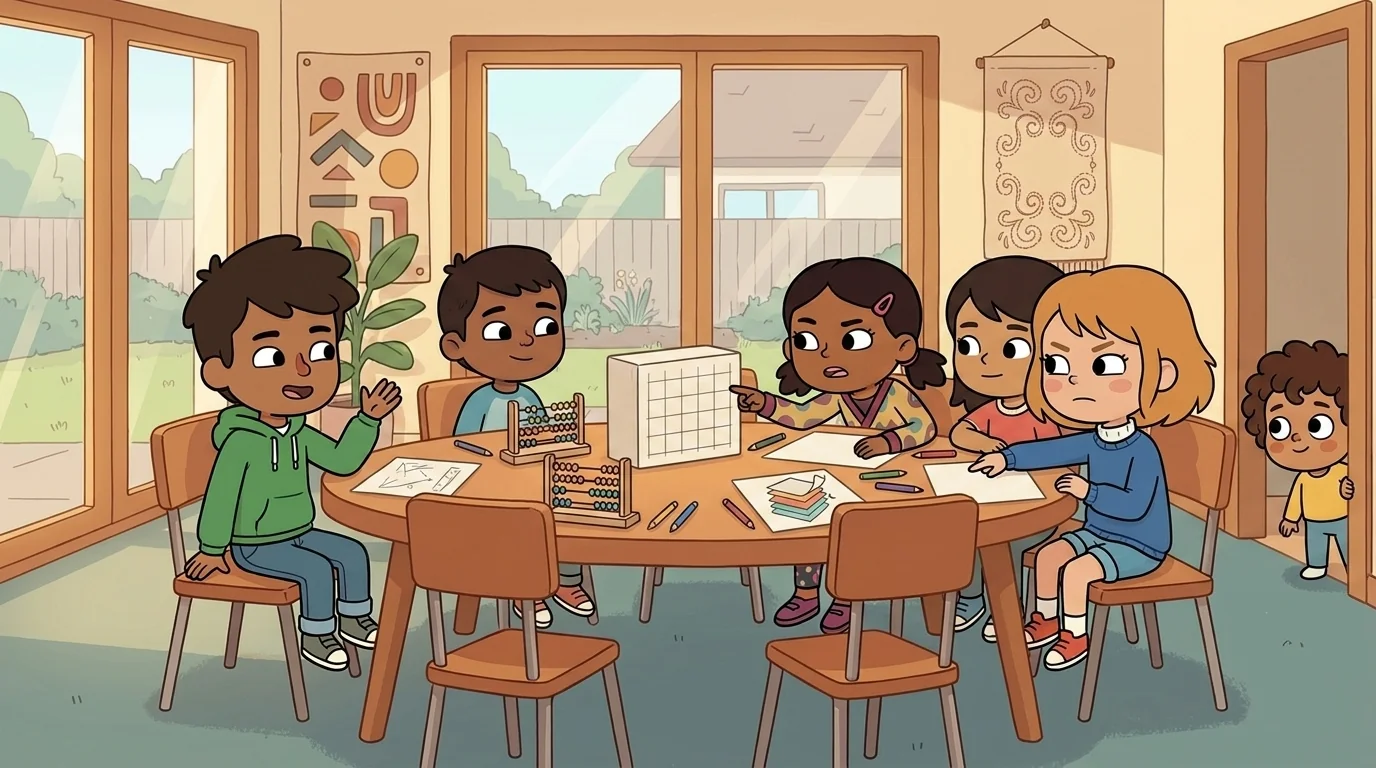
A younger kid had been hovering in the doorway — drawn in, the way kids always are, when a table of older ones is arguing about something that turns out to be friendly rather than fierce.
"So which one's the right way?" the kid asked.
The three friends looked at each other and, without planning it, all smiled.
"All of them," Bijou said. "That's the entire point. There isn't one right road. There's one right place — the number twenty-one — and there's a whole bunch of roads that lead there. And when all the roads arrive at the same place, that's exactly how you know you've truly reached it."
"So pick the road that feels most like yours," Tallis added. "I like counting everything twice and then fixing the double. Bijou likes matching things up, one to one. Cammy likes peeling off a layer at a time."
"And when we lay our answers side by side," Cammy finished, "and the numbers agree — that agreement is the proof. Count the same thing two ways, and the two totals absolutely have to match. If they match, you're done. You don't have to wonder anymore."
The kid looked at all of it at once — the shaded triangle, the doubled forty-two cut back to size, the peeled-off staircase of layers, and the single stubborn twenty-one sitting calmly underneath every one of the three.
"So I could check my own answer," the kid said, working it out, "by counting it a completely different way. And if the two ways agree, then I don't have to wonder whether I'm right."
"Now," said Tallis, "you're counting."
The CountCraft ensemble
Tallis, Bijou and Cammy is part of CountCraft's distributed-narrative cast. Each character embodies a different curricular primitive; together they teach the full subject.
-

Tallis
The Two-Ways Counter — counts the same collection along rows, then along columns, and insists the two totals be equal (double counting)
-
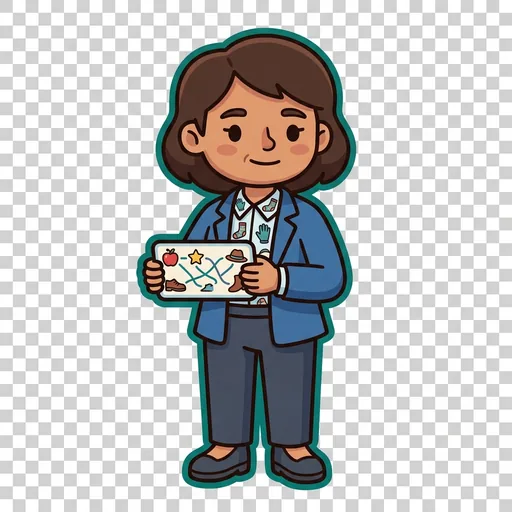
Bijou
The Pair-Matcher — draws a one-to-one pairing between two sets to prove they are exactly the same size (bijection)
-

Stacia
The Staircase-Mirror — mirrors a one-two-three staircase against itself to make a rectangle (triangular numbers)
-
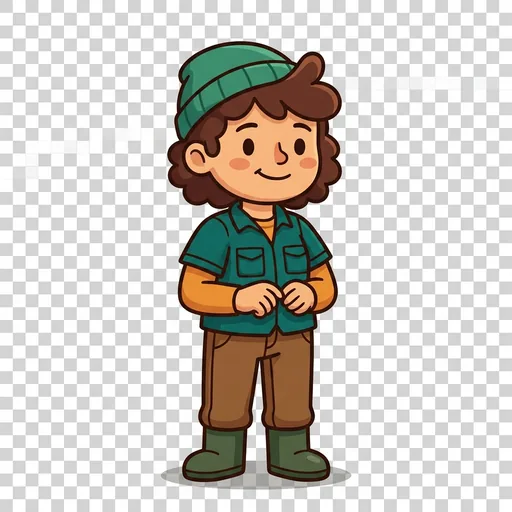
Nona
The Gnomon-Grower — adds the next odd L-shaped layer to grow a square one ring at a time (perfect squares)
-
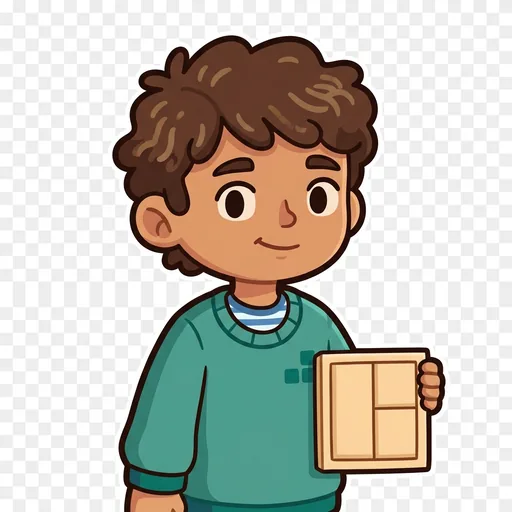
Arel
The Square-Cutter — cuts a square into four rectangles to read off a-squared plus two-a-b plus b-squared (area model)
-
Domina
The Domino-Tiler — tiles a strip with squares and dominoes and counts the number of ways (Fibonacci tilings)
-
Chessa
The Handshake-Counter — pairs everyone with everyone exactly once to count the handshakes (choose two)
-
Cammy
The Committee-Splitter — sorts every committee by whether the last person is in or out (Pascal's rule)
-

Sett
The Subset-Flipper — flips an in-or-out coin for each item to list every subset exactly once (two-to-the-n)
-
Parry
The Parity-Prover — two-colours a board to show when a tiling simply cannot exist (parity and impossibility)
-

Quill
The Proof Director (mentor) — a warm, attentive adult who coaches build-the-two-counts-then-read-the-identity, and never proves for the kid