Amass and Steep
AMASS & STEEP — *stored warmth is three things at once: how hot it is, how much of it there is, and what it's made of. one alone never tells you the whole story.*
Loading audio…
Press play to listen along. The line being read lights up as you go.
Show full transcript
Loading transcript…
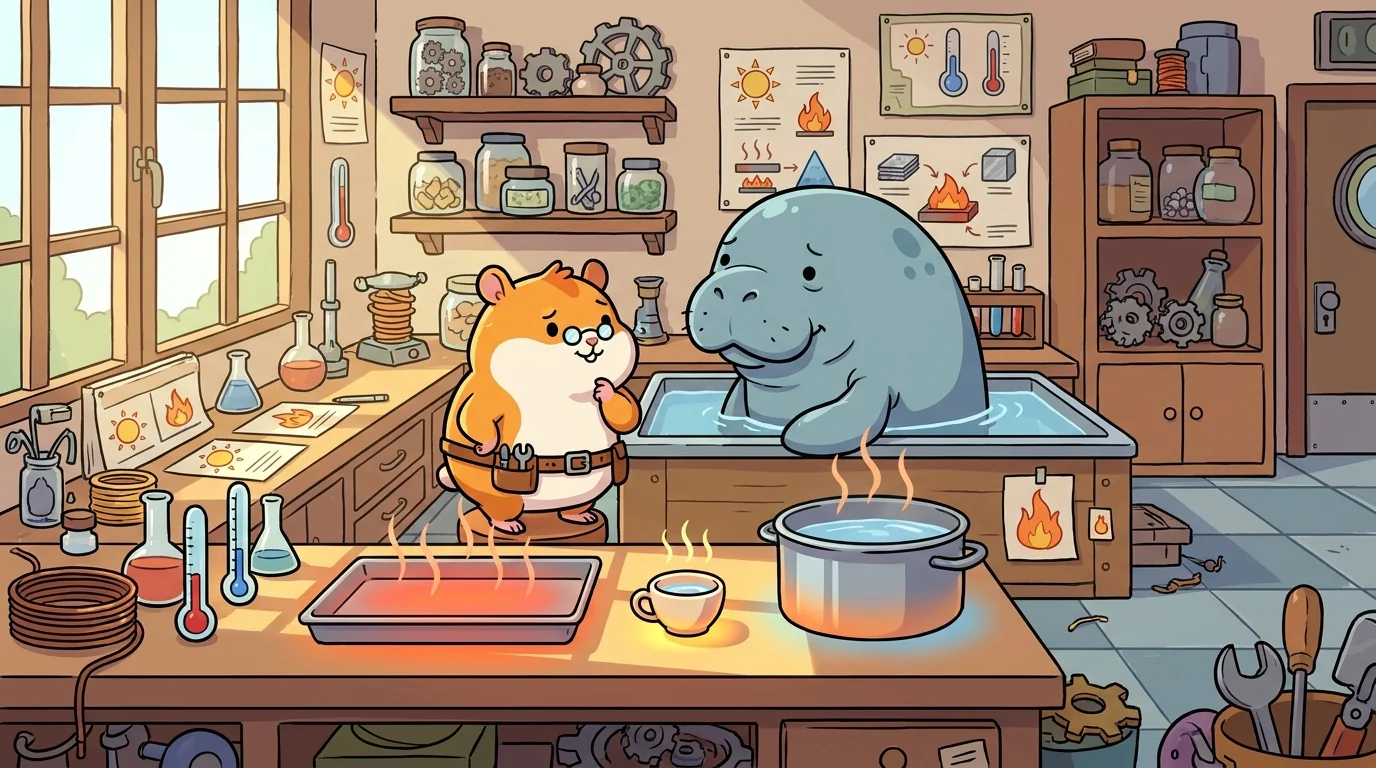
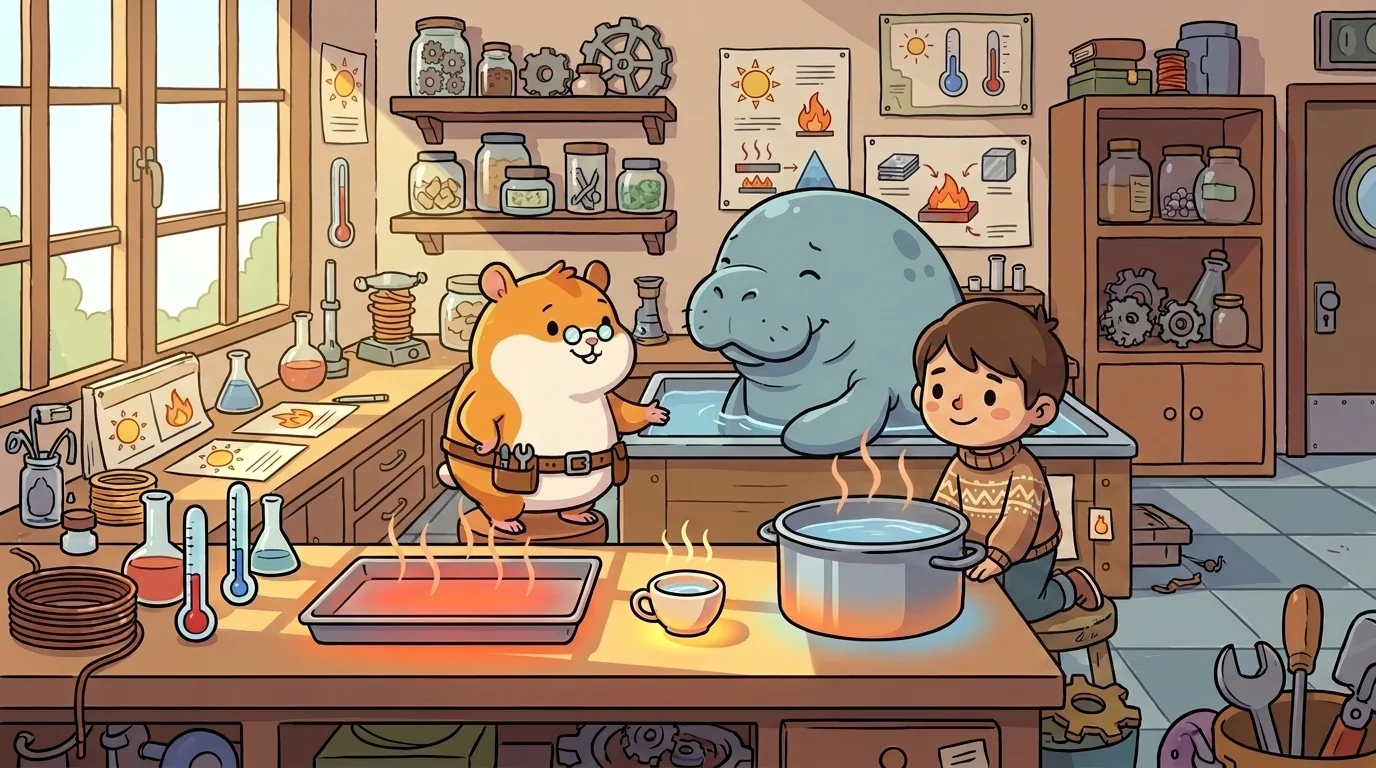
A student came to HeatForge with a puzzle that had two experts trading looks. "I don't get it," she said. "I put a tiny cup of water and a huge pot of water in the same sunny window all morning. When I touched them, the little cup was hotter — but my teacher said the big pot actually gained more heat. And both of them warmed up way slower than the metal tray next to them, which was scalding after ten minutes. It's like there are three different things going on and none of them agree."
Amass the hamster and Steep the manatee looked at each other — the one who counts how-much, the one who explains what-a-thing-is-made-of — and both nodded slowly, because the student had stumbled onto exactly the thing neither of them could explain alone.
"There are three things going on," said Amass. "And you'll need both of us to sort them."
"Both of us," Steep agreed, unhurried. "Because 'how warm is this, really' is never one question. It's three."
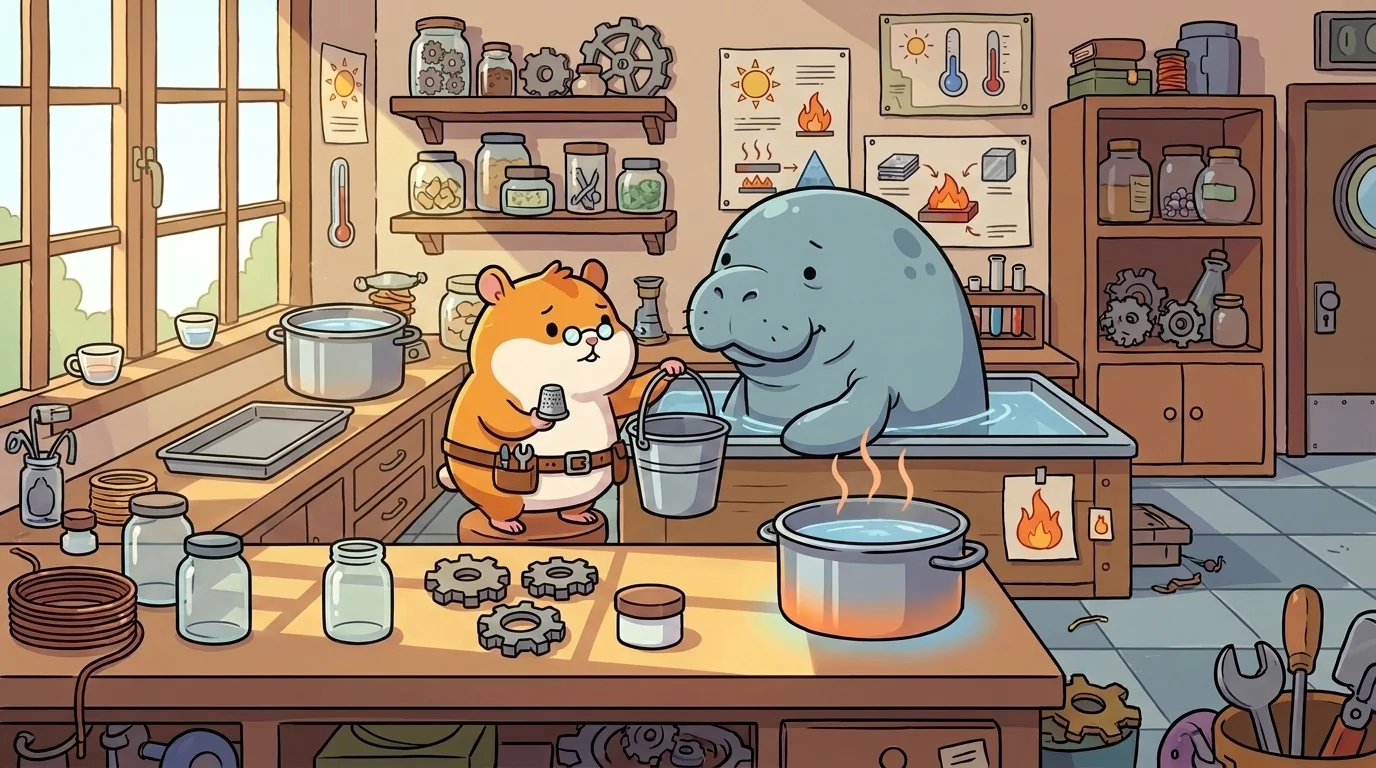
Amass went first, because the first tangle is the how-hot-versus-how-much confusion.
"Your first mix-up is mine to untangle," Amass said, pulling out her thimble and bucket. "The little cup felt hotter — its molecules were wiggling faster, higher temperature, yes. But 'hotter' is not 'more heat.' Heat is the total wiggling-energy, added up over every molecule. The big pot has so many more molecules that even at a lower temperature, it holds far more total heat than the scalding little cup." She weighed the two. "So that's two of your three things, already different: how hot — that's temperature, what your hand feels. How much total heat — that's the amount, and it depends on the temperature and how much water there is. A small hot thing and a big warm thing can trade places on those two questions completely." She looked across at Steep. "But that still doesn't explain your third puzzle — why both the waters warmed up so much slower than the metal tray, even in the same sun. Same sun, same window. That's not about how much water. That's about what water is. And that's her half."
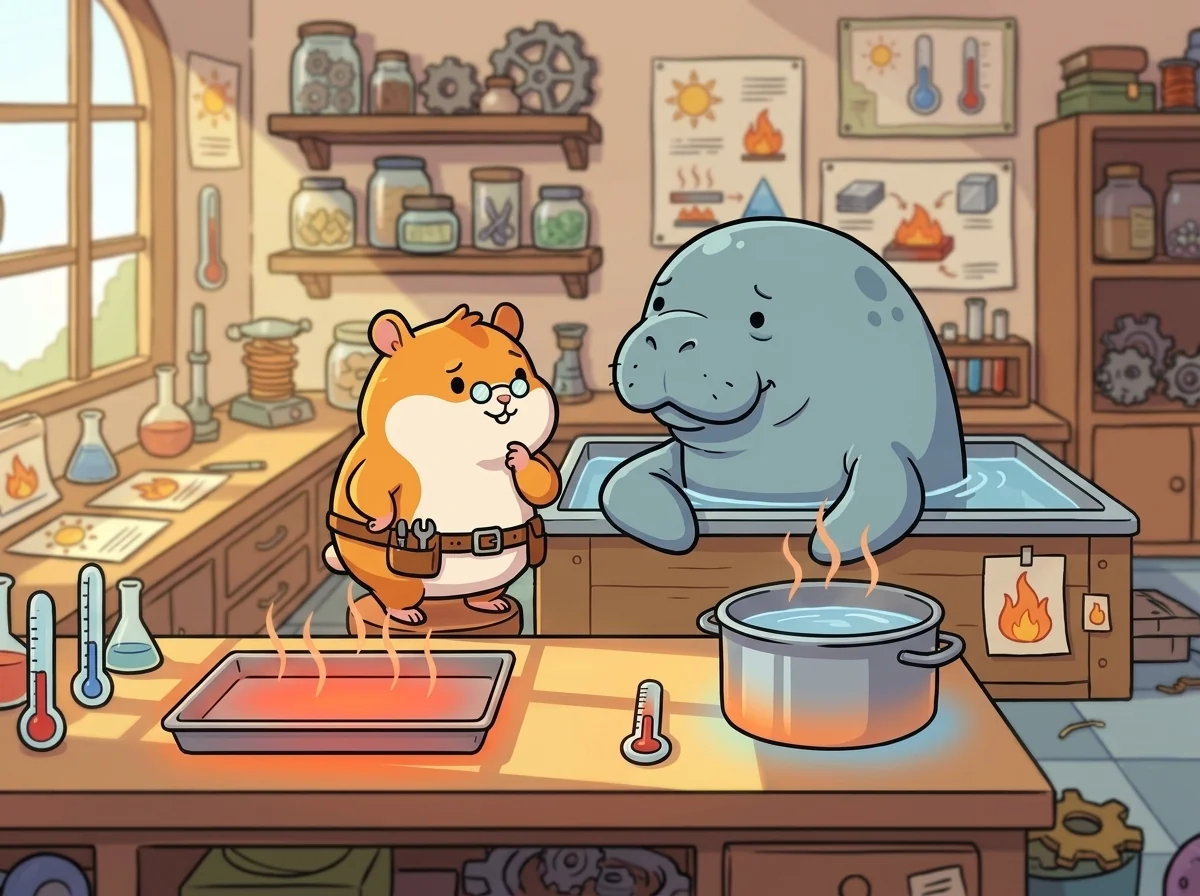
Steep took over, unhurried, because the third tangle is about the material itself.
"The metal tray and the water got the very same sunshine," Steep said, resting a flipper on each. "But the metal sprinted — a little heat changes metal's temperature a lot, so it got scalding fast. The water steeped — it takes a huge amount of heat to change water's temperature even a little, so it warmed slowly, even though the sun poured just as much energy into it." She let that settle. "That's heat capacity — how much heat a material needs to change its temperature by one step. It's built into what a thing is made of. Metal: low — heats fast, cools fast. Water: very high — the great heat sponge, slow to warm, slow to cool. So your third thing is: what it's made of. Same heat poured in, and metal and water do completely different things with it, because their materials store warmth so differently." She looked at Amass. "But knowing water's a sponge still doesn't tell you the total heat in your pot. For that, you need my material and your amount and your temperature — all three."
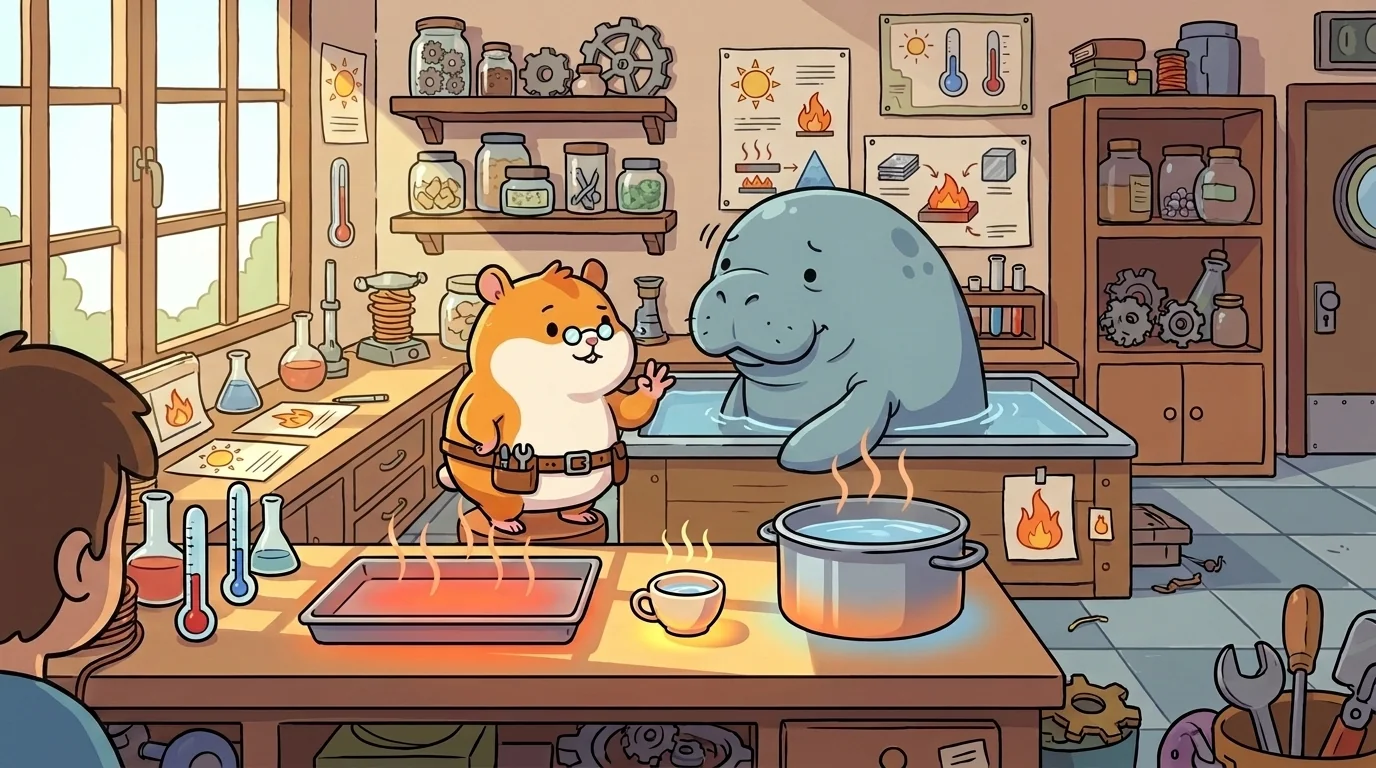
And then, together, they put the whole story in one frame.
"Here's the thing," said Amass, laying it out. "To know how much warmth is really stored in something — how much energy it's actually holding — you can't ask just one question. You have to ask all three of ours at once." She counted on her paws. "How hot is it — the temperature. How much of it is there — the amount. And what is it made of — the material, the heat capacity." She and Steep set the three side by side. "Your little cup: high temperature, small amount, so — not much total heat. Your big pot: lower temperature, but lots of it, and it's water, which stores warmth greedily — so, actually a lot of total heat, more than the cup. And your metal tray: scalding hot, but metal barely stores heat at all, so touch it and it dumps its little store into your hand all at once — which is why it feels so aggressive." She looked up. "Separately —"
"— I can tell you what a material does with heat, but not how much total it holds without knowing the temperature and the amount," said Steep.
"— and I can tell you how-hot and how-much, but not why the same sun warmed water and metal so differently without knowing what they're made of," said Amass. "But together — temperature times amount times material — we can tell you the whole true story of the warmth stored in anything. Three questions, one answer."
The student looked at the cup, the pot, and the tray, and for the first time saw them not as contradicting each other but as three different mixes of the same three ingredients — and it all, finally, made sense.
"So none of the three things alone was lying," the student said slowly. "They were each telling me one piece."
"Exactly right," said Amass, pleased. "How-hot was true. How-much was true. What-it's-made-of was true. You just kept trying to make one of them tell the whole story, and no single one can."
"Warmth isn't one number," said Steep gently. "It's three questions living together. How hot, how much, and made of what. Ask only one, and you'll be fooled by a hot little cup or a cold big ocean. Ask all three —"
"— and nothing about heat can trick you again," Amass finished.
The student looked from the counting hamster to the slow, steady manatee — one who sorts how-much from how-hot, one who explains what a thing is made of — and understood that the truth about stored warmth had never been hiding. It had just needed both of them, and all three of their questions, to come fully into view.
And Amass and Steep felt it settle warm and shared between them — that clicked-together, the whole picture takes more than one question gladness that comes when two partial views finally join into a complete one. Amass loved the counting. Steep loved the material. But what they loved most was this: showing a puzzled kid that warmth was never one thing pretending to be simple — it was three honest questions, and that once you learned to ask all three at once, the world of heat stopped being confusing and started being clear.
The HeatForge ensemble
Amass and Steep is part of HeatForge's distributed-narrative cast. Each character embodies a different curricular primitive; together they teach the full subject.
-
Touch
Conduction (contact-bound molecular transfer)
-

Drift
Convection (fluid circulation carrying heat)
-

Glow
Radiation (electromagnetic energy across empty space)
-

Shift
Phase change / latent heat (state transition without temperature change)
-

Hush
Insulation / thermal equilibrium (slowing transfer, reaching balance)
-

Amass
Heat quantity vs temperature — how-hot is not how-much; a lukewarm lake holds more total heat than a scalding cup
-

Billow
Convection — warmth makes things spread out and rise; heat needs room to move
-

Rasp
Friction heating — rub two things together and warmth appears; motion turns into heat
-

Smooth
Conduction toward equilibrium — heat always spreads toward even, and never un-spreads on its own
-
Steep
Heat capacity — some things soak up heat slowly and hold it long; water is a heat sponge