
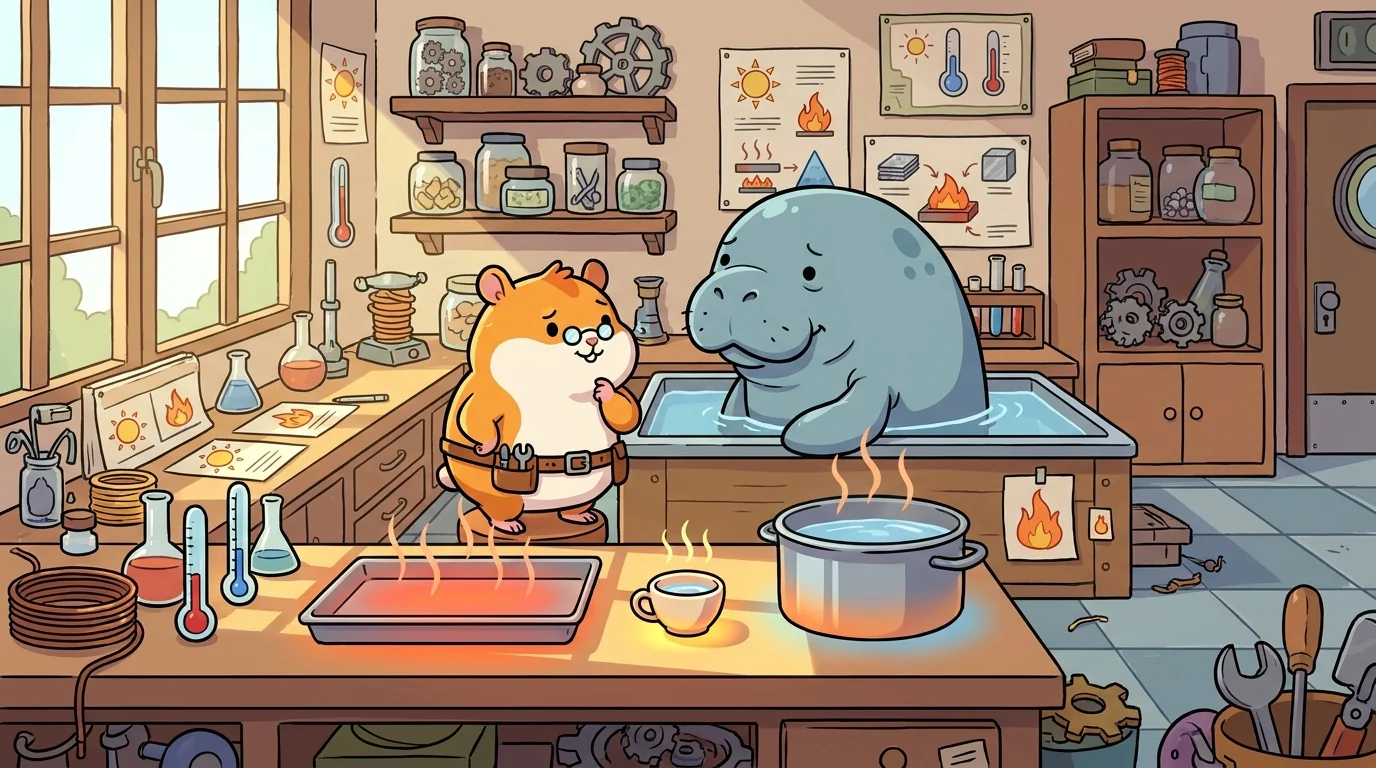
Amass and Steep
AMASS & STEEP — stored warmth is three things at once: how hot it is, how much of it there is, and what it's made of; one alone never tells you the whole story.
Listen along — Amass and Steep
Loading audio…
Press play to listen along. The line being read lights up as you go.
Show full transcript
Loading transcript…
Chapter 15 — Amass and Steep and the Three Faces of Stored Warmth
A young club member named Fira thought she had heat figured out. “It’s temperature,” she said confidently. “Hotter means more heat.” Amass and Steep — who taught the two halves of what heat content really is — traded a look. “You’ve got one of the three faces,” said Amass. “Steep holds the third. Let us show you why stored warmth is never one number — it’s three at once.”
Amass went first, holding up her scalding cup and gesturing at her lukewarm lake. “Face one and face two are mine. How hot — that’s temperature, how fast the particles jiggle. And how much — the amount of stuff, how many jigglers there are. My cup is high-temperature but tiny-amount; my lake is low-temperature but enormous-amount, so the lake stores far more total heat. Fira’s mistake was using only face one. But —” Amass paused “— even my two faces aren’t the whole story. Steep, tell her what I leave out.”
“What Amass leaves out is what the thing is made of,” said Steep. “Take two buckets — same size, same temperature, one water and one sand — and heat them from the same cold start. The sand’s temperature races up; the water’s crawls. Same amount, same target, wildly different heat needed, because water and sand have different specific heat capacities — different appetites for heat. So face three is the material. You can’t know how much heat something holds from its temperature and size alone; you also have to ask what it’s made of. Water, my heat sponge, hides enormous stored heat behind a modest temperature.”
Fira’s certainty wobbled, then reorganized. “So to know the heat stored in something, I need all three: how hot it is, how much there is, AND what it’s made of?” “All three, multiplied together,” said Amass. “Miss the amount and you think a spark beats an ocean. Miss the material and you think water and metal store heat the same — they don’t, not even close.” Steep nodded. “It’s like knowing the value of a pile of coins: you need how many coins, and what kind each is. Ten gold and ten copper are the same count, wildly different worth. Temperature is one face, amount another, material the third — and only all three together tell you the real stored warmth.”
So the two of them ran Fira through it with real objects — the scalding cup that stored almost nothing (tiny amount), the warm iron pan that gave up its heat fast (low appetite), the mild bathtub that stayed warm for an hour (huge amount and high appetite, being water) — until she could look at any warm thing and ask all three questions instead of one. “That’s the whole of heat content,” Amass told her. “Never just how-hot.” “Never just how-much,” said Steep. “How hot, how much, and what it’s made of — three faces of one stored warmth, and you need every one to see it true.”
The HeatForge ensemble
Amass and Steep is part of HeatForge's distributed-narrative cast. Each character embodies a different curricular primitive; together they teach the full subject.
-

Touch
Conduction (contact-bound molecular transfer)
-

Drift
Convection (fluid circulation carrying heat)
-

Glow
Radiation (electromagnetic energy across empty space)
-

Shift
Phase change / latent heat (state transition without temperature change)
-

Hush
Insulation / thermal equilibrium (slowing transfer, reaching balance)
-

Amass
Heat quantity vs temperature — how-hot is not how-much; a lukewarm lake holds more total heat than a scalding cup
-

Billow
Convection — warmth makes things spread out and rise; heat needs room to move
-

Rasp
Friction heating — rub two things together and warmth appears; motion turns into heat
-

Smooth
Conduction toward equilibrium — heat always spreads toward even, and never un-spreads on its own
-

Steep
Heat capacity — some things soak up heat slowly and hold it long; water is a heat sponge