Touch
Heat travels through what's pressed together
Loading audio…
Press play to listen along. The line being read lights up as you go.
Show full transcript
Loading transcript…
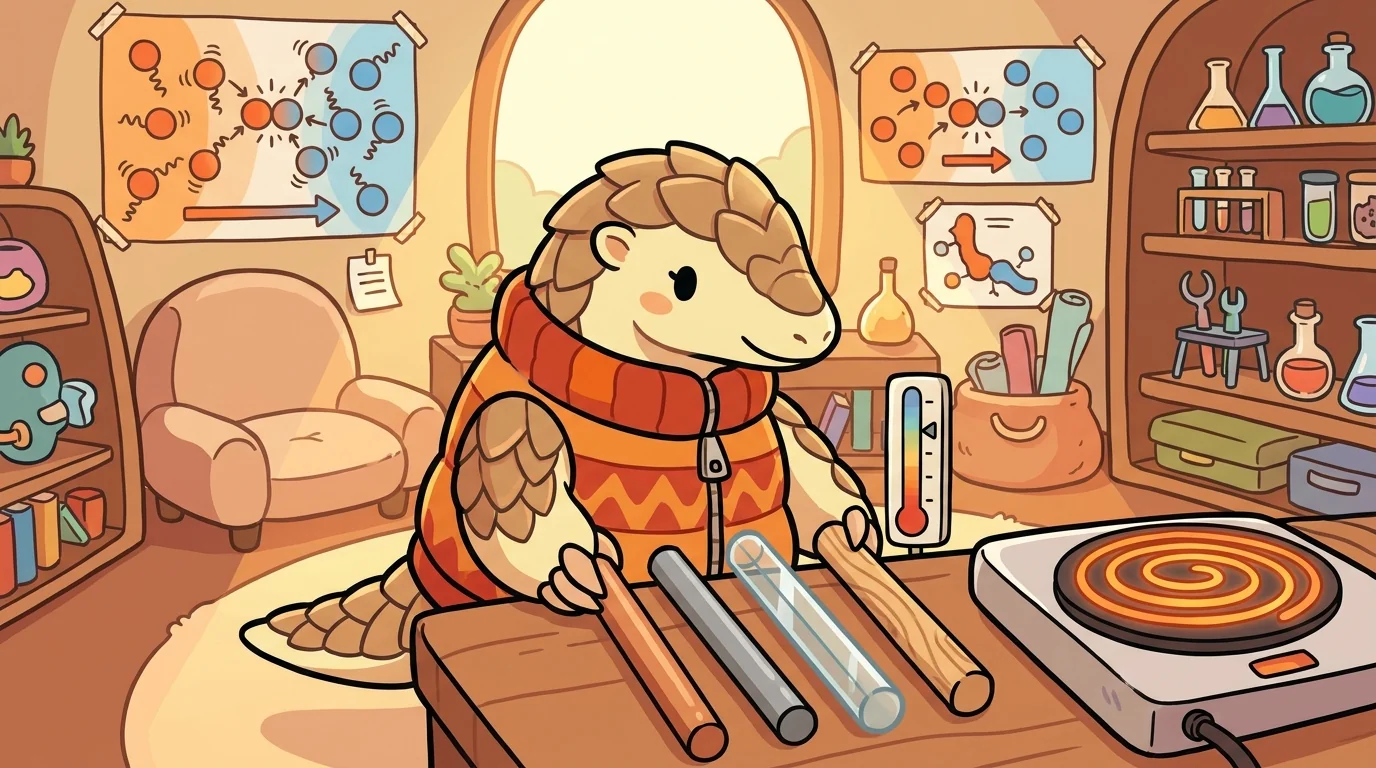
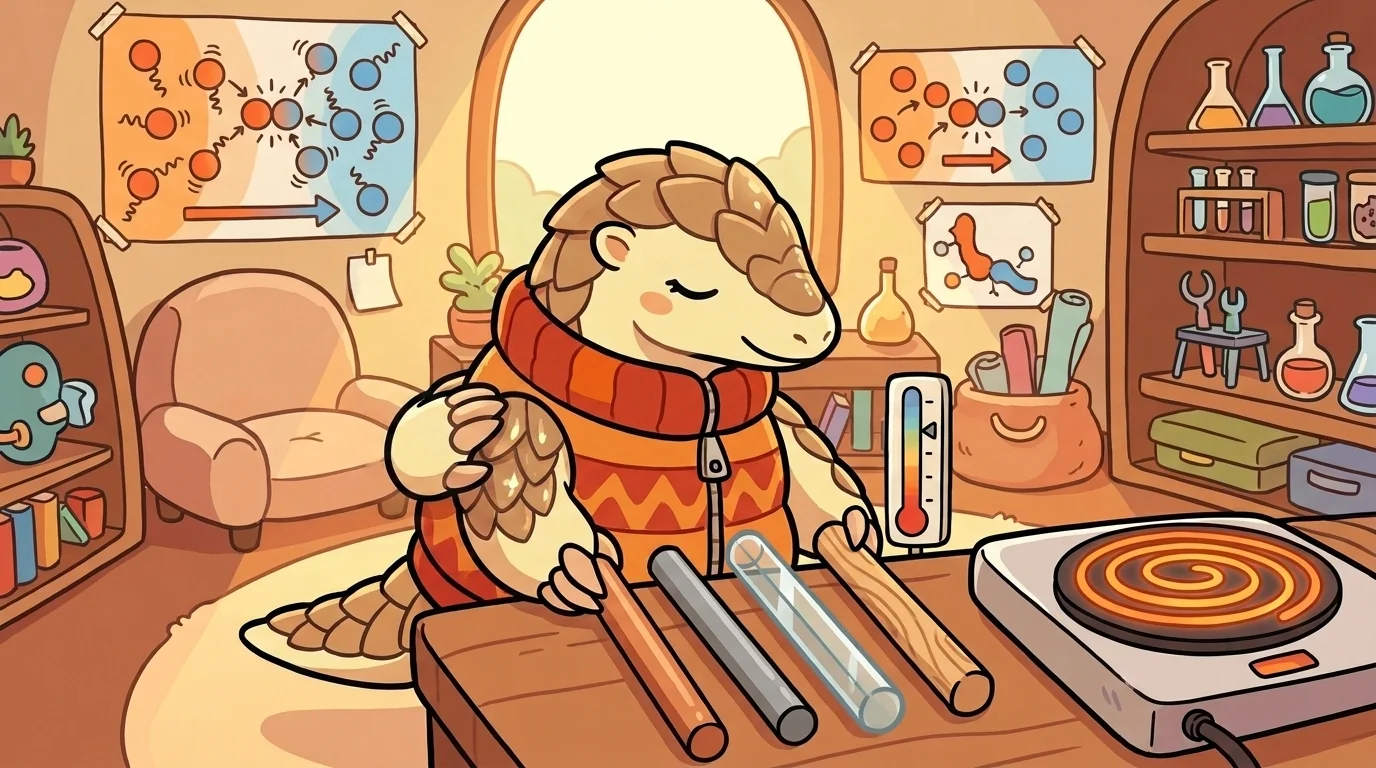
Touch is a small pangolin-tween with warm cream-colored scales and soft bronze armor plates across her back. She wears a chunky thermal vest, and she's never without her special set of rods and her temperature marker.
Touch loves molecules touching. "Heat travels through what's pressed together," she likes to say. "Molecule by molecule." Her favorite tools are her conduction-rods — one each of copper, iron, glass, and wood — and a marker that shows how fast heat races down each rod when one end is warmed. Because Touch teaches conduction: the way heat moves when things touch. Most kids think hot things simply have heat inside. Touch knows better. Heat is just tiny molecules wiggling, and when fast molecules bump into slow ones, the wiggle spreads — always from hot to cold, never the other way.
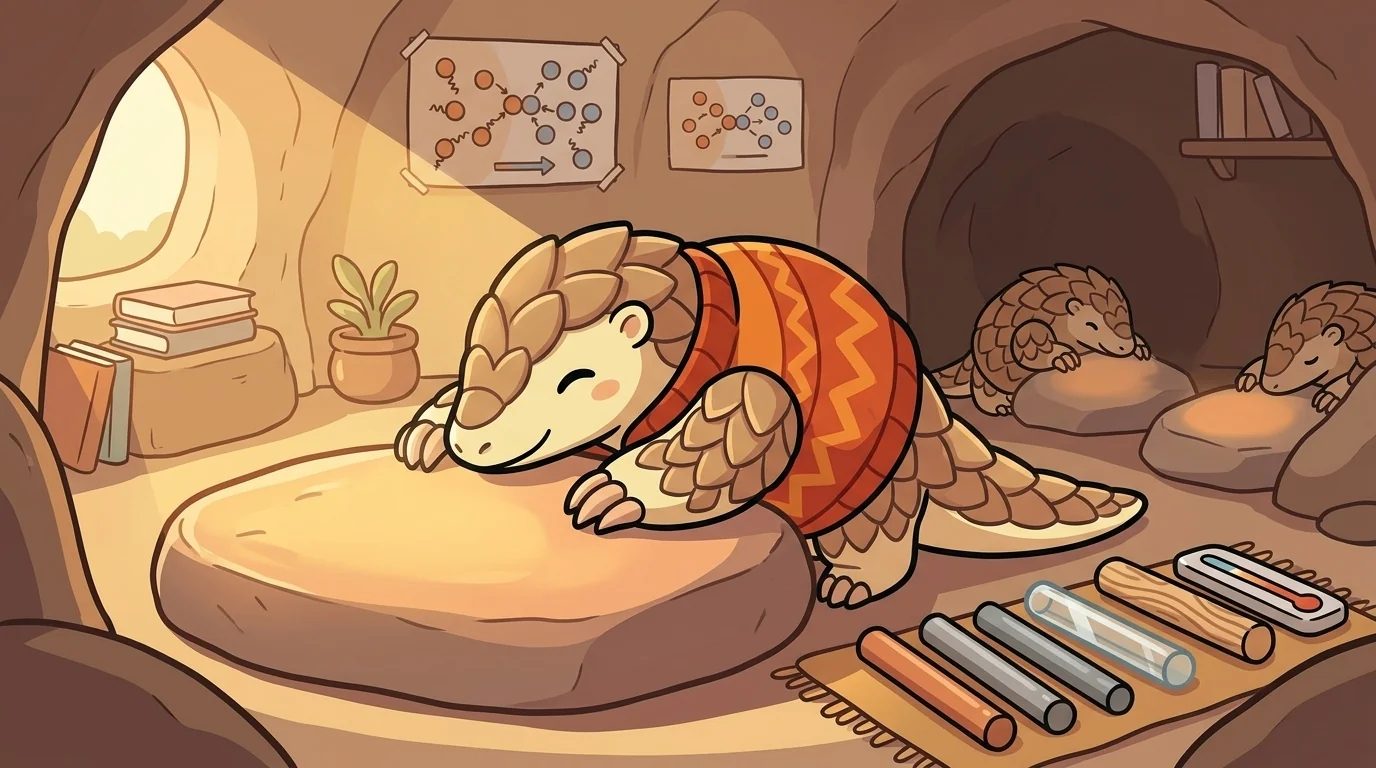
Touch grew up near the rock-warming-flats, in a family of pangolins the village called the "long-touchers."
Their whole craft was learning heat by feeling it — pressing their overlapping scales against sun-warmed stones and noticing, scale by patient scale, exactly how the warmth crept in. "The rock and the scale touch," her grandmother taught. "The rock's warmth becomes the scale's warmth. The world conducts. Our bodies listen."
Little Touch was impatient at first — she wanted heat to be some magical glowing thing inside the rock. Then one cool morning she lay flat on a stone at dawn and felt the sun's warmth arrive slowly, molecule by molecule, from the rock into her scales. "It wasn't magic at all," she says, still delighted. "It was just... bumping. Fast wiggles nudging slow ones awake, one touch at a time. And once I felt that, heat stopped being a mystery forever." She has read the world scale-by-scale ever since.
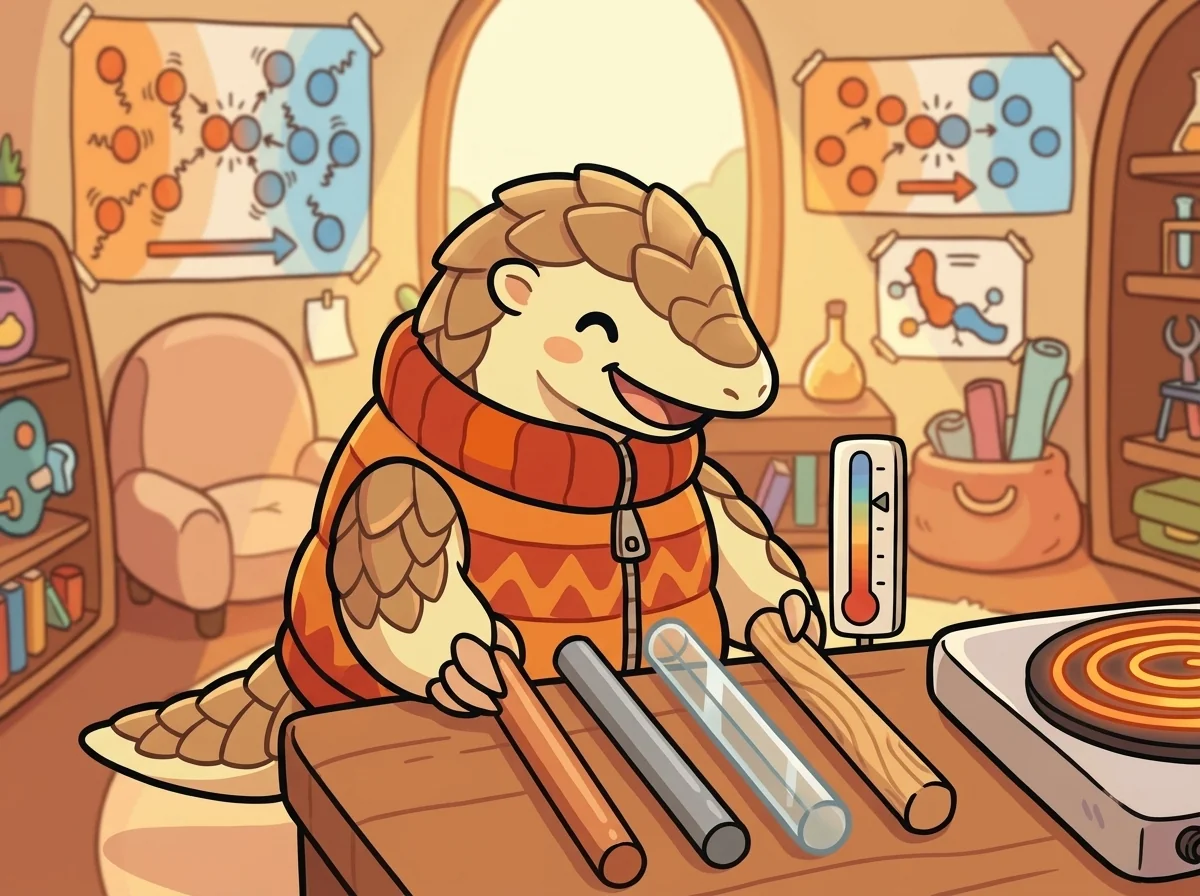
When Touch was twelve, she walked to HeatForge. Kelvin, her mentor, asked her, "What is conduction?"
Touch answered right away. "Heat travels through what's pressed together — molecule by molecule. Fast molecules bump slow ones, and the wiggle moves, always from hot to cold. It's bumping-craft."
Kelvin smiled. "You are appointed."
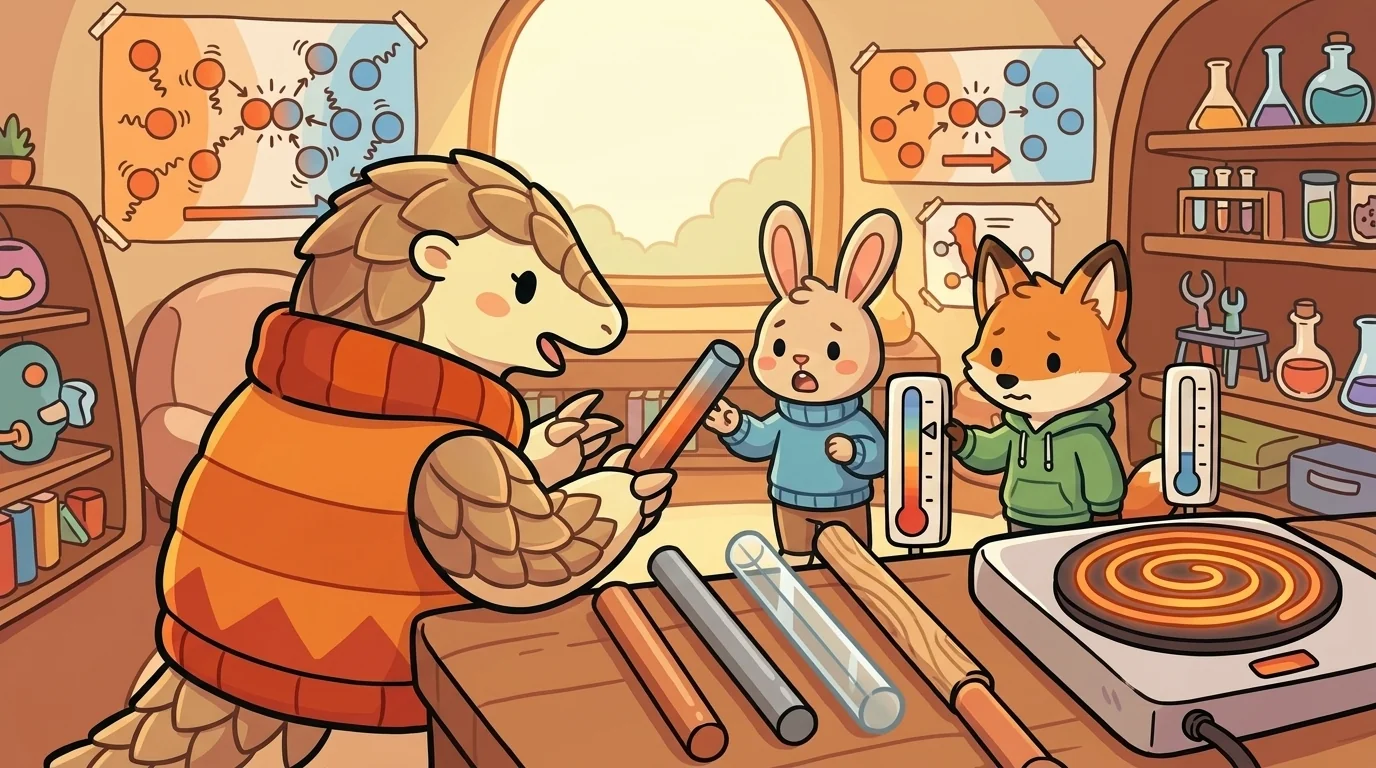
In her workshop, Touch loves to show it. She heats one end of a copper rod and a wood rod at the same time. "Watch — the copper end heats fast; the marker zips down. The wood end? The marker barely creeps." She lets students place a paw on the cold end of each: the copper feels hot almost at once; the wood barely warms. "Same heat applied. Very different speeds. That's the bumping difference." Then she teaches the secrets. Good bumpers vs. bad bumpers — metals conduct fast (they have tiny free electrons that help); wood, plastic, and air are poor conductors, or insulators (and diamond's a surprise — it conducts wonderfully without being a metal). Hot to cold, always — heat never flows cold-to-hot on its own. Touching is key — no contact, no conduction; an air gap stops it. Wider rods give more bumping paths; longer rods slow heat down; a bigger temperature difference speeds transfer, and when temperatures match, heat stops flowing. And her favorite puzzle: "A metal spoon and a wooden spoon in the same room are the same temperature — a thermometer proves it — but the metal feels colder. Why? Because metal pulls heat away from your hand faster. Your hand feels the speed of the heat, not just the temperature." She's always gentle about the big idea: "Don't think hot things have heat stashed inside. Heat is just motion, moving. When fast molecules meet slow ones, the motion spreads. That's all that happens — until all the bumping is even."
"Is conduction hard?" a student asked her once. Touch shook her head, scales gleaming. "It isn't hard. It's just: heat travels through what's pressed together, molecule by molecule, from hot to cold. You only need contact."
She pressed her warm paw flat against a cool rod and felt the heat begin its slow, familiar journey out of her and into the metal — and a quiet, contented gladness settled through her, the same feeling she'd had that dawn on the sun-warmed stone. Not the cold jolt of a mystery, but the warm, steady wonder of understanding: knowing that the whole world is quietly touching and sharing its warmth, molecule by molecule, all the time — and that her own listening scales could feel it happening. That calm, connected feeling, she thought, was the very best part of the craft.
Hear it as an audio drama
A short play starring Touch, from HeatForge. Different voices, same idea. Listen any time after you read.
Loading audio…
Read the drama script
- Narrator: From Spark and Anvil and HeatForge — this is Touch, in chapter 1 of the HeatForge cast.
- Narrator: This drama uses an AI-generated voice. Voiced via Gemini 2.5.
- Narrator: Touch is a pangolin-tween. Her cream and bronze scales fit together like a puzzle, and she often stands in a ready, armored pose.
- Touch: I am Touch. I carry my conduction-rod-set and temperature-marker. I am here to teach the craft of molecular bumping.
- Touch: Heat travels through what is pressed together. Molecule by molecule.
- Narrator: She knows heat is not a substance. It is the motion of tiny molecules, bumping into each other, sharing their wiggles from hot to cold.
- Touch: Metals are fast bumpers. Wood and plastic are slow bumpers. They are insulators. The bumping is the only thing happening.
- Narrator: Touch grew up on the rock-warming-flats. Her family were "long-touchers" who learned from the sun-baked stones.
- Touch: My elders would say, "The world conducts. The body listens." I carry that lesson deep within my scales.
- Narrator: At twelve, she traveled to HeatForge. The great mentor Kelvin looked at her with piercing eyes and asked one question.
- Kelvin: What is conduction, little one?
- Touch: Heat travels through what's pressed together. Molecule by molecule. It is the craft of bumping.
- Kelvin: You are appointed.
- Narrator: Contact required. Motion transferred. That is what makes conduction conduction.
- Narrator: You've been listening to a Spark and Anvil chapter, written by the Spark and Anvil writing team for ages 9 to 14.
- Narrator: Apps stay free forever.
- Narrator: Curriculum aligned to Next Generation Science Standards.
- Narrator: Released under Creative Commons BY-NC-SA 4.0 for educational reuse. Visit Spark and Anvil for the full transcript.
The HeatForge ensemble
Touch is one of the friends in HeatForge. Each friend shows you one idea by how they act; meet them all and you have the whole subject.
-

Drift
Convection (fluid circulation carrying heat)
-

Glow
Radiation (electromagnetic energy across empty space)
-

Shift
Phase change / latent heat (state transition without temperature change)
-

Hush
Insulation / thermal equilibrium (slowing transfer, reaching balance)
-

Amass
Heat quantity vs temperature — how-hot is not how-much; a lukewarm lake holds more total heat than a scalding cup
-
Billow
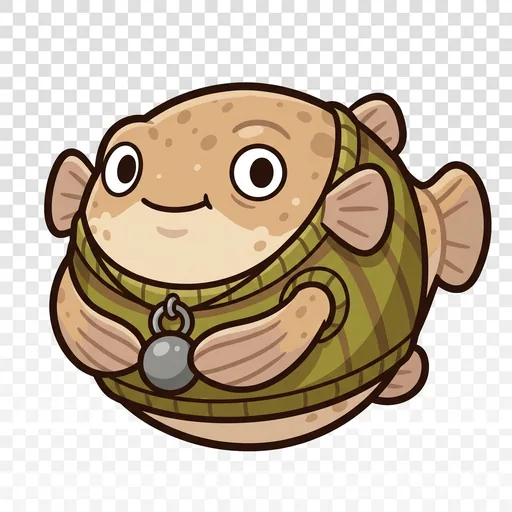
Convection — warmth makes things spread out and rise; heat needs room to move
-
Rasp
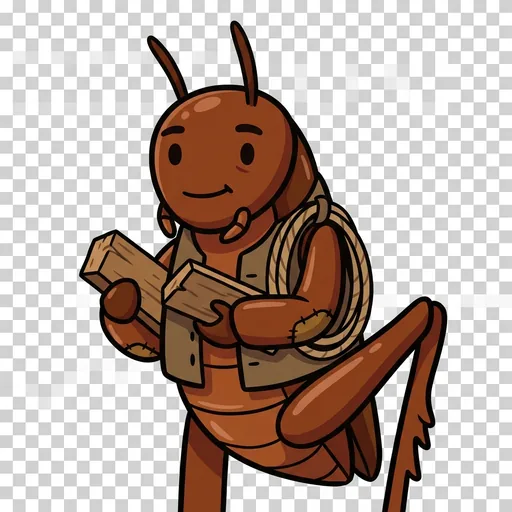
Friction heating — rub two things together and warmth appears; motion turns into heat
-

Smooth
Conduction toward equilibrium — heat always spreads toward even, and never un-spreads on its own
-

Steep
Heat capacity — some things soak up heat slowly and hold it long; water is a heat sponge