
Column and Yardstick
COLUMN & YARDSTICK — a statement can be perfectly true and still mislead, two different ways: Column guards against smuggled OPINION (what-I-think dressed as what-happened), Yardstick guards against missing CONTEXT (a bare number with no yardstick). True is not the same as honest — you have to guard both leaks.
Loading audio…
Press play to listen along. The line being read lights up as you go.
Show full transcript
Loading transcript…

Column the penguin and Yardstick the inchworm shared a workshop at InkQuest, and the students who passed between their two desks slowly understood something unsettling: that a sentence could be completely true and still leave a reader believing something false. Not by lying. By leaking.
"Everyone thinks the only way to mislead is to say something untrue," said Column, patting her two pockets. "It isn't. You can mislead with nothing but true words."
"Two ways, mostly," said Yardstick, unlooping her tape. "And they're my leak and Column's leak — and a good reporter has to plug them both, because the reader can't tell a true-but-misleading line from an honest one on their own. That's our job."

Column went first, because her leak is the sneakier of the two. "Watch a true sentence spring my leak," she said, and wrote on the board: The council foolishly wasted the whole evening on the fountain. "Every fact in there is real — there was a council, an evening, a fountain. But foolishly and wasted? Those are my think, smuggled into the reader's happened. The sentence is true in its facts and dishonest in its verdict — it hands you a conclusion while pretending to hand you a report." She rewrote it clean: The council spent the evening on the fountain proposal; two members later called it time poorly spent. "Same events. Now the opinion is attributed — it lives in a mouth, labeled — and the reader keeps the power to disagree. My leak is conflation: a judgment riding in disguised as a fact. Plug it by keeping happened and think in separate pockets, and putting every opinion in a name."
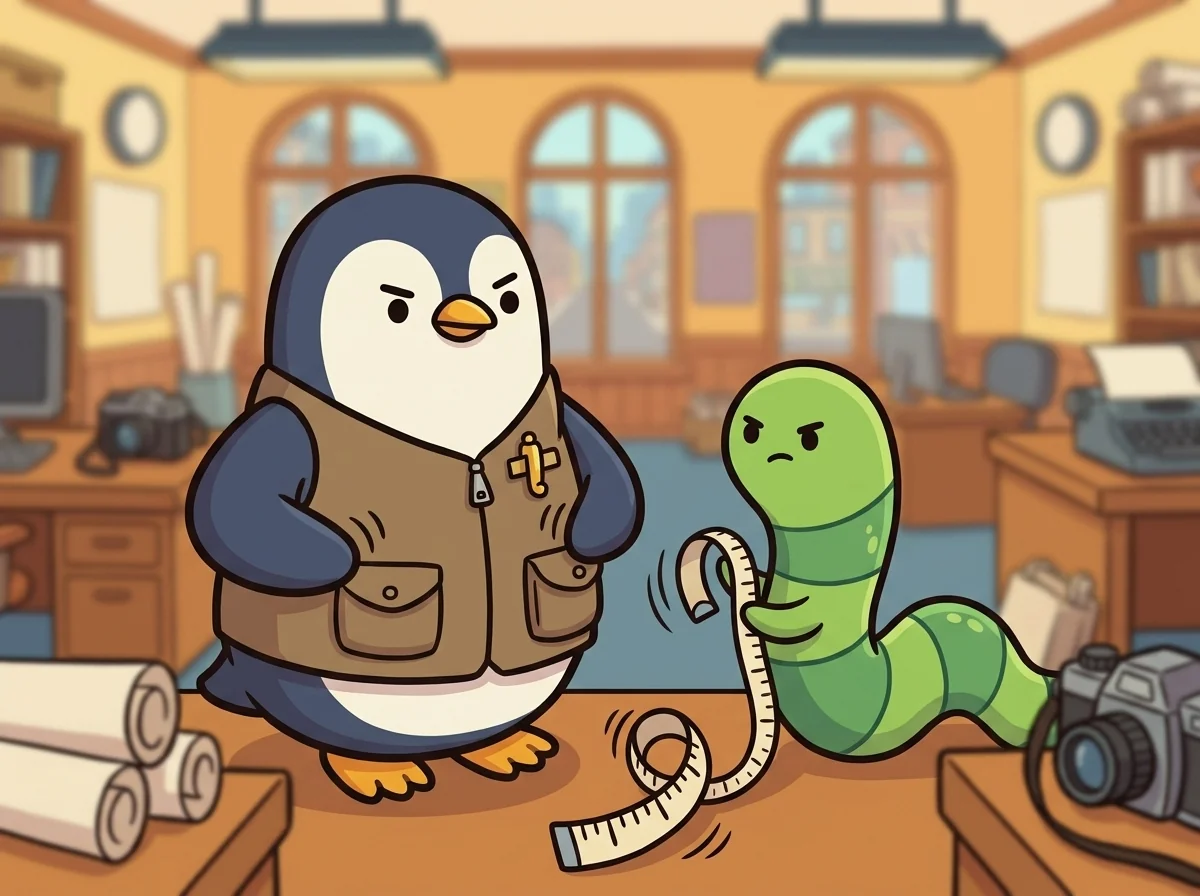
Then Yardstick inched forward, because her leak needs no opinion at all — just a missing comparison. "Mine is quieter," she said, and wrote: Two hundred animals fell ill in the valley this month. "Not one word of opinion. Not one word untrue. And still it can mislead completely — because two hundred out of what? Out of two hundred, that's a catastrophe. Out of two hundred thousand, in a normal month, that's ordinary life." She flipped a comparison-card. "My leak is the missing yardstick: a true number with no denominator, no baseline, no 'compared to whom.' The reader's imagination fills the gap — always with the scariest size — and walks away believing something the facts never actually said. Plug it by never letting a bare number reach the page: out of what, up from what, is that normal."

A student who could see both desks at once said the thing they'd been waiting for: "So a story can pass every fact-check and still lie — if it leaks opinion, or leaks context."
"That," said Column, "is the whole reason we share a workshop."
"There's an old line for it," said Yardstick. "True is not the same as honest. Every sentence you write can be factually true and still leave a false impression — through Column's leak or through mine. So you check a story twice: once for is every fact true? and once, separately, for does it leave an honest impression? A reporter who only does the first check will publish true things that mislead, and never understand why readers stopped trusting the paper."

And so the students stopped believing that 'is it true?' was the only question. They learned to ask the harder second one — is it honest? — and to hunt the two leaks that make a true thing lie. Column's leak: a judgment smuggled in as a fact; plug it with attribution and a labeled opinion. Yardstick's leak: a number stripped of its comparison; plug it with the denominator, the baseline, the yardstick.
"Guard my pocket," said Column.
"Guard my tape," said Yardstick.
There is a hard, grown-up steadiness in learning that truth alone is not enough — that a reporter's duty is not merely to avoid falsehood but to avoid false impressions, which is a larger and more careful thing. A liar and a careless truth-teller can leave a reader equally deceived. The difference between them and an honest journalist is not that the honest one never says anything untrue. It's that the honest one guards both leaks — the smuggled opinion and the missing context — every single time, so that what the reader believes after reading is as true as every word on the page.
The InkQuest ensemble
Column and Yardstick is part of InkQuest's distributed-narrative cast. Each character embodies a different curricular primitive; together they teach the full subject.
-

Lede
Story-from-data — finding the angle; what's the story under the numbers?
-

Pad
Field-capture + interview craft — open the question; let the answer breathe
-

Crosscheck
Verification + triangulation — three sources say the same thing, now I have something
-

Margin
Data-table + chart-annotation craft — label the axes; caption the chart; credit the data
-

Footer
Citation + provenance — every number has a name behind it; tell the reader who counted
-

Column
Fact-vs-opinion — what happened and what I think about it are two different things; label which is which
-

Dig
Investigative persistence — the first 'no' is where the story starts; keep asking, keep following
-

Errata
Corrections + accountability — when you get it wrong, fix it out loud; a paper owns its mistakes
-

Rejoinder
Fairness + right-of-reply — before you print it, get the other side; everyone named gets to answer
-

Yardstick
Context — a number alone means nothing; compared to what? give the reader something to measure against