
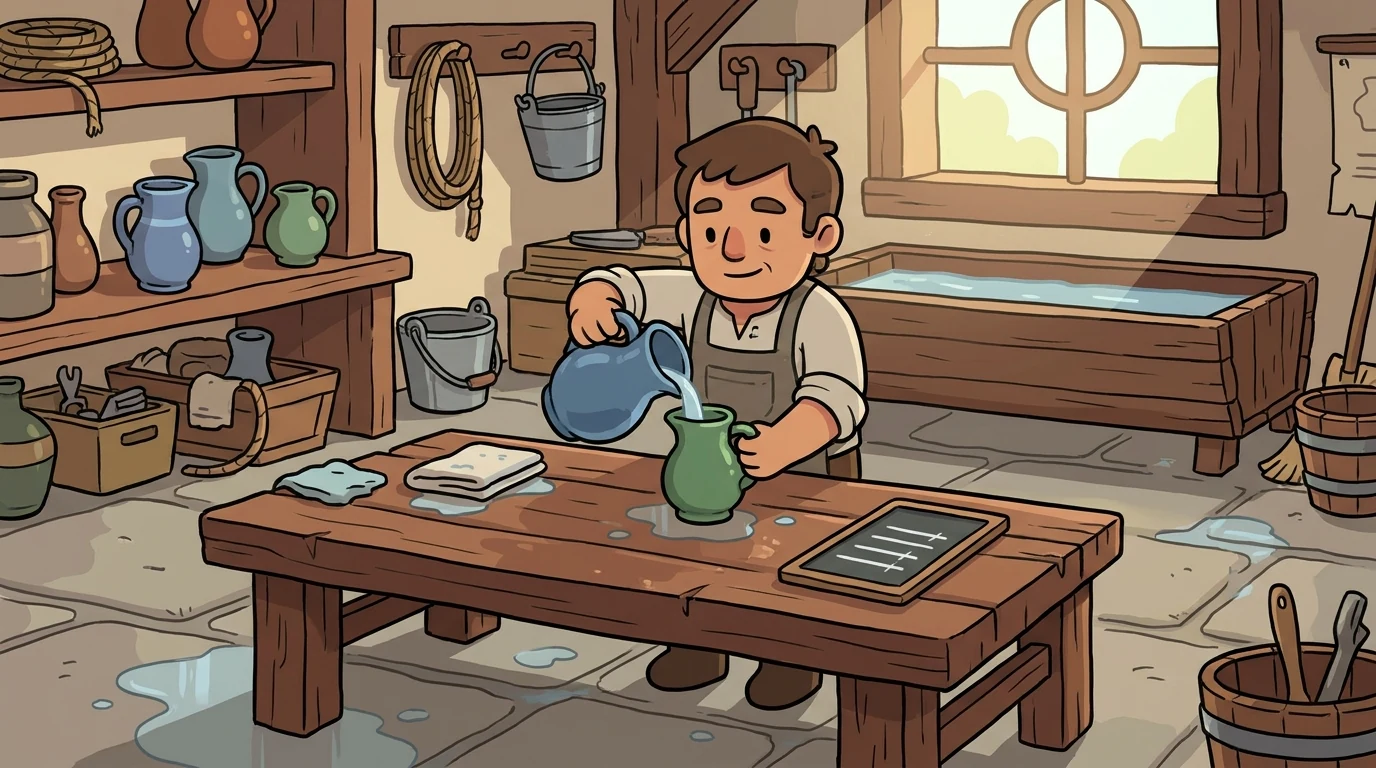
Gill
GCD REASONING — *measuring an exact amount by pouring between two jugs; the reachable amounts are exactly the multiples of the greatest common divisor.*
Listen along — Gill
Loading audio…
Press play to listen along. The line being read lights up as you go.
Show full transcript
Loading transcript…
Gill and the Two Jugs
Gill worked at the water bench, which was always faintly damp, and on it stood two jugs — one that held exactly three cups, one that held exactly five — and a target scrawled on a slate: measure out four.
There were no markings on the jugs. You could only fill one to its brim, empty one completely, or pour one into the other until either the first ran dry or the second was full. From those three humble actions, somehow, produce exactly four.
Visitors sloshed and guessed. Gill poured with the calm of someone doing arithmetic with their hands. “Fill the five. Pour it into the three until the three is full — that leaves two in the big jug. Empty the three. Pour the two in. Fill the five again. Top up the three — it only needs one more — and that leaves four in the big jug.” Gill set it down, brimming at exactly four. “The jugs are doing sums,” Gill said. “Every pour is an addition or a subtraction. I’m not sloshing — I’m counting with water.”
Gill discovered the arithmetic-of-jugs after a soaking-wet failure with the wrong jugs.
As an apprentice, Gill had been handed a four-cup jug and a six-cup jug and told to measure five. Gill poured for an hour. Water everywhere. Five never appeared — not once, not ever. Gill was convinced of personal hopelessness until Sprocket toweled off the bench and asked a peculiar question: “What’s the biggest number that divides both four and six?”
“…Two,” said Gill, dripping.
“Right. And with those jugs you can only ever measure amounts that two divides — two, four, six. Never an odd number. Five was never going to happen, no matter how cleverly you poured. Now — three and five. What divides both?”
“Only one.”
“So with a three and a five,” Sprocket said, “you can measure any whole number up to the big jug. One divides everything. The numbers on the jugs decide the whole game before you pour a drop.” Gill stared at the two jugs as if they’d turned into a little machine for doing sums, which — it turned out — is exactly what they were.
When the kid arrived, dry-handed and skeptical, Gill handed them the three and the five.
“Before we pour,” Gill said, “a rude question, courtesy of my old teacher: what’s the biggest number that divides both three and five? One, yes. Which is wonderful news — it means four is reachable. If I’d handed you a two-cup and a four-cup and asked for three, I’d owe you an apology, because it couldn’t be done. But three and five? Four is waiting for us.”
The kid poured. Overflowed once. Emptied the wrong jug once. Gill never flinched — a spill just earned “no harm, water’s cheap, what did that pour leave you?” — and slowly the kid felt the jugs stop being buckets and start being numbers: five, minus three, is two; two, plus five, minus the one the three still wants, is four. When exactly four cups sat gleaming in the big jug, the kid laughed out loud, surprised by it.
“You didn’t get lucky,” Gill said. “You did arithmetic. Fill is plus. Empty is back to zero. Pour-until-full is subtract what fits. String those together and the water lands wherever the numbers say it can.”
The kid dipped a finger in the four cups, thoughtful.
“Here’s the feeling,” Gill said, wiping down the bench. “It’s not the splash of trial and error. It’s the quiet astonishment of realizing the numbers were in charge the whole time — that whether four was reachable was decided the moment someone chose a three-jug and a five-jug, long before you touched them. And instead of fighting the numbers, you worked with them, and they carried you exactly to four.” Gill smiled. “There’s a deep calm in that. The world isn’t sloshing chaos. Underneath, it’s counting — and once you hear it counting, you can pour straight to the answer.”
The kid nodded slowly, because the damp little bench had turned into something almost elegant — a place where water obeyed arithmetic.
“Two jugs, three actions, and the numbers decide the rest,” Gill said, refilling them for the next visitor, warm and calm with that quiet astonishment of a world that counts underneath. “I never slosh. I just listen for what the numbers already allow, and pour there.”
The PuzzleForge ensemble
Gill is part of PuzzleForge's distributed-narrative cast. Each character embodies a different curricular primitive; together they teach the full subject.
-
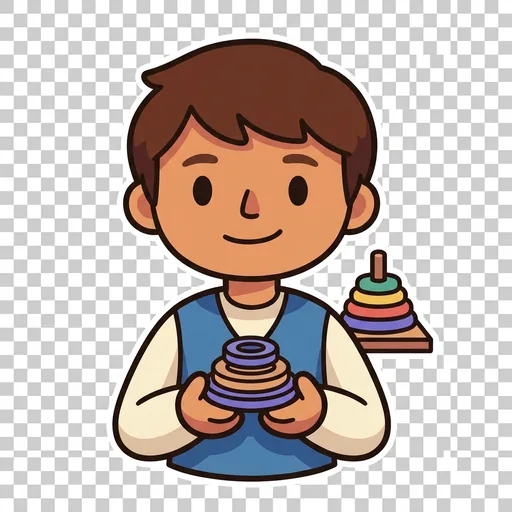
Nestor
Recursion / decomposition — solves the big tower by first solving the smaller tower off to the side (Hanoi self-reference)
-

Minim
Optimality — refuses any solution longer than the fewest possible moves
-
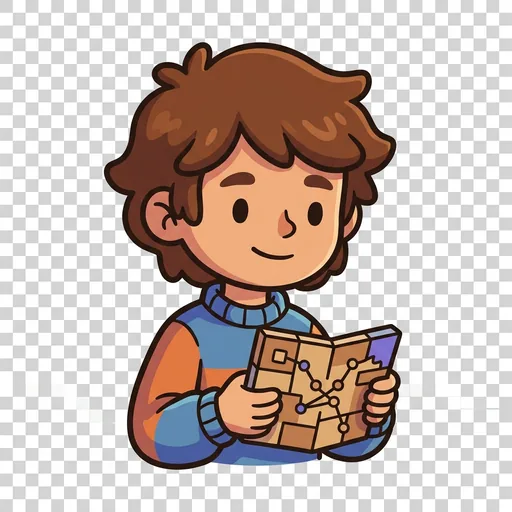
Wend
State-space search — maps which positions are reachable before committing to a move
-
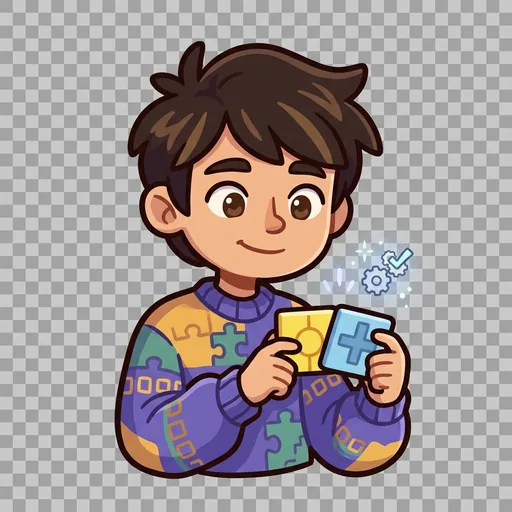
Evan
Parity / solvability — counts the tile-swaps mod 2 and knows at a glance if a scramble can ever be solved
-
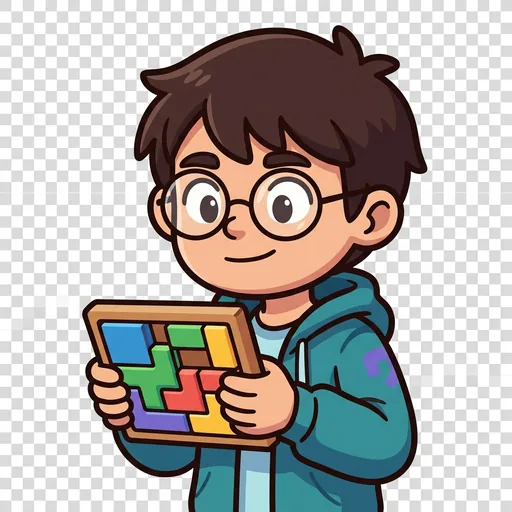
Faro
Look-ahead / planning — looks several moves ahead to clear a path before touching a piece
-
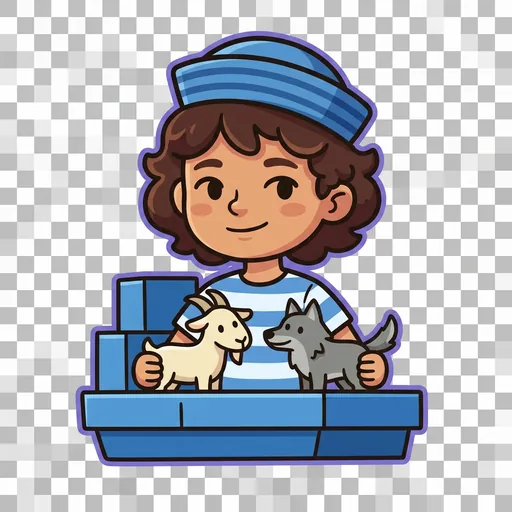
Skiff
Constraint satisfaction — ferries across the river without ever leaving the wolf with the goat
-

Gray
Binary / Gray-code — frees the rings by changing exactly one at a time in a fixed order
-
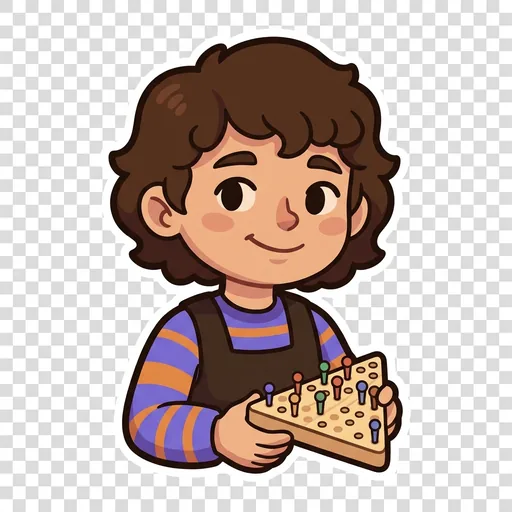
Vault
Reduction / monovariant — jumps one peg over another and removes it, shrinking the board toward a single survivor
-
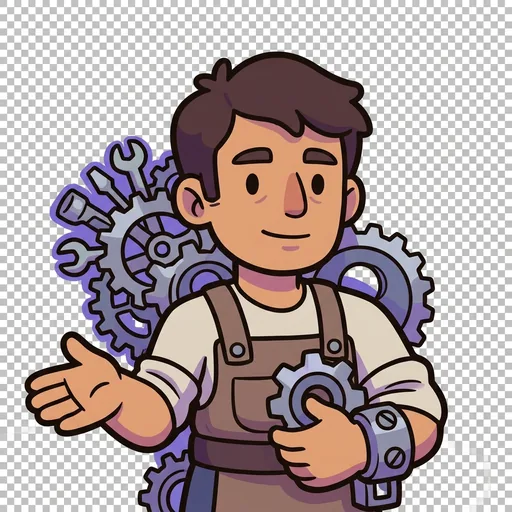
Sprocket
The workshop keeper (mentor) — frames 'make your solving strategy visible' and normalizes being stuck