
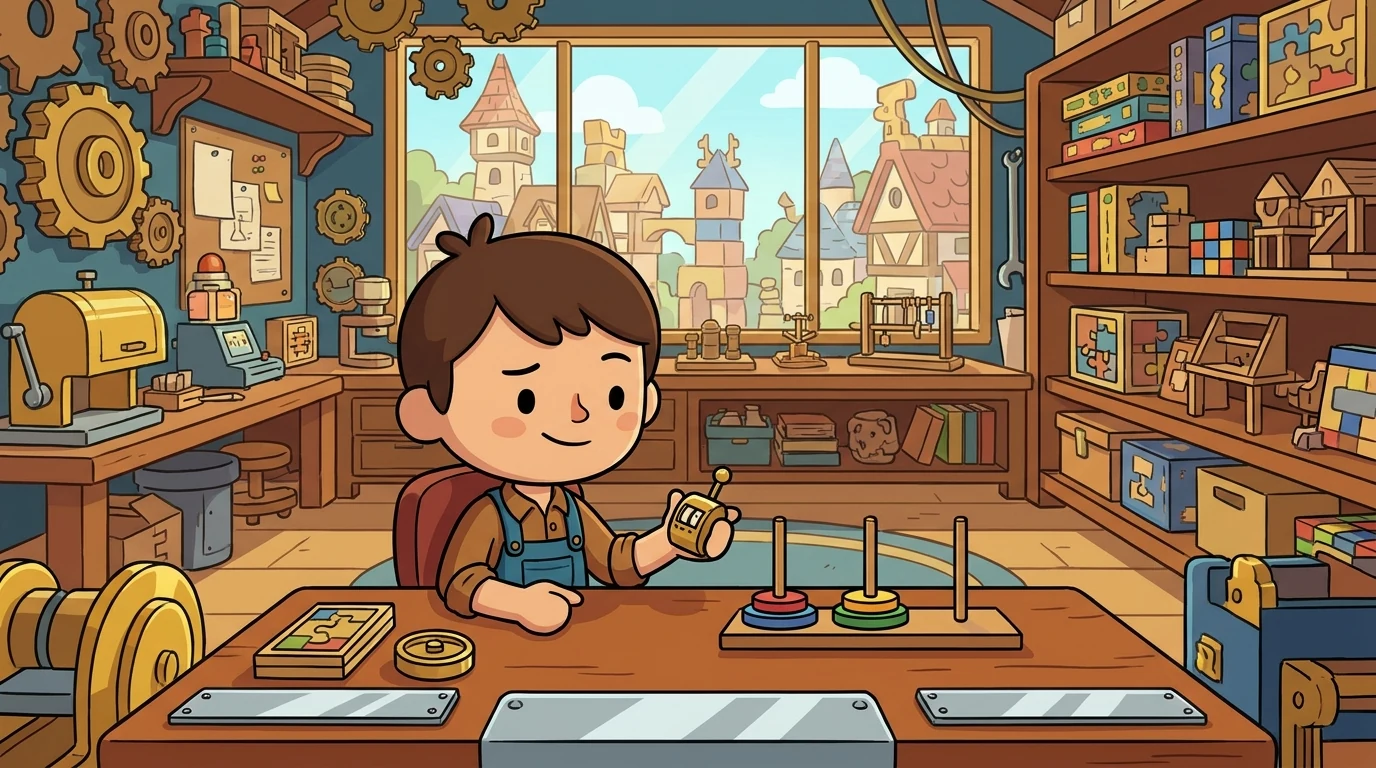
Minim
OPTIMALITY — *not just A solution, but the SHORTEST one; refusing any path longer than the proven minimum.*
Listen along — Minim
Loading audio…
Press play to listen along. The line being read lights up as you go.
Show full transcript
Loading transcript…
Minim and the Fewest Possible Moves
Minim kept a bench of gleaming counters and a small brass tally-clicker, and Minim was, by cheerful reputation, the pickiest person in the entire PuzzleForge workshop.
Solving a puzzle was not enough for Minim. Anyone could solve the Tower — flail around long enough and the discs eventually land. Minim wanted the shortest solution, the one with not a single wasted move. When a visitor finished a three-disc tower in nine moves, beaming, Minim would clap politely and then say, with enormous kindness, “Lovely. Now — could it be done in seven?” (It could. It always could. Seven was the fewest, and Minim knew it the way other people know their own name.)
“A solution says it can be done,” Minim liked to say, clicking the tally. “The fewest moves says you understand why.”
Minim’s pickiness had a beginning, and it wasn’t snobbery. It was a race lost fairly.
Years ago, young Minim had challenged an older apprentice to a tower-off. Minim solved it — genuinely solved it — in twenty-three moves, and felt magnificent. The older apprentice solved it in seven and shrugged. Minim was furious, then baffled, then, finally, curious. How did she know seven was even possible? How did she know it wasn’t six?
The answer, it turned out, was the most beautiful thing Minim had ever heard. Sprocket drew it out on the workshop chalkboard: to move a tower of n discs, you move the top n−1 out of the way, move the big one once, and move the n−1 back. So the fewest moves doubles each time you add a disc, plus that one move for the big fellow — one disc needs one move, two need three, three need seven, four need fifteen. Two-to-the-n, minus one. Not a guess. A guarantee.
“You mean,” young Minim breathed, “I can know the answer before I even touch it?”
“You can know the floor,” said Sprocket. “You can know that nobody, ever, in the history of towers, could do it faster. And once you know the floor, every extra move you make is a move you can feel, like a pebble in your shoe.”
Minim never made a wasteful move again without feeling that pebble.
When the kid reached Minim’s bench, they’d already conquered the Tower at Nestor’s station and were feeling pretty pleased.
“Nestor taught you to finish it,” Minim said warmly, sliding over the tally-clicker. “I’m going to teach you to finish it knowing. Solve the three-disc tower — and count every move out loud.”
The kid solved it. “…eight. Nine.”
“Nine,” Minim repeated, without a scrap of judgment. “A real, true solution — well done. Now. The fewest possible is seven. I’m not going to tell you which two moves were extra.” Minim smiled. “I’m going to let you find them, because finding your own extra pebbles is the whole art.” When the kid tried again and hit eight, Minim didn’t wince — Minim leaned in, delighted: “Closer! You felt one of them, didn’t you? One more pebble to shake out.” On the third try the kid hit seven, and stopped, and stared at the discs as if they’d become slightly holy.
“Seven,” said Minim. “And here’s the part that matters: you’re not guessing seven is best. You could work out, on that chalkboard, that seven is the fewest that could ever exist. So you’re done. Not done-for-now. Done-forever. Nobody will beat it.”
The kid ran a finger along the counters, quiet.
“That’s the feeling, isn’t it,” Minim said gently, and for once there was no pickiness in it at all — just recognition. “Not the pride of solving. The settledness of knowing there’s nothing left to shave off. No nagging little voice saying maybe there was a better way. You looked the puzzle dead in the eye and you know its floor and you touched it.”
The kid nodded, because that was exactly it — a clean, closed, complete feeling, like the last piece of something clicking flush.
“People think I’m picky,” Minim said, clicking the tally one last, satisfied time. “I’m not picky. I just love that feeling too much to stop one move short of it.”
The PuzzleForge ensemble
Minim is part of PuzzleForge's distributed-narrative cast. Each character embodies a different curricular primitive; together they teach the full subject.
-

Nestor
Recursion / decomposition — solves the big tower by first solving the smaller tower off to the side (Hanoi self-reference)
-
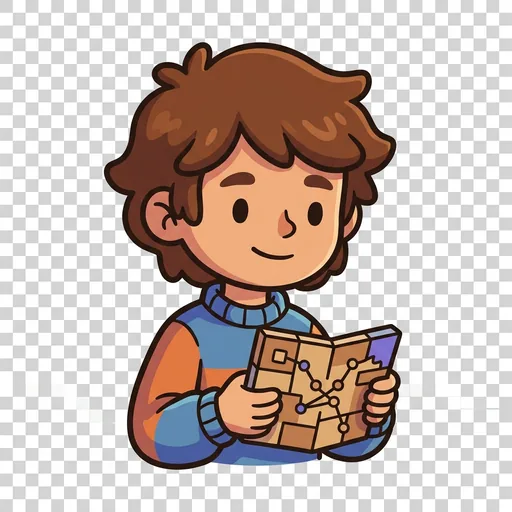
Wend
State-space search — maps which positions are reachable before committing to a move
-
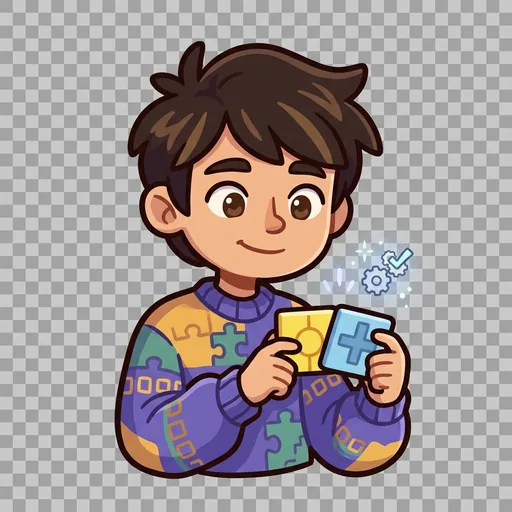
Evan
Parity / solvability — counts the tile-swaps mod 2 and knows at a glance if a scramble can ever be solved
-
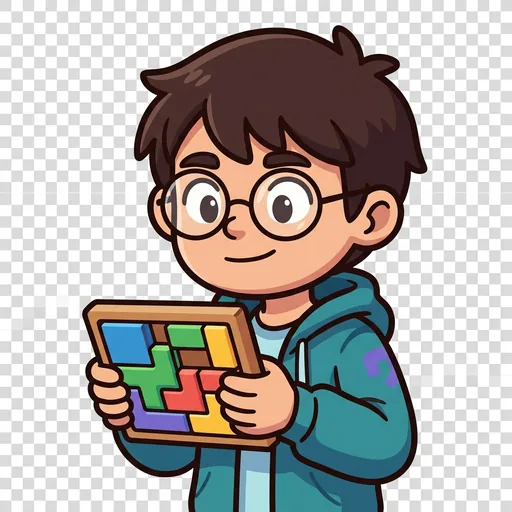
Faro
Look-ahead / planning — looks several moves ahead to clear a path before touching a piece
-

Skiff
Constraint satisfaction — ferries across the river without ever leaving the wolf with the goat
-

Gill
GCD / number reasoning — measures an exact amount by pouring back and forth between two jugs
-

Gray
Binary / Gray-code — frees the rings by changing exactly one at a time in a fixed order
-
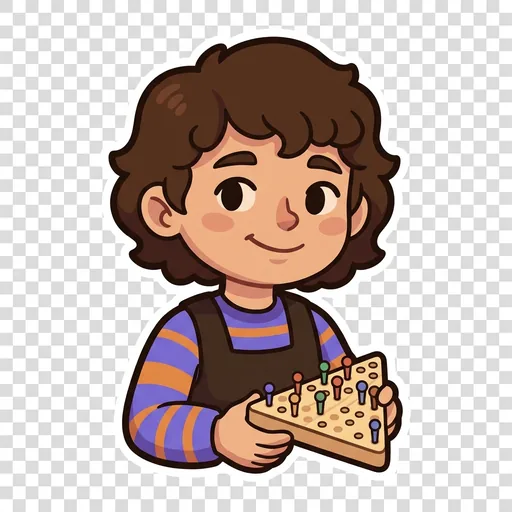
Vault
Reduction / monovariant — jumps one peg over another and removes it, shrinking the board toward a single survivor
-
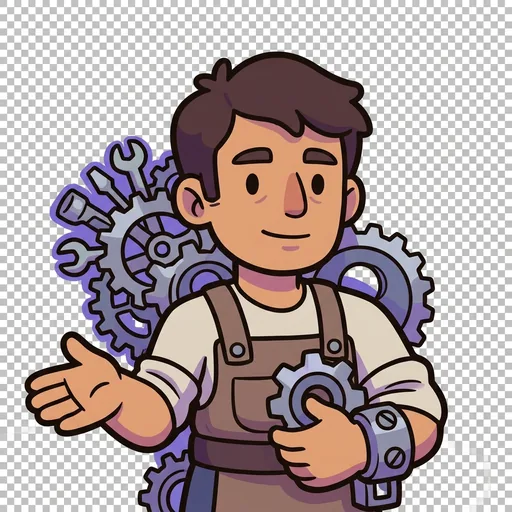
Sprocket
The workshop keeper (mentor) — frames 'make your solving strategy visible' and normalizes being stuck