
Gray
GRAY-CODE — *freeing the rings by changing exactly ONE thing at a time in a fixed order; a long sequence built from single, careful single-bit flips.*
Listen along — Gray
Loading audio…
Press play to listen along. The line being read lights up as you go.
Show full transcript
Loading transcript…
Gray and the Rings That Free One at a Time
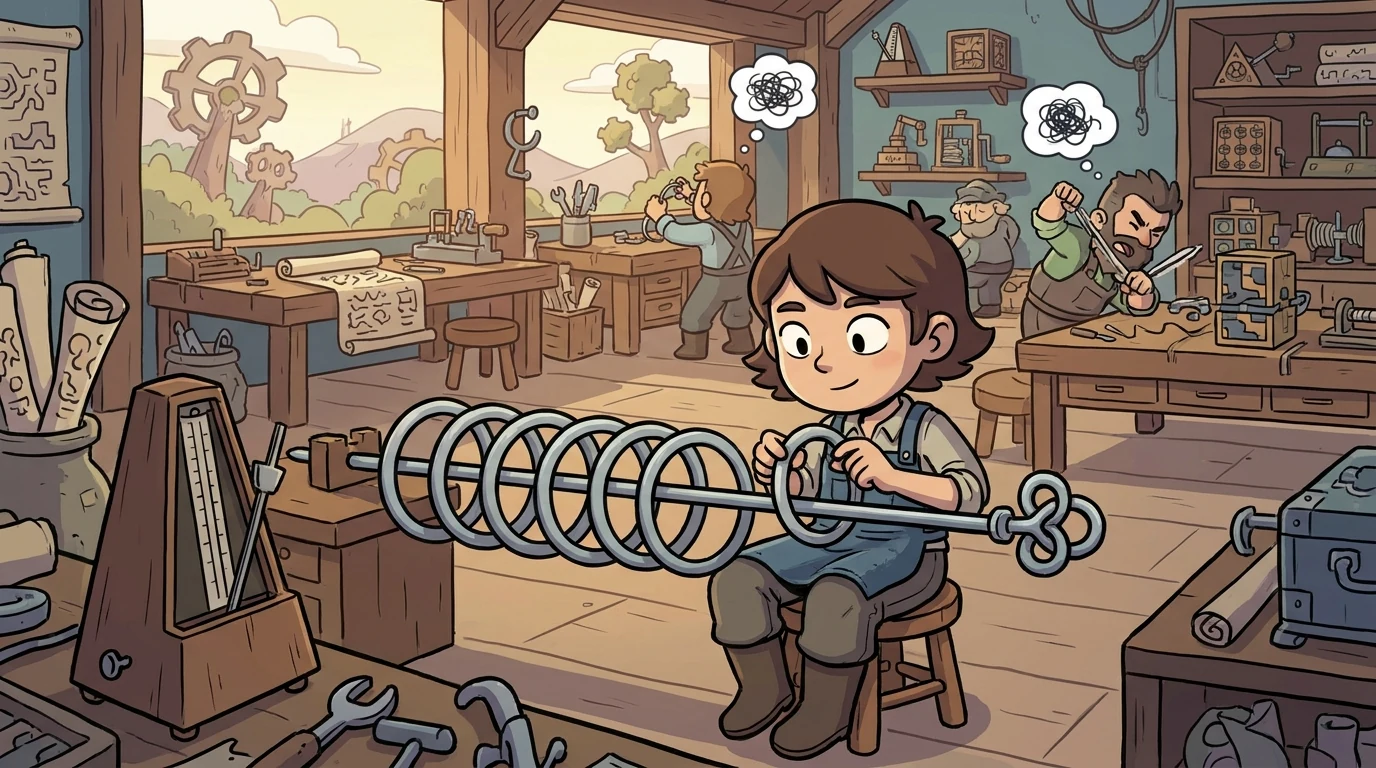
Gray tended the strangest contraption in the workshop: the Chinese rings. Nine metal rings looped onto a long bar through a maze of interlocking loops, and the goal was to get all nine off. The catch was diabolical. You could almost never take off the ring you wanted. The puzzle only let you move the ring at the very end, or the ring just past the last one still on — one specific ring at a time, in a rhythm that felt, to the impatient, like a locked door with an invisible key.
Visitors yanked. Rings clinked and refused. Gray never yanked. Gray moved with a metronome’s patience, changing exactly one ring’s state — on to off, or off to on — each turn, following the one order the puzzle allowed. “You can’t free the ring you want,” Gray said. “You can only free the ring you’re allowed — and that’s always the one where a single small change is legal. So I make that single change. Then the next single change becomes legal. One at a time, in order, forever, until they’re all off.”
Sometimes freeing all nine meant putting some back on along the way — and that maddened people. Gray found it beautiful. “Going backward a little is still one-change-at-a-time. The order knows where it’s going even when you don’t.”
Gray learned the one-at-a-time rhythm by ruining a set of rings through sheer impatience.
As an apprentice, Gray had wanted all nine off now, and had forced two rings at once, and jammed the whole contraption into a snarl that took Sprocket an hour to untangle. “You tried to change two things at once,” Sprocket said, working the snarl loose, “and the puzzle only ever allows one. That’s not a suggestion. It’s the law of the rings.” Sprocket freed the last snag and handed it back. “Here’s the secret that makes it bearable: there’s exactly one legal single-change at every step — sometimes taking a ring off, sometimes, annoyingly, putting one back on. Trust the single change even when it seems to go the wrong way. The order is a staircase. You can only take one stair. But every stair is takeable, and they all lead down.”
Gray stopped yanking. Gray started listening for the one legal change. The rings, astonishingly, cooperated.
When the kid arrived, they immediately tried to pull off ring number four, which the puzzle immediately refused with a stubborn clink.
“It won’t let you,” Gray said, not unkindly. “It never lets you take the one you want. Ask a smaller question: which single ring can I legally change right now? There’s always exactly one. Change that one. Don’t worry where it’s going yet.”
The kid found the one legal ring, changed it. Another became legal. Changed that. Gray never called a move wrong — when the kid grumbled that a legal move had put a ring back on, Gray just nodded: “One change at a time, even the backward-looking ones. The staircase knows.” Slowly, ring by single ring, the impossible tangle began to loosen. The kid stopped fighting for the ring they wanted and started trusting the one they were allowed, and there was a rhythm to it, almost soothing, like a long careful song where every note is a single flip.
When the ninth ring finally slid free, the whole contraption hung open and empty, and the kid blinked at it as if a locked door had simply dissolved.
“Feel that?” Gray asked, coiling the freed rings. “It’s not the rush of forcing something open. It’s the deep, patient calm of having untangled a huge thing without ever once grabbing at it — by only, ever, changing one small thing at a time, and trusting the order even when it seemed to backtrack. Nine rings. One flip each, in the right sequence. No forcing. No snarl.”
The kid felt it — a settled, unhurried satisfaction, the near-opposite of the yanking they’d walked in with.
“Big things don’t come apart when you grab them,” Gray said, hanging the rings back on the bar for the next visitor, settled and glad in that deep, patient calm. “They come apart when you change one small thing, and then the next, and you don’t rush the staircase. One at a time is slower. One at a time is the only thing that ever actually works.”
The PuzzleForge ensemble
Gray is part of PuzzleForge's distributed-narrative cast. Each character embodies a different curricular primitive; together they teach the full subject.
-

Nestor
Recursion / decomposition — solves the big tower by first solving the smaller tower off to the side (Hanoi self-reference)
-

Minim
Optimality — refuses any solution longer than the fewest possible moves
-
Wend
State-space search — maps which positions are reachable before committing to a move
-
Evan
Parity / solvability — counts the tile-swaps mod 2 and knows at a glance if a scramble can ever be solved
-
Faro
Look-ahead / planning — looks several moves ahead to clear a path before touching a piece
-

Skiff
Constraint satisfaction — ferries across the river without ever leaving the wolf with the goat
-

Gill
GCD / number reasoning — measures an exact amount by pouring back and forth between two jugs
-
Vault
Reduction / monovariant — jumps one peg over another and removes it, shrinking the board toward a single survivor
-

Sprocket
The workshop keeper (mentor) — frames 'make your solving strategy visible' and normalizes being stuck