
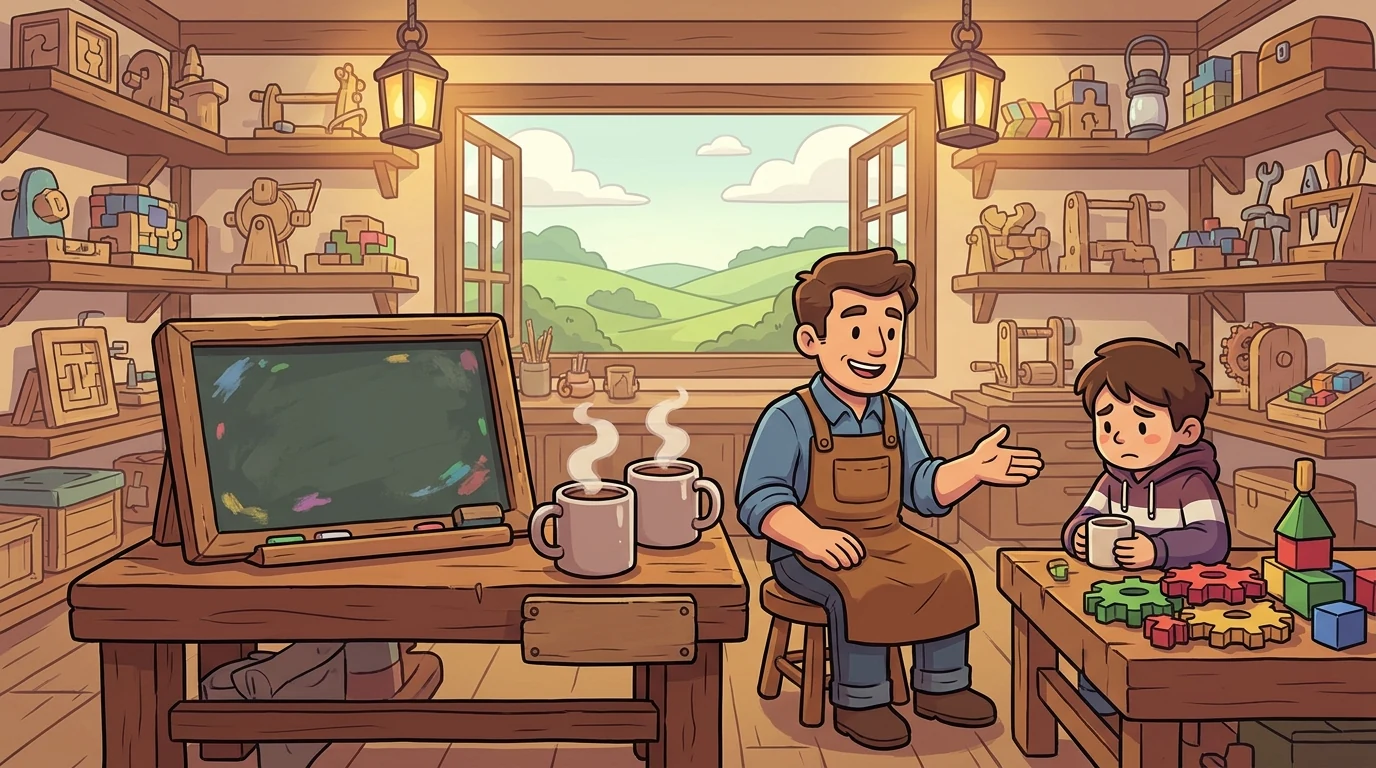
Sprocket
STRATEGY-VISIBLE / ANTI-SHAME FRAME — *the mentor whose recurring act is making the learner's thinking visible and normalizing being stuck, so every cast primitive can land.*
Listen along — Sprocket
Loading audio…
Press play to listen along. The line being read lights up as you go.
Show full transcript
Loading transcript…
Sprocket and the Workshop of Visible Thinking
Sprocket had run the PuzzleForge workshop longer than anyone could remember, and Sprocket’s own bench held no single puzzle. Instead it held cocoa, a very worn chalkboard, and a small hand-lettered sign that read: Being stuck is data.
Sprocket did not solve puzzles for visitors. That was, in fact, the one thing Sprocket refused to do. When a kid slumped in frustration and begged for the answer, Sprocket would pull up a stool, hand over a cocoa, and ask the maddening, wonderful question: “Show me your thinking. Not the answer you want — the thinking you’ve got so far. Say it out loud.” Because Sprocket had noticed, over all those years, that a stuck kid almost never had a broken brain. A stuck kid had invisible thinking — a plan trapped inside their head where neither of them could look at it. “I can’t help what I can’t see,” Sprocket would say gently. “And you can’t fix what you can’t see either. So let’s get it out where we can both look.”
That was Sprocket’s whole craft: making thinking visible, and treating stuck-ness as ordinary and interesting rather than shameful. Nestor’s smaller towers, Minim’s fewest moves, Wend’s maps, Skiff’s fences — none of them could land on a kid frozen in embarrassment. Sprocket melted the embarrassment first.
Sprocket had learned this from the wrong side of it.
Long ago, young Sprocket had a teacher who solved everything for the class — fast, brilliant, and utterly demoralizing. Every solution appeared like magic, and young Sprocket concluded, quietly and wrongly, that some people simply had the magic and Sprocket didn’t. It took Sprocket years to discover the truth: those brilliant teachers hadn’t been magic. They’d had visible-to-themselves thinking — little strategies they’d never bothered to say out loud, so it looked like magic from the outside. The day Sprocket first said a strategy aloud and watched a stuck classmate light up, Sprocket found a calling. “Nobody’s stuck because they’re less,” Sprocket decided. “They’re stuck because the strategy is hidden. Show the strategy, and the magic turns out to be teachable.”
When the kid arrived — often last, after a lap of the whole workshop, sometimes wobbly with a hard afternoon — Sprocket poured a cocoa and made room on the stool.
“You’ve met them all,” Sprocket said. “Nestor, Minim, Wend, all of them. Here’s the thing they have in common, the thing this whole workshop is really about: none of them think in secret. They say what they’re doing out loud. That’s not a personality quirk. That’s the actual skill.” Sprocket tapped the little sign. “You don’t get better at puzzles by getting the magic. You get better by making your thinking visible — so you can look at it, fix the one broken step, and keep the rest.”
The kid, who’d been carrying a small private worry about being slow, said it out loud for once: “I get stuck a lot.”
“Good,” said Sprocket, and meant it, and the kid startled. “Stuck is data. Stuck tells us exactly where your thinking went invisible. It’s not a verdict on you — it’s a flashlight showing us where to look. Say the stuck part out loud and it stops being a wall and starts being a question.” Sprocket never once said the kid was behind, or slow, or anything but a person with some thinking that hadn’t been said aloud yet.
And here, at the end of the workshop lap, was the feeling Sprocket had spent a whole life trying to give away: the kid sat up a little straighter, and the tight, embarrassed knot of maybe I’m just not good at this came loose — replaced by something warm and steadying, the relief of being met without judgment, of learning that stuck is normal and thinking-out-loud is the fix.
“That,” Sprocket said softly, refilling the cocoa, “is the feeling I run this whole workshop for. Not the triumph of a solved puzzle — the unclenching when you realize you were never less-than, you were just thinking in the dark. Turn the light on. Say it out loud. Nobody here is behind.” Sprocket smiled and nodded toward the benches. “Now — which puzzle do you want to go make visible first?”
The PuzzleForge ensemble
Sprocket is part of PuzzleForge's distributed-narrative cast. Each character embodies a different curricular primitive; together they teach the full subject.
-

Nestor
Recursion / decomposition — solves the big tower by first solving the smaller tower off to the side (Hanoi self-reference)
-
Minim
Optimality — refuses any solution longer than the fewest possible moves
-
Wend
State-space search — maps which positions are reachable before committing to a move
-
Evan
Parity / solvability — counts the tile-swaps mod 2 and knows at a glance if a scramble can ever be solved
-
Faro
Look-ahead / planning — looks several moves ahead to clear a path before touching a piece
-
Skiff
Constraint satisfaction — ferries across the river without ever leaving the wolf with the goat
-

Gill
GCD / number reasoning — measures an exact amount by pouring back and forth between two jugs
-

Gray
Binary / Gray-code — frees the rings by changing exactly one at a time in a fixed order
-
Vault
Reduction / monovariant — jumps one peg over another and removes it, shrinking the board toward a single survivor