
Wend
STATE-SPACE SEARCH — *mapping which positions are reachable and exploring them in order, instead of guessing moves at random.*
Listen along — Wend
Loading audio…
Press play to listen along. The line being read lights up as you go.
Show full transcript
Loading transcript…
Wend and the Map of Every Move
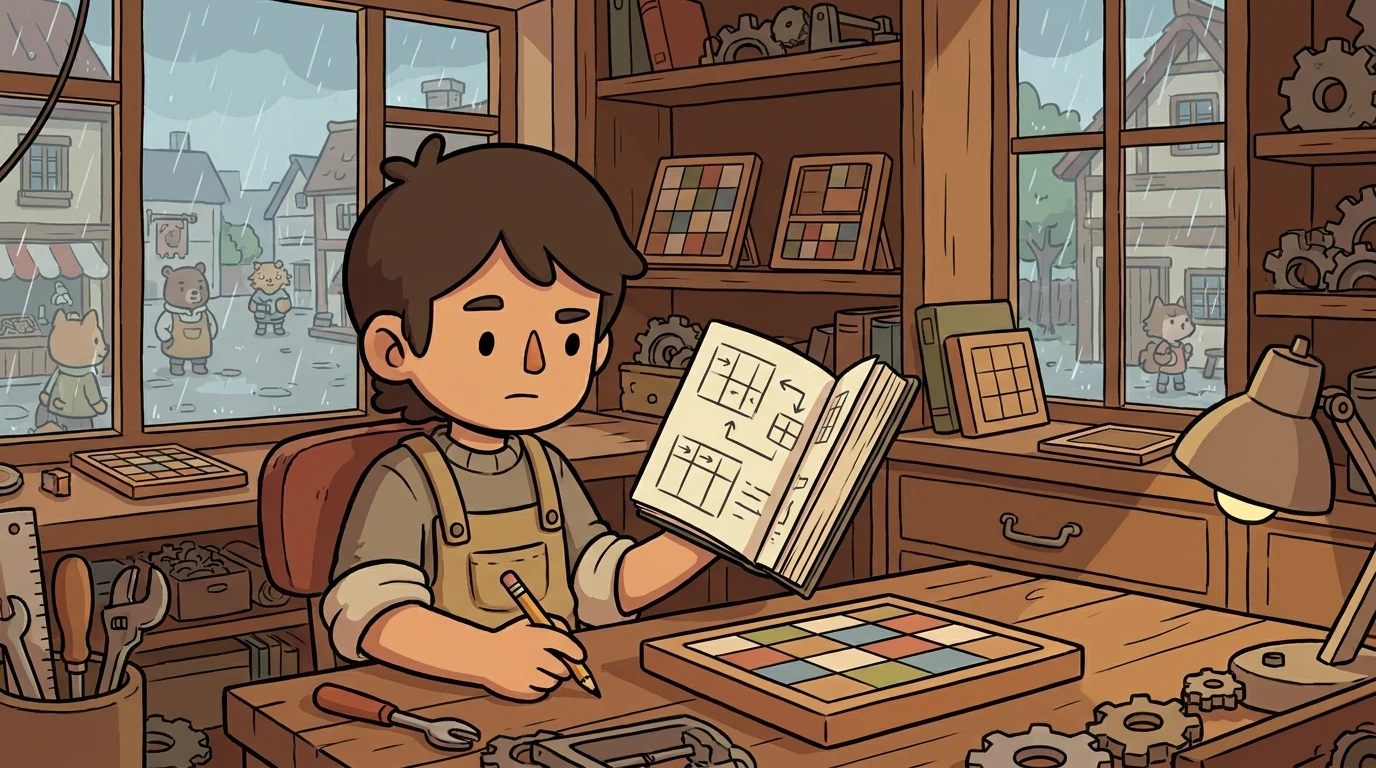
Wend worked at the sliding-tile bench — the fifteen little numbered squares in a four-by-four frame with one empty space, the puzzle that has driven people quietly mad since before anyone can remember.
Most visitors attacked it by feel: slide a tile, slide another, slide the first one back, get frustrated, slide wildly. Wend never slid wildly. Wend kept a notebook, and in the notebook Wend drew the positions — not the moves, the positions. “Here’s where we are,” Wend would say, sketching the current arrangement. “And from here, only three tiles can move. So there are only three places we can get to next. Let’s write down all three before we pick one.”
That was Wend’s whole art: instead of one hopeful guess, map out every place you could reach, then explore them nearest-first, keeping track of where you’d already been so you never wandered in circles. “The puzzle isn’t a maze of moves,” Wend said. “It’s a map of places. And I’d rather have the map.”
Wend built the first map out of pure exhaustion.
As an apprentice, Wend had spent a whole rainy afternoon on a scrambled tile-puzzle, sliding and re-sliding, and slowly realized — with a sinking horror — that Wend had returned to the exact same scramble at least four times without noticing. Hours, walking in circles inside a four-by-four frame.
Sprocket found Wend head-down on the bench. “You’re not lost because it’s hard,” Sprocket said. “You’re lost because you’re not writing down where you’ve been. Wanderers go in circles. Mappers don’t.” Sprocket tore a page from the notebook and drew the starting position in the center, then the three positions one move away around it, like spokes. “Explore the closest ring first. Cross off every place you visit. A place you’ve crossed off, you never visit again. Do that, and the very first time you reach the finish, you’ll have reached it by the shortest road — because you checked all the closer roads first.”
Wend looked at the little map of spokes and felt the rainy afternoon lift like fog.
When the kid arrived, Wend handed them a pencil before a single tile.
“Everyone wants to touch the tiles first,” Wend said. “We’re going to draw first. Sketch where we are. Now — which tiles can move? Only the ones next to the empty square. Good. That’s two places we could go to. Draw both.”
The kid drew, tentatively, then slid a tile and drew the new position, then another. Slowly the notebook filled with a little tree of arrangements, each one crossed off as they left it.
“Feels slow,” the kid admitted.
“It feels slow,” Wend agreed cheerfully, “right up until the moment it feels like cheating. Because look — you’ve never once revisited a scramble. You’ve never walked in a circle. Every position you draw is a new one, and you’re fanning outward, ring by ring.” Wend never called a slide wrong; a slide that led somewhere already-crossed-off just earned a gentle “we’ve been there — back up, try the next spoke.” When the finished arrangement finally appeared in the notebook, Wend tapped it. “And because we searched the near rings before the far ones, that path we just traced? Shortest one there is. We didn’t luck into it. We found it.”
The kid sat back and looked at the little map — the whole territory of the puzzle, drawn out, with a clean line threading from start to finish.
“There it is,” Wend said, watching the kid’s face. “That feeling. Not the thrill of a lucky slide — the steadiness of standing above the whole puzzle and seeing it as a place you’ve mapped, not a fog you’re stumbling through. No more circles. No more sinking horror of wait, have I been here before. Just the calm of knowing exactly where you are and exactly where you haven’t looked yet.”
The kid breathed out slow, and it was true — the maddening little frame had turned into something almost peaceful, a country with roads and a map.
“That’s why I always draw first,” Wend said, closing the notebook with a small, satisfied pat. “I’d rather spend a minute making the map than an afternoon lost inside the same four-by-four.”
The PuzzleForge ensemble
Wend is part of PuzzleForge's distributed-narrative cast. Each character embodies a different curricular primitive; together they teach the full subject.
-
Nestor
Recursion / decomposition — solves the big tower by first solving the smaller tower off to the side (Hanoi self-reference)
-
Minim
Optimality — refuses any solution longer than the fewest possible moves
-
Evan
Parity / solvability — counts the tile-swaps mod 2 and knows at a glance if a scramble can ever be solved
-
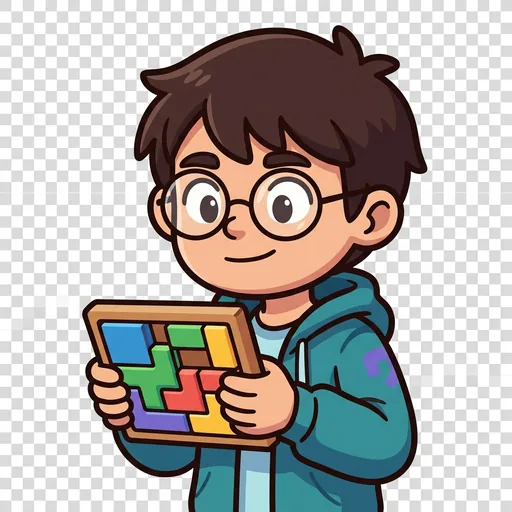
Faro
Look-ahead / planning — looks several moves ahead to clear a path before touching a piece
-
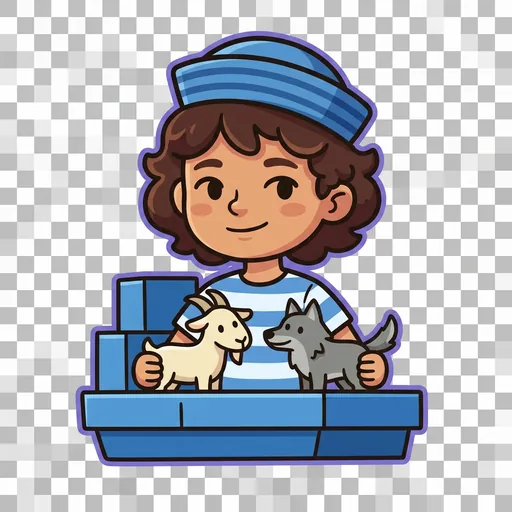
Skiff
Constraint satisfaction — ferries across the river without ever leaving the wolf with the goat
-
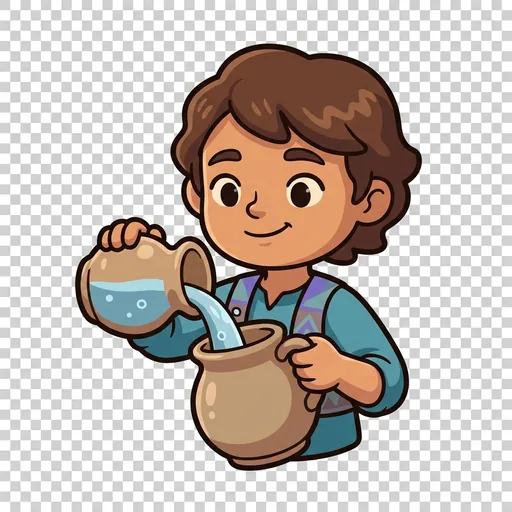
Gill
GCD / number reasoning — measures an exact amount by pouring back and forth between two jugs
-
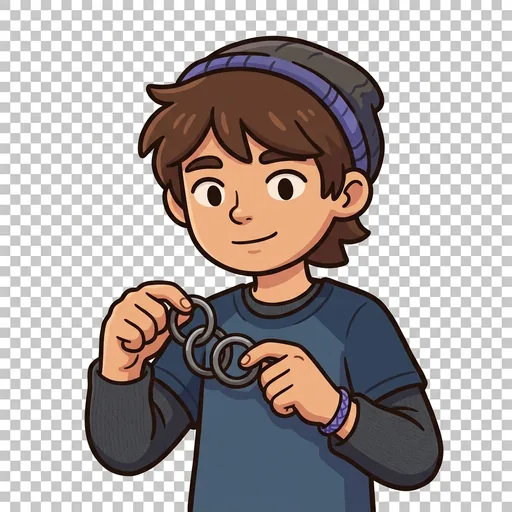
Gray
Binary / Gray-code — frees the rings by changing exactly one at a time in a fixed order
-
Vault
Reduction / monovariant — jumps one peg over another and removes it, shrinking the board toward a single survivor
-
Sprocket
The workshop keeper (mentor) — frames 'make your solving strategy visible' and normalizes being stuck