Bigsby
sample size
Loading audio…
Press play to listen along. The line being read lights up as you go.
Show full transcript
Loading transcript…
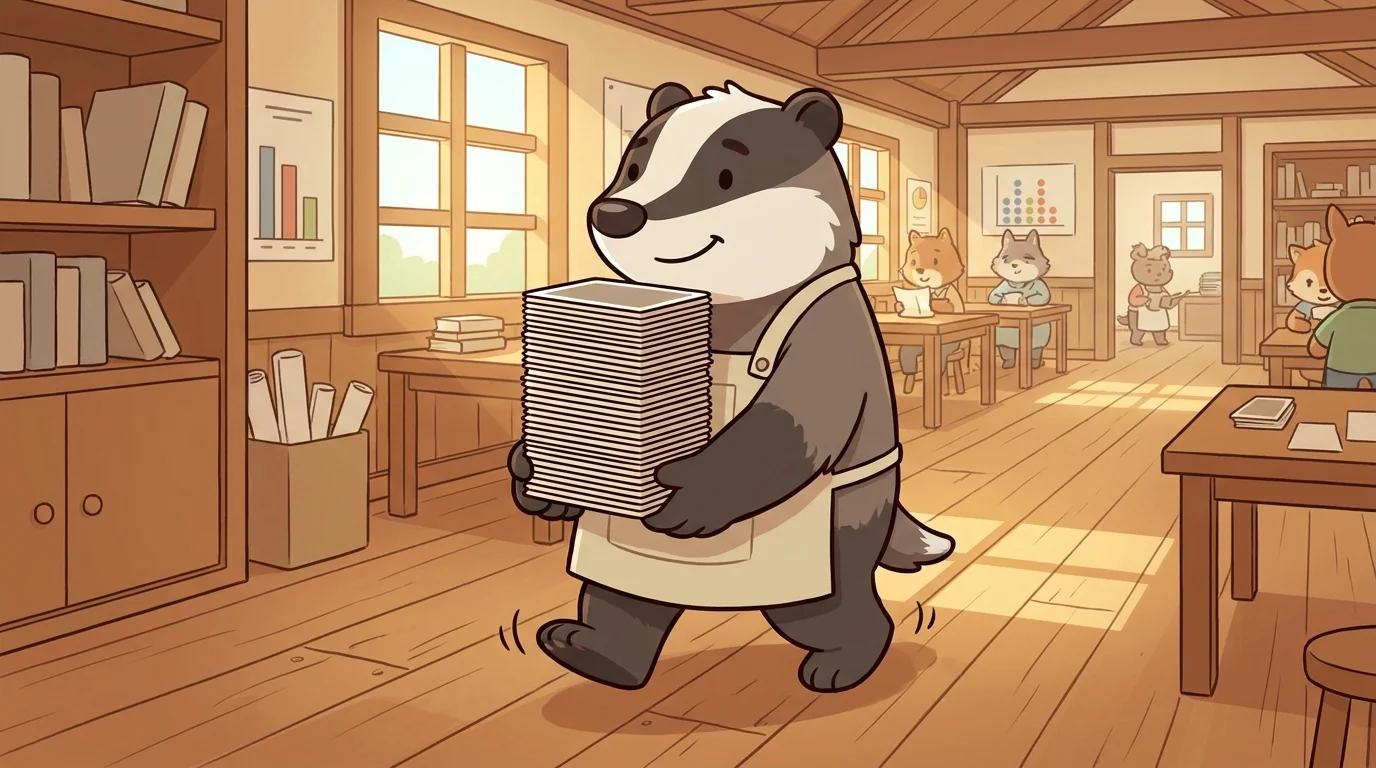
Bigsby is the largest animal in the Card Lab, and you always hear him before you see him. He is a badger, broad across the shoulders, with a white stripe running down his nose and a canvas apron knotted around his middle, its pocket full of pencil stubs. The old floorboards creak under him as he walks between the tables, a friendly creak, like the lab saying hello. And in both paws, held low and careful so that not a single card slides loose, he almost always carries the same thing: a tall, squared-off stack of face-down cards.
"More deals," Bigsby says, in a voice so slow and deep it seems to come up through the floor. "Always more deals."
The younger animals tease him about it. Why so many? they ask. You could test a rule on five deals and be finished before lunch. Bigsby never argues. He only smiles, sets down his stack, and tells them about the spring of the Great Five-Deal Mistake.
That spring, a pair of mice had a new solitaire rule they were sure was brilliant. To test it, they dealt five games. The new rule won four. "Eighty percent!" they squeaked, already drafting an announcement for the whole valley. Bigsby read their notes, nodded politely, and asked them for one small favor. Would they run the very same rule again, on five different deals?
They did. This time it won two.
"Forty percent?" said the mice, staring at each other. "But it was eighty a minute ago. Which one is real?"
"Maybe neither," said Bigsby. "With only five deals, luck is loud. One easy deal lands in your pile, or one brutal one, and your answer swings a long way. Suppose your rule truly wins about half the time. Five deals could easily hand you four wins, or one, or five, just from which deals happened to come up. Five deals can't tell a great rule from an ordinary one that got lucky."

The lab's screen can show exactly how much the data can and cannot say. After each test it draws a bar called an interval, the stretch of true win rates that the results can honestly support. When the mice looked at the bar for their five-deal test, it stretched nearly across the whole screen, from barely-helps to helps-enormously. Bigsby leaned over and tapped the glass. "That's not a finding," he said kindly. "That's fog. There's a hill out there somewhere, the true answer, and you're trying to see its shape through a thick grey morning. You can't. Not yet."
"Then how do we see it?" asked the smaller mouse.
Bigsby lifted his tall stack and set it on the table with a soft, heavy thump. "We deal more."
They ran the rule on fifty deals. The bar pulled in from both ends, a good long way, and the hill began to show a faint outline. They ran it on two hundred, and the bar shrank again, narrower and narrower, until it sat in a tight little band. Now they could actually say something: the rule helped, modestly but really, and they could say it without crossing their fingers.
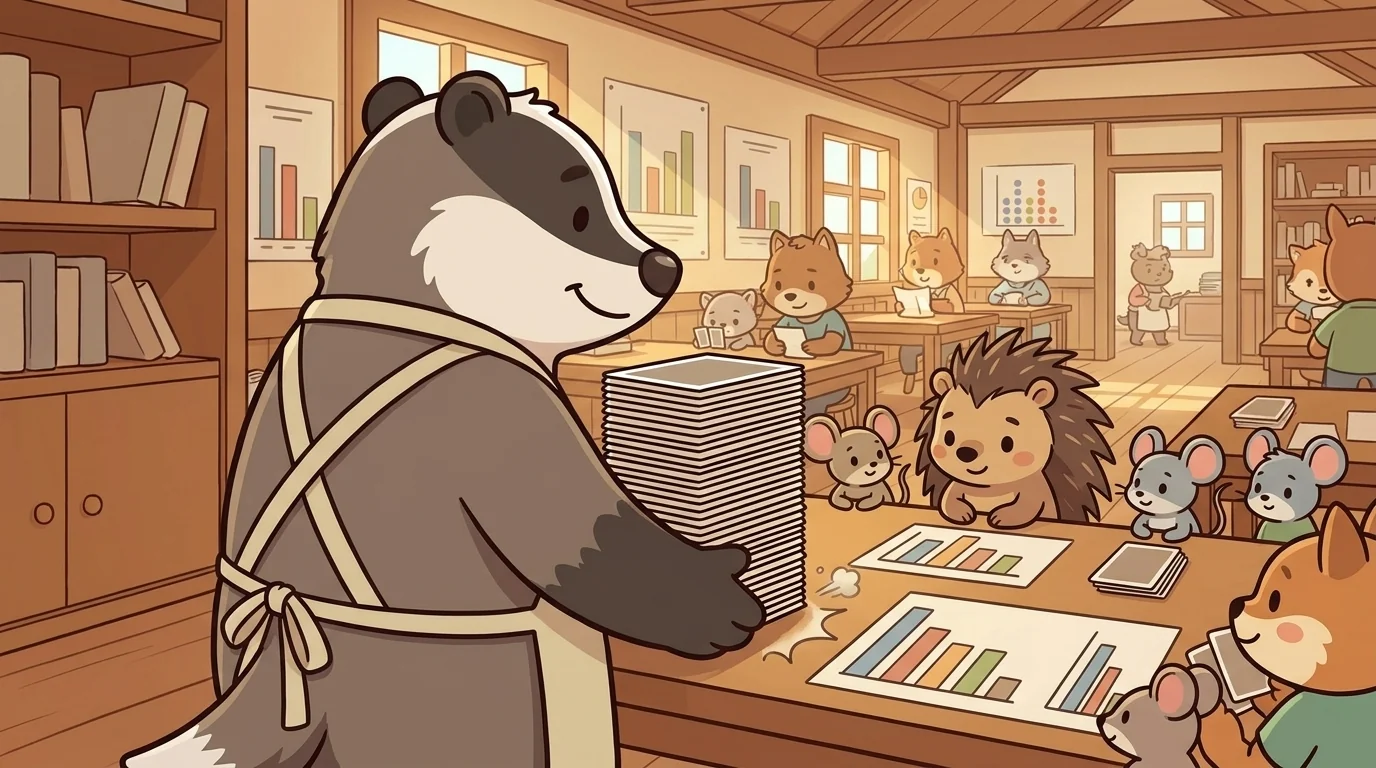
But the mice noticed something odd along the way, and to their credit, they said it out loud. "Going from five deals to fifty made the bar much narrower," said the smaller one. "Going from fifty to two hundred narrowed it much less, even though that was a hundred and fifty more deals. Did the extra deals stop working?"
"They didn't stop," said Bigsby, and his eyes crinkled, because this was his favorite part. "They just each did less. The first handful of deals clears away the thickest fog. After that, every new deal is thinning fog that's already thin. Here is the rule of thumb scientists use. To cut the width of your bar in half, you don't need twice as many deals. You need about four times as many. Half again? Four times again. The answer sharpens with the square root of how much you test, not in a straight line."
The mice worked it out on a scrap of paper. Five deals to twenty would halve the width. Twenty to eighty would halve it again. Eighty to three hundred and twenty, again. Each halving cost four times the work of the last.
"That's why you can't just toss in a handful of extra deals and call something certain," Bigsby went on. "A little more testing buys you a little more sharpness, and it keeps getting more expensive. A really sharp answer takes a really big stack. There's no shortcut through it. You just carry the stack."
The mice looked at his cards with new respect, and a little dismay, and then they went and dealt three hundred more.
Bigsby feels most like Bigsby at the very end of a long test, when the last deal has been played and the interval settles, at last, into a thin, clear band across the screen. It is a deep, warm, satisfied feeling, the feeling of finishing the last bite of a huge dinner, or setting the final stone on a wall you built yourself. It took a long time. It was worth every deal.
You have some of Bigsby in you whenever you choose patience over speed, and whenever you ask whether an answer rests on enough evidence to hold its shape. Before you trust a result, check how many times you actually tested it, and say it the way he does: "Bigsby piles on more deals, and the answer comes into focus."
Then keep dealing, one steady card at a time, and watch the fog lift off the hill.
Hear it as an audio drama
A short play starring Bigsby, from Solitaire Lab. Different voices, same idea. Listen any time after you read.
Loading audio…
Read the drama script
- Narrator: From Spark and Anvil and Solitaire Lab — this is Bigsby, in chapter 1 of the Solitaire Lab cast.
- Narrator: This drama uses an AI-generated voice. Voiced via Gemini 2.5.
- Narrator: The floorboards of the Card Lab creaked as Bigsby the badger carried his tall stack of face-down cards.
- Mouse: Bigsby! Our rule won four out of five deals. That's eighty percent!
- Bigsby: Lovely. Would you run it again, on five different deals?
- Narrator: They did. This time the rule won only two.
- Mouse: Forty percent? Which one is real?
- Bigsby: Maybe neither. With five deals, luck is loud. One easy deal or one hard one swings the answer a long way.
- Mouse: Then how do we find out?
- Bigsby: We deal more. Fifty. Then two hundred.
- Narrator: With every batch, the honest range on the screen grew narrower, like fog lifting off a hill.
- Mouse: But the second batch helped less than the first.
- Bigsby: That's the rule. To make your range half as wide, you need about four times as many deals.
- Mouse: Then we'd better keep dealing.
- Narrator: Small tests are foggy. Big, patient tests come into focus. That's Bigsby's whole idea.
- Narrator: You've been listening to a Spark and Anvil chapter, written by the Spark and Anvil writing team for ages 9 to 14.
- Narrator: Apps stay free forever.
- Narrator: Curriculum aligned to Common Core and Next Generation Science Standards.
- Narrator: Released under Creative Commons BY-NC-SA 4.0 for educational reuse. Visit Spark and Anvil for the full transcript.
The Solitaire Lab ensemble
Bigsby is one of the friends in Solitaire Lab. Each friend shows you one idea by how they act; meet them all and you have the whole subject.
-

Dealia
asks what you predicted BEFORE you look at the data
-

Twinnie
Deals every hand twice - the same deals for both rules, so the test is fair
-

Hedgeworth
Never says more than the data can - reports at least ... and at most ...
-

Maybelle
Knows an unknown is a maybe, not a no - the search ran out of time
-

Lopsy
Counts the deals where only ONE rule won - those odd pairs are the whole story
-
Lanternby
Knows the measuring tool is part of the result - a bigger search proves more wins of the SAME deals
-

Glassby
Knows FreeCell hides nothing, so a 'lost' there is a proof about the deal itself
-

Tiebelle
Calls it a tie when the two ranges overlap - no winner the data cannot back
-

Seedwick
Knows the same run seed rebuilds the same deals, so anyone can re-check your test
-
Tabitha
Keeps one row per deal in the CSV so you can draw the chart yourself
-
Addison
Knows a rule that only ADDS moves can never truly win less - reason before you run