
Tabitha
raw data - keep one row for every deal, not just the final total, so anyone can make their own chart and spot what a summary hides
Loading audio…
Press play to listen along. The line being read lights up as you go.
Show full transcript
Loading transcript…
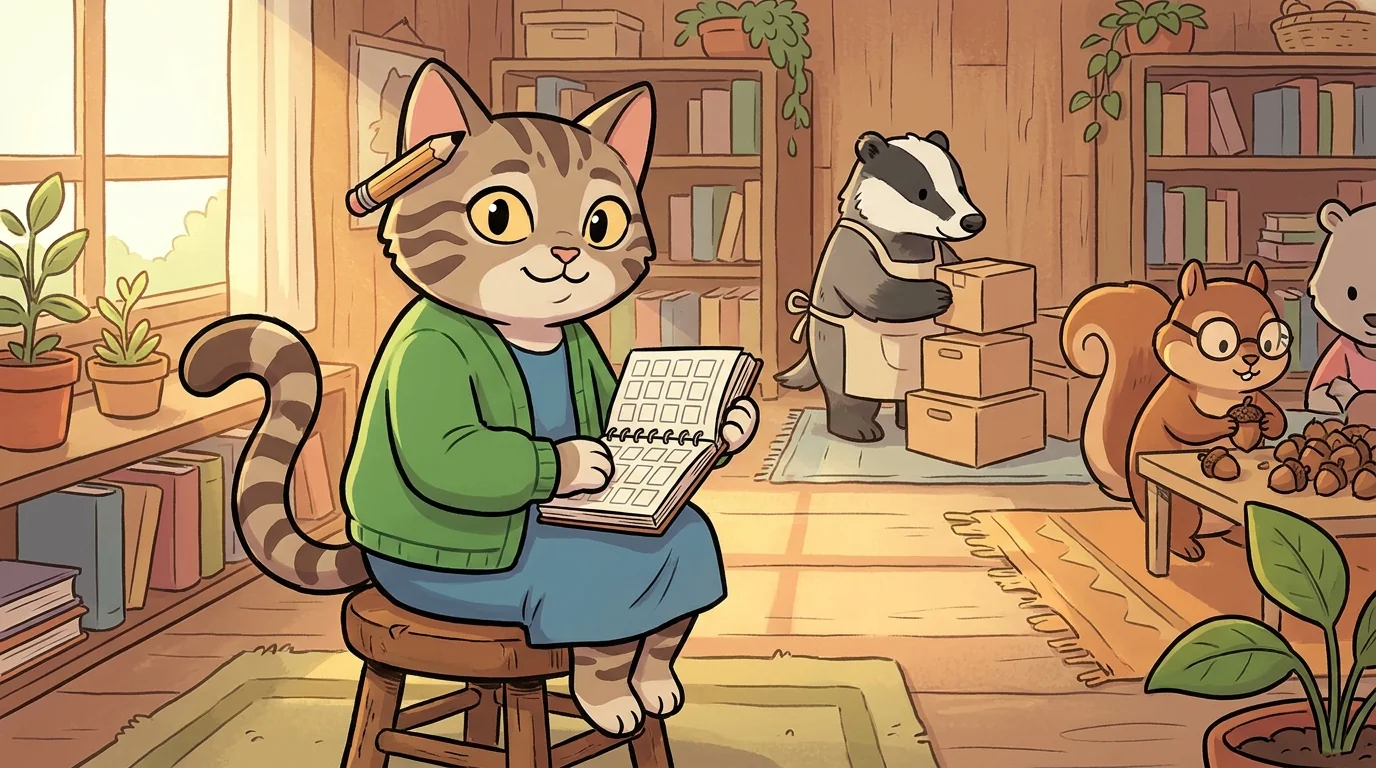
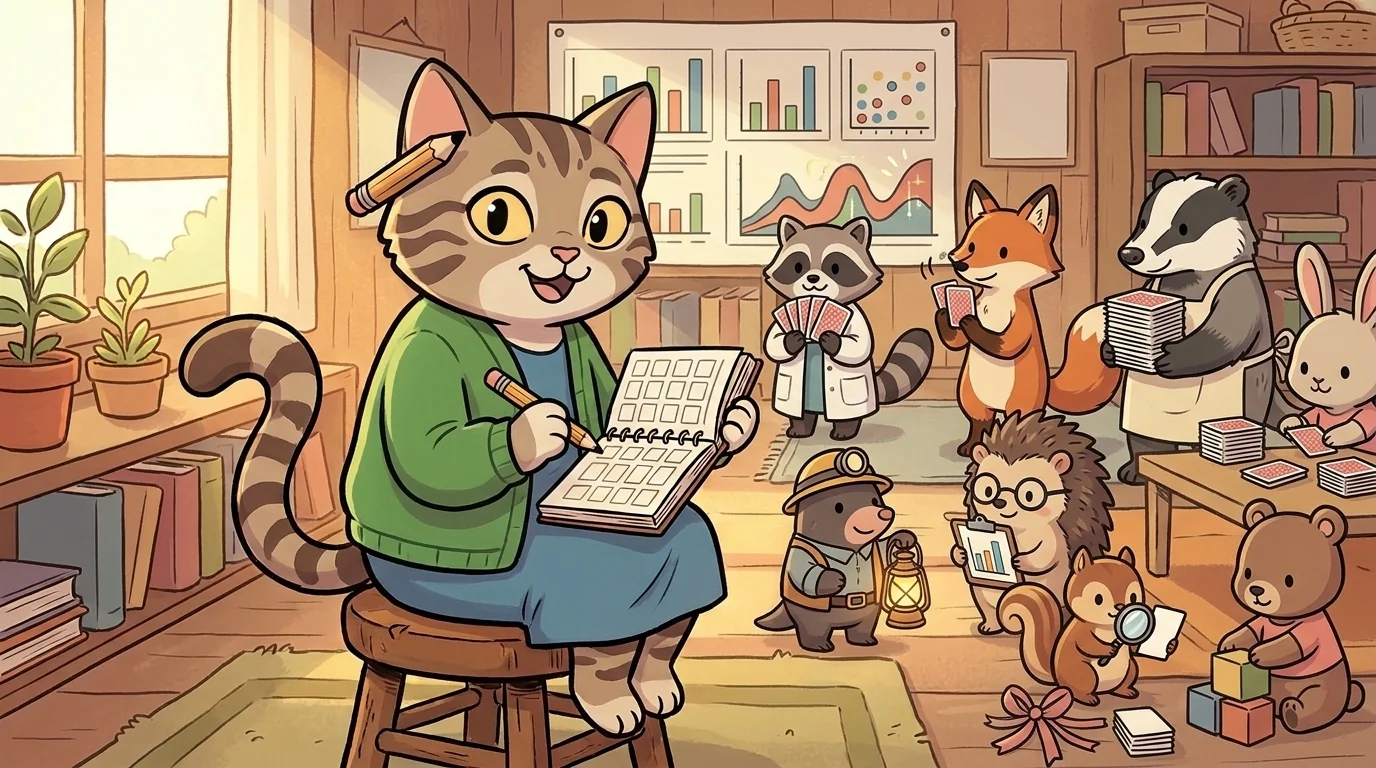
Tabitha is a tabby cat with stripes that swirl around her like brushstrokes and a tail she curls into a neat question mark when she sits. She carries a notebook everywhere, the kind with pages of little empty squares, and a stubby pencil tucked behind one ear.
What goes in Tabitha's notebook is not stories or drawings. It is rows. One row for every deal.
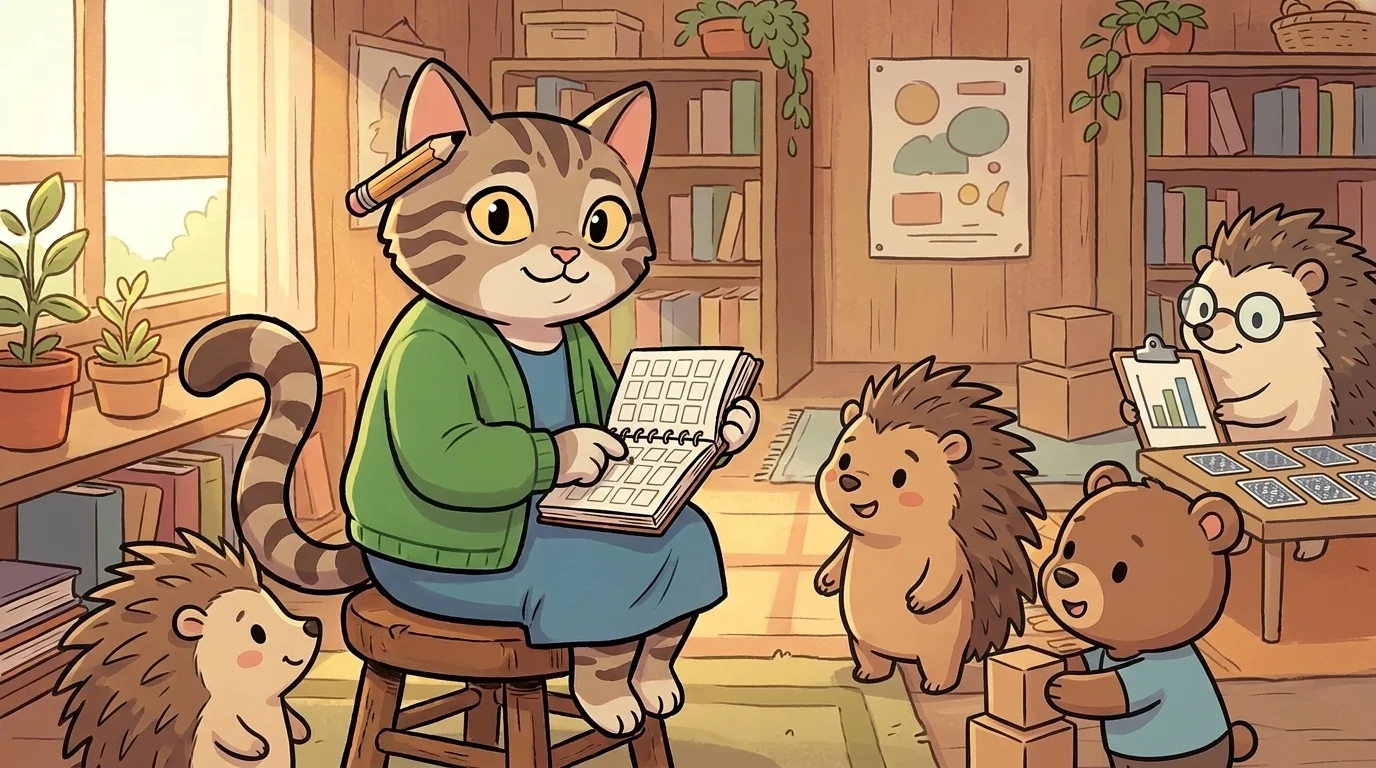
"Every deal gets its own line," she says, tapping the page. "Which deal it was, the seed that built it, and what each rule did: won, lost, or not sure yet. One line each. No skipping."
The younger animals sometimes find this funny. Why write down every single deal, they ask, when the lab already tells you the total? Forty-two wins out of sixty. Isn't that enough?
Tabitha always smiles, because she knows the story of the Hiding Pattern.
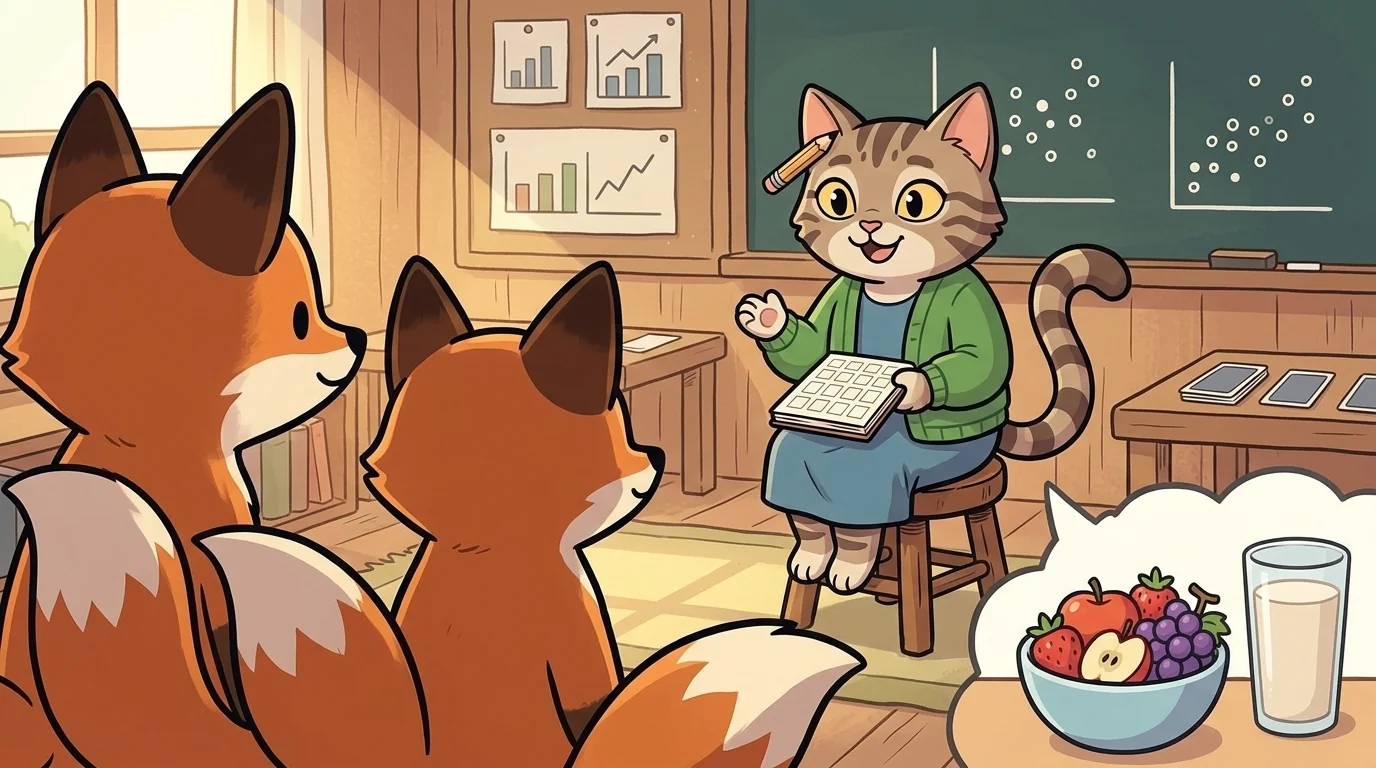
A group of young foxes once ran a big test and got a total that looked ordinary: a rule that won a little more than half its deals. They were ready to write "a bit better than half" on their poster and call it done.
Tabitha asked to see the rows.
The foxes looked puzzled. They hadn't kept rows. They had only kept the total. So Tabitha asked the lab to download the full table, one line per deal, into a file she could open in her notebook. The lab calls this a CSV file. It is just a long list of rows, easy for anyone to read or draw from.
Then Tabitha did something the foxes had never thought to do. She didn't look at the total at all. She drew her own chart: a little grid with the first rule's answer along one side and the second rule's answer along the other, and one dot for each deal in the square where it belonged.
And a pattern appeared that the total had completely hidden.
Every deal the first rule had lost, the second rule had lost too. The second rule's extra wins came only from deals where the first rule had said not sure yet. The new rule hadn't rescued any lost deals at all. It had only finished deals the first search never got to the end of.
The foxes stared at the dots. "The total made everything look the same," one said slowly. "But it isn't the same at all."
"A total is like a smoothie," said Tabitha, eyes twinkling. "You can taste that there's fruit in it, but you can't see the strawberries anymore. The rows are the whole fruit bowl. Keep the rows, and you can always blend your own total later. But once you only have the total, you can never get the rows back."
The foxes started over. This time, they kept every row. They drew three different charts, argued happily about which one showed the pattern best, and made a science-fair poster that taught everyone something new.
Tabitha feels most like Tabitha when a chart she drew herself suddenly shows a shape nobody expected. It is a quick, delighted, tingly feeling, like pulling a string on a sweater and watching a hidden pattern unravel into view.
You have a bit of Tabitha in you whenever you keep the details instead of throwing them away. When you finish a test, save every row, and say it the way she does: "Tabitha keeps every row, so you can draw the picture yourself."
Then grab a pencil, and see what your rows are hiding.
The Solitaire Lab ensemble
Tabitha is part of Solitaire Lab's distributed-narrative cast. Each character embodies a different curricular primitive; together they teach the full subject.
-

Dealia
(Mentor, a card-dealing raccoon) - asks what you predicted BEFORE you look at the data
-

Twinnie
Deals every hand twice - the same deals for both rules, so the test is fair
-

Hedgeworth
Never says more than the data can - reports at least ... and at most ...
-

Maybelle
Knows an unknown is a maybe, not a no - the search ran out of time
-

Bigsby
Knows more deals make the answer sharper - the interval gets narrower
-

Lopsy
Counts the deals where only ONE rule won - those odd pairs are the whole story
-

Lanternby
Knows the measuring tool is part of the result - a bigger search proves more wins of the SAME deals
-

Glassby
Knows FreeCell hides nothing, so a 'lost' there is a proof about the deal itself
-

Tiebelle
Calls it a tie when the two ranges overlap - no winner the data cannot back
-

Seedwick
Knows the same run seed rebuilds the same deals, so anyone can re-check your test
-

Addison
Knows a rule that only ADDS moves can never truly win less - reason before you run