
Twinnie
a paired test - run both rules on the very same deals, so any difference comes from the rule, not from luck
Loading audio…
Press play to listen along. The line being read lights up as you go.
Show full transcript
Loading transcript…

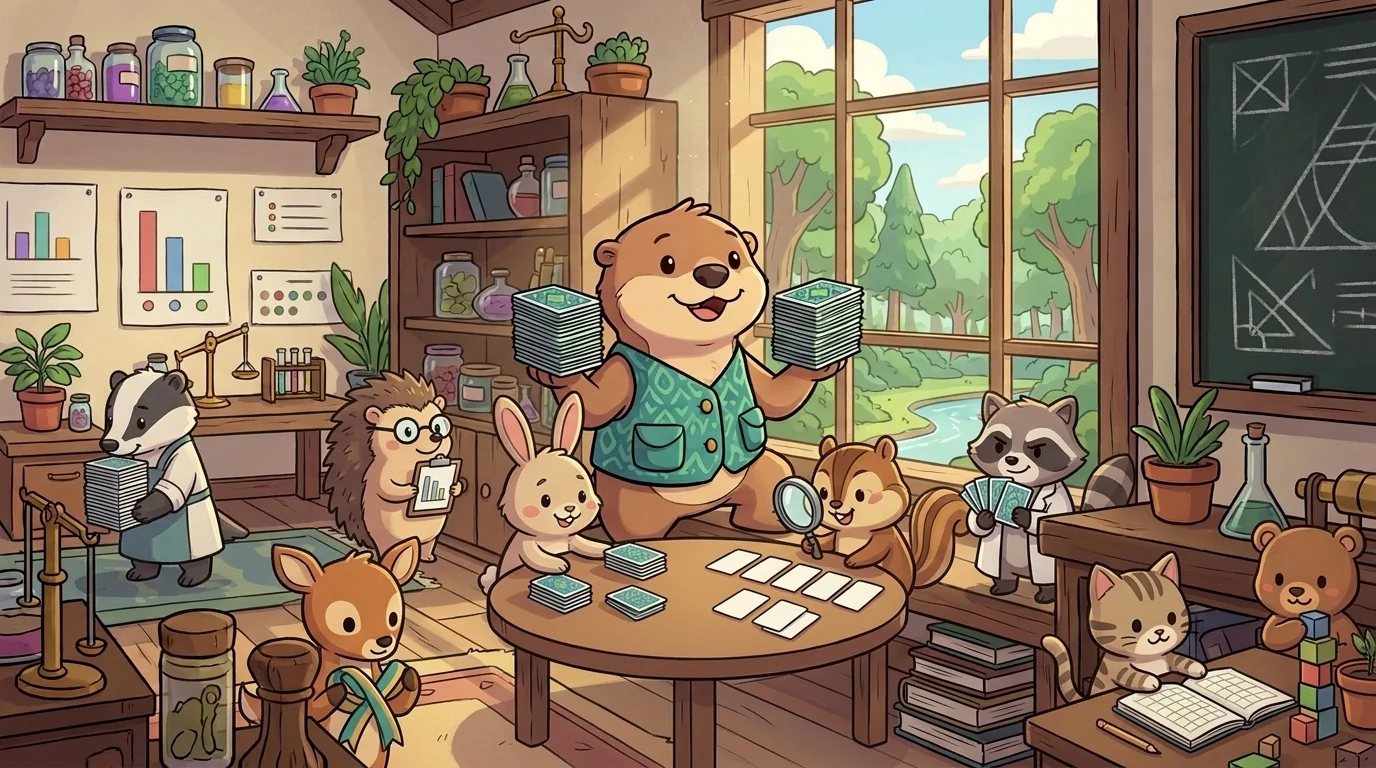
On a shelf near the window of the Card Lab, there is an otter who never holds just one stack of cards. Her name is Twinnie. She wears a teal vest with deep pockets, and in each paw she carries a stack of face-down cards. The two stacks are exactly the same height. If you ask to see them, she will show you: every card in the left stack sits in the same place as its twin in the right stack.
"One for rule A," she says, lifting the left paw. "One for rule B." She lifts the right. "Same deals. Always the same deals."
Twinnie learned this the hard way.

A while ago, two badger cousins came to the lab arguing. One cousin, Pim, said you should never take a card back down once it has gone up to the finished piles. The other cousin, Mossy, said taking cards back was a clever trick and won more games. They decided to settle it with a contest.
Pim played ten games his way. Mossy played ten games her way. Mossy won six. Pim won three.
"See?" Mossy said. "My rule wins twice as often."
Twinnie had been watching from her shelf, whiskers twitching. She slid down, landed with a soft thump, and asked a question that made both cousins go quiet.

"Were your twenty deals the same?"
They weren't, of course. Pim had shuffled his own cards. Mossy had shuffled hers. Some deals come out easy, with the aces near the top and the long runs falling right into place. Some come out tangled, with every useful card buried under a King. Nobody can win a tangled deal, whatever rule they use.
"So maybe Mossy's rule is better," Twinnie said, "or maybe Mossy just got the easy deals. From your contest, there is no way to tell which. The luck and the rule are all mixed up together."
Pim looked relieved. Mossy looked annoyed. Twinnie looked like she had a plan.

She took one fresh deck and dealt twenty hands. Then she did something careful and slow. She dealt the same twenty hands again, card for card, into a second row. Two identical rows of twenty deals. She pushed the first row toward Pim's rule and the second row toward Mossy's rule, and the lab's solver played every single one.
Now each deal had a twin. Deal number seven for Pim was exactly deal number seven for Mossy. If a deal was easy, it was easy for both of them. If it was tangled, it was tangled for both of them. The luck was the same on both sides, so it could not tip the scale.
When the results came in, the gap between the cousins had almost disappeared. On most deals, both rules won, or both rules lost. Only a handful of deals came out differently.
"Those few," Twinnie said, tapping them, "are the only place the rule made a difference. Everything else was the deck."
Mossy thought about it for a long moment. "So my rule is a little bit better," she said slowly. "Not twice as good."
"A little bit, on these deals," Twinnie agreed. "And now you know it's really your rule, because the luck was a twin."
Twinnie feels most like Twinnie when she finishes laying out the second row and every card lines up with its partner. It is a calm, level feeling, like a scale that has stopped wobbling and settled perfectly flat. Nothing is tipping it. Whatever happens next will be honest.
You have a bit of Twinnie in you whenever you want a fair test. Next time you compare two ways of doing something, give them the same chances, and say it the way she does: "Twinnie deals it twice, so the rule gets the blame and never the luck."
Then let the two stacks tell you the truth.
The Solitaire Lab ensemble
Twinnie is part of Solitaire Lab's distributed-narrative cast. Each character embodies a different curricular primitive; together they teach the full subject.
-

Dealia
(Mentor, a card-dealing raccoon) - asks what you predicted BEFORE you look at the data
-

Hedgeworth
Never says more than the data can - reports at least ... and at most ...
-

Maybelle
Knows an unknown is a maybe, not a no - the search ran out of time
-

Bigsby
Knows more deals make the answer sharper - the interval gets narrower
-

Lopsy
Counts the deals where only ONE rule won - those odd pairs are the whole story
-

Lanternby
Knows the measuring tool is part of the result - a bigger search proves more wins of the SAME deals
-

Glassby
Knows FreeCell hides nothing, so a 'lost' there is a proof about the deal itself
-

Tiebelle
Calls it a tie when the two ranges overlap - no winner the data cannot back
-

Seedwick
Knows the same run seed rebuilds the same deals, so anyone can re-check your test
-

Tabitha
Keeps one row per deal in the CSV so you can draw the chart yourself
-

Addison
Knows a rule that only ADDS moves can never truly win less - reason before you run