
Addison
reason before you run - a rule that only adds moves can never truly win fewer deals, so thinking first tells you what the test can and can't show
Loading audio…
Press play to listen along. The line being read lights up as you go.
Show full transcript
Loading transcript…

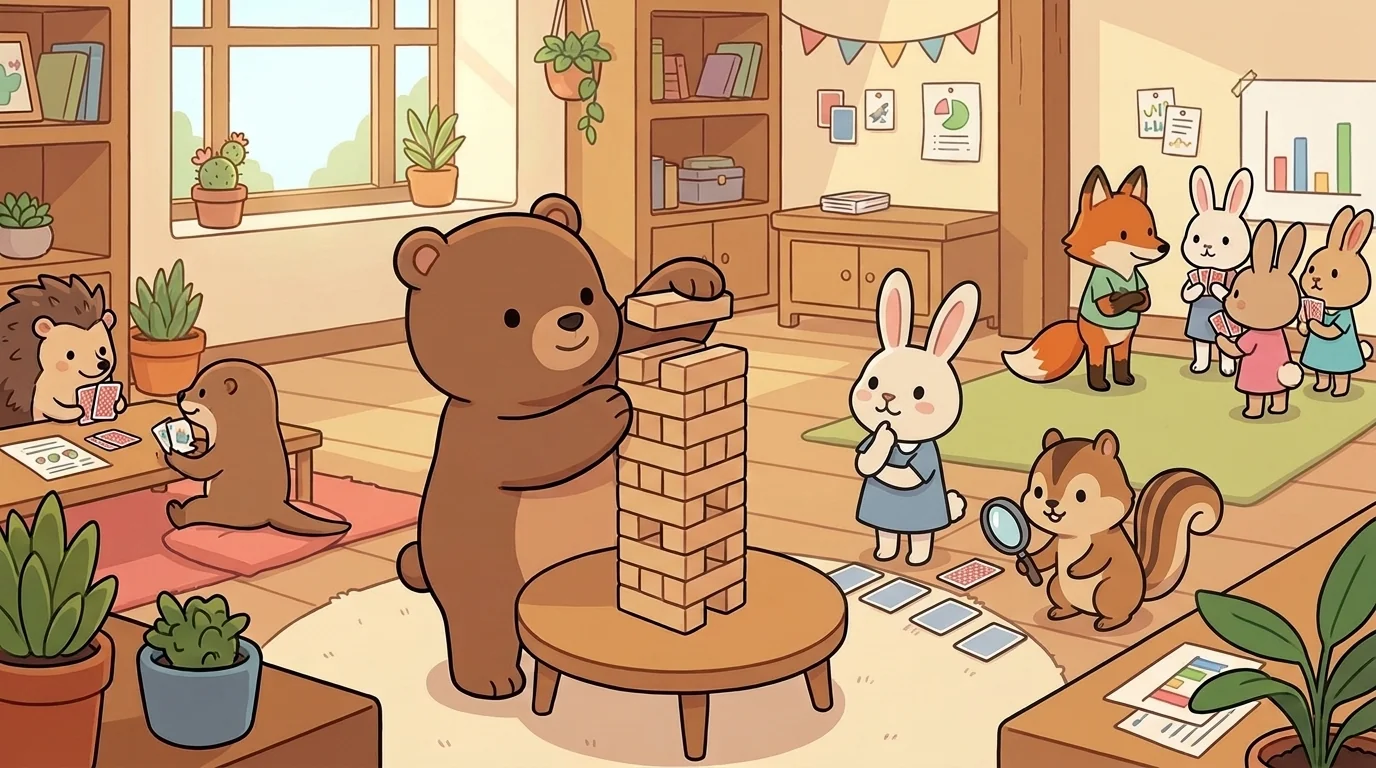
Addison is a bear cub, round and soft, with small ears and a steady, careful way of doing everything. In a quiet corner of the Card Lab, he is always building the same thing: a tower of wooden blocks. He places each block slowly, checks that it is level, and then places one more on top. Never faster than he can keep it straight.
"Adding a block never takes a block away," Addison says. It sounds too simple to be important. But it is the key to one of the cleverest things in the lab.
One day Maybelle the fox brought a group of rabbits to Addison's corner. The rabbits were confused. They had tested a rule where any card could go into an empty column, not just a King. And the lab had shown fewer proven wins for their rule than for the normal one.
"How is that possible?" asked the oldest rabbit. "Maybelle says the missing wins are probably in the maybe pile. But how can we be sure our rule isn't really worse?"
Addison set down his block and thought for a long moment. Then he asked a question.
"Under your rule, can you still make every move the normal rule allows?"
The rabbits thought. "Yes," said one. "A King can still go into an empty column. We just let other cards go there too."
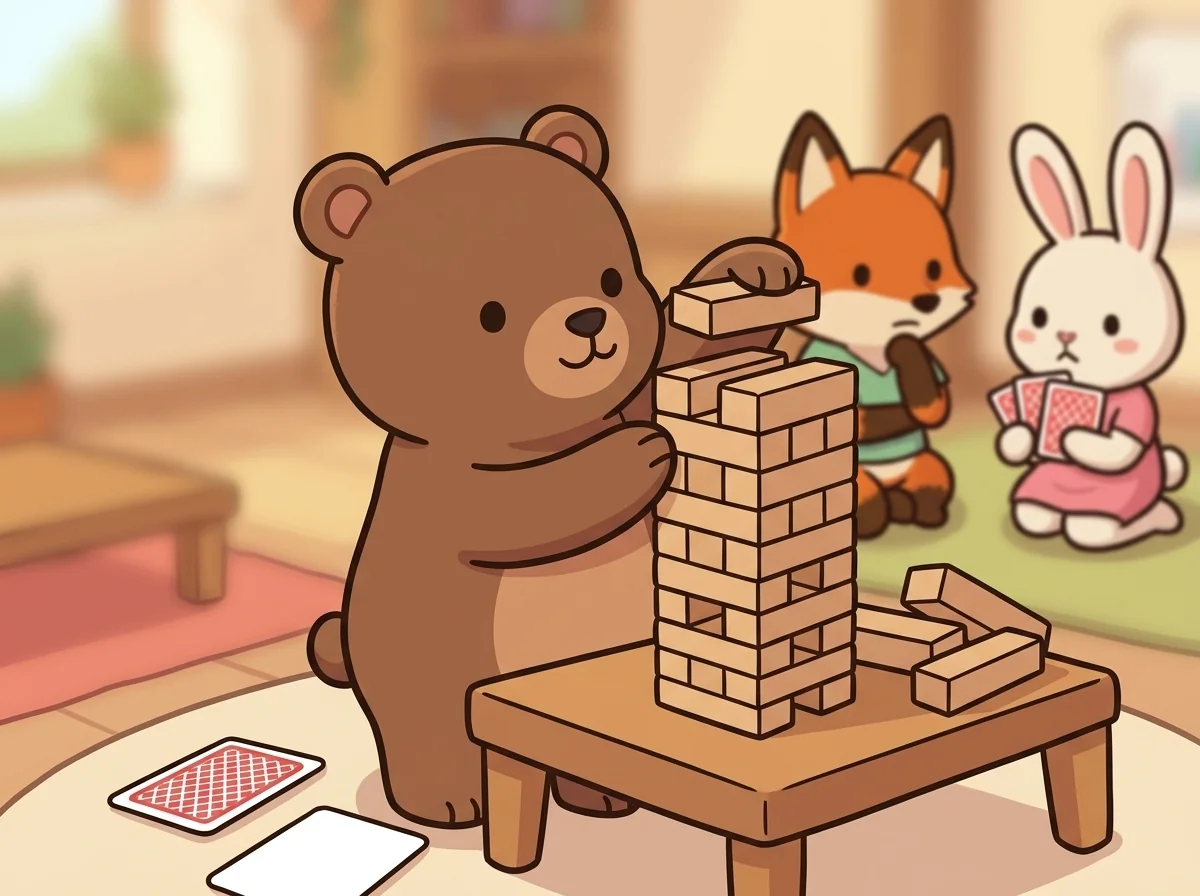
"So your rule only adds moves," said Addison. "It never takes any away."
He picked up a block and set it on his tower. "Think of every way to win a deal under the normal rule as a path. Now, under your rule, is that same path still allowed?"
The rabbits' eyes widened. "It is," said the oldest slowly. "Every move on that path is still allowed in our rule. So if the normal rule can win a deal, our rule can win it too, by doing exactly the same moves."
"Exactly," said Addison. "Adding moves is like adding a block. It can't take away a win that was already possible. So your rule can never truly win fewer deals than the normal one. It can only win the same, or more."

He placed another block, perfectly level. "We worked that out without running a single deal. Just by thinking."
"But then why did the lab show fewer wins?" asked a young rabbit.
"Because the lab isn't showing the truth directly," said Addison. "It's showing what the solver managed to prove in the time it had. Your rule has more moves, so there are more paths to search, so the solver runs out of time more often. Those extra not sure yets made your rule look worse. But our thinking tells us they can't really be losses that the normal rule would have won."
The rabbits looked at each other, amazed. They had come in worried that their rule was bad. Now they understood that the strange result was about the solver's time, not about their rule, and they had worked out why using nothing but careful thought.
"So you should always think before you test?" asked the young rabbit.
"Think first, then test," said Addison. "Thinking tells you what's possible. Testing tells you what actually happens. When they disagree, that's a clue that something about the test, like the time limit, is getting in the way."
Addison feels most like Addison when a careful thought clicks into place and something confusing suddenly makes sense. It is a solid, grounded, sure feeling, like setting down the last block of a tower and feeling it hold perfectly still.
You have a bit of Addison in you whenever you stop to reason before you rush to test. When a rule only gives more choices, remember what that means, and say it the way he does: "Addison adds a block and knows: more choices can never lose a win."
Then build your understanding, one steady block at a time.
The Solitaire Lab ensemble
Addison is part of Solitaire Lab's distributed-narrative cast. Each character embodies a different curricular primitive; together they teach the full subject.
-

Dealia
(Mentor, a card-dealing raccoon) - asks what you predicted BEFORE you look at the data
-

Twinnie
Deals every hand twice - the same deals for both rules, so the test is fair
-

Hedgeworth
Never says more than the data can - reports at least ... and at most ...
-

Maybelle
Knows an unknown is a maybe, not a no - the search ran out of time
-

Bigsby
Knows more deals make the answer sharper - the interval gets narrower
-

Lopsy
Counts the deals where only ONE rule won - those odd pairs are the whole story
-

Lanternby
Knows the measuring tool is part of the result - a bigger search proves more wins of the SAME deals
-

Glassby
Knows FreeCell hides nothing, so a 'lost' there is a proof about the deal itself
-

Tiebelle
Calls it a tie when the two ranges overlap - no winner the data cannot back
-

Seedwick
Knows the same run seed rebuilds the same deals, so anyone can re-check your test
-

Tabitha
Keeps one row per deal in the CSV so you can draw the chart yourself