
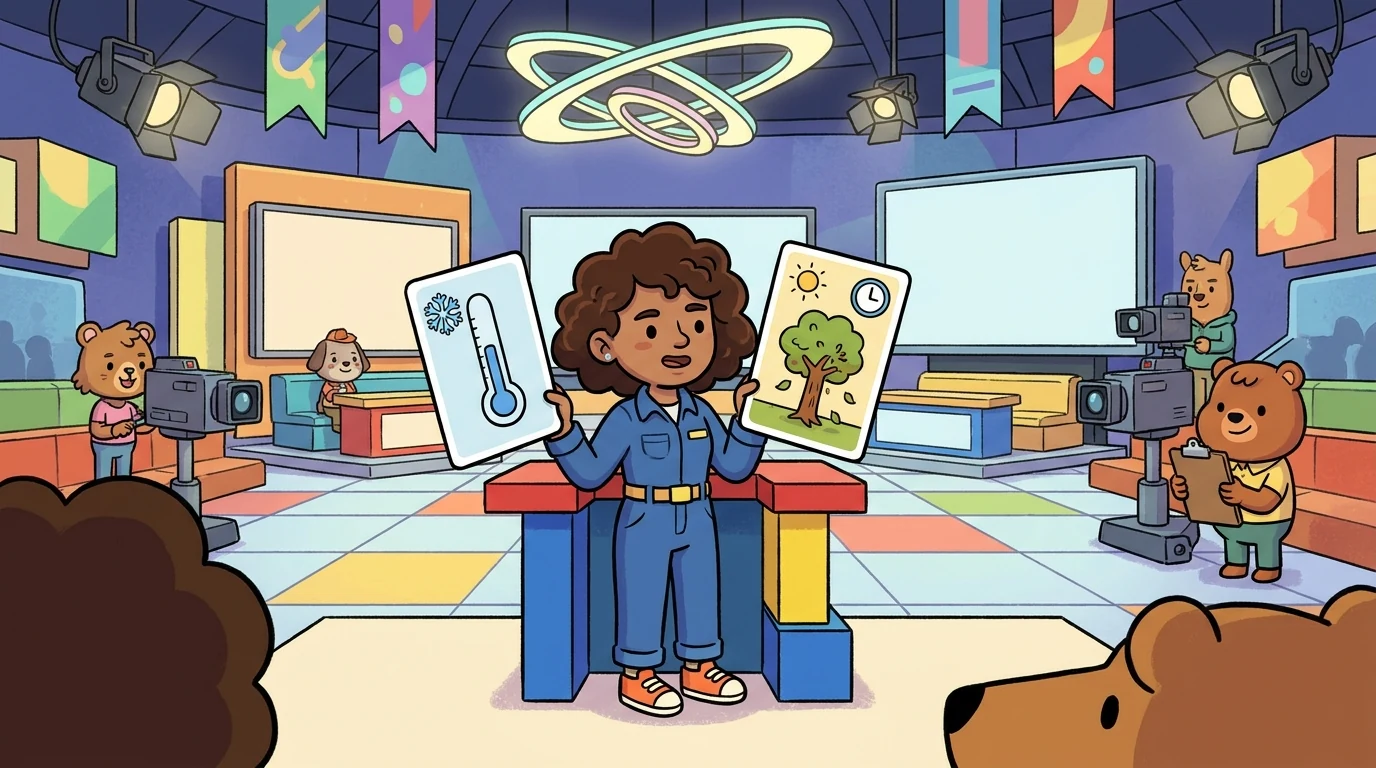
Nuance
BEST-ANSWER DISCRIMINATION (Advanced) — reading all options and ranking for completeness still holds, but advanced questions add: the QUALIFIER that decides between two true answers (most/primary/best/first/directly — the small word that ranks the survivors), 'all of the above' / 'none of the above' reasoning (if two options are clearly right, 'all' becomes likely; if one is clearly wrong, 'all' dies), and the SCOPE trap (a precise answer that's correct about the wrong thing). The advanced move: locate the qualifier and let IT do the ranking, and check each survivor's SCOPE against the exact thing the question asks.
Chapter — Nuance and the Small Word That Ranked the Answers
Nuance’s rule — read every option, then rank the survivors for completeness — retired the beginner’s almost-right trap. The advanced contestants already read all four and compare. What she teaches them now is how to break the tie when two options are both genuinely true and comparably complete: because the question almost always contains a small, quiet word whose entire job is to rank them — and the trap is reading past it.
“You’ve learned two true-ish answers aren’t a coin flip — one is better,” she says. “But what makes it better isn’t always ‘more complete.’ Often it’s a single word in the question — primary, most, directly, first, best — that tells you which dimension to rank on. Miss that word and both answers look equally right, and you flip a coin you didn’t need to flip. The tie-breaker was printed in the question the whole time.”
The question that taught her had two flawless answers.
“What is the PRIMARY cause of the seasons?” Option: the tilt of the Earth’s axis. Option: the Earth’s distance from the Sun changing. Nuance, ranking for completeness, found both “true-sounding” — and both are things people say about seasons. She nearly flipped a coin. Then Emcee circled one word: PRIMARY. “The distance does change,” he said, “and it has a tiny effect — so it’s not false. But the question asked for the primary cause, and that’s the tilt. The word primary isn’t decoration. It’s the entire ranking instruction. It tells you: I know more than one of these is true; pick the biggest one.” Nuance saw it. The distance answer was the almost-right — true, real, and not primary.
“Completeness ranks answers when the question is open,” Emcee said. “But when the question has a qualifier — primary, most, directly — that word is the ranking rule. Find it first. It decides the tie.”
So advanced Nuance added the qualifier-hunt to her best-answer move:
Locate the ranking word. Before comparing survivors, scan the question for most, primary, best, first, directly, mainly, least, greatest. “That word tells you the dimension to rank on. Most common ≠ most severe ≠ first discovered. The qualifier picks the ruler you measure with.”
Rank on THAT dimension. Two true answers, ranked by the qualifier: primary → biggest cause; directly → the immediate one, not the distant one; first → earliest, even if a later one is more famous.
Check the SCOPE trap. An answer can be perfectly correct — about the wrong thing. “What causes tides? — ‘the wind moves water’ is a true statement about water, wrong about tides. It’s precise, factual, and out of scope. Always check: is this answer correct about exactly what the question asked, or correct about something adjacent?”
And the ‘all/none of the above’ logic: if you can confirm two options are clearly right, all of the above becomes likely; if you can prove one is clearly wrong, all of the above is dead. “Those options aren’t tie-breakers — they’re countable. Use elimination on them like Nix would.”
The confident contestant handed Nuance a stem stuffed with two-true traps: “Which factor MOST directly affects how high a ball bounces: the material it’s made of, the height it’s dropped from, gravity, or all of the above?”
Nuance hunted the qualifier first: MOST directly.
the material — affects bounce, true. But most directly? It affects the bounciness ratio, real but not the immediate height-driver.
the height it’s dropped from — directly sets how much energy it has to bounce with. This is the most direct lever on bounce height. Strong.
gravity — affects it, but it’s a constant background, not the thing you’d vary to change bounce height; less “direct” in the everyday sense the question means.
all of the above — all three affect it (so ‘all’ is tempting), BUT the qualifier is most directly, which demands ONE — a ranking, not a collection. “All of the above dies the moment the question says most,” Nuance said. “Most asks for a single winner; all refuses to rank. The qualifier killed the collector option.”
Answer: the height dropped from — the most direct lever. “Three of these are true influences,” Nuance said. “All of the above baited the collector, and material and gravity baited the completist. But MOST directly was the ranking instruction, and only one answer wins that race. The small word did all the work.”
An advanced contestant resisted. “This feels like word-games. If three things genuinely affect the bounce, isn’t ‘all of the above’ the honest answer?” Nuance smiled — the deepest confusion, and a fair one. “It would be, if the question asked which of these affect the bounce,” she said. “Then all-of-the-above is right and honest. But it asked which MOST directly — and a question that asks for a ranking is not asking for a list. Answering ‘all of the above’ to a ‘most’ question isn’t more honest — it’s refusing to answer the question that was asked. The qualifier defines the question. Change the qualifier and the right answer changes, even with identical options.” She wrote two versions. “Which affect X? → all of the above. Which MOST affects X? → the single biggest. Same options. The word is the question.” She tapped it. “Precision isn’t a game. It’s answering what was actually asked instead of what’s generally true.”
The contestant looked at a “most” question he’d answered with “all of the above.” “I collected when I should have ranked,” he said. “The qualifier told you which,” said Nuance. “It always does. Find it first.”
That night Nuance ran the crew’s cruelest deck — the two-flawless-answers questions, each hinging on a single qualifier — and instead of ranking blind for completeness, she found the most / primary / directly / first in each stem and let it choose the dimension. The almost-right answers, which used to beat her by being equally true, now lost cleanly the moment she measured them against the ruler the question named.
“Read every option, rank the survivors — that’s the floor,” she said, squaring the deck. “But when two answers are both true, the tie-breaker is usually one small word in the question: most, primary, directly, first. Find it — it tells you which ruler to measure with. Check each answer’s scope against exactly what was asked. And never answer a ranking question with a collection. ‘Not wrong’ was never the goal, and neither is ‘all of them.’ The goal is the one the qualifier points to.”
The QuizQuest ensemble
Nuance is part of QuizQuest's distributed-narrative cast. Each character embodies a different curricular primitive; together they teach the full subject.
-

Recalla
Retrieval practice — pulls a fact from memory instead of re-reading it; recalling it (the testing effect) is what makes it stick
-
Nix
Elimination — crosses out the options that can't be right to narrow the field down to the answer
-
Gauge
Confidence calibration — checks HOW sure you are before you lock in, so your certainty matches your correctness
-

Bluff
The confident-wrong contestant — gives a fast, sure, WRONG answer; the one the host must catch (misconception-spotting)
-

Switcheroo
Interleaving — jumps between subjects round to round so recall stays flexible instead of crammed
-
Tick
Speed-vs-accuracy — the buzzer-timer who trades a little speed to get the answer right
-
Encore
Spaced recall — brings a fact BACK a few rounds later so it moves into long-term memory
-
Facta
Fact vs. opinion — sorts what is checkable and true from what is only a view
-

Hinta
Clue-reading — reads the question stem for the hint hidden inside it before answering