
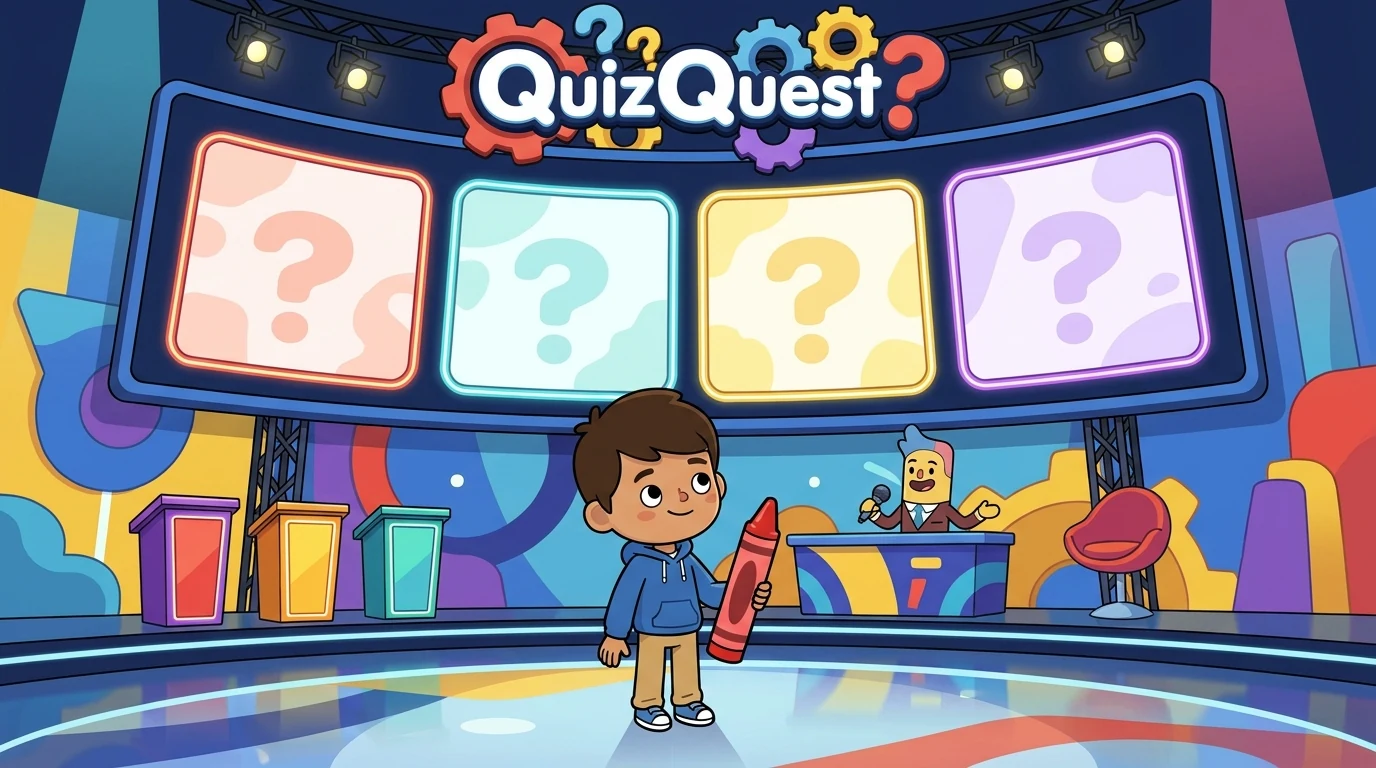
Nix
ELIMINATION — when you're unsure among options, first cross out the ones that CANNOT be right (too big, wrong category, contradicts a known fact). Each option ruled out shrinks the field and raises your odds on what remains. You don't always need to know the answer directly — you can find it by removing everything it isn't.
Chapter — Nix and the Answers That Couldn’t Be
Nix carries a big soft red crayon and a saying that sounds backwards until you try it: “You don’t have to know the answer. You just have to know what it isn’t.”
On the QuizQuest set, when a contestant freezes on a four-option question, Nix steps up. He doesn’t point at the right answer. He crosses out the wrong ones — one, then another — until the field is small enough that even a nervous guesser can see the truth standing there alone.
“Every option you can rule out,” he says, tapping the crayon, “makes the real answer easier to reach. Four choices feels impossible. Cross out two you know are wrong, and suddenly it’s a coin-flip — and often you can flip that coin with your gut and win.”
Nix learned elimination because for a long time he thought he had to know everything directly, and that belief froze him solid.
He’d see a question, not know the exact answer, and stop — because in his head, “not knowing the answer” meant “can’t do this.” He’d stare at four options as if they were all equally likely, all equally mysterious, and the pressure of picking one from four unknowns was so heavy he’d just guess randomly or give up.
Emcee watched him freeze one too many times and said, “You’re trying to walk straight to the answer. Try walking away from the wrong ones instead.” He pointed at the four options. “This one — could a river be a thousand miles tall? No. Cross it. This one — is that even the right kind of thing? No. Cross it.” Two crossed. “Now you’ve got two left, and you know a little about both. It’s not four impossible choices anymore. It’s a fair fight.” Nix had never thought of it that way — that you could find the answer by subtraction.
So Nix built the elimination move, and it’s a specific order: before you try to pick the right one, cross out every one you can prove wrong.
He scans the options for the ones that fail a test he already knows: wrong size (too big, too small), wrong category (that’s a country, not a river), contradicts a fact he’s sure of (it can’t be that — that happened later). Each one he can rule out, he crosses. Whatever survives the crossing-out is where he spends his real thinking.
“The magic,” Nix says, “is that ruling out uses knowledge you didn’t know you had. You might not know the tallest mountain, but you know a mountain isn’t measured in gallons. That’s enough to cross an option. You’re not guessing blind — you’re guessing smart, on a field you already shrank.”
A contestant named Priya loved this but pushed on its edge. “What if I can’t cross out ANY of them? What if they all seem possible?” Nix smiled — the honest question.
“Then you’ve learned something real: this one you genuinely don’t know, and no amount of staring changes that. Elimination isn’t magic — it can’t manufacture knowledge you don’t have. But it almost always clears at least one option, and usually two. Try it before you decide you’re stuck. Most ‘impossible’ questions have one answer that’s obviously silly once you look for silly.” He pointed at a sample. “See this option — it’s the wrong century entirely. Gone. Now you’re at three, and you do have a hunch about one of those.”
Priya crossed the silly one, felt the field shrink, and her hunch got braver. “It feels less scary with fewer of them,” she said. “That’s the whole point,” said Nix. “Fear loves four unknowns. It hates two.”
That evening Nix practiced on the hardest quiz-deck the crew owned — questions he mostly didn’t know cold. Old Nix would have frozen. New Nix picked up his red crayon and went hunting not for right answers but for wrong ones. Cross the impossible size. Cross the wrong category. Cross the one that contradicts the date he was sure of. And again and again, when only one or two survived, the answer was reachable — sometimes known, sometimes a smart flip.
He scored far better than he “should” have on a deck he barely knew, and that was the lesson made real. “I still don’t know most of these cold,” he said, capping the crayon. “But I know what they’re not. Cross out the impossible first — the answer’s easier to find once you’ve cleared the way to it.”
The QuizQuest ensemble
Nix is part of QuizQuest's distributed-narrative cast. Each character embodies a different curricular primitive; together they teach the full subject.
-

Recalla
Retrieval practice — pulls a fact from memory instead of re-reading it; recalling it (the testing effect) is what makes it stick
-

Gauge
Confidence calibration — checks HOW sure you are before you lock in, so your certainty matches your correctness
-

Bluff
The confident-wrong contestant — gives a fast, sure, WRONG answer; the one the host must catch (misconception-spotting)
-

Switcheroo
Interleaving — jumps between subjects round to round so recall stays flexible instead of crammed
-

Tick
Speed-vs-accuracy — the buzzer-timer who trades a little speed to get the answer right
-

Encore
Spaced recall — brings a fact BACK a few rounds later so it moves into long-term memory
-

Facta
Fact vs. opinion — sorts what is checkable and true from what is only a view
-

Hinta
Clue-reading — reads the question stem for the hint hidden inside it before answering
-

Nuance
The almost-right answer — knows the close-but-not-complete answer and why the full answer is better