
Encore
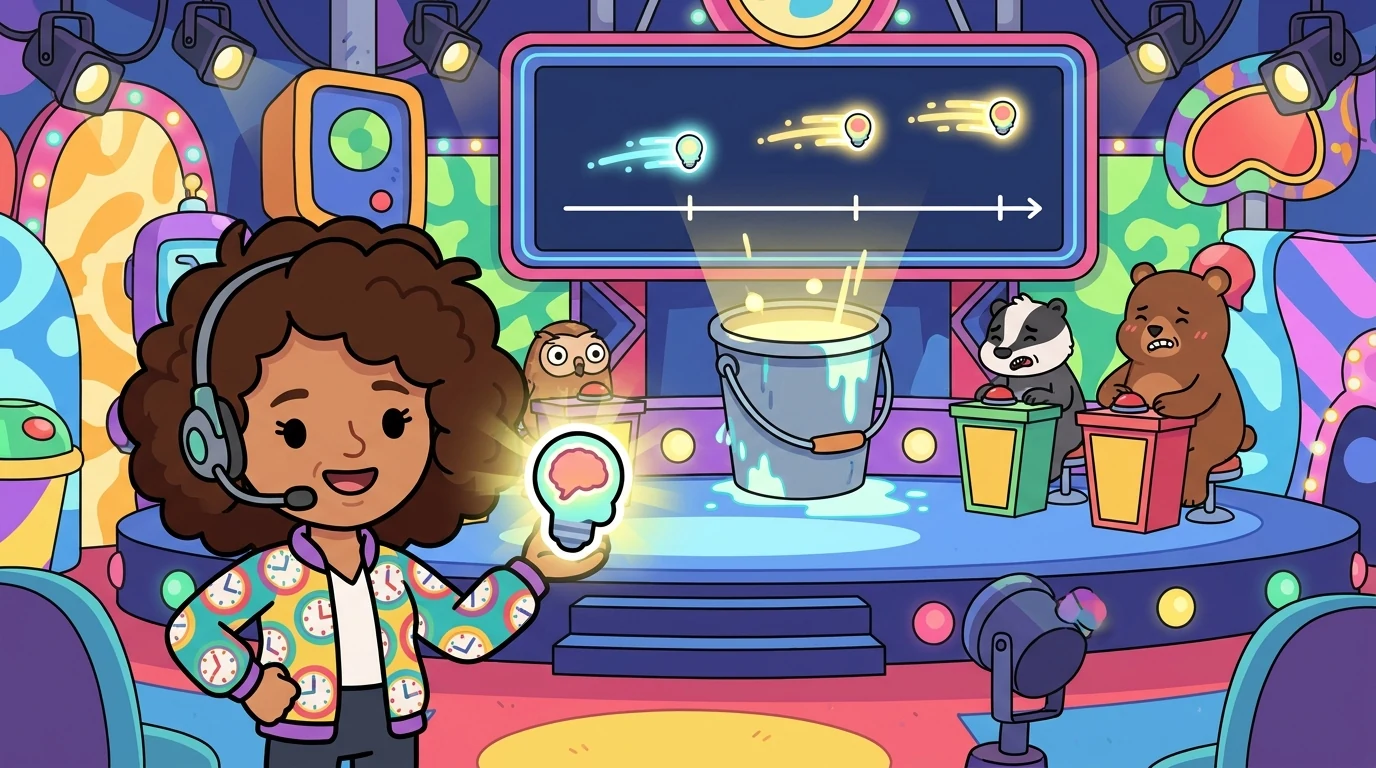
SPACED RECALL — reviewing a fact at increasing intervals over time (rather than cramming it all at once) moves it into durable long-term memory. The trick is to revisit a fact right around when you'd start to forget it: each successful recall after a gap strengthens the memory and lengthens how long it will last.
Chapter — Encore and the Fact That Came Back
Encore is the crew member who never says goodbye to a question. On QuizQuest, a fact you answered three rounds ago will suddenly reappear — “Encore!” she calls, and there it is again, the same fact, asking to be remembered one more time. Contestants groan. Encore just smiles, because the groan means it worked.
“Everything you learn starts fading the moment you learn it,” she says. “That’s not a flaw — that’s just how memory works. But here’s the beautiful part: every time you bring a fact back right as it’s about to slip, you don’t just save it — you make it fade slower next time. So I bring facts back. Again a little later. Again a little later than that. Each return buys the fact a longer life.”
Encore learned this because she once crammed a whole subject into one heroic night and watched it evaporate.
The night before a big quiz, she studied for hours — everything, all at once, over and over in one long session. By morning she felt stuffed full of facts. By the quiz that afternoon, a lot of it held. By the next week’s review quiz, almost all of it was gone. She’d poured everything into her memory in one go, and memory, it turned out, is a leaky bucket when you fill it all at once and never come back.
Emcee found her frustrated that the crammed facts had vanished. “You filled the bucket in one pour,” he said. “One big pour leaks out fast. But if you’d poured a little, come back the next day and poured again, come back three days later and poured again — the same total water would’ve soaked in instead of running out. Memory isn’t a bucket you fill once. It’s a plant you water on a schedule.”
So Encore built her spacing move: bring each fact back at spreading intervals — soon after first learning it, then a bit later, then later still.
She learns a fact, then returns to it after a short gap (a day), tests herself, and if she still has it, she waits a longer gap before the next return (a few days), then longer still (a week). Each successful recall after a gap tells her the memory is getting stronger, so it can survive a longer wait.
“The magic timing,” she says, “is bringing it back right when you’re about to forget it — not while it’s still fresh (too easy, no benefit) and not long after it’s gone (too late, you’re relearning from scratch). Right at the edge of forgetting, one recall does the most work. That’s why I pop old questions back into the show at just-annoying intervals. The little struggle to dredge it up is the plant drinking.”
A contestant named Mara objected on principle. “But if I already know a fact, why waste time reviewing it? I should study new stuff.” Encore nodded — the classic mistake, the one that had cost her.
“Because ‘I know it now’ and ‘I’ll know it next month’ are different,” she said. “The fact you learned yesterday feels solid today and will be half-gone by next week if you never revisit it. A quick review — one recall — right before it fades keeps it forever, and it takes seconds. Skipping review to cram new facts just means your new facts will also evaporate, and now you’ve lost the old ones too.” She popped an old card back up. “This one — you learned it last week. Can you still get it?” Mara reached, got it (barely). “That ‘barely’ is the sound of a fact you almost lost. One recall now, and it’s safe again for much longer.”
Encore’s favorite ally is Recalla, the retrieval expert, because spacing and retrieval are two halves of one thing. “Recalla says pull it from memory instead of re-reading,” Encore explains. “I say pull it from memory again after a gap. Put them together: don’t re-read, and don’t do it all at once. Reach for it, wait, reach for it again. Retrieval spaced out over time — that’s the whole recipe for a memory that lasts.”
That night Encore built a review schedule instead of a cram pile: a few facts today, the same ones tomorrow, then in three days, then next week — each return a quick self-test, each gap a little longer than the last. It was almost no work per day. And she knew, this time, the facts would still be there next month, because she’d stopped pouring the bucket all at once and started watering the plant.
“Cramming fills you up and leaks out,” she said, tucking an old card back into the deck to resurface later. “Bring each fact back at spreading intervals — right as it’s about to fade — and it moves into the memory that stays. That’s why I always call for an encore.”
The QuizQuest ensemble
Encore is part of QuizQuest's distributed-narrative cast. Each character embodies a different curricular primitive; together they teach the full subject.
-

Recalla
Retrieval practice — pulls a fact from memory instead of re-reading it; recalling it (the testing effect) is what makes it stick
-

Nix
Elimination — crosses out the options that can't be right to narrow the field down to the answer
-

Gauge
Confidence calibration — checks HOW sure you are before you lock in, so your certainty matches your correctness
-

Bluff
The confident-wrong contestant — gives a fast, sure, WRONG answer; the one the host must catch (misconception-spotting)
-

Switcheroo
Interleaving — jumps between subjects round to round so recall stays flexible instead of crammed
-

Tick
Speed-vs-accuracy — the buzzer-timer who trades a little speed to get the answer right
-

Facta
Fact vs. opinion — sorts what is checkable and true from what is only a view
-

Hinta
Clue-reading — reads the question stem for the hint hidden inside it before answering
-

Nuance
The almost-right answer — knows the close-but-not-complete answer and why the full answer is better