
Hinta
CLUE-READING — the question itself often contains the information needed to answer it: a definition inside the stem, a root word you recognize, a date or place that narrows it, a grammatical hint (a/an, singular/plural). Reading the full question CLOSELY for these built-in clues frequently reveals the answer even when you didn't know it cold.
Chapter — Hinta and the Clue Inside the Question
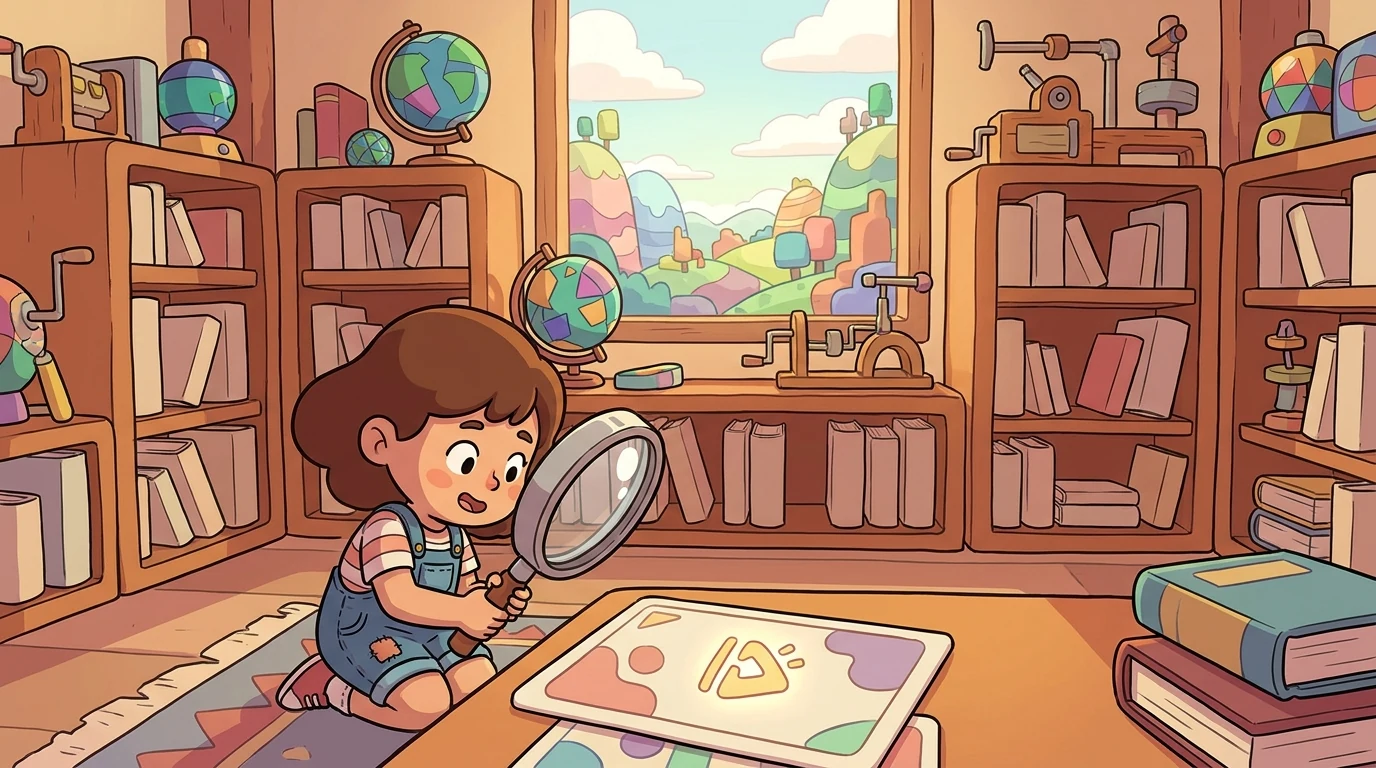
Hinta carries a magnifying glass, and she uses it not on the answer cards but on the questions. “Everyone stares at the four answers hoping one glows,” she says. “But the treasure is usually buried in the question — a little clue the question-writer left behind, on purpose or by accident. Read the question closely enough and it often hands you the answer it’s pretending to hide.”
She holds up a sample under the glass. “‘Which INSTRUMENT does a violinist play?’ Look — the question already told you. ‘Violin-ist.’ The clue is sitting right there in the word. Most people skim past it reaching for the answers. I read the question like it’s the answer, because half the time, it is.”
Hinta learned to read for clues because she used to skim questions and miss the gifts inside them.
She’d glance at a question, decide “I don’t know this,” and panic-guess — never noticing that the question had quietly defined the very word it was asking about, or that a root she recognized was hiding in the hard term, or that a date in the stem had already narrowed the field to one. She treated the question as an obstacle to rush past, not a text to mine.
Emcee caught her guessing on a question whose answer was, quite literally, spelled out in the stem. “You said you didn’t know this,” he said, “but look —” he ran a finger under a phrase in the question — “the definition is right here. The question told you what the word means; it just asked you to notice.” Hinta stared. She had known it — the question had given it to her — and she’d skimmed right over the gift. “The question isn’t your enemy,” Emcee said. “It’s often your biggest hint. Read it like it’s on your side.”
So Hinta built her clue-reading move: read the whole question slowly, mining it for the built-in hints before you even look at the options.
She hunts specific kinds of buried clues: a definition folded into the stem (“this gas, which plants breathe in…”). A root word she recognizes inside a hard term (“aqua-” means water; “-ology” means study of). A narrowing detail — a date, a place, a number — that rules out most options. Even grammar: does the answer need to be plural? does the stem end in “an,” hinting the answer starts with a vowel?
“The question-writer had to describe the answer to ask about it,” Hinta says. “And describing it leaks clues. My magnifying glass just catches the leaks. It’s not cheating — it’s reading. The clue was always there for anyone who slowed down to see it.”
A contestant named Beck was skeptical. “That only works on easy questions. Hard ones don’t leave clues.” Hinta smiled and handed him a genuinely hard card. “Read it. Slowly. Out loud. Every word.”
Beck read: “Which ancient city, whose name means ‘between two rivers,’ was located in Mesopotamia?” He started to say “I don’t know ancient cities—” then stopped. “Wait. ‘Between two rivers’… ‘Meso-potamia’… ‘potam’ is like… river? And ‘meso’ is middle, between?” The clue had been sitting in the question the whole time. “The answer was almost in the word Mesopotamia,” Beck said, amazed. “Hard questions leak clues too,” said Hinta. “Sometimes more — a writer working hard to ask a tough question has to pack in more description, and description leaks. You just have to actually read it instead of flinching away.”
Hinta’s discipline pairs with Tick’s, and she says so often: “Tick tells you to read the whole question so you don’t miss a NOT or an EXCEPT. I tell you to read the whole question so you don’t miss the clue. Same slowdown, two payoffs. The racing eye misses the traps and the treasure. Reading closely catches both.” She taps her glass. “Nobody who skims a question is reading it. And the question is the most useful thing on the screen.”
That night Hinta ran a deck of questions she didn’t know cold, but instead of guessing, she put every stem under the glass first — hunting definitions, roots, narrowing details, grammar tells. Question after question turned out to be carrying its own answer, tucked into the wording, waiting for someone to notice. She scored far above what her raw knowledge should have allowed, purely by reading what was already in front of her.
“People reach past the question to grab at the answers,” she said, lowering her magnifying glass. “But the answer is usually hiding in the question — in a definition, a root, a little detail. Read the whole thing closely, mine it for the clue, and half the time the question answers itself.”
The QuizQuest ensemble
Hinta is part of QuizQuest's distributed-narrative cast. Each character embodies a different curricular primitive; together they teach the full subject.
-

Recalla
Retrieval practice — pulls a fact from memory instead of re-reading it; recalling it (the testing effect) is what makes it stick
-
Nix
Elimination — crosses out the options that can't be right to narrow the field down to the answer
-
Gauge
Confidence calibration — checks HOW sure you are before you lock in, so your certainty matches your correctness
-

Bluff
The confident-wrong contestant — gives a fast, sure, WRONG answer; the one the host must catch (misconception-spotting)
-

Switcheroo
Interleaving — jumps between subjects round to round so recall stays flexible instead of crammed
-
Tick
Speed-vs-accuracy — the buzzer-timer who trades a little speed to get the answer right
-
Encore
Spaced recall — brings a fact BACK a few rounds later so it moves into long-term memory
-
Facta
Fact vs. opinion — sorts what is checkable and true from what is only a view
-

Nuance
The almost-right answer — knows the close-but-not-complete answer and why the full answer is better