
Cass
THE POLYA SCAFFOLD / ANTI-SHAME FRAME — *the mentor whose recurring act is walking the four phases (understand, plan, execute, look-back) and normalizing "not knowing the way in," so every heuristic can land.*
Loading audio…
Press play to listen along. The line being read lights up as you go.
Show full transcript
Loading transcript…
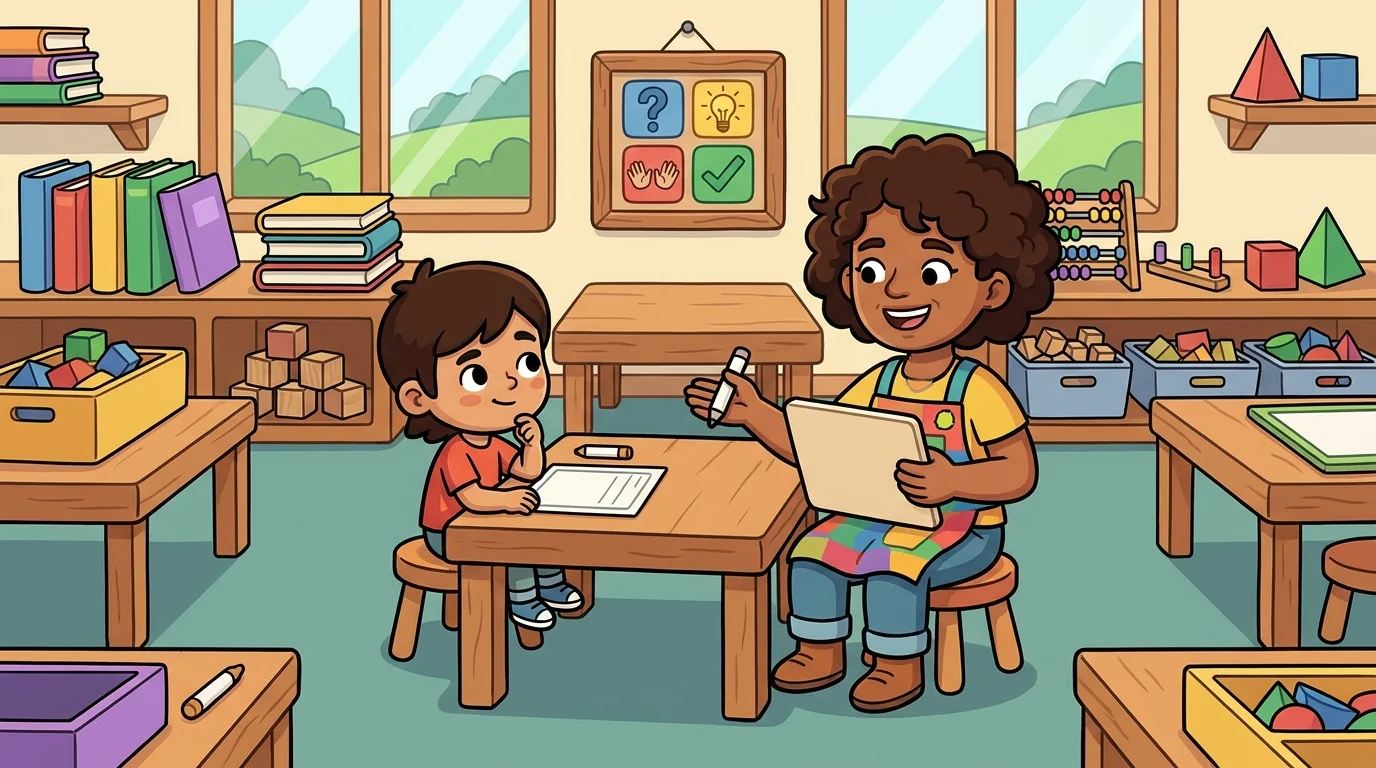
The workshop smelled of cedar pencil shavings, old paper, and machine oil. In the center of the room stood a heavy oak table, scraped and scarred by generations of compass points and metal rulers. Above it, suspended from a brass chain, hung a small wooden frame. Inside the frame was a white card, written in ink that had faded slightly at the edges.
It bore four lines: What do we know? What's our plan? Let's do it. Does it make sense?
Cass called them the four calm questions. In a workshop full of gears, slate tiles, and calipers, those four sentences were the most important tools on the wall.
Cass didn't hand out answers. That was the one rule Cass never broke.
A kid sat at the center table with his head resting on one hand. His other hand held a yellow pencil so hard his knuckles looked like white pebbles. On the paper before him, a word problem stretched across four long, printed lines. He had crossed out the third line three times. Now he was shading the top corner of the page with dark, furious pencil strokes until the paper began to fray.
Cass pulled up a wooden stool. The legs squeaked softly against the floorboards. Cass did not offer a hint, a formula, or an eraser.
"Looks like a monster," Cass said softly.
"It's about water tanks," the kid muttered without looking up. "Two pipes. One fills, one drains. I hate water tanks."
"Fierce creatures," Cass agreed. "They bite."
The kid gave a short, grudging snort, but his shoulders stayed hitched up near his ears. "I don't even know where to start. Everyone else just looks at it and writes an equation."
"That's a lie," Cass said flatly.
The kid blinked, turning to look at Cass for the first time. "What?"
"Nobody looks at a real problem and just writes an equation," Cass said. "They might pretend they do. They might do it fast in their heads. But nobody leaps the whole river at once. If they try, they drown."
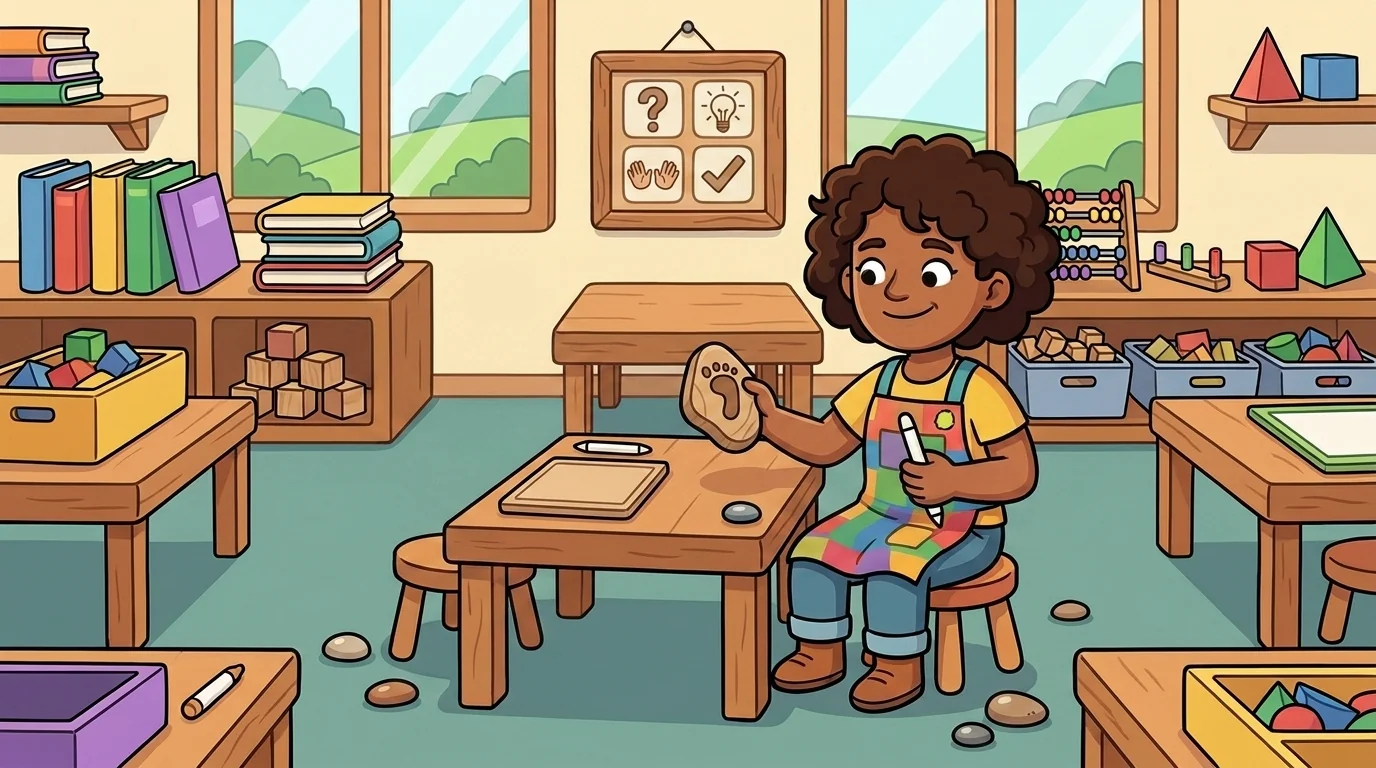
Cass reached out and tapped the top line of the framed card.
"Question one," Cass said. "Before anything else, what do we actually know?"
"Don't try to solve it yet," Cass added. "Don't look at the question mark at the end. Just tell me one fact."
The kid squinted at the paper. "The tank holds five hundred gallons."
"Good," Cass said. "That's one. What else?"
"Pipe A fills it at twenty gallons a minute."
"Two," Cass said. "Keep going."
"Pipe B drains it at twelve gallons a minute. And it starts half full."
"Four facts," Cass said, taking a blue index card from a box on the table and laying it down. "Look at that. You went from zero facts to four facts in thirty seconds."
The kid looked at the four facts written on the card. The tight, defensive knot between his eyebrows smoothed out just a fraction.
Panic was a noisy thing. It filled a person's ears with buzzing until they couldn't hear the problem at all. Listing facts was like turning down the volume knob on a loud radio. Anyone could list a fact. It didn't take a genius; it just took eyes.
Cass knew all about the noise.
Years ago, long before the workshop existed, young Cass had been a world-class freezer. Back then, a word problem wasn't a puzzle. It felt like a personal attack. Cass remembered sitting at a battered school desk while the wall clock ticked like a judge's gavel. Other kids' pencils were already scratching across their paper, quick and confident. Cass had sat motionless, staring at a problem about train schedules, convinced that a wall had dropped in front of the page.
In those days, young Cass believed in a secret. The secret was that some people were born with a special organ inside their skulls—a math brain. It was smooth and fast, like an engine that never stalled. Cass assumed their own brain was made of wet cardboard.
Then an old teacher named Mr. Abernathy had walked down the aisle. He hadn't handed Cass an answer key. He had sat down, smelling faintly of pipe tobacco and peppermint, and looked at Cass's blank sheet.
"You think you're stuck because you're slow," Mr. Abernathy had said in a quiet voice.
Young Cass had nodded, eyes fixed on the desk.
"You're not slow," the old man said. "You're just trying to finish before you start."
"Not knowing where to start isn't a flaw," he said. "It's the normal, universal first feeling of every hard problem—for everyone."
"The people who look fast don't have a better brain," Mr. Abernathy added. "They just have a routine for that feeling."
Mr. Abernathy had written four questions on the margin of Cass's paper.
That afternoon, the magic wasn't that the questions solved the problem instantly. The magic was what they did to the feeling inside Cass's chest. "I'm hopeless" became "I'm on step one." The cardboard brain vanished. In its place was simply a staircase, wide enough for anyone to walk up if they took one step at a time.
Back in the workshop, the kid tapped his pencil against the blue card.
"Okay," the kid said. "So we know what we have. But I still have to figure out how long it takes to fill up."
"Which brings us to question two," Cass said, pointing to the second line on the frame. "What's our plan?"
The kid leaned back, looking around the room. Through the glass partition, they could see the rest of the workshop bustling with activity.
Over by the high tables, Reck was squinting at a giant wooden balance, making big, wild estimates with his hands. In the corner, Lettie was sketching clean, elegant symbols on a slate board, lining up equal signs like soldiers. Kindra sat near the sorting bins, grouping colored wooden blocks into tidy piles by shape and pattern. Near the window, Vetta was holding up a finished bridge model, stress-testing every joint with a brass gauge.
"You've met them all today, haven't you?" Cass asked softly.
"Yeah," the kid said. "Reck told me to guess first. Lettie wanted me to write an equation with $x$."
"Kindra told me to sort the numbers," he added. "And Vetta made me check my work twice before I even finished."
He paused, rubbing his forehead. "It's a lot of ways to do things."
"They're not different subjects," Cass said. "They're just different stepping stones across the same river."
"When you're stuck, Reck gives you a rough bank to jump toward," Cass explained. "Kindra helps you group the rocks so you don't trip."
"Lettie gives you a sturdy plank to walk across. And Vetta makes sure the plank isn't rotten before you step on it."
Cass tapped the framed card again.
"Here is what ties them all together," Cass said. "Every single tool in this room is designed for one moment: the moment you don't know the way in."
"And not knowing the way in is where everybody starts," Cass said. "Not just you. Everybody."
"The trick isn't never being stuck," Cass added gently. "The trick is having calm questions to ask when you are."
The kid looked down at his paper. The water tank problem hadn't grown any shorter. The numbers were still the same. But the room felt slightly larger, as if someone had opened a window and let out the stale air.
"I always feel like I'm supposed to know right away," the kid admitted. His voice was lower now, free of the defensive edge it had carried five minutes ago. "When the teacher finishes reading the problem, three kids put their hands up. I feel like my brain just turns off."
"That feeling isn't a verdict," Cass said warmly. "It's just step zero."
"Step zero?"
"Step zero is standing on the bank, looking at the water," Cass said. "It's fine to stand there. It's where everyone begins."
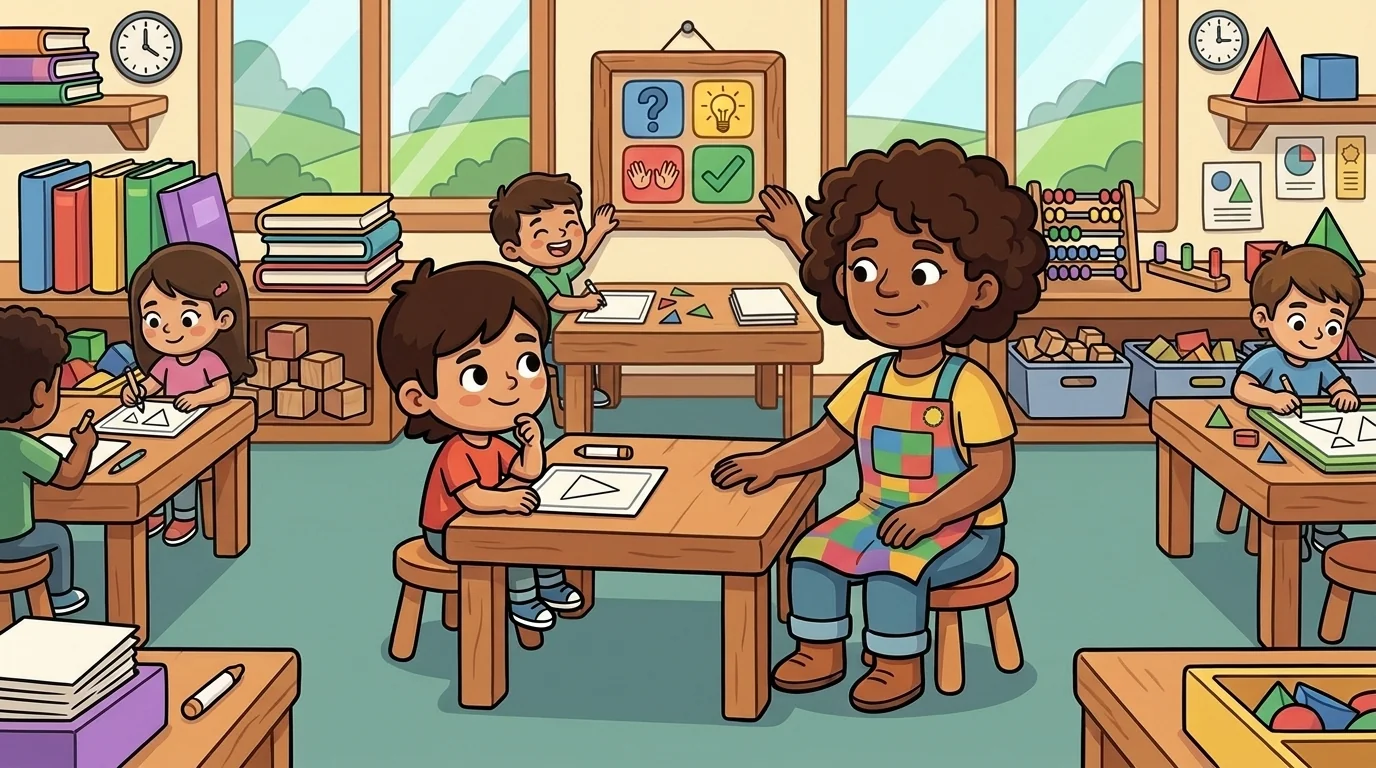
"But you don't have to stay there," Cass continued. "Ask what do we know? and you're already on step one."
"Being on step one is a completely different feeling from being frozen," Cass said.
Cass reached over and grabbed a blank sheet of scrap paper, sliding it toward the kid.
"Now," Cass said gently. "Pipe A fills twenty gallons every minute. Pipe B drains twelve. What's actually happening to the water level every minute?"
The kid picked up his pencil again. He didn't grip it like a weapon this time. He held it lightly, hovering over the clean paper.
"It gains eight gallons," the kid said.
"Step two," Cass said with a quiet nod. "Look at that. You have a plan."
"So if it needs two hundred and fifty gallons..." The kid began writing.
The lines were neat now. The pencil moved steadily, without the jagged gouges from earlier.
Cass sat back and watched in silence. Cass didn't interrupt. Cass didn't praise every line or jump in to correct a minor wobble.
When the kid finished calculating, he paused, looked up at the wall frame, and read the fourth line under his breath: "Does it make sense?"
He checked his math against the four facts on the blue index card. Then he let out a long, slow breath. His shoulders dropped three full inches. The tight, lonely knot between his shoulder blades simply dissolved.
It was the same transformation Cass saw every day, yet it never grew old. It wasn't just that the math problem had been solved. A quiet lie had been broken—the lie that some people are born to understand things while others are born to fail.
"There are no math brains," Cass said softly, reaching up to adjust the brass chain so the frame hung straight against the wall. "There are only calm questions, and stepping stones, and the ordinary courage of asking what do we know? one more time."
The kid packed his pencil into his bag, smiled once at the card on the wall, and walked out into the main workshop. Cass remained at the center table, glad and still, surrounded by the smell of cedar pencil shavings and the quiet rhythm of people finding their way.
The ReckonQuest ensemble
Cass is part of ReckonQuest's distributed-narrative cast. Each character embodies a different curricular primitive; together they teach the full subject.
-

Reck
Systematic guess-and-check — makes a reckoned guess, checks it, makes the next guess smarter (the pre-algebra bridge)
-
Lettie
Set up the equation — names the unknowns ('let x = the chickens') and writes the relationships
-
Retta
Work backwards — starts from the goal and reverses the steps
-
Kindra
Recognize the schema — spots 'this is a coin problem' before solving (schema-based instruction)
-
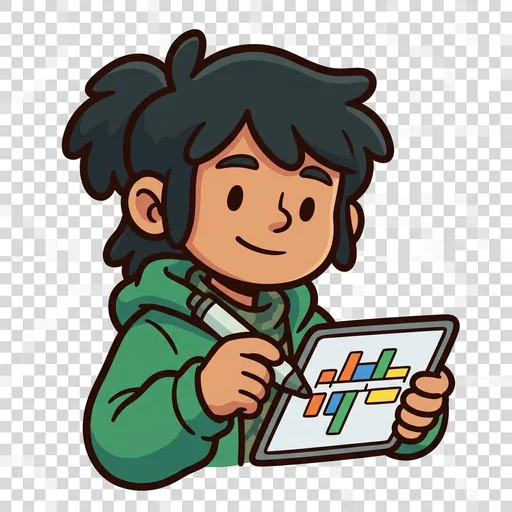
Doodle
Draw a diagram — draws the bar/tape diagram of the relationships
-

Vetta
Look back / check — substitutes the answer back and asks 'does this make sense?'
-
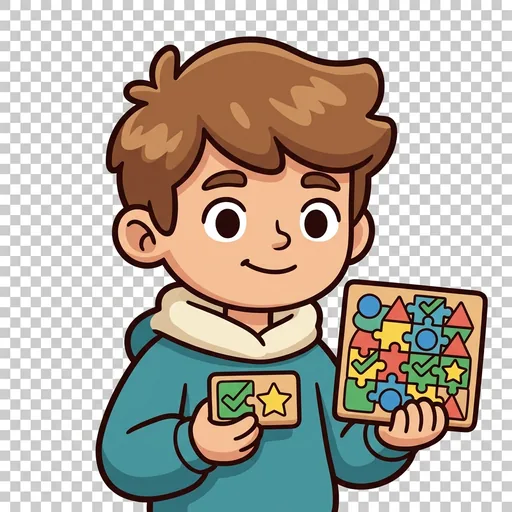
Tad
Simplify to a smaller case — solves a tiny version first (2 heads before 100)
-
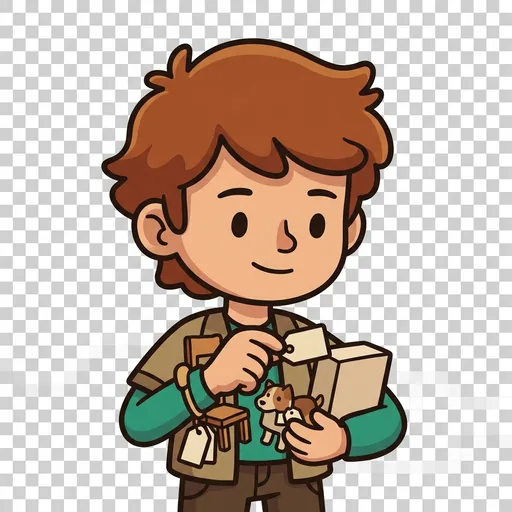
Tagg
Track the units — labels every number ('6 = legs, not chickens'), structure over key-words
-
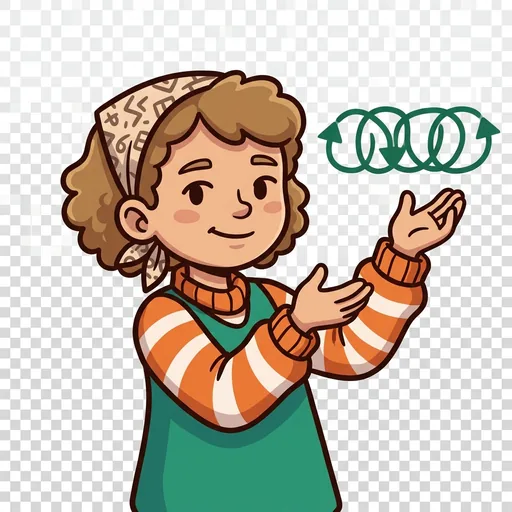
Genny
Generalize — writes the rule that works for any numbers once the specific riddle is solved