Vetta
LOOK BACK / CHECK
Loading audio…
Press play to listen along. The line being read lights up as you go.
Show full transcript
Loading transcript…
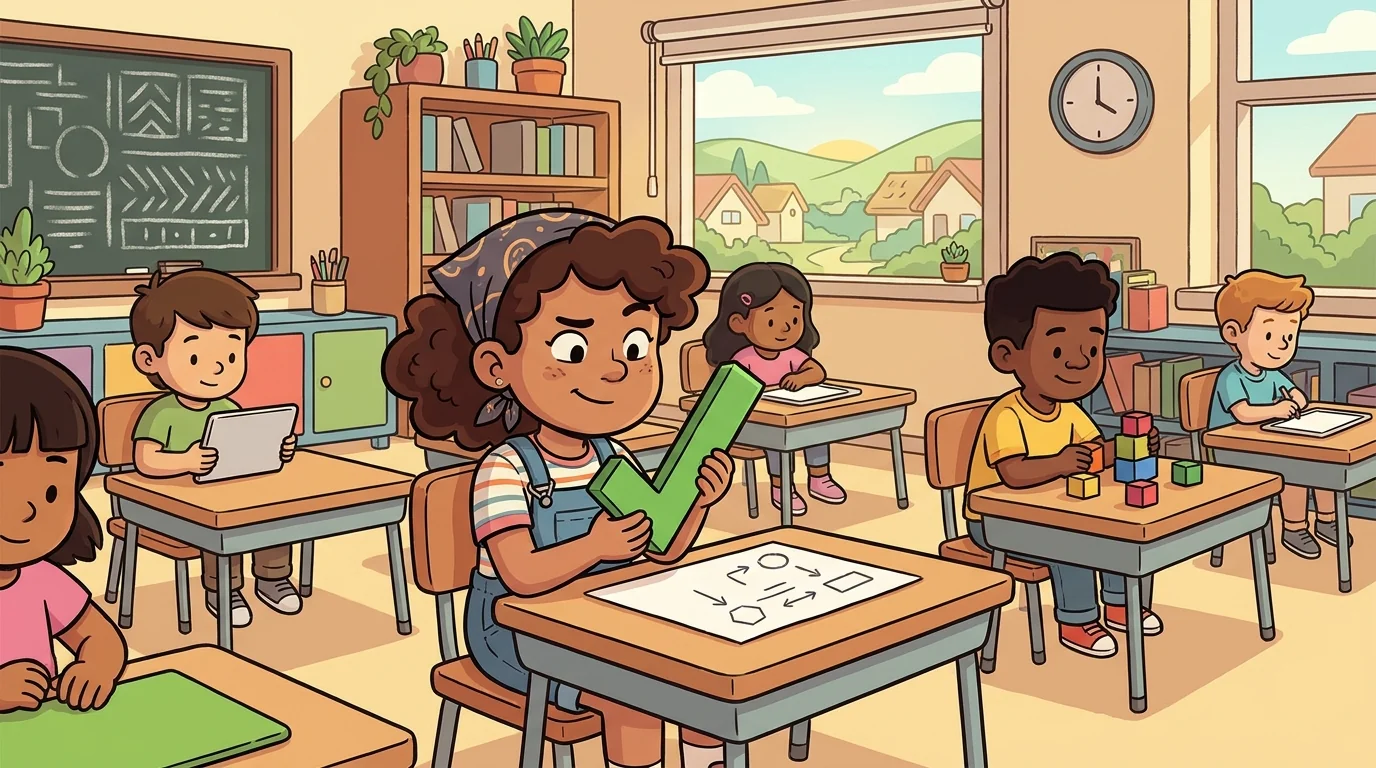
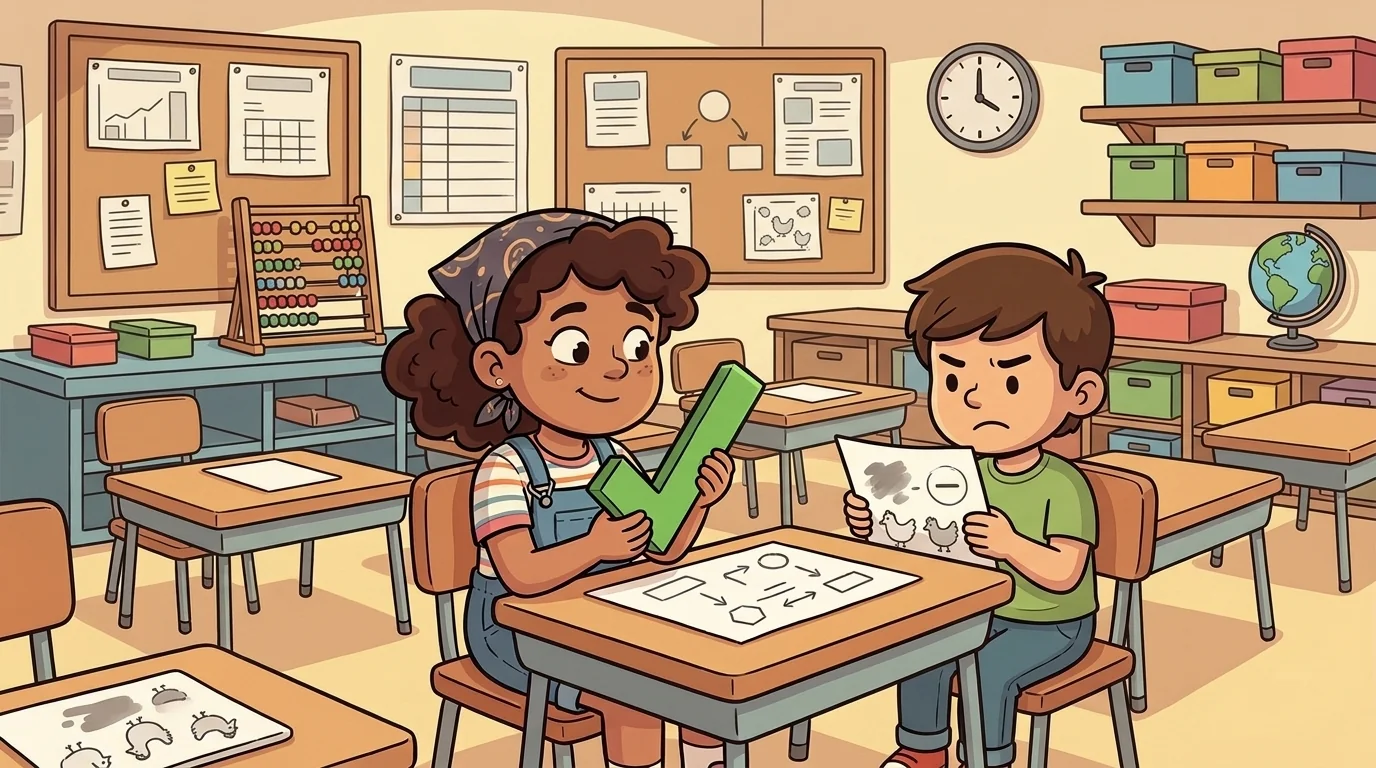
Vetta worked at the last desk in the workshop — the one solvers reached when they thought they were done — and Vetta asked everyone the same four gentle words: "Does this make sense?"
Getting an answer, Vetta believed, was only three-quarters of solving. The last quarter was looking back: taking your answer and carrying it back to the original problem to see if it actually fit the words and the world. "You got 'negative 4 chickens'?" Vetta would say, kindly. "Let's check — can you have negative four chickens? On what farm?" Or, "You got the answer as 3.5 buses — half a bus? For a field trip?" Vetta didn't shame the answer; Vetta just carried it back to reality and let reality speak. "Plug it back in," Vetta said. "Read the original question again with your answer in it. If the sentence sounds absurd, the answer's telling you something. If it fits like a key in a lock — now you can trust it."
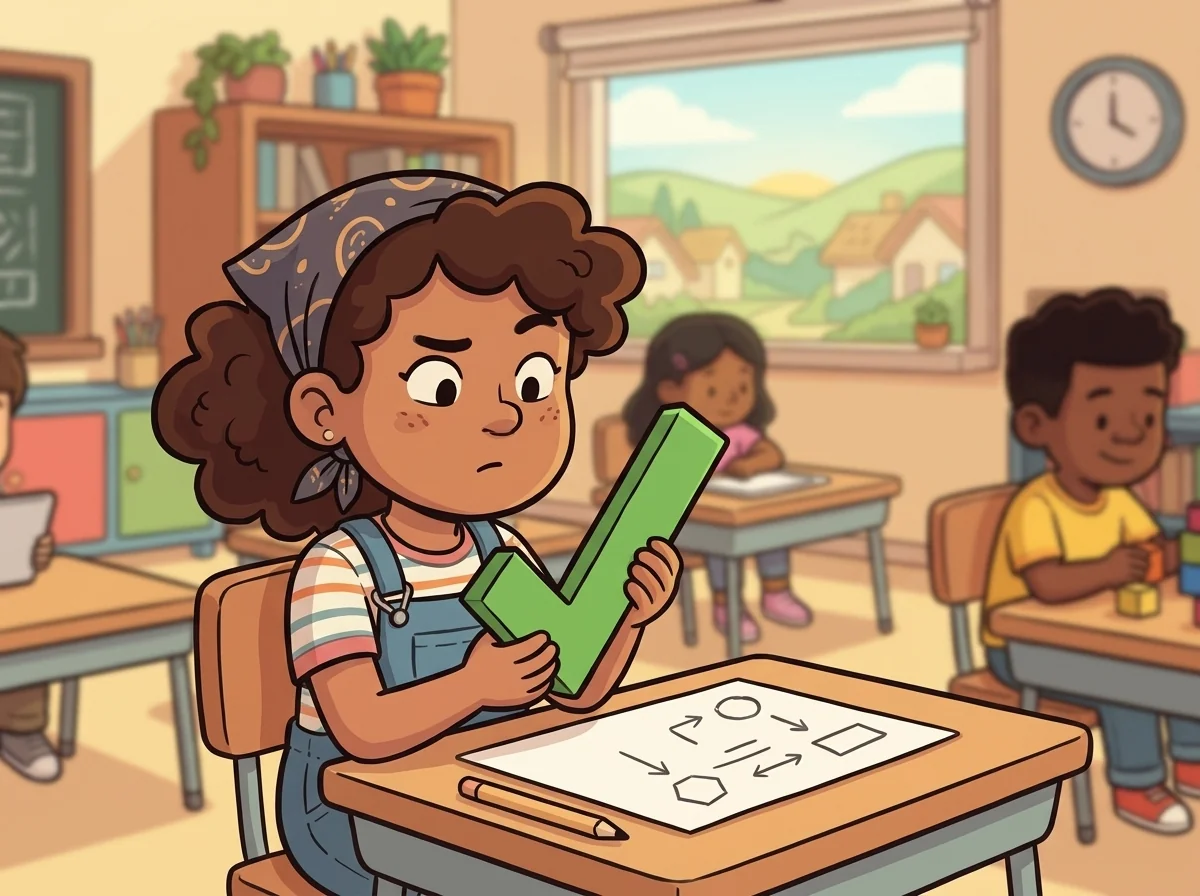
Vetta became the checker after trusting a very wrong answer.
As a young solver, Vetta was fast and confident and handed in an answer of "42 pancakes per person" without a flicker of doubt — because the arithmetic was flawless. The arithmetic was flawless. The setup had been upside down, and nobody eats 42 pancakes, and Vetta was mortified. Cass didn't scold. Cass said, "Your computing was perfect. You just never asked the last question. A right calculation on a wrong setup gives a confident, tidy, completely wrong answer. So always carry it home and check: does 42 pancakes per person make sense? No? Then something upstream is off — and you caught it before anyone else did." From then on, Vetta never trusted an answer until it had survived the walk back to reality.
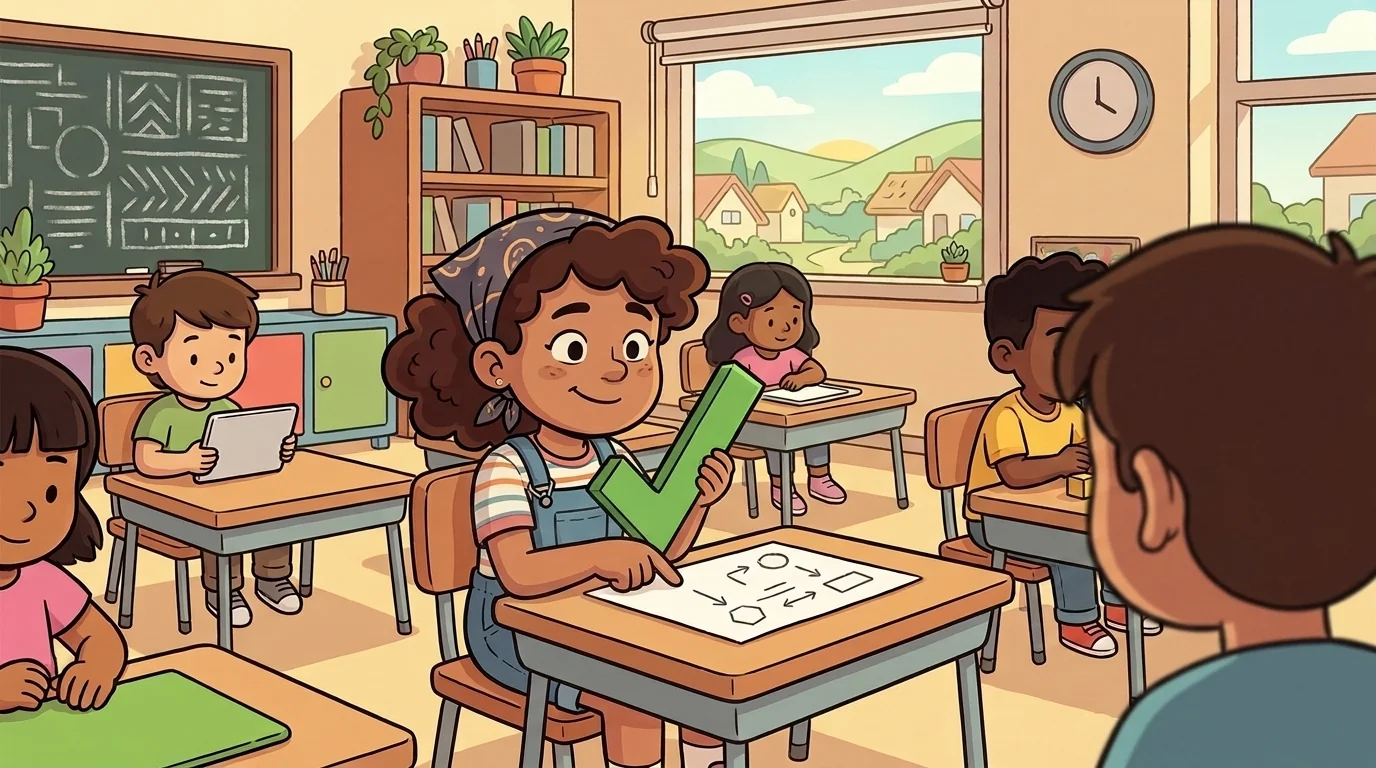
When the kid arrived, having just solved the chickens-and-cows riddle at Reck's or Lettie's desk, they expected Vetta to just say "correct" and wave them on.
Instead Vetta smiled. "You got 3 chickens and 5 cows. Lovely. Before we celebrate — let's check. Carry it back to the words. Three chickens and five cows: is that 8 heads?" The kid counted: 3 + 5 = 8. "And the legs? Three chickens at 2 legs, five cows at 4 legs?" 6 + 20 = 26. "Twenty-six legs, exactly what the problem said." Vetta beamed. "Now you know. Not because you hope so — because you carried it home and it fit every single word."
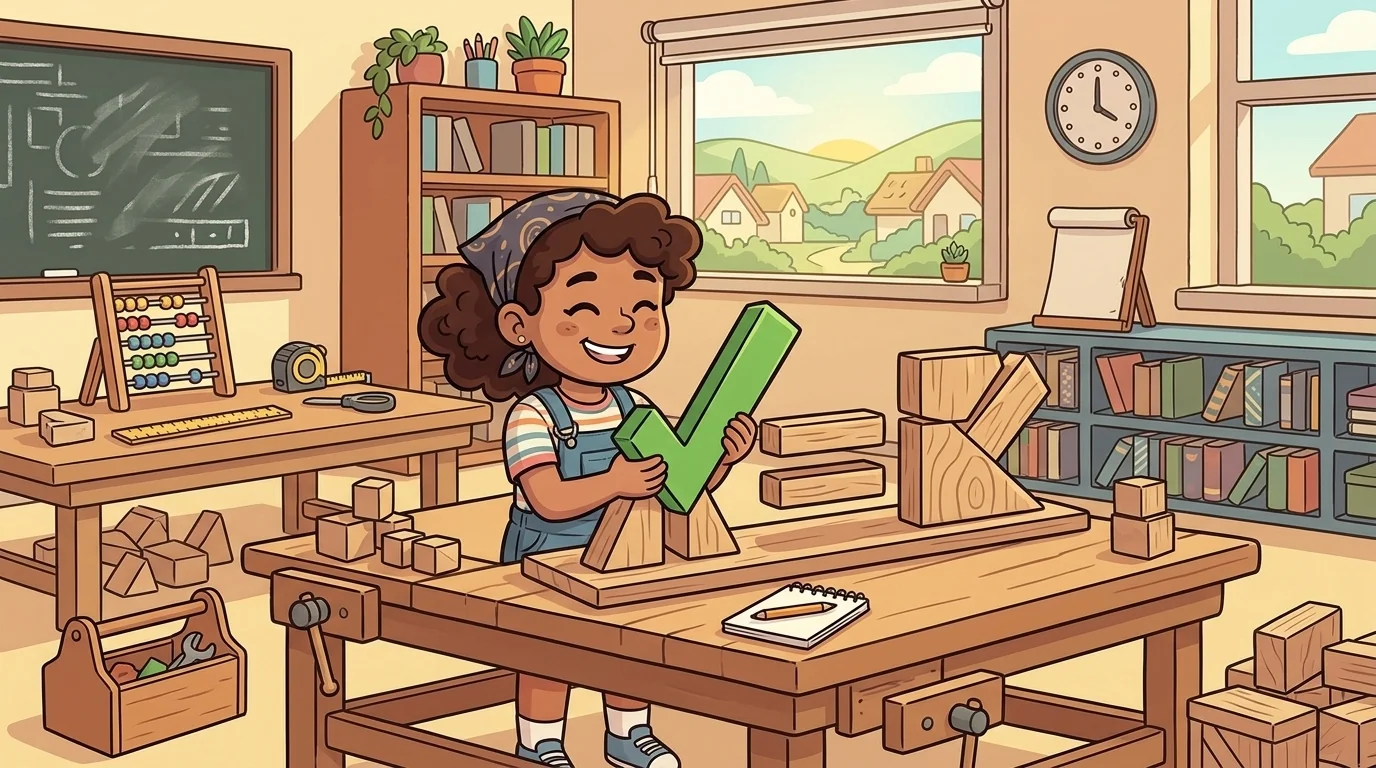
Vetta never treated a failed check as a failure — when a check didn't fit, Vetta lit up: "Wonderful — the check just caught something before it could embarrass us. Let's find the upstream slip." And the kid learned that the check wasn't a judge waiting to condemn them; it was a friend guarding the door.
And the feeling that filled the kid when the numbers fit every word was a deep, grounded certainty — the solid, satisfying confidence of knowing rather than hoping, the difference between handing in an answer with crossed fingers and handing it in with a steady hand. That quiet, rooted assurance —I checked it against the real question and it fits — settled warm in the kid's chest, and Vetta felt the same warmth echo back, glad and calm, because trading crossed-fingers-hope for grounded-certainty was the whole reason Vetta guarded the last desk. "Does this make sense?" Vetta said softly, and it wasn't a challenge now but a comfort, content and warm. "Ask it every time, and you'll always know — not just guess — that you're right." That grounded certainty of the checked answer — that was the very best thing Vetta gave.
Hear it as an audio drama
A short play starring Vetta, from ReckonQuest. Different voices, same idea. Listen any time after you read.
Loading audio…
Read the drama script
- Narrator: From Spark and Anvil and Reckonquest — this is Vetta, in chapter 1 of the Reckonquest cast.
- Narrator: This drama uses an AI-generated voice. Voiced via Gemini 2.5.
- Narrator: Vetta is a careful tortoise-tween who never trusts an answer until the answer has proven itself.
- Vetta: I am Vetta. What I teach is look back — put the answer back into the original words and ask, does this actually make sense?
- Narrator: A solver announces triumphantly that the field holds forty cows.
- Solver: Forty cows! I solved it!
- Vetta: Before we celebrate — the problem said there were thirty animals in total. Can there be forty cows among thirty animals?
- Solver: Oh. No. That's more cows than animals. Something went wrong.
- Vetta: And THAT is the look-back doing its work. It didn't shame you — it caught the slip before anyone else could.
- Vetta: Substitute the answer back. Does it fit the heads? The legs? The story? If the numbers quarrel with the words, we look again.
- Solver: Eighteen chickens, twelve cows. Thirty heads, eighty-four legs. It fits.
- Narrator: Vetta's last question is the quiet guardian of every solution — the difference between an answer and a right answer.
- Vetta: Always look back. An answer you have checked against the words is an answer you can trust.
- Narrator: You've been listening to a Spark and Anvil chapter, written by the Spark and Anvil writing team for ages 9 to 14.
- Narrator: Apps stay free forever.
- Narrator: Curriculum aligned to Common Core and Next Generation Science Standards.
- Narrator: Released under Creative Commons BY-NC-SA 4.0 for educational reuse. Visit Spark and Anvil for the full transcript.
The ReckonQuest ensemble
Vetta is one of the friends in ReckonQuest. Each friend shows you one idea by how they act; meet them all and you have the whole subject.
-

Reck
Systematic guess-and-check — makes a reckoned guess, checks it, makes the next guess smarter (the pre-algebra bridge)
-

Lettie
Set up the equation — names the unknowns ('let x = the chickens') and writes the relationships
-

Retta
Work backwards — starts from the goal and reverses the steps
-

Kindra
Recognize the schema — spots 'this is a coin problem' before solving (schema-based instruction)
-

Doodle
Draw a diagram — draws the bar/tape diagram of the relationships
-

Tad
Simplify to a smaller case — solves a tiny version first (2 heads before 100)
-

Tagg
Track the units — labels every number ('6 = legs, not chickens'), structure over key-words
-
Genny
Generalize — writes the rule that works for any numbers once the specific riddle is solved
-

Cass
The scaffold keeper — runs understand→plan→execute→look-back and normalizes not knowing the way in


