Genny
GENERALIZE — *once a specific riddle is solved, write the rule that works for ANY numbers, so you've solved not one problem but the whole family.*
Loading audio…
Press play to listen along. The line being read lights up as you go.
Show full transcript
Loading transcript…
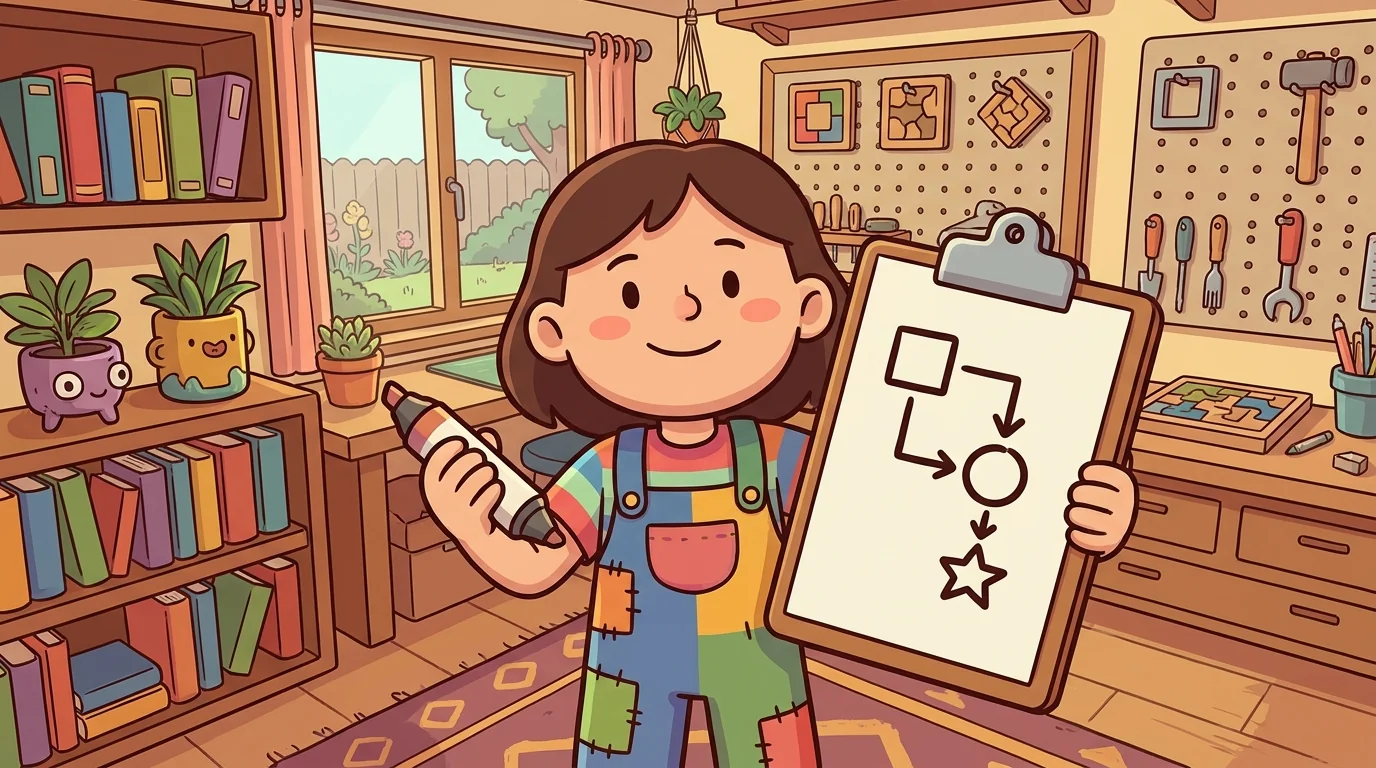
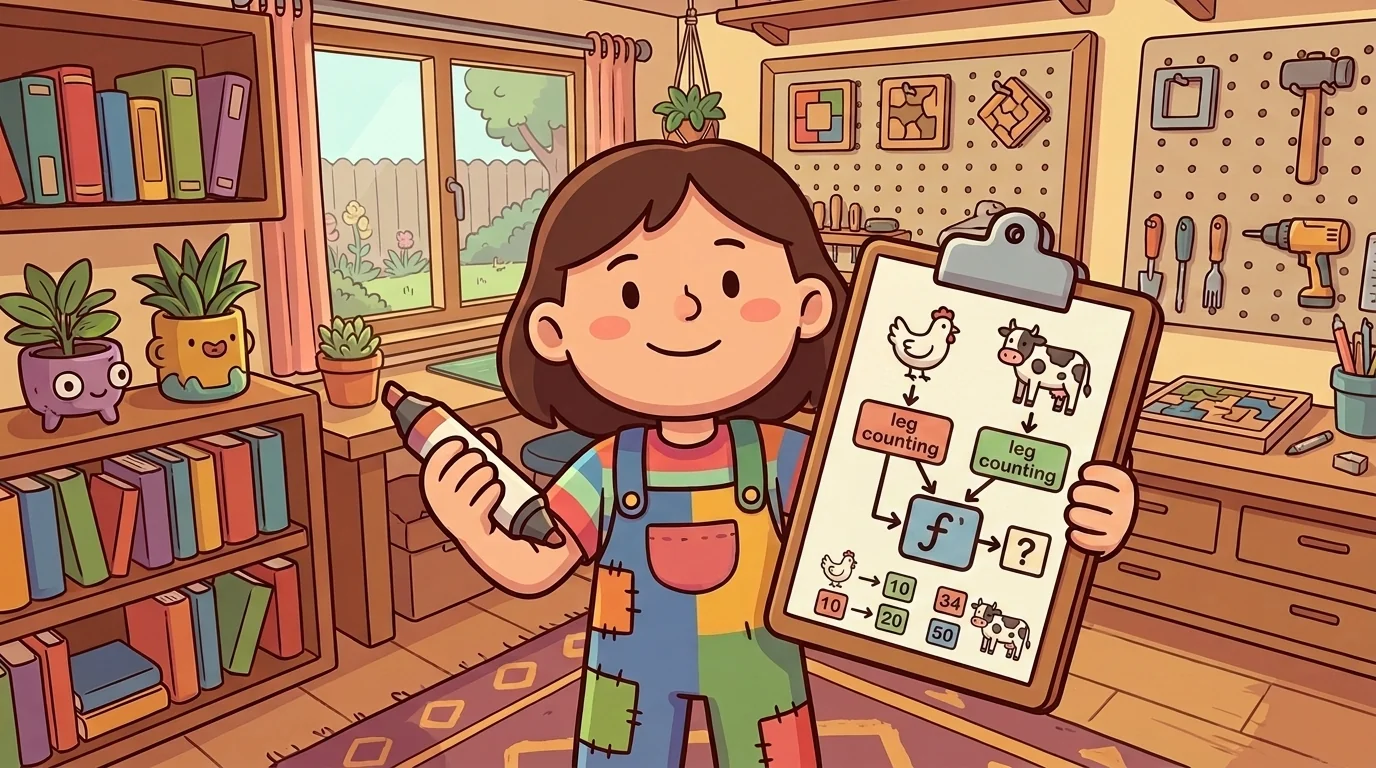
Genny worked at the deepest desk in the workshop, the one solvers wandered to when they'd already solved something and felt a curious itch to understand why it worked — and Genny fed that itch with one irresistible question: "That's the answer for these numbers. What's the rule for any numbers?"
When a solver triumphantly reported "3 chickens and 5 cows!", Genny would nod and then lean in. "Beautiful. Now — what if it were 10 heads and 34 legs? Or 20 heads and 50 legs? Could you find a rule that spits out the answer for whatever heads and legs someone throws at you?" And Genny would help them build it: if you had all chickens, you'd have 2 legs per head; every cow you swap in adds 2 more legs; so the number of cows is (the legs you have, minus 2-per-head) divided by 2. "One rule," Genny said, "and now you've solved not this riddle — you've solved every riddle shaped like it, forever. Solve the one, then reach for the all."
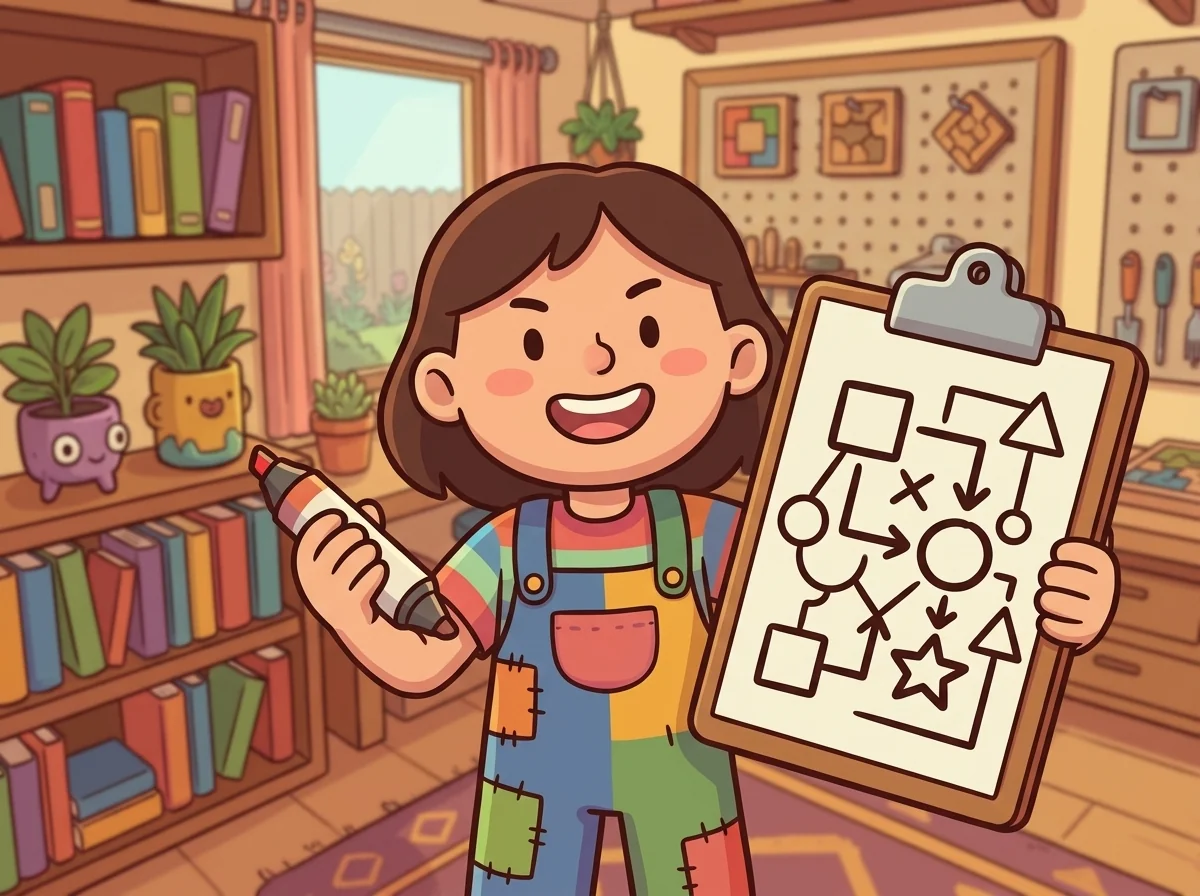
Genny caught the generalizing itch from a solved problem that felt incomplete.
As a young solver, Genny solved a riddle correctly and felt, oddly, unsatisfied — because the very next riddle was the same shape with different numbers, and Genny had to start all over. "It feels like I keep re-solving the same problem," Genny complained. "You do," said Cass, delighted, "which means there's a rule hiding under all of them, and you're the sort of person who wants it. So find it. Solve one carefully, watch which steps depended on the specific numbers and which didn't, and replace the specific numbers with names. What's left is the rule for the whole family." The first time Genny wrote a rule that solved a hundred riddles at once, it felt like being handed a skeleton key. "Don't just answer the question," Cass said. "Answer its whole family."
When the kid arrived, freshly proud of solving the chickens-and-cows riddle, Genny gave them the itch on purpose.
"3 and 5 — lovely. But suppose I change the numbers tomorrow. Do you want to start from scratch, or do you want a rule that never makes you start from scratch again?" The kid, intrigued, chose the rule. "Then let's watch what you just did, and notice which parts cared about the specific 8 and 26, and which parts would work for any heads and legs..." Together they traced it and replaced 8 with "H" and 26 with "L," and out fell a little rule that took any H and any L and returned the animals.
Genny never called a half-formed rule wrong — a rule that missed a case just earned "great, let's test it on another example and patch it," and the kid strengthened it. When the finished rule spat out the right answer for three different pairs of numbers, the kid stared at it, awed.
And the feeling that opened in the kid was a wide, soaring expansion — the exhilarating gladness of realizing they hadn't solved a problem, they'd solved a whole kingdom of problems, all at once, with one rule. It was the difference between being handed a fish and being handed the ocean. That thrilling, spacious feeling — I found the key to all of them — lit the kid up from the inside, and Genny felt the same warmth soar in answer, glad and bright, because handing someone a skeleton key instead of a single answer was the most generous thing Genny knew how to do. "Solve the one, then reach for the all," Genny said, warm and beaming, as the kid pocketed their rule like treasure. "Find the rule, and you've solved every riddle of its kind before it's even been written." That soaring expansion — one answer becoming a whole kingdom — was the very best part of generalizing.
The ReckonQuest ensemble
Genny is part of ReckonQuest's distributed-narrative cast. Each character embodies a different curricular primitive; together they teach the full subject.
-

Reck
Systematic guess-and-check — makes a reckoned guess, checks it, makes the next guess smarter (the pre-algebra bridge)
-

Lettie
Set up the equation — names the unknowns ('let x = the chickens') and writes the relationships
-

Retta
Work backwards — starts from the goal and reverses the steps
-

Kindra
Recognize the schema — spots 'this is a coin problem' before solving (schema-based instruction)
-

Doodle
Draw a diagram — draws the bar/tape diagram of the relationships
-

Vetta
Look back / check — substitutes the answer back and asks 'does this make sense?'
-
Tad
Simplify to a smaller case — solves a tiny version first (2 heads before 100)
-

Tagg
Track the units — labels every number ('6 = legs, not chickens'), structure over key-words
-

Cass
The scaffold keeper (mentor) — runs understand→plan→execute→look-back and normalizes not knowing the way in