
Doodle
DRAW A DIAGRAM — *draw the bar/tape diagram of the relationships so the problem becomes a picture you can see, not just words you must hold in your head.*
Loading audio…
Press play to listen along. The line being read lights up as you go.
Show full transcript
Loading transcript…
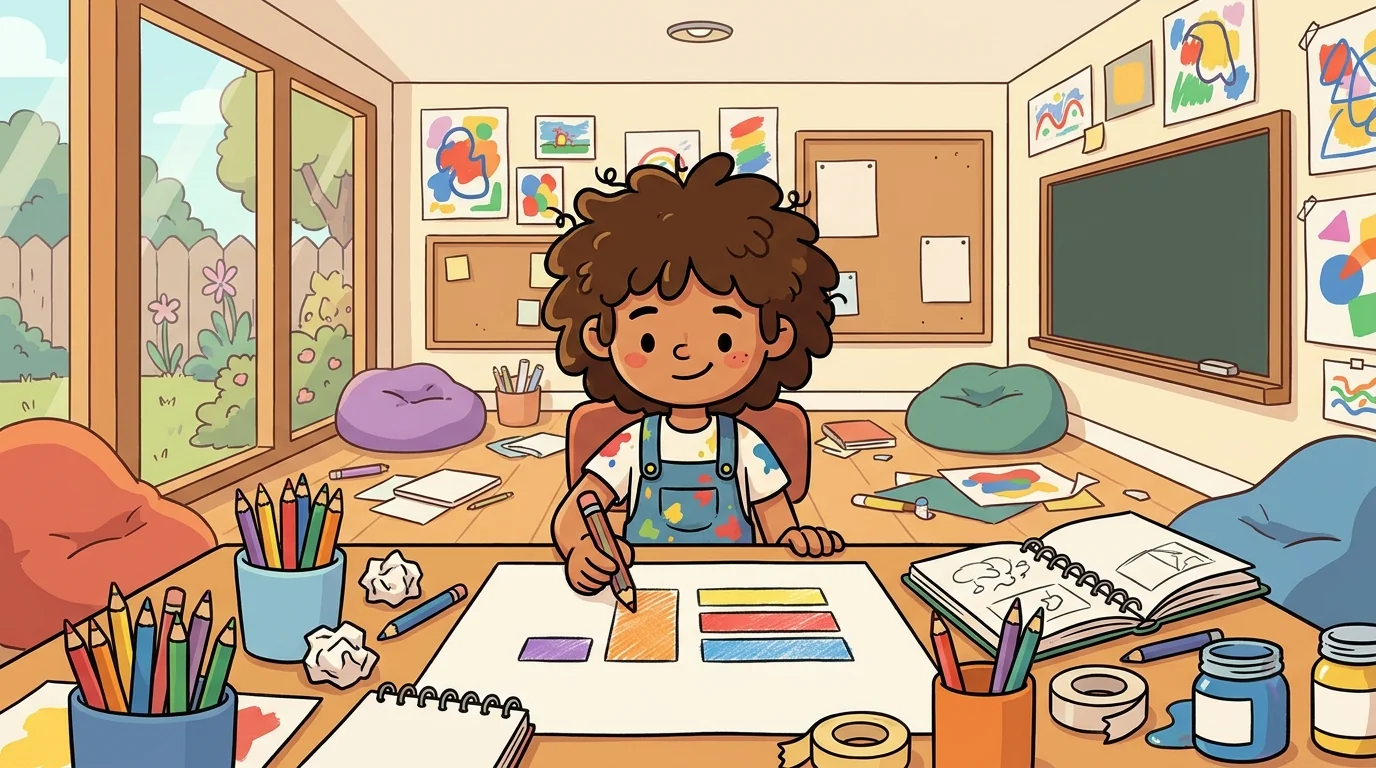
Doodle worked at a wide oak table buried under scrap paper, pencil shavings, and colored pencils. Cedar shavings dusted the wooden edges like pale confetti, but Doodle never solved a problem with raw numbers first. Numbers were slippery, like soap in a tub. Instead, Doodle always drew.
Word problems, Doodle believed, were hard mostly because they asked your brain to juggle too many facts at once. Take a simple example: Maya has twice as many stickers as Jon, and together they have eighteen. If you hold "twice" and "together" and "eighteen" in your head, something usually slips onto the floor. Your brain gets tired of holding all those loose pieces. So Doodle drew the problem instead.
Doodle picked up a soft charcoal pencil and sketched a neat rectangle for Jon's stickers. Right below it, Doodle drew two matching bars side by side for Maya. Doodle bracketed the whole group on the paper and wrote eighteen at the end.
Suddenly, the problem was not a pile of noisy words anymore. It was just three identical wooden blocks lined up on the paper. If three equal blocks added up to eighteen, each single block had to be six. Jon had six stickers, while Maya had two blocks for twelve. The problem was finished before anyone even felt like doing arithmetic.
"The words make you hold everything at once," Doodle said, shading Jon's bar with a sky-blue pencil. "The picture holds it for you. You just read the answer off the drawing."
Doodle had not always known this secret. Years ago, as a younger solver, Doodle tried to hold every relationship in mind at the same time. Doodle would drop the "twice" halfway through a test, or forget which cousin had three more marbles than the other. The numbers tangled together like headphones pulled out of a dark pocket, leaving Doodle feeling scatterbrained and slow.
Then came Cass, who sat at the back table with a brass ruler and a box of sixty-four colored pencils. One Tuesday afternoon, Cass noticed Doodle staring at a page and chewing a pencil top until the wood split. Cass slid across the wooden bench and set a thick navy pencil on Doodle's open notebook.
"Stop carrying all that heavy furniture in your head," Cass said softly, tapping Doodle's temple with two fingers. "Your brain has better things to do than store boxes. Put it on the paper."
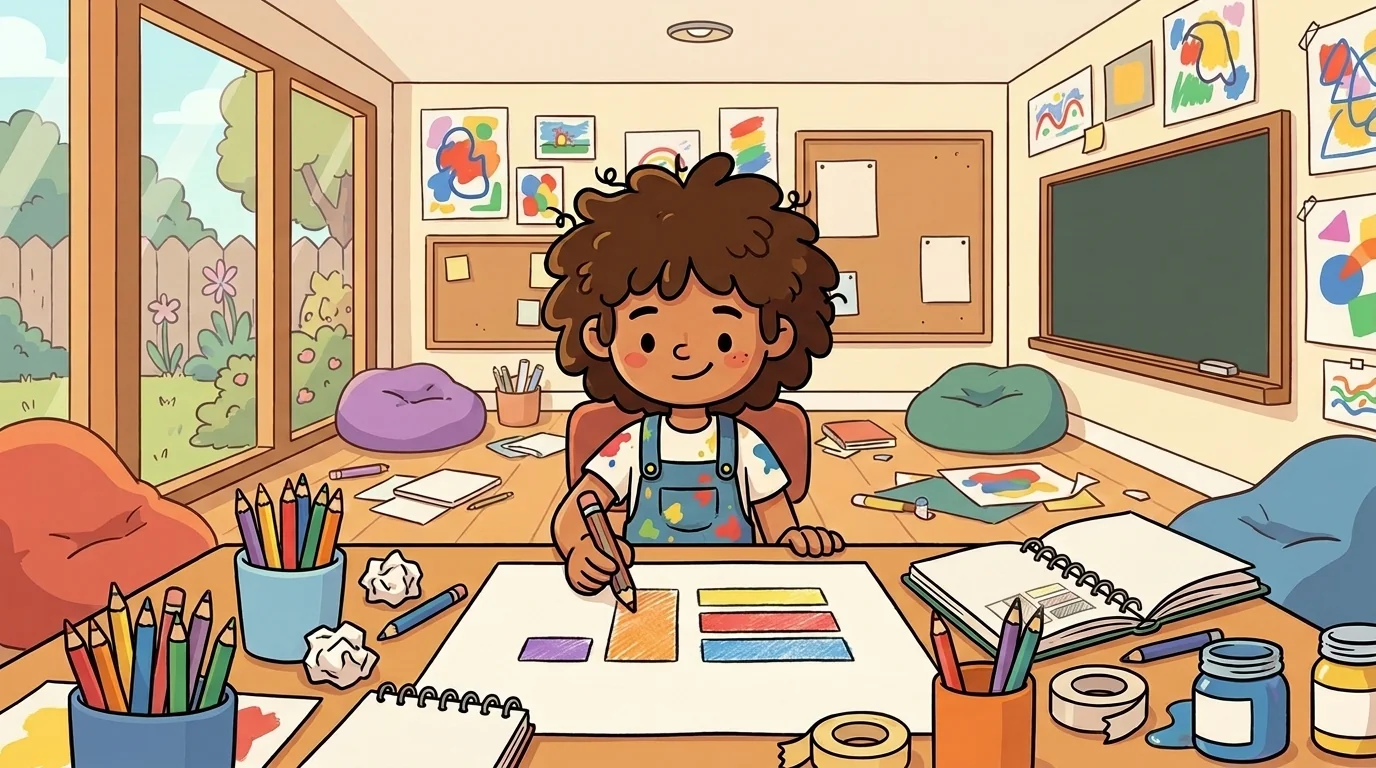
Cass pointed to a problem about three brothers sharing forty-five books. "Draw the youngest brother as a tiny box," Cass instructed. "Draw the middle brother as two boxes, and draw the oldest as two boxes plus five extra books."
Doodle picked up the navy pencil and made five neat rectangles on the paper. Cass showed Doodle how to subtract the five extra books from forty-five, leaving forty to split evenly across five identical boxes. Each box was eight, and the answer sat right there on the page, clear as glass.
The first time Doodle watched an answer fall out of a sketch like that, it felt like cheating in the best possible way. "The paper remembers so you don't have to," Cass said with a small smile, packing up her brass ruler. From that day on, Doodle never tried to juggle a word problem again. Doodle drew every single one.
On a rain-streaked Thursday, a kid named Leo walked into the workshop dragging his sneakers across the floorboards. Leo slumped into the chair across from Doodle's desk, dropping a crumpled sheet of paper onto the blotter before rubbing his knuckles into his eyes.
"I hate farm problems," Leo muttered to his own knees. "They give you legs and heads and you have to figure out how many pigs there are. My brain is melting."
Doodle smoothed out the crumpled homework page with the flat palm of one hand. The problem read: A barn contains chickens and cows. There are 8 animals in total, and together they have 26 legs. How many chickens and how many cows are in the barn?
Leo had written random numbers in the margin, with heavy eraser smudges where he had rubbed holes through the paper. "You're trying to guess," Doodle said gently. "Guessing makes your head hot."
"There are too many moving parts," Leo said, slouching lower in his wooden chair. "If I change the chickens, the legs change. If I change the cows, the total changes."
Doodle reached into the desk drawer and pulled out a fresh sheet of thick grid paper. Doodle slid a bright yellow pencil into Leo’s hand before he could write another number.
"Don't hold it in your head," Doodle said. "Let's draw a diagram."
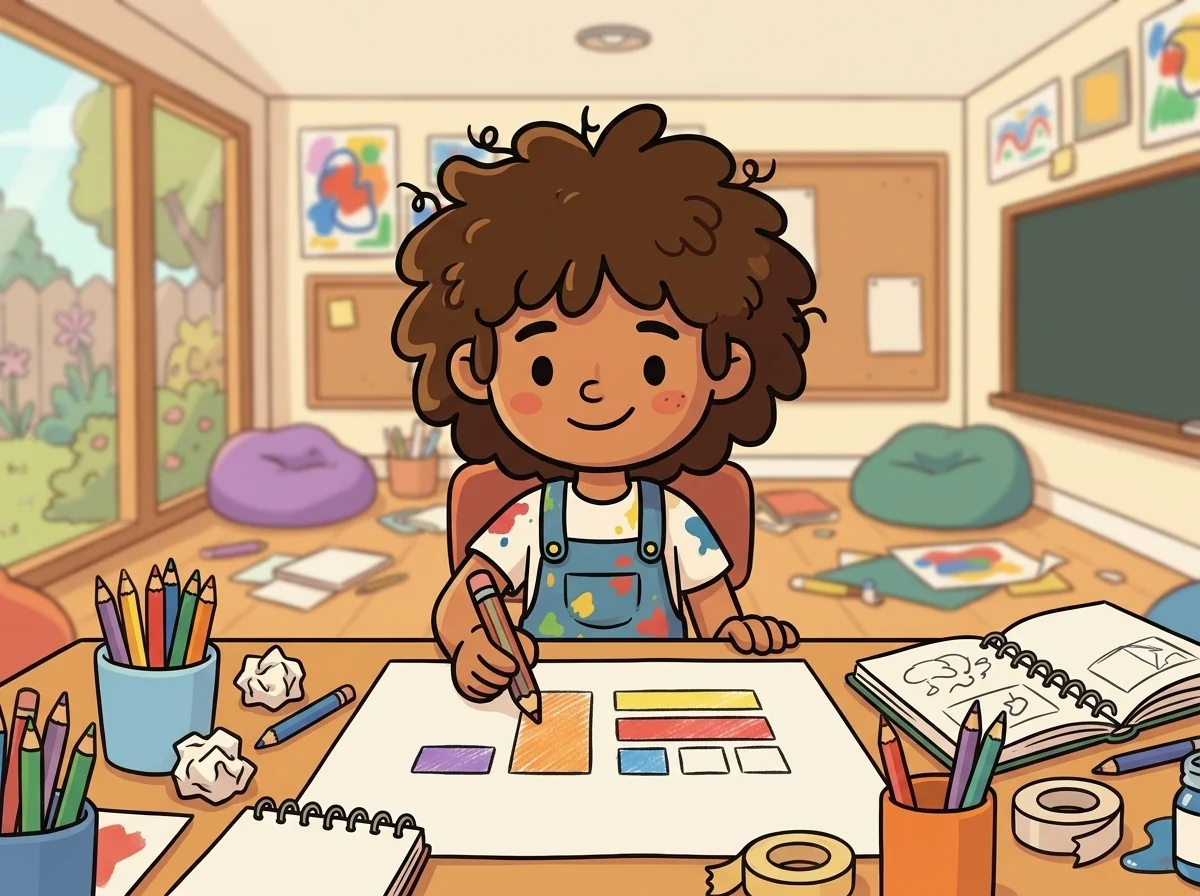
Leo blinked at the grid paper. "A diagram? For farm animals?"
"Who's in the barn?" Doodle asked, pointing to the total count.
"Eight animals," Leo said.
"Draw eight boxes in a row," Doodle told him. "Each box is one living creature."
Leo drew eight tidy squares across the page.
"Now," Doodle said, leaning forward. "Every animal in that barn has at least two legs, right? Even the cows have at least two legs."
"Right," Leo said. "Unless it's a very unfortunate cow."
Doodle gave a short, quiet laugh. "Put two sticks inside every single box to give each animal its first two legs."
Leo picked up the yellow pencil and drew two quick vertical lines in each of the eight boxes before looking up.
"How many legs did you just draw on the paper?" Doodle asked.
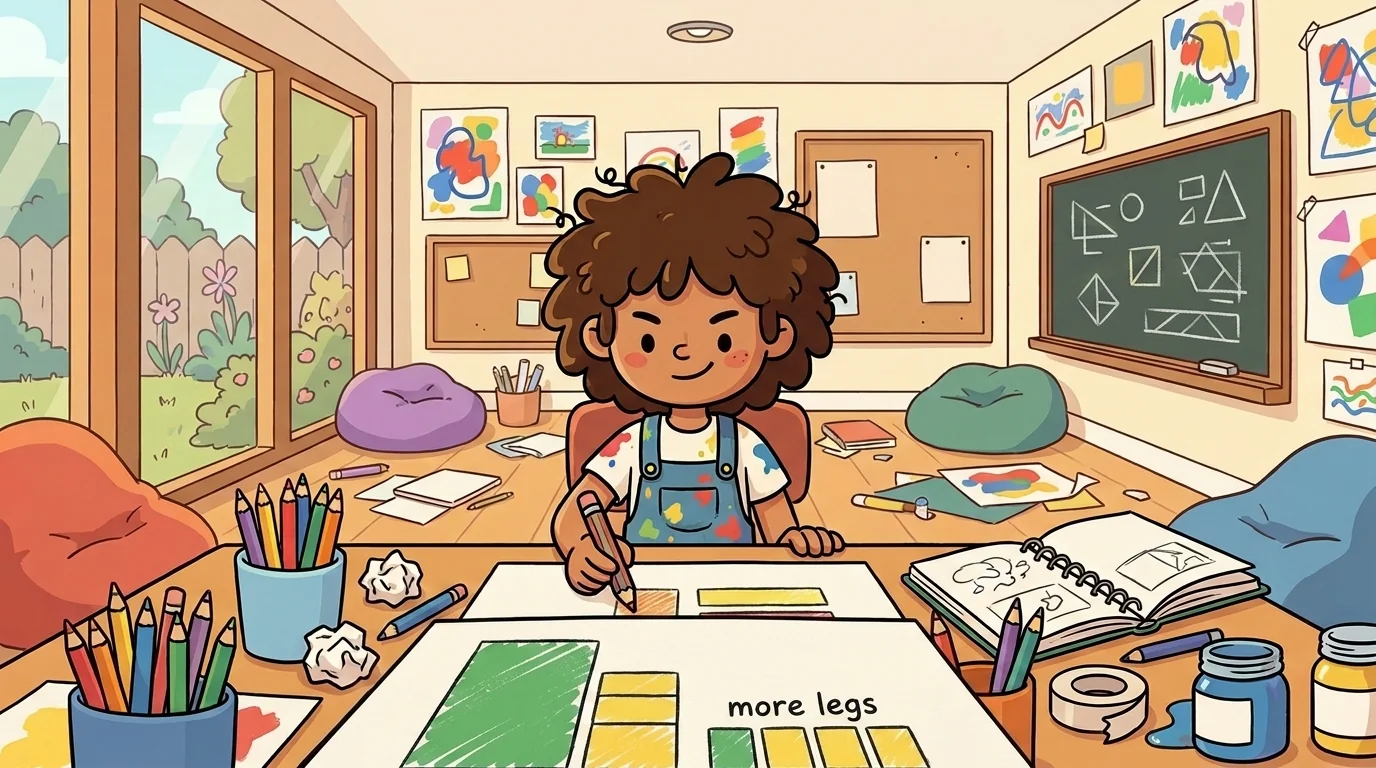
Leo counted by twos across the row. "Sixteen."
"How many legs did the problem say were in the barn?"
"Twenty-six," Leo answered.
"So how many extra legs are still standing outside the barn waiting to be attached?"
Leo stared at his drawing. "Ten legs," he said slowly.
"Where do those ten extra legs belong?" Doodle asked softly.
"To the cows," Leo said. "Because cows need two more legs each to stop being chickens."
"So give two extra legs to a box until all ten extra legs are gone," Doodle said.
Leo drew two extra lines in the first box. "That's one cow," he whispered. He added two lines to the second box, the third, the fourth, and the fifth before pausing to count his extra lines. "Two, four, six, eight, ten. I ran out of extra legs!"
"Look at your drawing," Doodle said. "What do you see?"
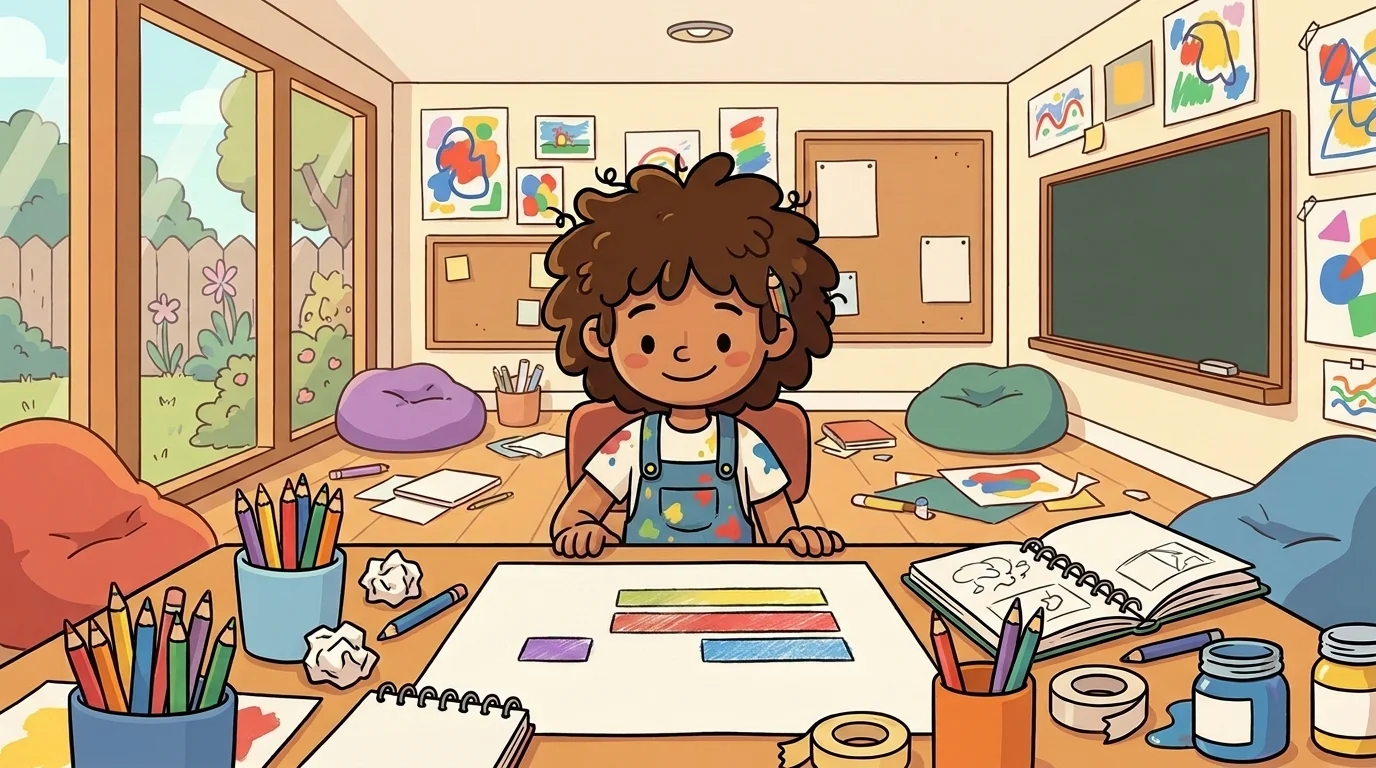
Leo set his pencil down on the grid paper as his eyes traveled across the row of boxes. "Five boxes have four legs," he said. "Three boxes have two legs."
"So how many cows are in the barn?"
"Five cows," Leo said.
"And how many chickens?"
"Three chickens." Leo sat up straight, his chest expanding. "Five cows and three chickens! That's eight animals, and twenty plus six makes twenty-six legs!"
Doodle never called a sketch wrong. If a student drew blocks that were too small or crowded, Doodle simply pulled out a larger sheet of paper. "Let's redraw that part bigger," Doodle would say, handing over a green pencil, and clarity always followed space.
The answer to Leo's farm problem had not been computed through long equations or frantic guessing. It had simply been read off the picture Leo made with his own hands.
Leo leaned back in the wooden chair, resting his hands behind his head as the knot between his eyebrows dissolved. In its place came a bright, uncluttered lightness. It was the specific relief of a crowded, juggling mind suddenly emptying itself onto a quiet page. He didn't have to carry the legs and heads in his brain anymore, because the paper was holding them for him.
The scatterbrained panic Doodle remembered so well from childhood had lifted completely from the room, replaced by the calm clarity of seeing instead of straining. Doodle watched that lightness arrive across Leo’s face and felt a warm, quiet satisfaction. Handing someone an un-crowded mind was the best gift a simple drawing could give.
"The paper remembers so you don't have to," Doodle said softly, reaching across the desk to tuck a fresh blue pencil behind Leo’s left ear. "Draw the problem next time, and let the picture do the worrying."
The ReckonQuest ensemble
Doodle is part of ReckonQuest's distributed-narrative cast. Each character embodies a different curricular primitive; together they teach the full subject.
-

Reck
Systematic guess-and-check — makes a reckoned guess, checks it, makes the next guess smarter (the pre-algebra bridge)
-
Lettie
Set up the equation — names the unknowns ('let x = the chickens') and writes the relationships
-
Retta
Work backwards — starts from the goal and reverses the steps
-
Kindra
Recognize the schema — spots 'this is a coin problem' before solving (schema-based instruction)
-

Vetta
Look back / check — substitutes the answer back and asks 'does this make sense?'
-
Tad
Simplify to a smaller case — solves a tiny version first (2 heads before 100)
-
Tagg
Track the units — labels every number ('6 = legs, not chickens'), structure over key-words
-
Genny
Generalize — writes the rule that works for any numbers once the specific riddle is solved
-
Cass
The scaffold keeper (mentor) — runs understand→plan→execute→look-back and normalizes not knowing the way in