
Genny
GENERALIZE — *once a specific riddle is solved, write the rule that works for ANY numbers, so you've solved not one problem but the whole family.*
Loading audio…
Press play to listen along. The line being read lights up as you go.
Show full transcript
Loading transcript…
Genny worked at the very back of the workshop, where the floorboards creaked underfoot and the air smelled like cedar shavings and dry slate dust. To reach Genny’s desk, you had to squeeze past Tad’s table, which was always buried under piles of tiny wooden counting blocks. You had to duck under Lettie’s drying lines, where paper strips with neat blue labels swung in the draft from the hallway. You walked past the loud chatter of people arguing over clues until the noise faded into a steady, hummed rhythm.
Genny’s desk was wide, heavy, and stained dark with fifty years of spilled ink. The top was covered in slate boards, brass calipers, and tiny balance scales that clinked whenever someone stepped heavily nearby. Most solvers came to Genny after they had already finished a puzzle. They had the right number written at the bottom of their page. Yet they still felt a strange, restless itch behind their ears. They had found the answer, but they wanted to understand why it worked.
Genny fed that itch with a single question.
"That's the answer for these numbers," Genny would say, leaning forward on both elbows. "What's the rule for any numbers?"
When solvers first heard this, they usually blinked. They had worked hard to get their final number. They wanted to celebrate, not get asked for more work. But Genny never rushed them. Genny just waited, holding a piece of white chalk like a key, until the solver’s eyes lit up with curiosity.
Genny had caught that same itch years ago as a beginner in the workshop.
Back then, Genny had sat at a small pine table near the front window, solving story riddles one by one. Genny remembered the exact rainy afternoon it happened. A riddle had asked for the number of carts and horses in a barn. Genny had drawn thirty wheels and sixteen horse legs, counted them carefully, and written down four carts and four horses. The answer was right. Genny had received a green ink stamp on the paper.
Five minutes later, the supervisor handed over another sheet of paper. This time, it was a riddle about boats and oars.
Genny looked at the page and felt a sudden, heavy tiredness. It was the exact same problem disguised in new clothes. The numbers were bigger, but the steps were identical. Genny had to draw circles again, subtract legs again, and divide by two again.
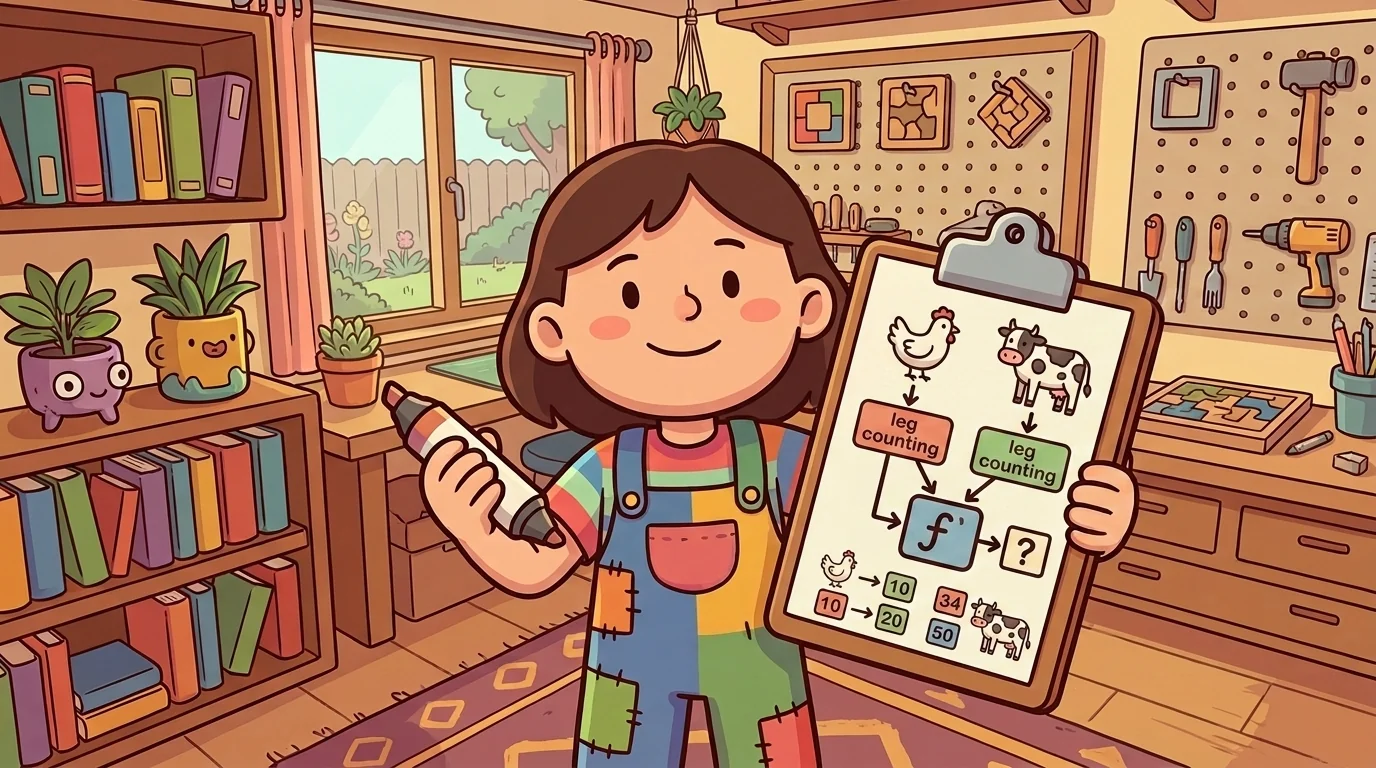
"It feels like I keep re-solving the same problem over and over," Genny complained to Cass, who sat nearby filing index cards into metal trays.
Cass stopped filing and turned around. Cass had silver hair tucked behind one ear and carried a heavy ring of brass skeleton keys at her belt.
"You are," Cass said, sounding utterly delighted instead of sympathetic. "Which means there is a rule hiding under all of those riddles. You are the kind of solver who wants that rule. So go find it."
"How?" Genny asked, looking down at the messy drawings of boat oars.
"Solve one specific case very carefully," Cass said, pointing her pencil at the paper. "Watch which steps depended on your specific numbers, and which steps didn't. Then throw out the specific numbers. Replace them with general names. What you have left is the rule for the whole family."
Genny tried it that afternoon. Instead of calculating four carts, Genny wrote down a formula using letters for wheels and axles. When Genny tested it on the next five boat riddles, the answers popped out instantly without drawing a single boat.
It felt like magic. More than magic, it felt like key-making.
"Don't just answer the question," Cass had told Genny that day, handing over a blank slip of brass. "Answer its whole family."
Now, years later, a kid walked up to Genny’s deep desk. The kid was twelve years old, wearing an apron smudged with blue ink, holding a damp slate like a trophy.
"I got it," the kid announced proudly. "Three chickens and five cows!"
Genny looked at the slate. On it was written a story problem about a barn with eight heads and twenty-six legs. The kid had drawn eight circle heads and added stick legs. He counted sixteen legs, subtracted sixteen from twenty-six, and divided the rest by two to get five cows.
"Beautiful," Genny said, nodding slowly. "Three chickens and five cows. That is completely right."
The kid grinned, reaching for the wooden approval stamp.
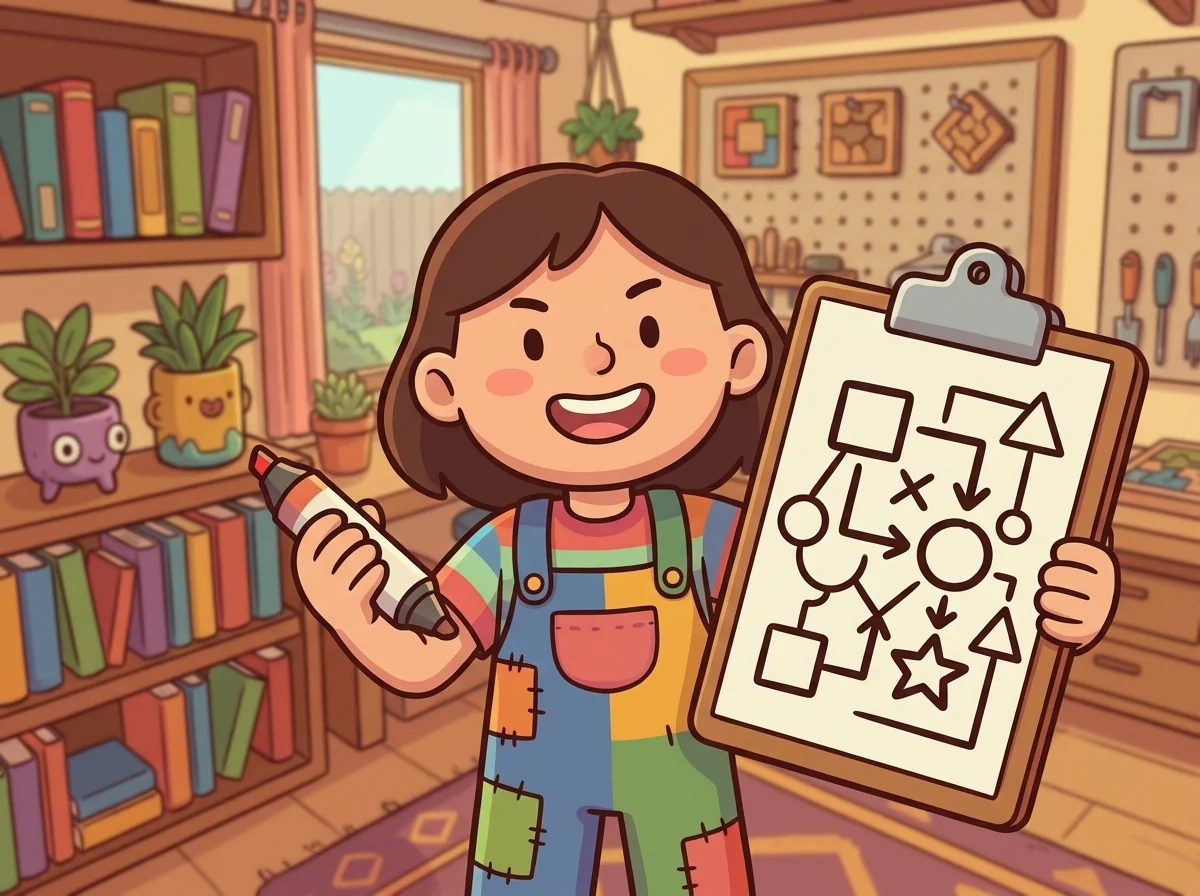
Genny leaned across the ink-stained desk. "Now—what if someone comes in tomorrow and changes the numbers? What if they tell you there are ten heads and thirty-four legs? Or twenty heads and fifty legs?"
The kid stopped reaching for the stamp. His eyebrows pulled together. "I'd have to draw the circles again. And do the stick legs again."
"Do you want to start from scratch every time?" Genny asked softly. "Or do you want a rule that never makes you start from scratch again?"
The kid stared at his slate. He looked at the long columns of scratch marks he had erased three times. "I want the rule."
"Good," Genny said, handing over a fresh slate and a piece of soft chalk. "Then let's watch what you just did. We can use generalizing to find the machine hidden inside your arithmetic."
Genny pointed to the erased numbers. "Notice which parts cared about the specific eight heads and twenty-six legs. And notice which parts would work for any animals someone throws at you."
They traced the steps line by line.
"First," Genny said, "you assumed every animal was a chicken. So you gave every head two legs."
"Right," the kid said. "Two legs per head."
"What if there were H heads?" Genny asked, replacing the eight with a neat chalk letter H.
"Then it's two times H," the kid said immediately.
"Exactly," Genny said. "Now, you took your total legs—let's call that L—and subtracted those chicken legs."
"So L minus two times H," the kid said, his voice rising in volume.
"And every cow you swap in adds two more legs to the barn," Genny continued. "So how many cows are there?"
"The leftover legs divided by two!" the kid burst out. He took the chalk from Genny's hand and wrote it down across the bottom of the slate:
Cows = (L - 2H) / 2
"Look at that," Genny whispered. "One rule. Now you haven't solved just this riddle. You've solved every riddle shaped like it, forever."
"Wait," the kid said, looking nervous. "What if I got it wrong? What if it breaks?"
"Then we patch it," Genny said comfortably. "A rule that misses a case isn't a failure. It just needs a little armor. Let's test it."
Genny pulled out a slip of paper from a wooden drawer. "Try ten heads and thirty-four legs."
The kid plugged ten in for H and thirty-four in for L. Two times ten was twenty. Thirty-four minus twenty was fourteen. Fourteen divided by two was seven. Seven cows! Which meant three chickens.
"It worked," the kid said, stunned.
"Try twenty heads and fifty legs," Genny challenged.
The kid worked the chalk furiously across the slate board. Two times twenty was forty. Fifty minus forty was ten. Ten divided by two was five cows. Fifteen chickens.
The kid stared at the slate for three long seconds. He didn't speak. He didn't pick up his chalk.
A wide, quiet feeling bloomed across the kid’s face. It was the exhilarating gladness of realizing he hadn't just solved a single homework card. He had unlocked a whole kingdom of problems, all at once, with seven letters and two minus signs. It was the difference between being handed a single baked fish and being handed an ocean net.
That thrilling, spacious feeling—I found the key to all of them—lit the kid up from his shoes to his messy hair.
Genny watched him and felt that same warmth rise in response. Handing someone a single answer was fine. But handing someone a skeleton key was the most generous thing Genny knew how to do.
"Solve the one, then reach for the all," Genny said softly, beaming across the quiet desk.
The kid wiped his dusty chalk hands on his jeans. He tucked the slate carefully into his satchel like a piece of found treasure.
"Find the rule," Genny added, watching him walk toward the workshop doors, "and you've solved every riddle of its kind before it's even been written."
The ReckonQuest ensemble
Genny is part of ReckonQuest's distributed-narrative cast. Each character embodies a different curricular primitive; together they teach the full subject.
-

Reck
Systematic guess-and-check — makes a reckoned guess, checks it, makes the next guess smarter (the pre-algebra bridge)
-

Lettie
Set up the equation — names the unknowns ('let x = the chickens') and writes the relationships
-
Retta
Work backwards — starts from the goal and reverses the steps
-
Kindra
Recognize the schema — spots 'this is a coin problem' before solving (schema-based instruction)
-
Doodle
Draw a diagram — draws the bar/tape diagram of the relationships
-

Vetta
Look back / check — substitutes the answer back and asks 'does this make sense?'
-
Tad
Simplify to a smaller case — solves a tiny version first (2 heads before 100)
-
Tagg
Track the units — labels every number ('6 = legs, not chickens'), structure over key-words
-
Cass
The scaffold keeper (mentor) — runs understand→plan→execute→look-back and normalizes not knowing the way in