
Kindra
RECOGNIZE THE SCHEMA — *see past the surface story to the underlying TYPE of problem ("this is a coin problem"), so you know which method fits before you start.*
Loading audio…
Press play to listen along. The line being read lights up as you go.
Show full transcript
Loading transcript…
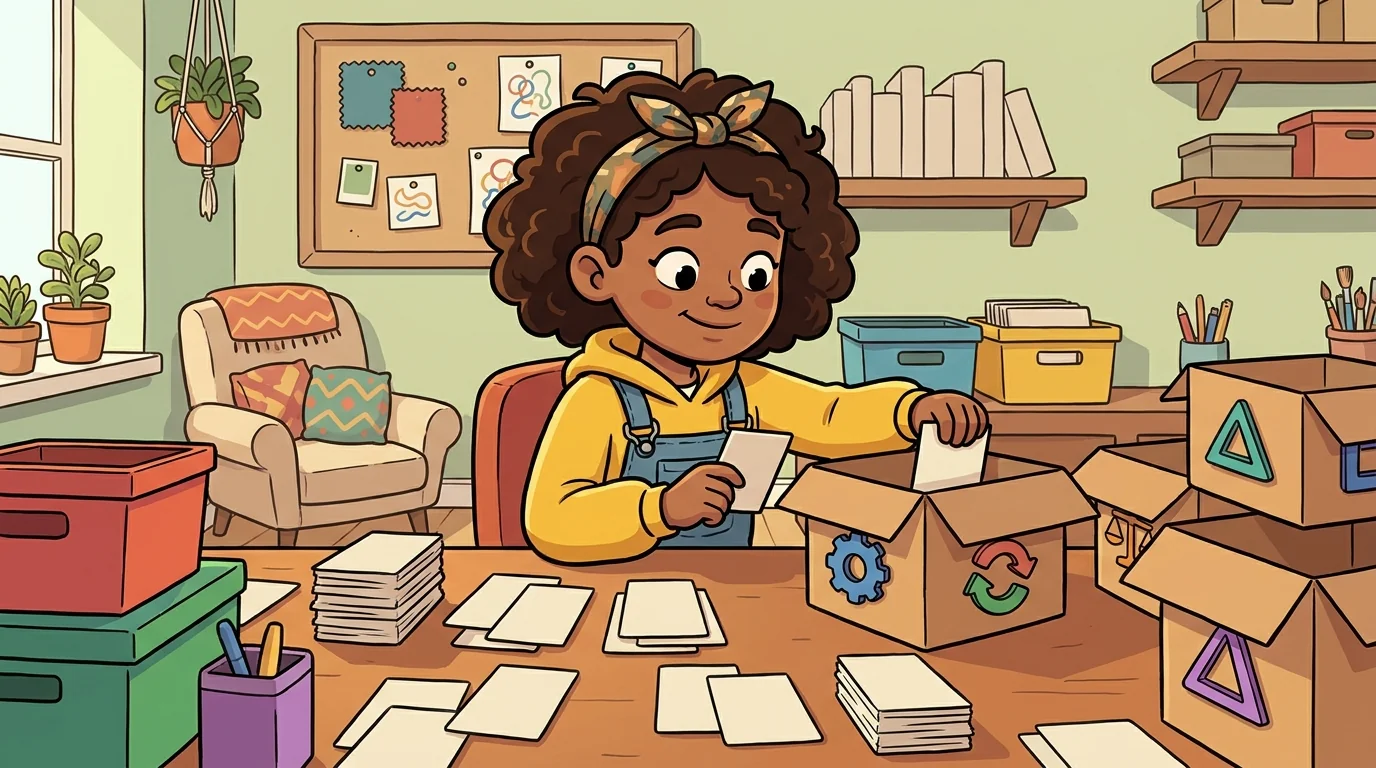
Kindra worked at a wide oak desk that smelled faintly of cedar shavings and old paper. The surface looked like a staging area for a small, meticulously organized war. Index cards sat in neat stacks, held down by smooth brass paperweights. Down the center ran four wooden trays, carved by hand and labeled with dark ink: rate, total-and-parts, comparison, and combining.
Kindra had a peculiar habit before touching a pencil or opening a calculator. Before doing a single line of math, Kindra sorted every incoming puzzle by its hidden architecture. In the workshop, this process had a formal name: schema recognition. To Kindra, it was simpler than that. It was just pulling off a costume.
"Look at this one," Kindra said, lifting an index card written in cramped blue cursive. "A farmer has a leaky barrel losing three gallons every hour. And this card over here shows a cyclist riding twelve miles every hour." Kindra laid the two cards side by side on the green blotter. "Different stories. Different costumes. Underneath, they are the exact same problem."
Kindra dropped both cards into the rate tray with a satisfying wooden clack.
"They are both about something happening at so-much-per-something," Kindra explained. "A leaky barrel is just a bike ride wearing a bucket."
Kindra could look at a riddle dressed up in ancient coins, missing stamps, or lost chickens and instantly spot the skeleton underneath. The trick was ignoring the nouns. Nouns were smoke and mirrors designed to make simple math look terrifying.
"The story is just a disguise," Kindra liked to say. "A coin problem, a stamp problem, and a ticket problem are all the same problem in different hats. If you name the type, you already half-know the method. You have already solved its cousins before."
Kindra had not always seen through the costumes. The sorting habit was born out of a very specific, agonizing afternoon three years earlier.
As a younger solver, Kindra approached every new word problem with cold, stomach-churning panic. A problem about brass coins felt completely unrelated to a problem about postage stamps. When a problem about bus tickets appeared on a test, Kindra froze, felt the room shrink, and started over from absolute zero. It was exhausting work. Every page was a dark room full of unknown shapes.
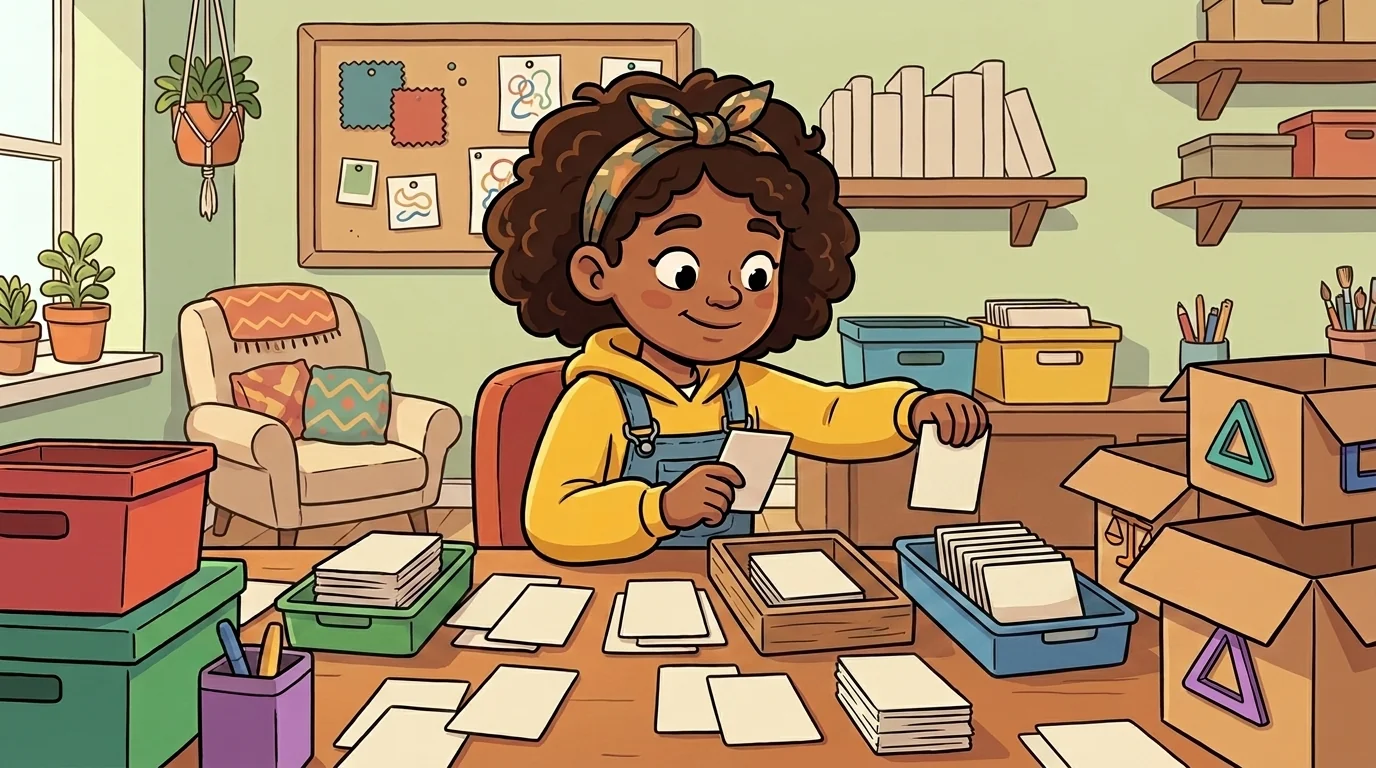
Then Cass had intervened.
Cass was an older mentor who worked in the back row, surrounded by tall stacks of leather-bound ledgers. One rainy Tuesday, Cass noticed Kindra staring at a worksheet covered in red marks. Kindra was chewing the pink eraser off a pencil, tears of frustration itching behind the eyes.
Cass did not offer a formula. Instead, Cass cleared a space on the table and pulled out three separate index cards.
"Read the first one out loud," Cass said calmly.
Kindra swallowed hard and read. "A jar contains twenty coins, all nickels and dimes, worth a total of one dollar and sixty cents. How many of each coin are in the jar?"
"Good," Cass said. "Now read the second."
"A collector has twenty postage stamps, consisting of five-cent stamps and ten-cent stamps, worth one dollar and sixty cents. How many of each stamp does she have?"
Kindra paused, squinting at the paper. "They... use the same numbers."
"Read the third," Cass insisted softly.
"A ticket booth sold twenty tickets for the school play. Student tickets cost five dollars, and adult tickets cost ten dollars. The total sales were one hundred and sixty dollars." Kindra stopped reading and looked up at Cass.
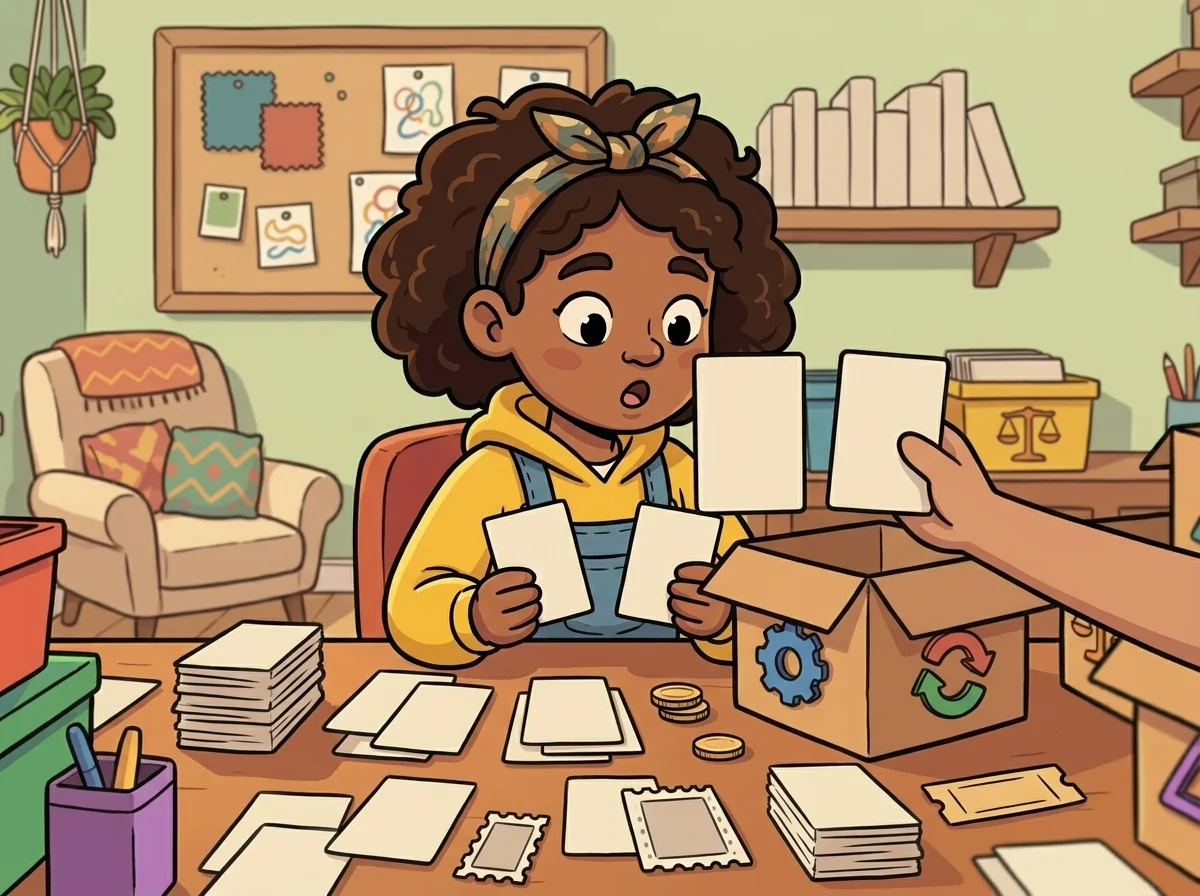
"What is actually different about these three problems?" Cass asked. "Besides the nouns?"
Kindra studied the three cards, shifting them around on the table while looking for the catch. Slowly, the blood rushed back into Kindra's face as the truth settled in.
"Nothing," Kindra whispered. "There is no difference."
"You have been meeting the same problem over and over for six months," Cass said gently. "You panicked every single time because it changed its hat. Learn to see under the hat. Once you do that, every 'new' problem becomes an old friend."
Kindra carved the wooden sorting trays that very afternoon. From that day on, the panic never returned.
On a cold Thursday morning, an eleven-year-old kid walked into the study nook carrying a crumpled worksheet. The kid dropped into the heavy wooden chair opposite Kindra's desk. The kid's shoulders were hunched up near the ears, and the grip on their yellow pencil was tight enough to turn the knuckles white.
"It's about chickens," the kid muttered, dumping the page onto the blotter. "And cows. I hate farm problems. I don't know anything about cows."
Kindra leaned back in the swivel chair and tapped the edge of the desk.
"Before you touch that pencil," Kindra said, "let me ask you something. What kind of problem is this? Forget the cows for a second. What are we actually looking at?"
The kid squinted at the paper with heavy suspicion. "There are eight animals total. Chickens and cows."
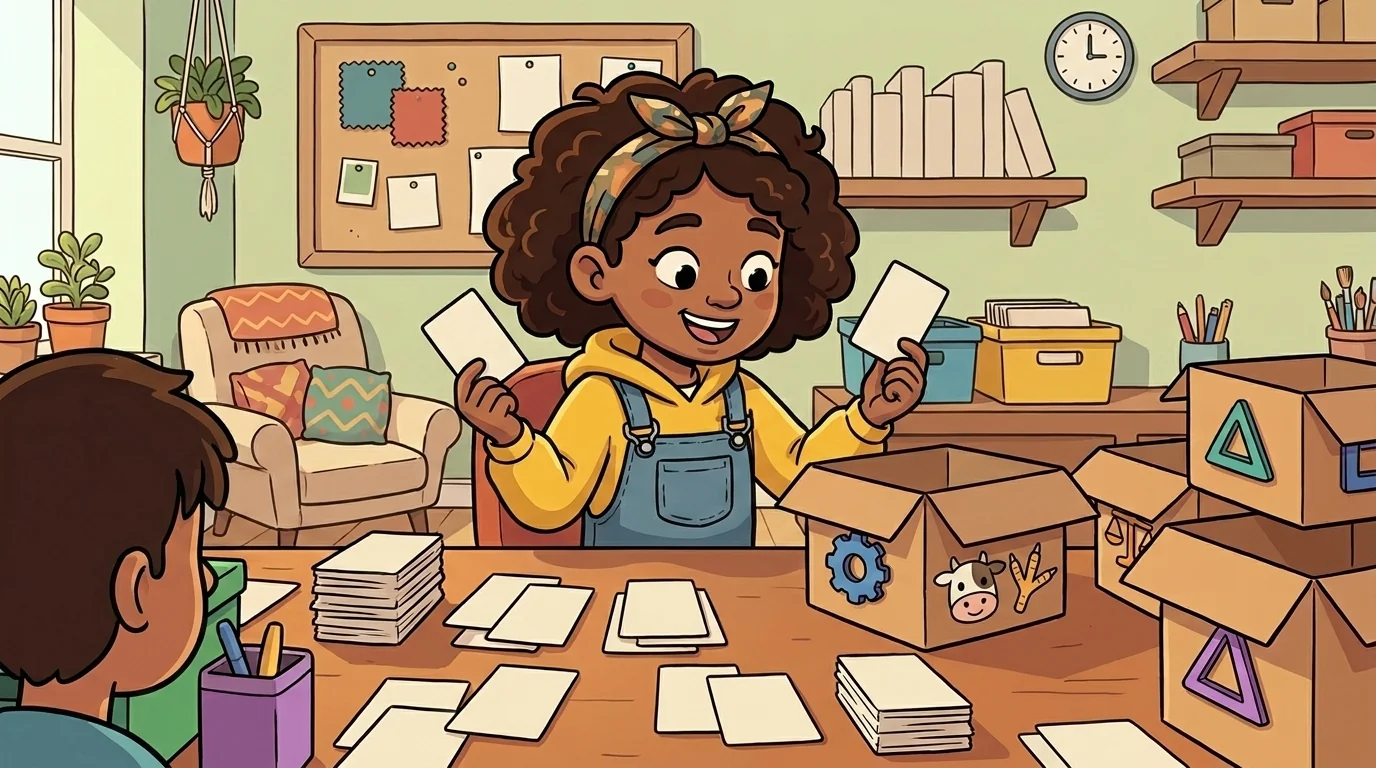
"Okay," Kindra said. "That's a total count of things. What else?"
"There are twenty-six legs," the kid said, sounding tired. "Chickens have two legs. Cows have four."
Kindra leaned forward and rested both elbows on the desk. "Does that shape remind you of anything we worked on last Tuesday?"
The kid stared at the ceiling for a long moment. The pencil rested loosely on the page now. "It's... wait. Is it like that coin problem? Two kinds of coins, a total count of coins, and a total value?"
Kindra's face lit up with a brilliant, wide smile.
"Exactly," Kindra said. "Same problem, different hat. Chickens are nickels. Cows are dimes. Legs are cents. You solved this three days ago. It just showed up in feathers this time."
The kid blinked, looking down at the worksheet as if the printed ink had suddenly shifted shape. "So I don't need a new way to solve it?"
"Not at all," Kindra said. "You already own the key."
The kid reached for a blank card to slide into a tray. "So it goes in... rate?"
Kindra didn't say wrong. Kindra never used that word when sorting.
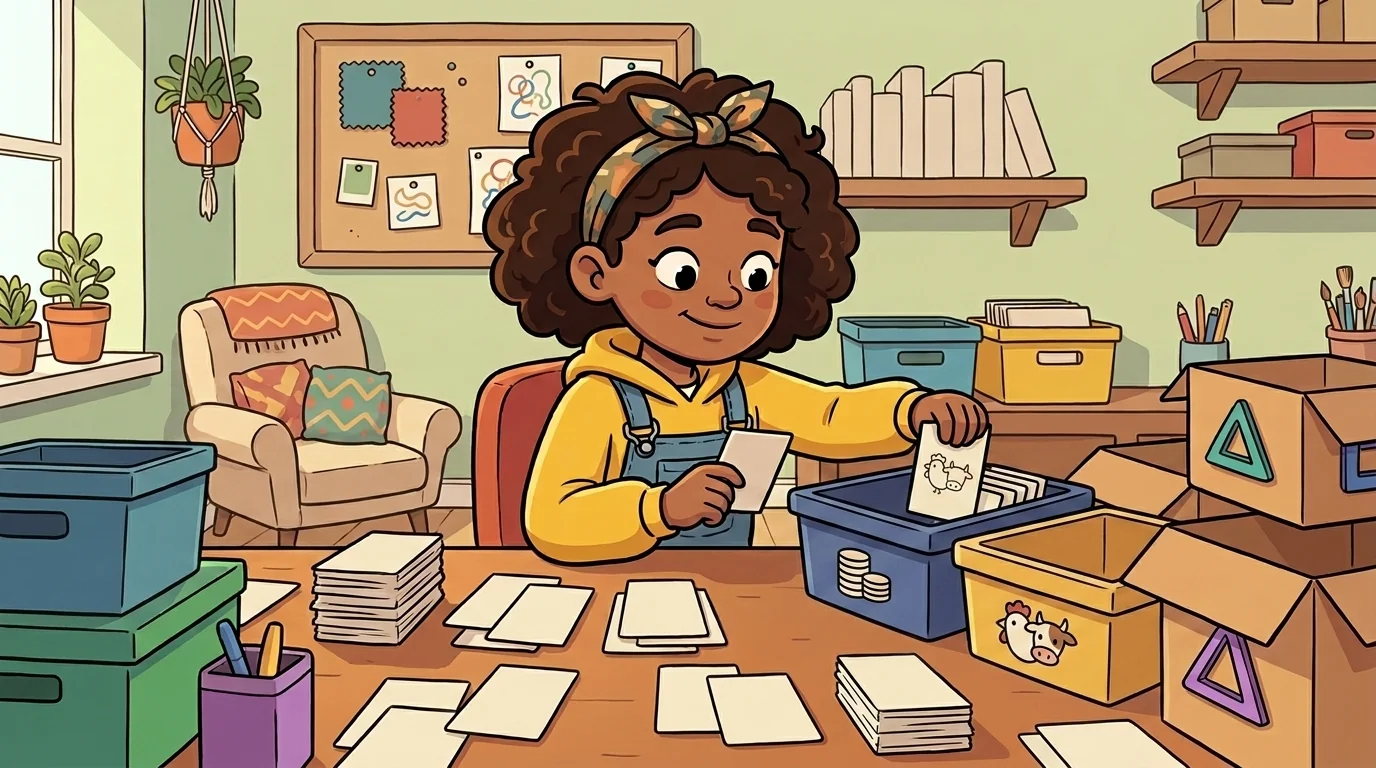
"Let's test it," Kindra suggested gently. "In a rate problem, something happens per something else. Miles per hour, or dollars per gallon. Is anything happening per unit here?"
The kid stopped, thought it over, and shook their head. "No. It's just two parts that add up to a big total."
"So where does it belong?"
The kid picked up the card and dropped it cleanly into the tray labeled total-and-parts. It landed with a soft wooden thud.
"Total and parts," the kid said, a sudden lightness in their voice.
Kindra watched the kid pick up the pencil again. The white knuckles were gone. The tense, rigid line of the kid's shoulders relaxed into something easy and comfortable.
What filled the room was not just the quiet noise of math getting done. It was the warm, spreading feeling of recognition. It was the cozy relief of realizing that a scary stranger in the dark was just a friend wearing a silly mask.
Kindra reached out and nudged the tray slightly closer to the kid.
"The story is just a costume," Kindra said softly, watching the kid write out the equations with steady hands. "See the type, and you never meet a stranger. You only meet old friends in new hats."
Kindra leaned back, listening to the pencil lead move across the paper, feeling the quiet warmth that made every minute of sorting worth the effort.
The ReckonQuest ensemble
Kindra is part of ReckonQuest's distributed-narrative cast. Each character embodies a different curricular primitive; together they teach the full subject.
-

Reck
Systematic guess-and-check — makes a reckoned guess, checks it, makes the next guess smarter (the pre-algebra bridge)
-

Lettie
Set up the equation — names the unknowns ('let x = the chickens') and writes the relationships
-

Retta
Work backwards — starts from the goal and reverses the steps
-
Doodle
Draw a diagram — draws the bar/tape diagram of the relationships
-

Vetta
Look back / check — substitutes the answer back and asks 'does this make sense?'
-
Tad
Simplify to a smaller case — solves a tiny version first (2 heads before 100)
-

Tagg
Track the units — labels every number ('6 = legs, not chickens'), structure over key-words
-
Genny
Generalize — writes the rule that works for any numbers once the specific riddle is solved
-
Cass
The scaffold keeper (mentor) — runs understand→plan→execute→look-back and normalizes not knowing the way in