
Tagg
TRACK THE UNITS — *label what every number IS ("6 = legs, not chickens") and follow the units; structure over key-word tricks.*
Loading audio…
Press play to listen along. The line being read lights up as you go.
Show full transcript
Loading transcript…
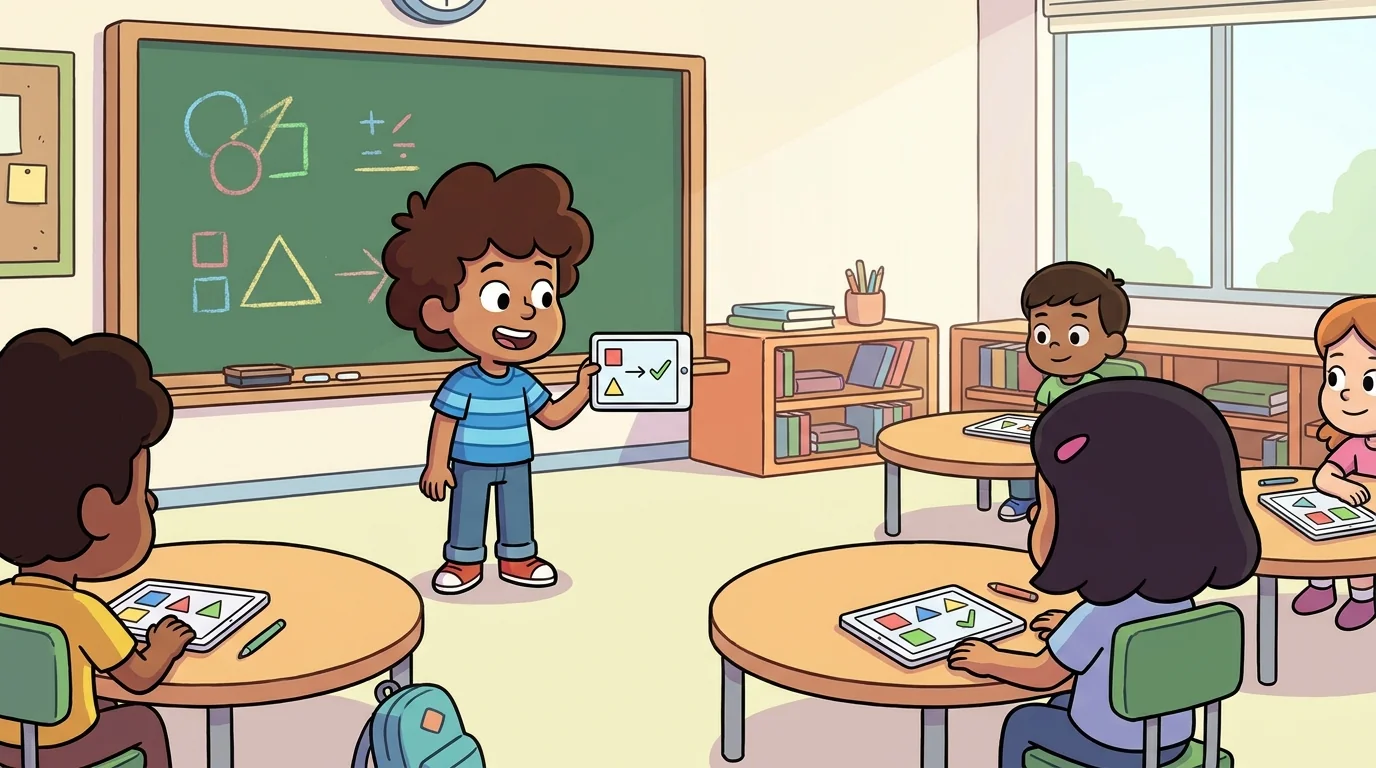
Tagg’s worktable sat near the back corner of the workshop, smelling faintly of cedar shavings and paper glue. On the left corner sat three neat stacks of sticky labels in electric blue, bright yellow, and hot pink. On the right corner sat four freshly sharpened pencils, their graphite tips glinting under the desk lamp. Tagg’s first move on any math problem was always the same: tag every number with what it actually measures. A bare digit sitting on paper was an unfinished thought. An unfinished thought was an open trap waiting to spring.
Word problems, Tagg knew from hard experience, were built to test a solver’s patience. The trickiest part was rarely the large numbers or the long division. It was the insidious lure of the "key word." Many students were taught early on that words like "altogether" meant add, while words like "left" meant subtract. Tagg viewed this method as well-meaning nonsense that routinely got smart kids hurt.
"Consider a simple example," Tagg would say, leaning back in the heavy oak chair. "Suppose a problem mentions six legs and three chickens, and then asks how many there are altogether. A key-word solver sees the word 'altogether' and immediately adds six and three. They proudly write down nine." Tagg paused, looking over the top of a wooden ruler. "But nine what? Nine leg-chickens? There is no such creature on any farm in the world."
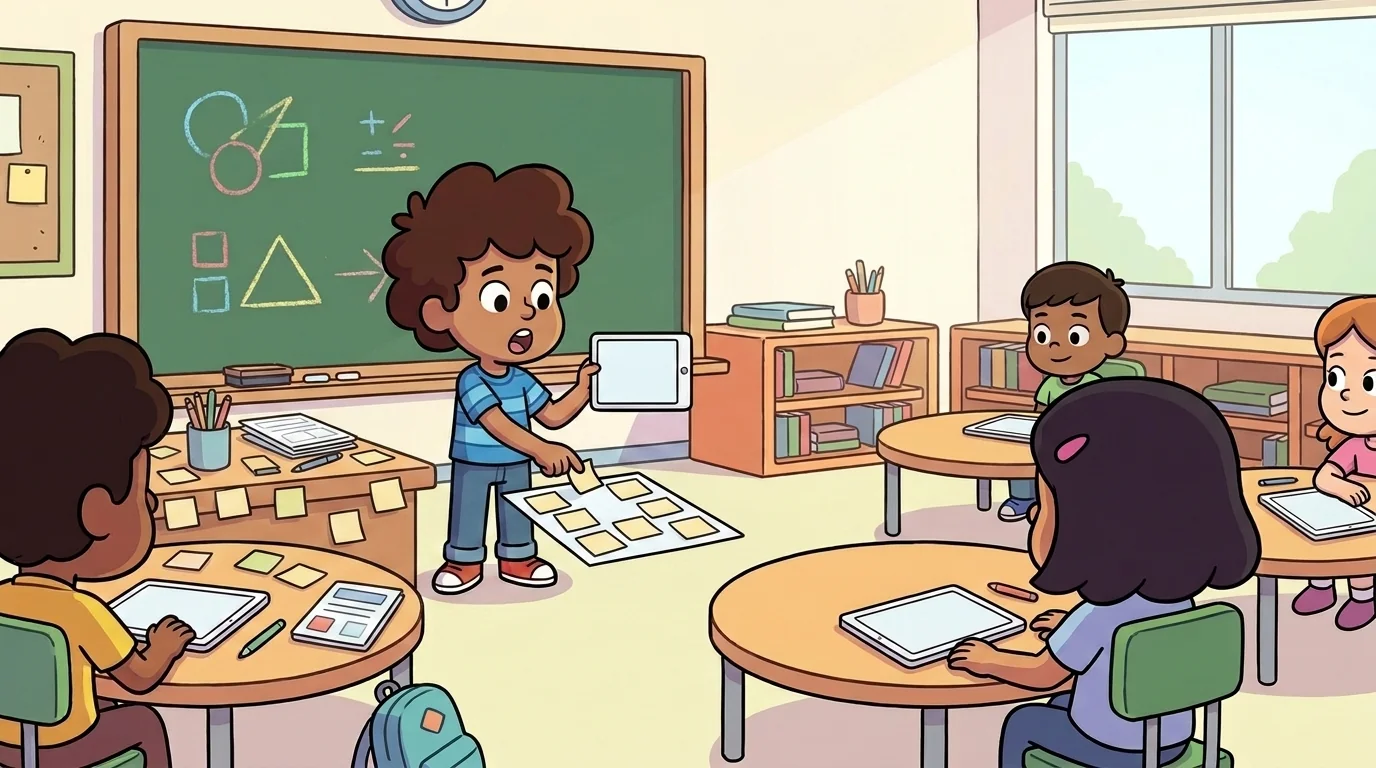
Tagg would peel two bright yellow strips from the stack with a sharp flick of the thumb. "You stick a tiny label beside every single number. This six is legs. This three is chickens. You can't add legs to chickens any more than socks to Tuesdays. Tag every number with its unit, and those units tell you what operations are allowed. Same units can combine. Different units cannot. The labels keep you honest when a key word tries to pull a fast one."
Tagg had not developed this habit out of sheer boredom. He became the tagger because a key word had once betrayed him.
As a younger solver, Tagg had trusted key-word rules without question. If a problem contained the phrase "in all," he automatically added the values together. He remembered a rainy Tuesday afternoon in the old study hall. He had rushed through an exam, slamming numbers together like freight cars on a single track. The phrase "in all" appeared right at the end of the prompt, practically screaming at him to add. He added the figures, wrote down his answer, and handed in his paper with a broad smile.
When the paper came back covered in thick red ink, Tagg felt stunned and cheated. The problem had used the phrase "in all," but adding was completely wrong because the two numbers counted different things. One number represented the total cost in dollars, while the other counted the weight of flour in pounds. Adding them produced a completely meaningless figure.
Cass had walked over to Tagg’s desk, holding a warm mug of black tea. Cass didn't offer fake sympathy or tell Tagg that he had tried his best. Instead, Cass set the mug down on the blotter and pulled up a wooden stool.
"Key words are a shortcut that works until it doesn't," Cass said, pointing a long finger at the mistake. "And then it fails you at the worst possible moment. Here is the honest tool: don't ask what word this is. Ask what this number is counting. Label it. Once every number wears its unit, you'll see instantly that you can't add the legs to the chickens. The labels won't let you."
That evening, Tagg swept all his old key-word cheat sheets directly into the trash bin. He bought his first pack of sticky labels and began tagging units on every sheet of scratch paper he touched. From that day forward, the traps stopped working on him.
A young solver named Toby stepped up to Tagg’s desk on a bright Thursday afternoon. Toby was twelve years old, with blue ink smudges across his knuckles and a wrinkled worksheet squeezed in his grip. He sat down on the wooden stool, chewing nervously on the eraser end of his pencil.
"I'm stuck on problem four," Toby muttered, flattening the crumpled paper against the tabletop. "It says there are 26 legs and 8 heads in the barnyard, and it asks for the total in all. I added 26 and 8 to get 34, but the key in the back says that's wrong."
Tagg didn't scold the boy. Instead, Tagg slid a pad of bright yellow sticky labels across the wooden desk along with a fine-point pen.
"Before you combine anything," Tagg said quietly, "tag it. What is this 26? Label it."
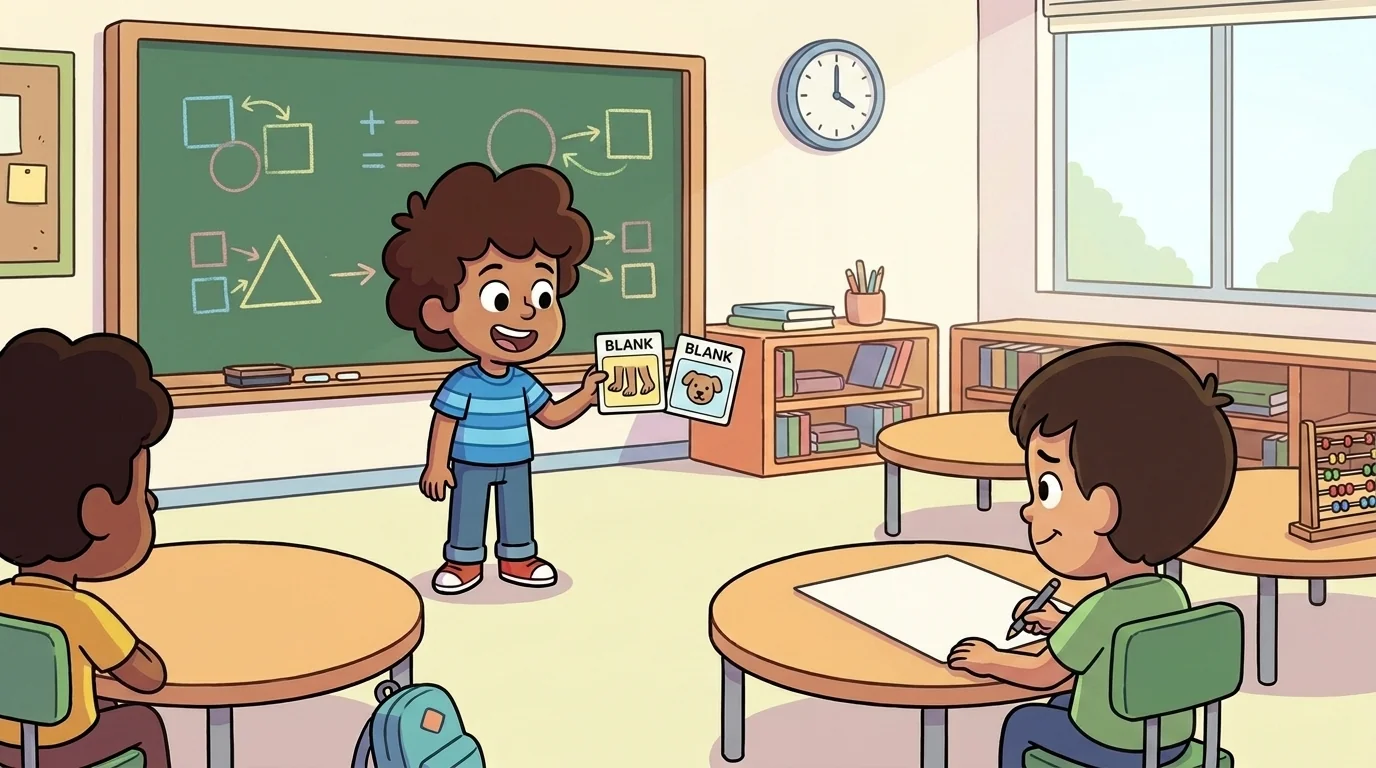
Toby took the pen and wrote legs on a yellow square. He peeled the label off the pad and stuck it right next to the number 26 on his paper.
"Good," Tagg said. "Now what is this 8?"
"It's heads," Toby said. He wrote heads on a second yellow square and stuck it next to the 8.
"Now look at those two labels," Tagg said, gesturing to the paper. "Can you add legs to heads?"
Toby stared down at the two bright yellow tags on his worksheet. His pencil remained suspended in the air as his brows furrowed in concentration. Then his eyes widened, and a slow grin spread across his face.
"No," Toby said, shaking his head slowly. "They're... different things."
"Different units," Tagg agreed, leaning back in his chair. "The key word 'total' wanted you to smash them together like rocks in a bucket. The labels just saved you. Now you see that the 8 constrains the total number of animals, while the 26 constrains the total legs. Two different jobs, which means two different equations."
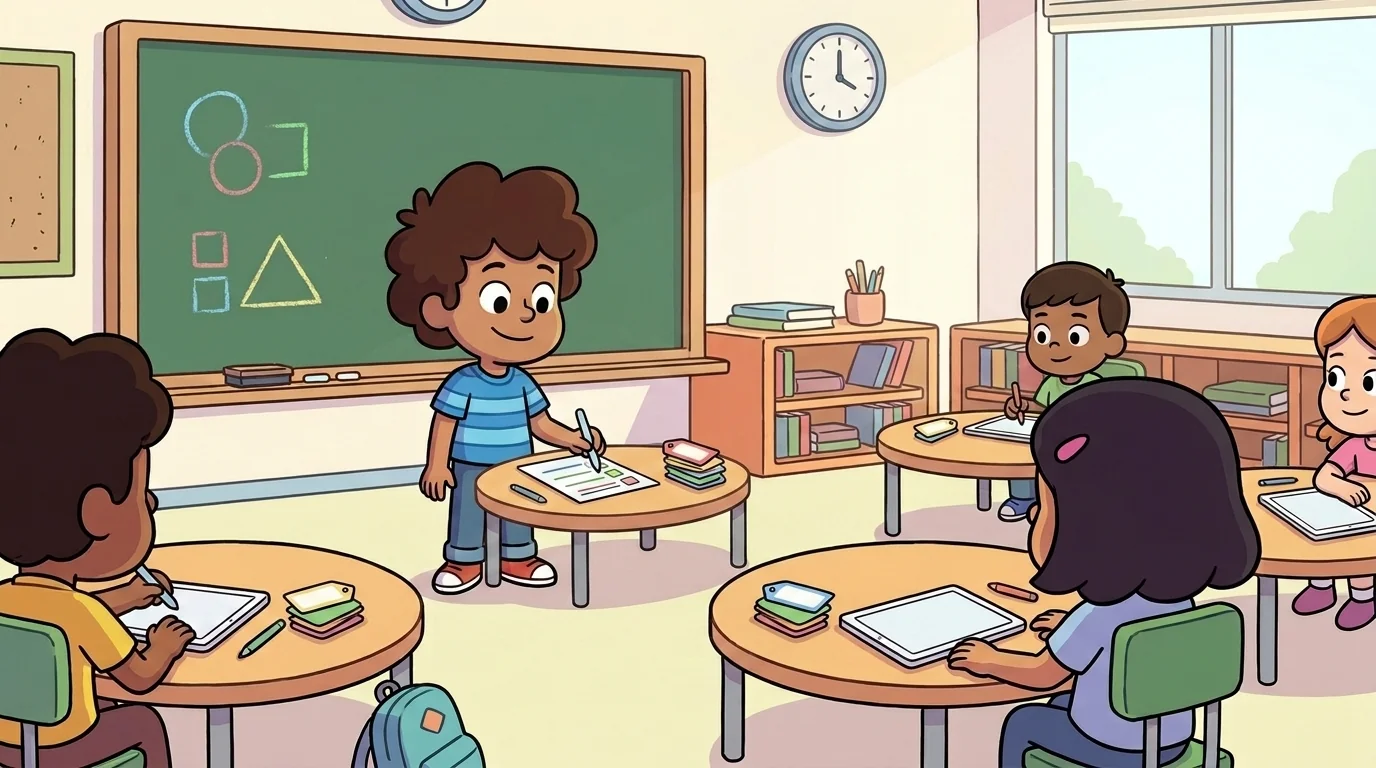
Toby turned back to his paper with newfound energy. He spent the next ten minutes testing combinations until the count of four-legged pigs and two-legged chickens matched both totals on his page.
When Toby moved on to problem five, he reached for a label before Tagg could even say a word. The prompt mentioned three boxes and twelve apples per box. Toby labeled the 3 as boxes and the 12 as apples per box. When he saw the word "altogether" in the prompt, he didn't blindly add three and twelve. He multiplied them, combining boxes with apples per box to yield thirty-six apples.
Tagg never mocked a solver who almost fell for a key-word slip. Whenever a student reached to smash illegal numbers together, Tagg simply offered a gentle reminder: "check the labels: same unit?" Every single time, the student caught the mistake themselves. Number by labeled number, the math laid itself out cleanly and without deception.
A clear-eyed, grounded confidence grew inside every solver who worked at Tagg’s desk. It was the steady, reliable feeling of not being fooled by clever phrases or tricky wordings. The old anxiety of guessing whether to add, subtract, multiply, or divide simply faded away. In its place remained the quiet certainty of a simple rule: follow the units, and they will never lie to you.
Tagg watched Toby complete his assignment and felt a warm, quiet satisfaction. Handing someone a tool that couldn't betray them was the finest work a mentor could do.
"Tag every number with what it is," Tagg said, peeling a fresh pink label off the pad. "The units are honest even when the words are tricky."
The ReckonQuest ensemble
Tagg is part of ReckonQuest's distributed-narrative cast. Each character embodies a different curricular primitive; together they teach the full subject.
-

Reck
Systematic guess-and-check — makes a reckoned guess, checks it, makes the next guess smarter (the pre-algebra bridge)
-

Lettie
Set up the equation — names the unknowns ('let x = the chickens') and writes the relationships
-

Retta
Work backwards — starts from the goal and reverses the steps
-

Kindra
Recognize the schema — spots 'this is a coin problem' before solving (schema-based instruction)
-

Doodle
Draw a diagram — draws the bar/tape diagram of the relationships
-

Vetta
Look back / check — substitutes the answer back and asks 'does this make sense?'
-

Tad
Simplify to a smaller case — solves a tiny version first (2 heads before 100)
-
Genny
Generalize — writes the rule that works for any numbers once the specific riddle is solved
-
Cass
The scaffold keeper (mentor) — runs understand→plan→execute→look-back and normalizes not knowing the way in